Choose undermount drawer slides when concealed hardware is a priority and the drawer box is built for the runner system. Choose side-mount slides when exposed rails are acceptable and they fit the cabinet, drawer, and service requirements. Neither mounting position automatically offers greater strength or smoother soft-close action. Compare the specified load rating, clearances, extension, and complete installed cost.
For builders, the decision starts with the drawer box. A runner that looks suitable in a catalog can still require different drawer dimensions, bottom construction, or mounting brackets. Confirm those interfaces before ordering hardware or releasing drawer production.
Undermount vs Side-Mount Drawer Slides at a Glance
| Decision | Concealed undermount runners | Side-mounted ball-bearing slides |
|---|---|---|
| Appearance when open | Runners sit beneath the box, leaving drawer sides free of exposed rails | Rails are visible beside the drawer |
| Drawer construction | Coordinate box width, side thickness, bottom recess, rear preparation, and front locking devices | Coordinate outside box width with slide thickness and required side space |
| Cabinet interface | Confirm runner fixing, rear support, and frame clearance | Confirm fixing surfaces, frame clearance, and any brackets or blocking |
| Load selection | Select the rated runner and approved drawer configuration | Select the rated slide and approved drawer configuration |
| Extension | Choose the required travel from the selected product range | Choose the required travel from the selected product range |
| Closing action | Available with different closing or opening mechanisms | Available with different closing or opening mechanisms |
| Alignment and adjustment | Locking devices and runner adjustments can help set drawer-front alignment | Slotted fixing holes and, on some models, adjustment cams help positioning |
| Replacement | Match runners, locking devices, and drawer preparation as a system | Match side space, length, mounting pattern, and drawer requirements |
How the Two Systems Fit the Drawer
Concealed Undermount Runners
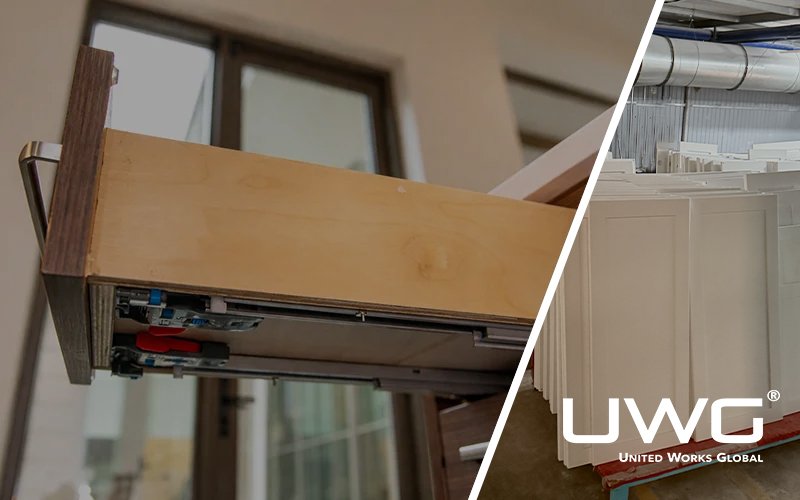
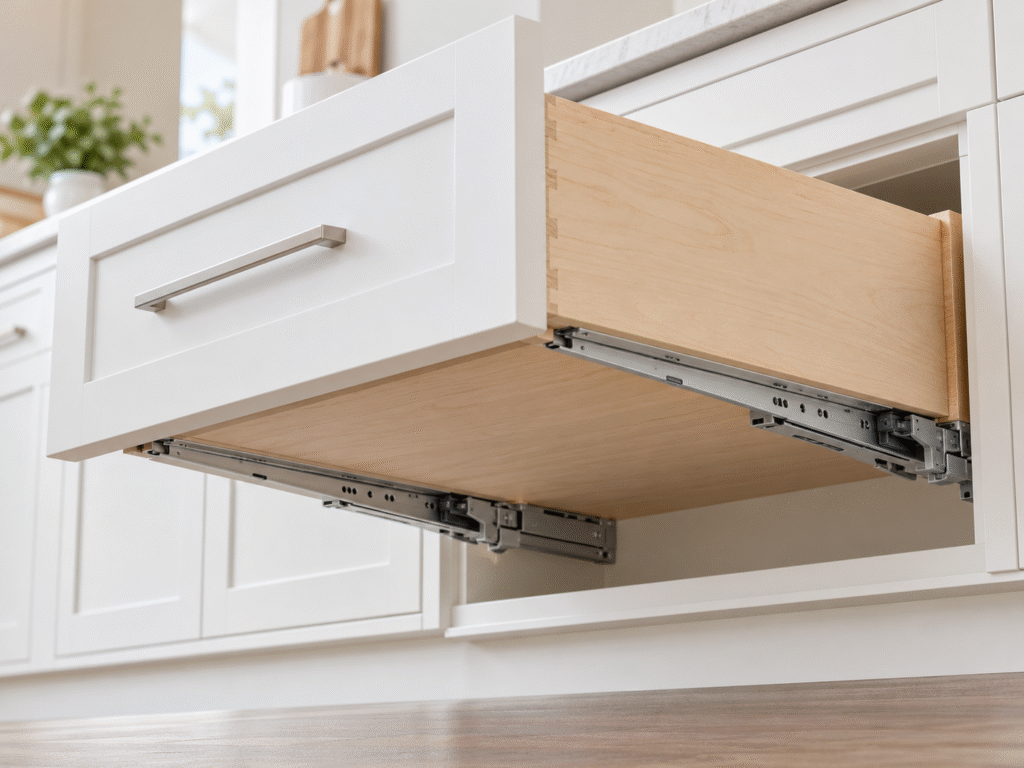
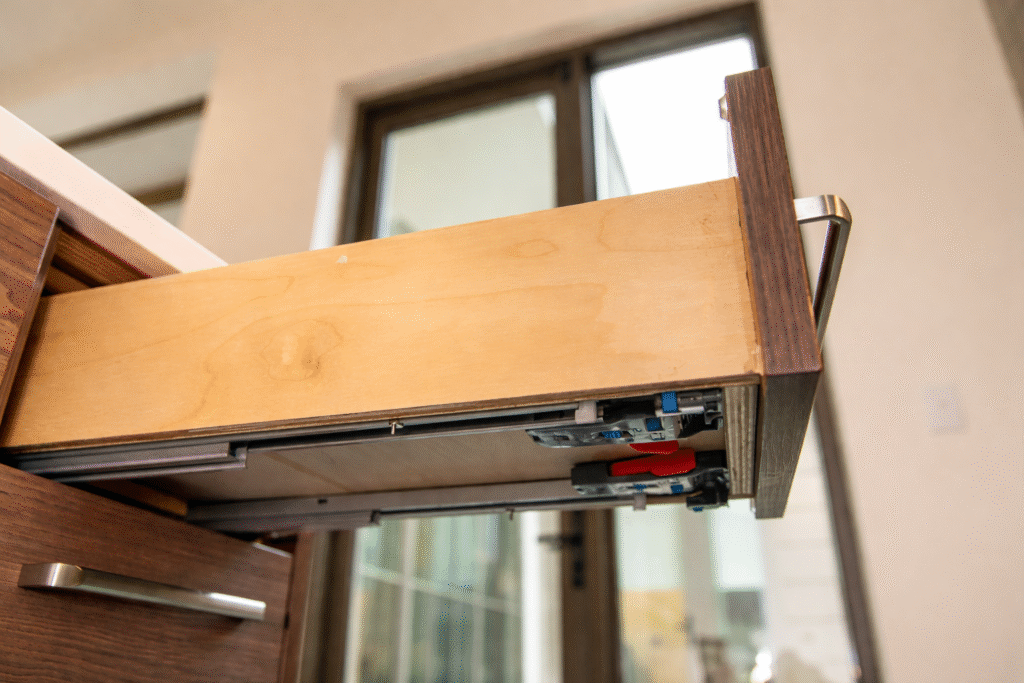
Undermount runners sit below the drawer box. Depending on the design, front locking devices connect the drawer to the runners, while rear hooks or other locating features engage the back of the box.
The drawer must be made for those connections. Required details can include bottom recess, permitted side thickness, rear notches, and locating holes. A groove used to hold the drawer bottom is not automatically a groove that engages a locking clip.
Choose the runner before finalizing the box drawing. This is particularly useful in new cabinet production, where machining and hardware preparation can be repeated consistently.
Side-Mounted Ball-Bearing Slides
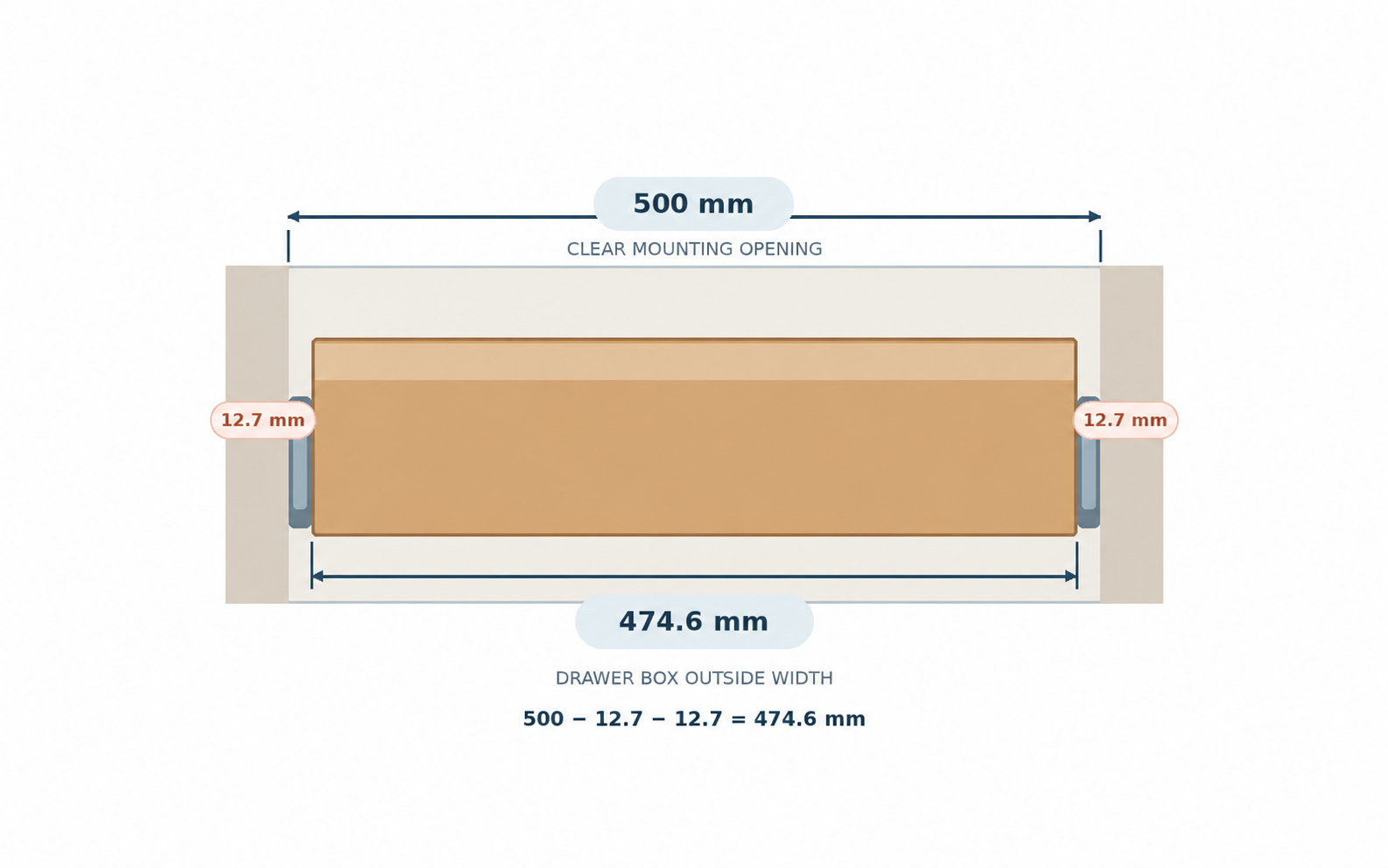
Side-mounted slides attach to the drawer sides and cabinet mounting surfaces. Their required side space determines the relationship between the cabinet opening and the drawer’s outside width.
For a model specifying 12.7 mm of clearance per side, a 500 mm clear mounting opening gives a nominal drawer outside width of:
500 − 12.7 − 12.7 = 474.6 mm
Apply that calculation at the actual slide mounting plane. The difference between framed and frameless cabinets matters here: a face frame can project inward from the cabinet sides, requiring brackets or blocking to establish the correct mounting surfaces. Use the selected model’s clearance tolerances when setting the production dimensions.
Do not assume the drawer front width is the box width. Overlay fronts can cover an opening that is wider than the drawer box itself.
Which Type Handles More Weight
Mounting position is not a load rating. Both categories include products for different loads, and high-capacity concealed runners exist alongside lighter-duty side-mounted slides.
Use the drawer slide selection guide to establish load and extension requirements, then compare the proposed models on the same basis:
- Whether the rating applies to a pair or a complete runner assembly.
- Whether the published capacity is dynamic or static.
- The slide length, drawer width, mounting orientation, and test conditions.
- The weight of the drawer, organizers, and intended contents.
For example, a drawer weighing 7 kg with 2 kg of fixed organizers and 36 kg of contents creates 45 kg of moving weight. This is a calculation example, not a product rating. Check the selected slide’s capacity definition against that complete moving assembly.
For wide drawers, also check the permitted width and any required stabilization. A high load number alone does not establish resistance to racking when the drawer is pulled from one corner.
Can You Install Side-Mount Slides Flat Under a Drawer
Only use that orientation when the product documentation permits it. Turning a side-mounted rail flat changes how it carries load. Some models have separate flat-mount ratings; others are restricted to side mounting.
A purpose-designed undermount runner is not the same as a side-mounted slide rotated beneath the drawer.
Soft-Close Action and Drawer Access
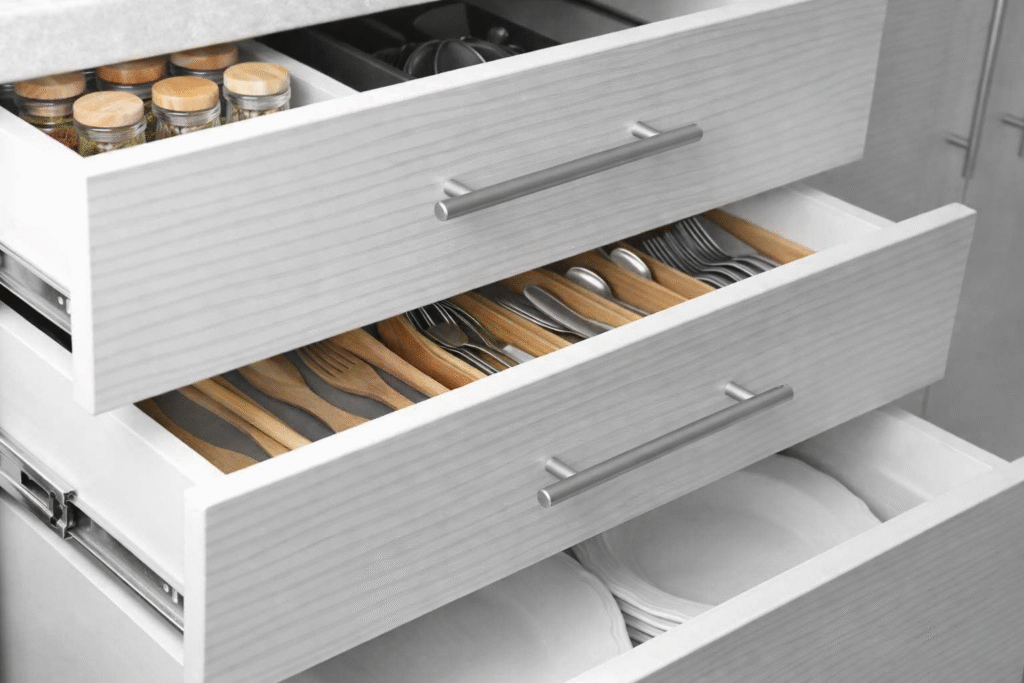
Soft-close is a mechanism, not a mounting position. Both undermount and side-mounted systems can provide damped closing. Compare the specified mechanism under the intended drawer load instead of assuming that concealed hardware will always feel smoother.
Keep these functions separate:
- Soft-close slows the final closing movement.
- Self-close draws the drawer into its closed position and does not, by itself, establish damped closing.
- Push-to-open releases the drawer through pressure on the front; compatibility with soft-close depends on the system.
Extension is another separate choice. Partial extension leaves some of the drawer behind the cabinet front, full extension improves access to the rear, and over-travel moves the drawer farther out. Specify the access needed for cookware, organizers, or equipment before selecting the runner length and travel.
Installation and Replacement
New Cabinet Production
For new cabinets, either system can be integrated into a repeatable manufacturing process. Undermount preparation may be completed in the factory; side-mounted systems still require accurate box widths and parallel mounting surfaces.
For repeated layouts in multifamily projects, record the approved runner model, drawer dimensions, and required brackets by cabinet type so the same specification can be repeated across units.
Compare the full workflow: drawer machining, runner installation, front alignment, drawer removal, and final adjustment. Installation time depends on how much preparation has already been completed, not just on where the rails sit.
Build and test one representative drawer before producing the full order. Check movement with the intended load, closing action, front gaps, and removal access.
Existing Drawers and Retrofits
Replacing a slide with a compatible model is different from changing the mounting system. Before converting side-mount to undermount, measure the existing box width, bottom recess, side thickness, rear preparation, and available cabinet depth.
The existing drawer may need modification or replacement. Compare that work with keeping a compatible side-mounted system. Do not order concealed runners on the assumption that the original box will fit unchanged.
For either system, retain the model identification and mounting details for future replacements. Runners, clips, and brackets from different product families should not be treated as interchangeable parts.
Kitchens, Vanities and Utility Storage
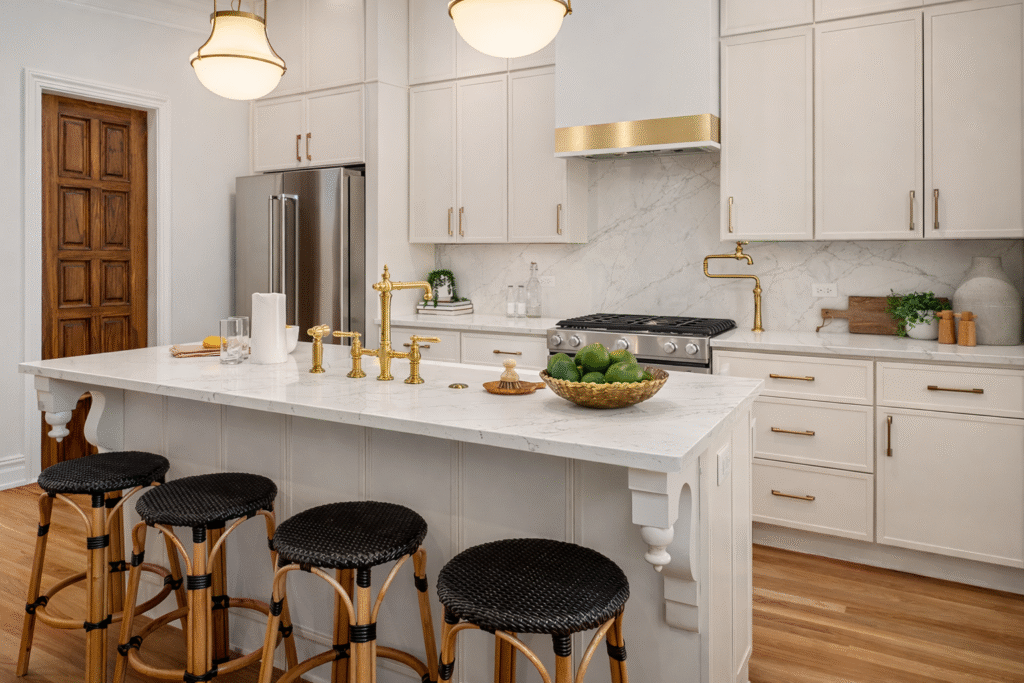
For kitchens and visible built-ins, concealed runners offer a clean view of the drawer sides. Side-mounted rails remain a practical option where their appearance is acceptable and the selected hardware meets the storage requirements.
For bathroom vanities, specify the material, protective finish, and suitability for moisture exposure. Positioning hardware under a drawer does not make it corrosion-resistant. Coordinate plumbing, drawer cutouts, and mounting space at the same time.
For utility, garage, and wide storage drawers, start with the loaded weight, width, extension, and service access. Select hardware for those conditions rather than assigning every heavy drawer to side-mount or every premium cabinet to undermount.
How to Compare Installed Cost
Compare complete systems with the same length, load requirement, extension, and closing action. A low-priced basic roller slide and a concealed soft-close runner are different purchases, even if both are described as bottom-mounted.
| Cost item | What to include |
|---|---|
| Slide package | Pair or assembly, locking devices, brackets, and required accessories |
| Drawer construction | Box material, machining, bottom preparation, and any replacement box |
| Installation | Fixing, positioning, front alignment, and final adjustment |
| Retrofit work | Removal, changed mounting surfaces, and drawer modifications |
| Service | Replacement availability and access to runners and release devices |
Use supplier quotations for the hardware and a consistent installation scope. Do not select from a universal price range that mixes different product types or omits required accessories.
What Builders Should Specify Before Ordering
Keep the cabinet schedule, drawer drawing, and hardware list together. For each drawer configuration, record:
- Runner type, manufacturer, model, and length.
- Drawer outside dimensions, side thickness, and bottom construction.
- Cabinet construction and clear mounting opening.
- Intended moving weight and required extension.
- Closing or opening mechanism and any stabilization requirements.
- Locking devices, brackets, fasteners, and included adjustments.
- Moisture exposure, finish requirements, and replacement arrangements.
The kitchen cabinet hardware buying guide covers coordination with hinges and other cabinet storage components.
Frequently Asked Questions
Are Bottom-Mount Slides Always Concealed Undermount Slides
No. Bottom-mount can describe different arrangements, including bottom-edge roller hardware and specialized pull-out systems. Confirm the product’s mounting diagram rather than using the name as a complete specification.
Are Side-Mount Drawer Slides Stronger Than Undermount Slides
Not as a category. Compare the specific products’ rated loads, drawer-width limits, extension, and mounting conditions. Both types include products for different load requirements.
Can You Replace Side-Mount Slides With Undermount Slides
Yes, if the drawer and cabinet can accommodate the selected system. Box width, bottom recess, rear preparation, and locking-device locations can require changes, so this is not always a direct hardware swap.
Do Both Types Offer Soft-Close
Yes. Both can be supplied with soft-close mechanisms. Confirm the feature and its compatibility with the selected drawer and load; mounting position alone does not identify the closing action.
How Much Clearance Do Drawer Slides Need
Use the selected model’s dimensions and tolerances. Side-mounted rails need the specified space beside the drawer; concealed undermount systems also define drawer construction and space below the box. There is no one clearance value for every slide.
Conclusion
Choose concealed undermount runners when you want hidden hardware and can build or adapt the drawer to the selected system. Choose side-mounted slides when exposed rails suit the project and the model fits the existing box, load, and service requirements.
The better choice is the one that matches the complete drawer design. Compare fit, rated performance, access, closing action, and installed cost before releasing the cabinet order.