Installation delays can kill project timelines and eat into margins. Choosing between SPC and LVP flooring affects not just material cost, but labor speed and rework risk. Pick the wrong one, and you may deal with subfloor issues or callbacks. So which installs faster?
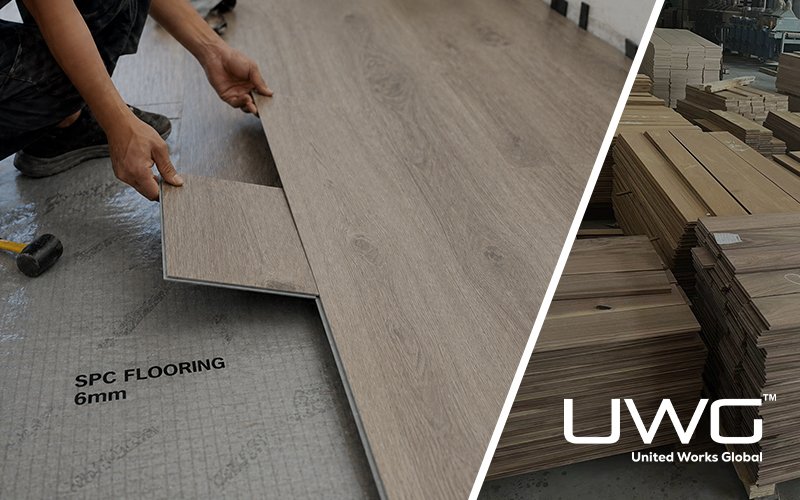
SPC flooring is generally faster and easier to install for contractors because its rigid stone-plastic core provides stronger click-lock stability and tolerates minor subfloor imperfections. LVP flooring, being more flexible, requires a smoother subfloor and more precise alignment. On most job sites, SPC reduces prep time and installation errors, making it a more efficient option for contractors handling tight deadlines and large areas.
But installation speed isn’t just about the click system. It comes down to how each material behaves on real job sites.
What Is the Structural Difference Between SPC and LVP Flooring?
The biggest installation difference starts at the core.
SPC (Stone Plastic Composite) flooring uses a rigid limestone-based core, while LVP (Luxury Vinyl Plank) uses a flexible PVC core.
This affects everything on-site:
- SPC stays straight and locks firmly
- LVP bends slightly, which can complicate alignment
From my experience, rigid boards like SPC behave more predictably during installation. You don’t fight the material as much, especially on large commercial layouts.
Which Flooring Is Easier to Install on Uneven Subfloors?
This is where SPC clearly wins for contractors.
SPC can handle minor subfloor imperfections without telegraphing issues. LVP, on the other hand, tends to follow the subfloor more closely.
Real-world impact:
- SPC: Less prep, faster start
- LVP: More leveling required
If your subfloor isn’t perfectly smooth, LVP will cost you extra time in prep—or worse, lead to visible defects later.
Simple Installation Comparison Table
| Feature | SPC Flooring | LVP Flooring |
| Core Type | Rigid (stone composite) | Flexible (PVC) |
| Subfloor Tolerance | High | Low |
| Installation Speed | Faster | Moderate |
| Cutting Method | Saw recommended | Utility knife |
| Click Stability | Strong | Moderate |
| Error Margin | Forgiving | Less forgiving |
Do You Need Different Tools for SPC vs LVP Installation?
Yes—and this affects job efficiency.
SPC’s rigid core usually requires:
- A circular saw or miter saw for clean cuts
LVP can often be cut with:
- A utility knife (score and snap) —
At first glance, LVP seems easier. But in reality:
- SPC cutting is faster for bulk work
- LVP cutting becomes inconsistent on thicker planks
On larger projects, power tools used for SPC actually save time overall.
How Does Rigidity Impact Installation Speed and Labor Cost?
Rigid planks lock faster. That’s the bottom line.
SPC’s click-lock system:
- Snaps in place more securely
- Reduces repositioning
LVP requires:
- More careful alignment
- Occasional re-locking
Contractor insight:
On a 1,000 sq ft job:
- SPC can save several labor hours
- Fewer mistakes = fewer callbacks
SPC vs LVP Price: Does Installation Time Affect Total Cost?
Many builders only compare material price—but that’s incomplete.
- LVP may be slightly cheaper upfront
- SPC often reduces labor cost and installation time
So the real equation is:
Total Cost = Material + Labor + Risk
In many cases, SPC wins because:
- Less prep work
- Faster installation
- Lower chance of rework
SPC vs LVP vs WPC: Which One Is Most Contractor-Friendly?
Quick comparison:
- SPC: Best for speed, durability, and uneven subfloors
- LVP: Good for smooth residential installs
- WPC: Softer, quieter, but less rigid
If your priority is efficiency and consistency, SPC is usually the safest choice.
Can LVP Be Installed as Fast as SPC in Any Scenario?
Yes—but only under ideal conditions.
LVP performs well when:
- Subfloor is perfectly level
- Installation area is small
- Aesthetic flexibility is prioritized
In these cases, LVP can match SPC speed. But on real job sites, those conditions are rare.
SPC Flooring Pros and Cons for Installation Projects
Pros (Contractor Perspective):
- Faster installation
- Less subfloor prep
- More predictable results
Cons:
- Harder cutting process
- Slightly heavier handling
Still, for most contractors, the pros outweigh the cons—especially on large-scale builds.
Summary
For contractors, installation efficiency matters more than theory. SPC flooring offers faster installs, better tolerance, and fewer errors. LVP still works in controlled conditions, but SPC is often the safer, more practical choice on real job sites.
Frequently Asked Questions About SPC vs LVP Installation
Q: Is SPC flooring faster to install than LVP flooring?
A: Yes, for most contractors, SPC flooring is significantly faster to install. Because SPC has a rigid stone-plastic core, the click-lock mechanisms snap together more firmly and securely on the first try. LVP has a softer, more flexible PVC core, which can sometimes bend or require more careful alignment during installation, slowing down the overall process on large jobs.
Q: Which flooring is better if my subfloor is slightly uneven?
A: SPC is the clear winner for slightly uneven subfloors. Thanks to its ultra-rigid core, SPC can bridge minor imperfections in the subfloor without telegraphing (showing) those bumps on the surface. LVP is flexible, meaning it will eventually mold to the shape of the floor beneath it, requiring the contractor to spend extra time and money perfectly leveling the subfloor before installation.
Q: Do you need different tools to cut SPC versus LVP flooring?
A: Because LVP is flexible, it can usually be cut quickly using the “score and snap” method with a standard utility knife. SPC is much denser due to its limestone composite core. While it can technically be scored and snapped, contractors highly recommend using a power tool like a circular saw or miter saw to achieve clean, fast, and consistent cuts, especially on large-scale projects.
Q: Does faster installation make SPC cheaper than LVP overall?
A: It often does. While the upfront material cost of SPC might be slightly higher than entry-level LVP, the significant reduction in labor hours—due to faster clicking mechanisms and less required subfloor preparation—frequently makes the total installed cost of SPC flooring equal to or lower than LVP.
Articles that you may be interested in:
Flooring Patterns: Herringbone, Chevron, Wide Planks, and More