Are you selecting the right SPC flooring wear layer—or making a decision that could increase long-term costs?
For U.S. builders and wholesalers, wear layer selection is not just a product choice. It directly affects durability, replacement cycles, and overall project profitability.
For most U.S. builders and wholesalers, 12 mil wear layers are suitable for low-traffic residential use, while 30 mil is designed for heavy commercial environments. In practice, 20 mil offers the most efficient balance of durability, cost control, and scalability—making it the industry-standard choice for multi-family and light commercial projects.
The key is not choosing the thickest wear layer, but selecting the one that aligns with real usage conditions and long-term project value.
What Is a Wear Layer in SPC Flooring?
The wear layer is the engineered top surface of SPC flooring that directly determines how the product performs under real-world use—not just in terms of scratch resistance, but in how long the floor maintains its appearance and structural integrity over time.
From a professional and commercial perspective, the wear layer is not simply a protective coating. It is a key driver of lifecycle cost, influencing maintenance frequency, customer satisfaction, and ultimately, replacement cycles.
However, focusing on thickness alone can be misleading.
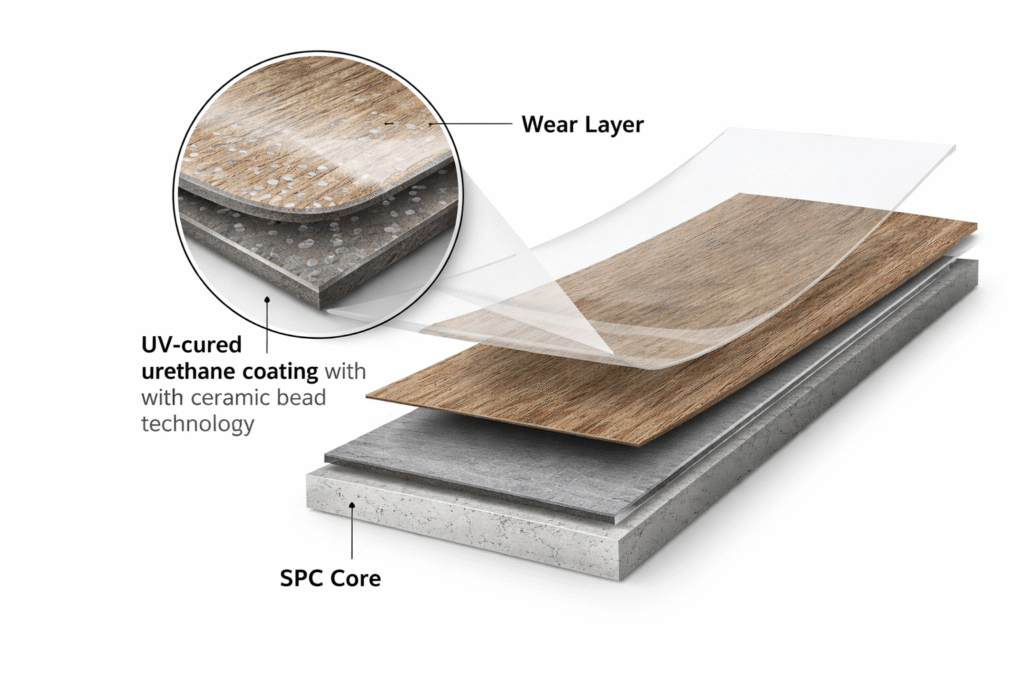
High-performance SPC flooring is built as a system, where multiple components work together:
- A hardened vinyl wear layer provides the primary defense against abrasion and daily traffic
- A UV-cured urethane coating with ceramic bead technology enhances resistance to micro-scratches, stains, and wear patterns
- A dimensionally stable SPC core ensures structural integrity and prevents deformation over time
These layers function collectively, meaning that durability is not defined by thickness alone, but by the integration of material quality, surface technology, and structural design
👉 In practice, a well-engineered 20 mil system can outperform a poorly constructed thicker alternative.
12 mil vs. 20 mil vs. 30 mil Wear Layer: Cost, Durability and ROI
When evaluating wear layer thickness, the real question is not which option is more durable—but which one delivers the best return over the lifespan of a project.
| Wear Layer | Typical Application | Expected Service Life | Relative Cost | ROI Assessment |
| 12 mil | Low-traffic residential | 5–10 years | $ | Low — higher replacement risk |
| 20 mil | Residential + multi-family + light commercial | 10–20 years | $$ | High — optimal balance of cost and durability |
| 30 mil | Heavy commercial / high-traffic environments | 20+ years | $$$ | Medium — often over-specified |
The critical insight is this:
A wear layer decision is not a material choice—it is a financial decision.
Selecting a thinner wear layer for cost savings may lead to premature wear and replacement, while over-specifying thickness can unnecessarily increase upfront investment without meaningful returns.
In fact, misalignment between wear layer and application can increase total flooring costs by 2–3× over the project lifecycle.
The most effective strategy is to match durability precisely to real usage—not to maximize thickness.
Is a 12 Mil Wear Layer Enough for Residential Flooring?
A 12 mil wear layer is typically positioned as an entry-level option, suitable only for low-traffic and low-risk environments.
Common applications include:
- Bedrooms and private residential areas
- Low-traffic housing units
- Budget-driven or short-term projects
12 mil wear layer Pros:
- Lowest upfront material cost
- Adequate performance in strictly controlled, light-use conditions
12 mil wear layer Cons:
- Limited resistance to sustained foot traffic
- Accelerated surface wear in multi-occupancy environments
- Higher likelihood of visible scratches, scuffs, and finish degradation
- Increased risk of early replacement and maintenance costs
From a project perspective, the key issue is not initial cost—but performance under real usage conditions.
In multi-family housing, rental units, or high-turnover properties, a 12 mil wear layer can wear down significantly faster than expected. This often results in:
- More frequent repairs or replacements
- Tenant dissatisfaction
- Increased lifecycle costs
Most 12 mil SPC flooring products (such as 5.5mm series constructions) are designed specifically for light-duty residential applications—not for demanding or scalable projects.
A 12 mil wear layer can be cost-effective in the short term, but when applied beyond its intended use, it often becomes a false economy—saving upfront, but costing significantly more over time.
Is a 20 Mil Wear Layer Good for Commercial and Multi-Family Projects?
Yes—but more importantly, 20 mil is not just “good.” It is the industry-standard specification for most residential, multi-family, and light commercial projects.
In real-world applications, 20 mil wear layers are widely adopted because they deliver consistent performance under moderate to heavy daily use, without the cost burden of over-specification.
It is commonly used for:
- Multi-family developments and apartment complexes
- Rental and high-turnover properties
- Light commercial environments such as offices and retail
- High-traffic residential areas (living rooms, kitchens, hallways)
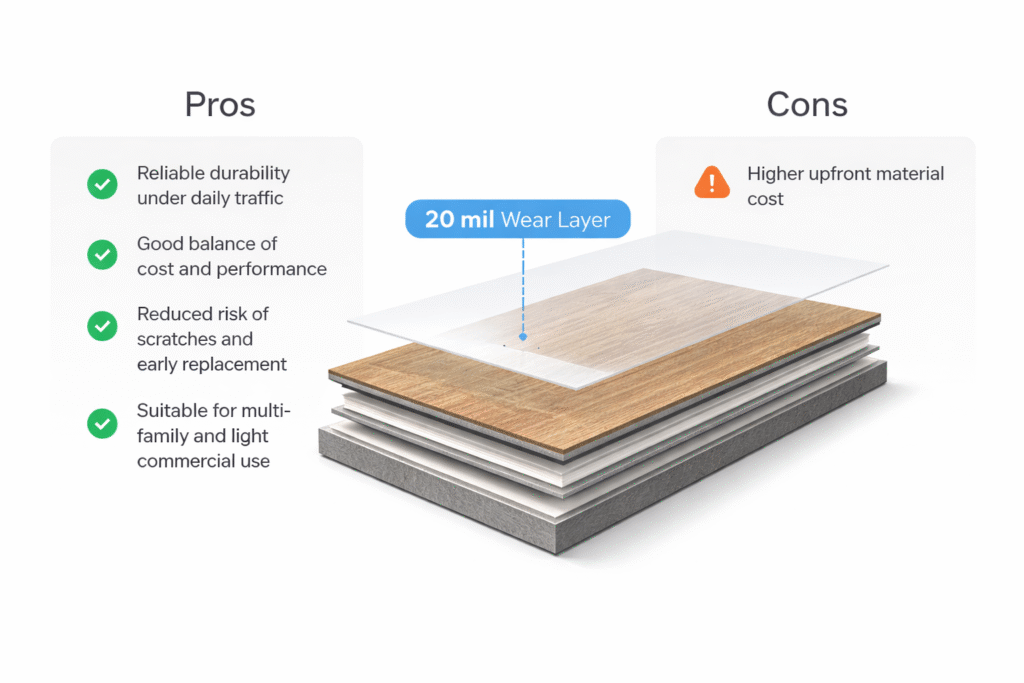
20 mil wear layer Pros:
- Reliable durability under real-life traffic conditions
- Optimized balance between upfront cost and long-term performance
- Reduced risk of premature wear, complaints, and replacements
- Scalable specification across multiple projects and units
20 mil wear layer Cons:
- Higher upfront cost compared to entry-level 12 mil options
From a commercial perspective, the value of 20 mil lies in risk control.
It minimizes the likelihood of early failure while maintaining cost efficiency—making it the preferred choice for developers and wholesalers who need predictable performance across projects.
Most professional-grade SPC flooring systems—including standard configurations used by suppliers like UWG—are built around 20 mil wear layers, reflecting its proven balance of durability, cost, and scalability.
20 mil is not just a middle option—it is the most efficient and commercially viable standard for the majority of flooring projects.
Do You Really Need a 30 Mil Wear Layer for SPC Flooring?
A 30 mil wear layer is engineered for extreme durability requirements, typically found in heavy commercial and public environments.
Typical applications include:
- High-traffic retail spaces
- Airports, schools, and public facilities
- Commercial areas with continuous foot traffic
30 mil wear layer Pros:
- Maximum resistance to wear and abrasion
- Extended service life in demanding environments
30 mil wear layer Cons:
- Significantly higher material cost
- Over-engineered for most residential and multi-family projects
- Lower return on investment in standard applications
The key issue with 30 mil is not performance—but cost efficiency.
In most residential or multi-family scenarios, the additional thickness does not translate into proportional value. Instead, it increases upfront investment without meaningfully extending usable lifespan under normal conditions.
From a project budgeting perspective, this results in:
- Higher initial capital expenditure
- Reduced margin flexibility
- Limited practical benefit in typical use cases
In other words, 30 mil is often not a performance upgrade—but a cost inefficiency when misapplied.
30 mil is essential for specialized, high-traffic commercial environments—but for most projects, it represents over-specification rather than optimization.

Why Wear Layer Thickness Alone Doesn’t Determine SPC Flooring Performance
While thickness matters, real-world performance depends on the entire flooring system—not just the wear layer.
Surface coatings, core stability, and installation quality all play a critical role in durability and lifespan.
A well-engineered 20 mil system can outperform a poorly constructed thicker alternative.
How to Choose the Right SPC Wear Layer for Your Project
The right choice depends on three key factors:
1. Traffic level
- Low → 12 mil
- Medium → 20 mil
- High → 30 mil
2. Project type
- Residential → 12–20 mil
- Multi-family → 20 mil
- Commercial → 20–30 mil
3. Cost vs long-term value
- Lowest upfront → 12 mil
- Best ROI → 20 mil
- Maximum durability → 30 mil
In most real-world scenarios, this framework naturally leads to 20 mil as the most balanced option.
What Wear Layer Do Builders and Developers Prefer?
In practice, most builders, developers, and wholesalers standardize on 20 mil wear layers across projects.
This is not by chance—it reflects years of field experience balancing cost, durability, and risk.
20 mil provides:
- Reliable performance under daily use
- Lower replacement and maintenance risk
- Scalable consistency across multiple projects
For the majority of residential and multi-family applications, 20 mil is not just a recommendation—it is the proven industry standard.
Summary
Selecting the right SPC wear layer is a strategic decision that impacts cost, durability, and long-term performance. While 12 mil works for light residential use and 30 mil suits heavy commercial spaces, 20 mil offers the best balance of durability, cost efficiency, and scalability—making it the preferred choice for most builders and wholesalers.
Frequently Asked Questions About SPC Flooring Wear Layers
Q: What does “mil” mean in SPC flooring wear layers?
A: A “mil” is a measurement of thickness equal to one-thousandth of an inch (0.001 inches)—it is not the same as a millimeter. It measures the clear, protective urethane coating applied over the printed design layer of the SPC or LVP flooring. A higher mil count means a thicker protective barrier against scratches, dents, and heavy foot traffic.
Q: Is a 12 mil wear layer thick enough for a residential home?
A: Yes, a 12 mil wear layer is considered the industry standard for light to moderate residential use. It provides excellent protection for low-traffic areas like bedrooms, living rooms, and dining areas in typical single-family homes without large pets or heavy commercial activity.
Q: When should a builder or renovator upgrade to a 20 mil wear layer?
A: A 20 mil wear layer is highly recommended for high-traffic residential areas, homes with large pets, and light commercial spaces like boutique retail shops or small offices. For multifamily apartments or rental units, upgrading to a 20 mil wear layer is a smart investment, as it significantly extends the lifespan of the floor and reduces tenant turnover replacement costs.
Q: Do I need a 30 mil or thicker wear layer for my project?
A: A 30 mil or 40 mil wear layer is strictly designed for heavy-duty commercial environments. It is the best choice for high-traffic areas such as hospitals, schools, large retail supermarkets, and busy corporate corridors. Using a 30 mil wear layer in a standard residential home is generally considered overkill and an unnecessary expense.
Articles that you may be interested in:
Noise-Reducing Flooring Solutions for Multifamily Projects (2026 Guide)