Material selection in construction directly impacts structural performance, cost efficiency, and project timelines. An unsuitable material can introduce unnecessary risk and complexity. Among commonly used options, plywood stands out as a widely applied yet often underestimated solution. This raises a practical question for builders: when does plywood truly become the right choice?
Plywood is an engineered wood panel made by bonding thin veneer layers with alternating grain directions, resulting in improved strength, dimensional stability, and resistance to cracking. In construction, it is widely used for structural sheathing, subflooring, roofing, and formwork. It is most effective in applications that require a balance of structural performance, cost efficiency, and environmental stability, particularly where solid wood may deform or where consistent material behavior is critical.
Understanding how plywood is structured, manufactured, and applied allows builders to make more precise, performance-driven material decisions.
Understanding Plywood: Structure, Composition, and Core Characteristics
Plywood is not simply a wooden board—it is a highly engineered material developed to address the structural limitations of natural timber.
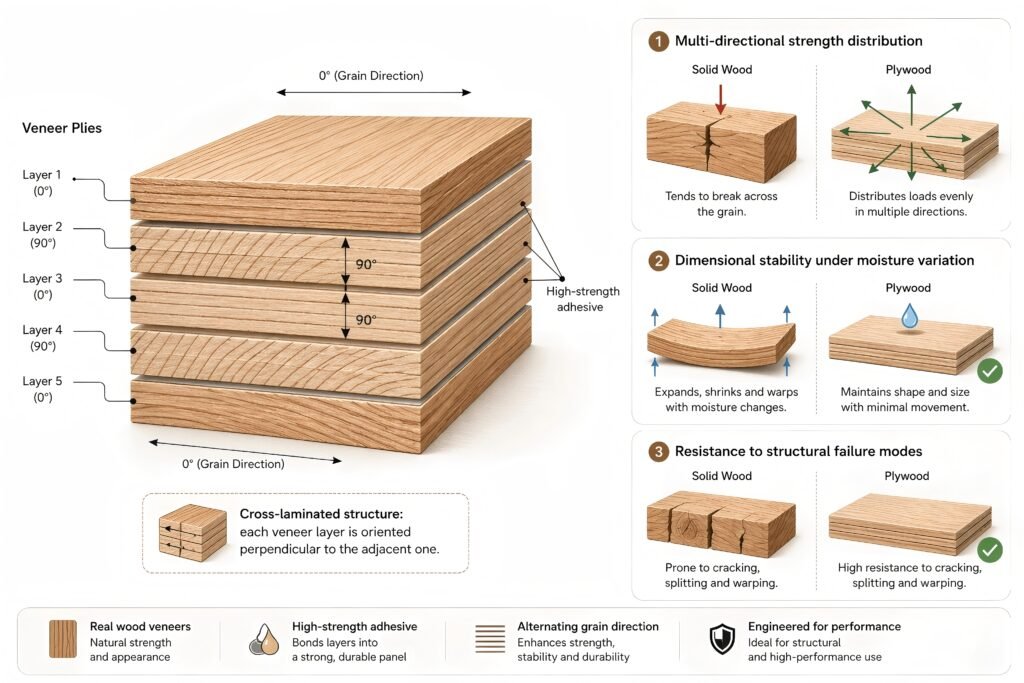
At its core, plywood is composed of multiple thin layers of wood veneer, known as plies, which are bonded together using high-strength adhesives. What distinguishes plywood from solid wood is its cross-laminated structure: each veneer layer is oriented perpendicular to the adjacent one. This intentional arrangement fundamentally alters how the material behaves under load and environmental stress.
From an engineering perspective, this structure delivers three critical performance improvements:
- Multi-directional strength distribution Unlike solid wood, which is strongest along the grain but weak across it, plywood distributes loads more evenly in both directions, making it more reliable in structural applications.
- Dimensional stability under moisture variation Natural wood expands and contracts with humidity changes. The cross-graining in plywood counteracts these movements, significantly reducing expansion, shrinkage, and deformation.
- Resistance to structural failure modes The layered configuration minimizes common defects such as cracking, splitting, and warping, which are typical risks in solid timber under stress.
In addition to its layered design, the type of adhesive used (e.g., interior, exterior, or marine-grade bonding) further defines plywood’s performance characteristics, particularly in terms of moisture resistance and durability.
As a result, plywood offers what engineers refer to as predictable and controlled performance—a key requirement in modern construction, where materials must perform consistently under varying conditions.
Compared to solid wood, which can exhibit natural variability and unpredictable behavior, plywood provides a more standardized, reliable, and scalable solution, making it a foundational material in contemporary building systems.
How Plywood Is Manufactured
The performance of plywood is not accidental—it is engineered through a highly controlled manufacturing process designed to enhance strength, stability, and durability.
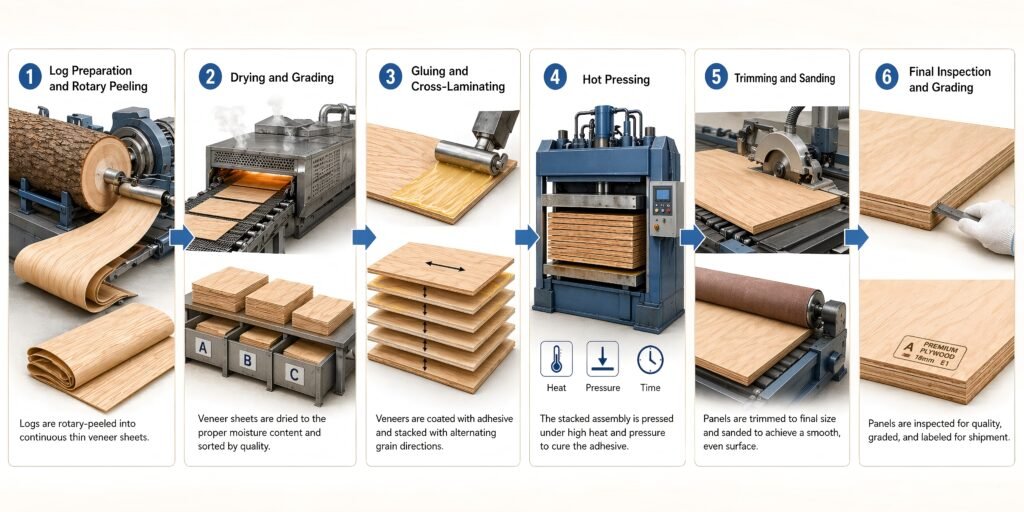
The process begins by rotary-peeling logs into thin veneer sheets, which are then carefully dried and graded to ensure uniform quality. These veneers are assembled in alternating grain directions, creating the foundation for plywood’s structural behavior.
However, the true performance of plywood lies not in the steps themselves, but in how each stage contributes to its final properties:
- Cross-laminating (grain orientation) By arranging each layer perpendicular to the next, plywood overcomes the natural anisotropy of wood, enabling more balanced load distribution and improved resistance to bending and shear forces.
- Adhesive technology The type and quality of adhesive used directly determine the panel’s resistance to moisture, delamination, and long-term environmental exposure. For example, exterior and marine-grade plywood rely on waterproof bonding systems to maintain integrity under harsh conditions.
- Hot pressing and consolidation The application of heat and pressure ensures strong interlayer bonding, eliminates internal voids, and enhances the panel’s overall density and structural consistency.
- Material grading and layer uniformity Consistent veneer quality is essential to avoid weak points within the panel, ensuring predictable mechanical performance across its entire surface.
Depending on the intended application, manufacturers adjust adhesive formulations and treatment processes to produce plywood suitable for interior, exterior, or high-moisture environments.
For builders, this means plywood is not just processed wood—it is a precision-engineered material with performance characteristics that can be tailored to specific construction demands.
Different Types of Plywood and Their Structural Roles
Not all plywood performs the same. Each type is engineered to meet specific structural, environmental, and application requirements in construction.
Rather than viewing plywood as a single material, builders should understand it as a category of engineered panels, each optimized for different use cases.
| Type of Plywood | Engineering Characteristics | Best Use Scenario | Key Advantage |
|---|---|---|---|
| Structural Plywood | High load-bearing capacity, graded for strength | Wall sheathing, subfloors | Reliable structural performance |
| Marine Plywood | Waterproof adhesive, void-free core | Coastal, wet, or high-humidity environments | Maximum moisture resistance |
| Hardwood Plywood | Dense surface, higher durability | Furniture, cabinetry, interior finishes | Superior surface quality |
| Softwood Plywood | Lightweight, cost-efficient | Roofing, general construction | Easy handling and lower cost |
| Exterior Plywood | Weather-resistant bonding | Outdoor structural applications | Good balance of durability and cost |
How to Interpret These Differences
From a builder’s perspective, choosing the right type of plywood is less about labels and more about matching performance to application conditions:
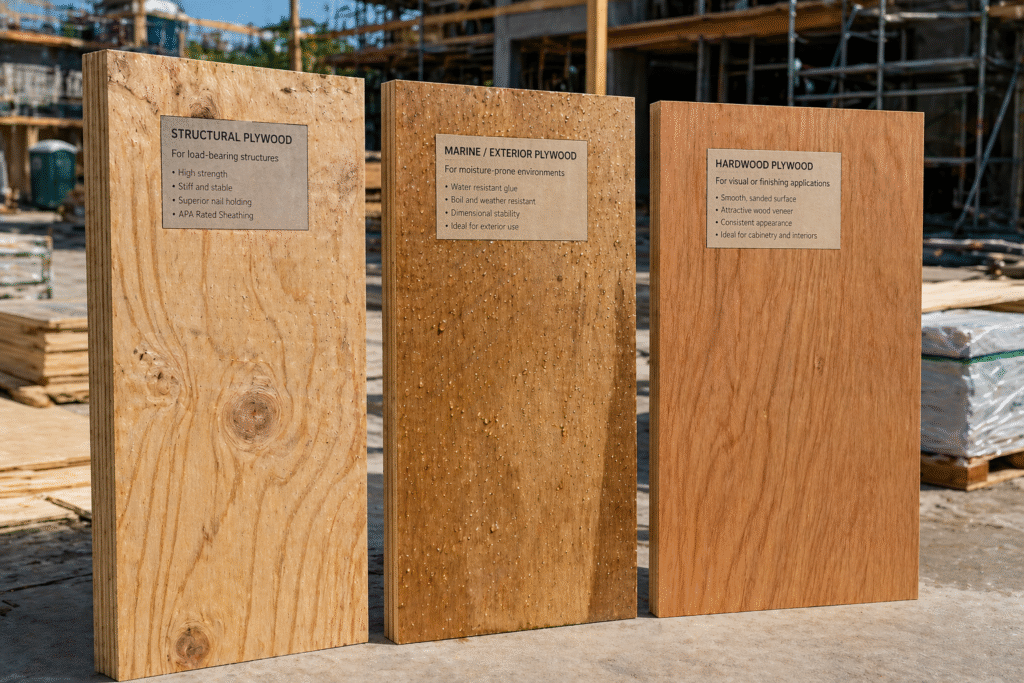
- For load-bearing structures, structural plywood is essential
- For moisture-prone environments, marine or exterior plywood is critical
- For visual or finishing applications, hardwood plywood is preferred
Each type represents a trade-off between strength, durability, cost, and environmental resistance.
Understanding these distinctions allows builders to move beyond generic material selection and adopt a more performance-driven approach to construction materials.
Why Builders Use Plywood: Performance Advantages in Construction
Plywood remains a core material in construction because it delivers a balanced combination of structural performance, cost efficiency, and workability.
Its cross-laminated structure enables uniform load distribution, improving resistance to bending, cracking, and shear stress compared to solid wood. At the same time, efficient use of raw materials makes plywood a cost-effective alternative without compromising strength.
From a practical standpoint, plywood is highly workable—easy to cut, shape, and install—allowing faster on-site execution and reduced labor costs.
Equally important is its dimensional stability. Unlike natural timber, plywood maintains its form under changing moisture and temperature conditions, minimizing deformation and reducing the likelihood of rework.
Together, these characteristics make plywood a reliable and scalable solution across a wide range of construction applications.
Limitations of Plywood: Performance Constraints and Risk Factors
Despite its advantages, plywood presents several limitations that must be considered in construction planning.
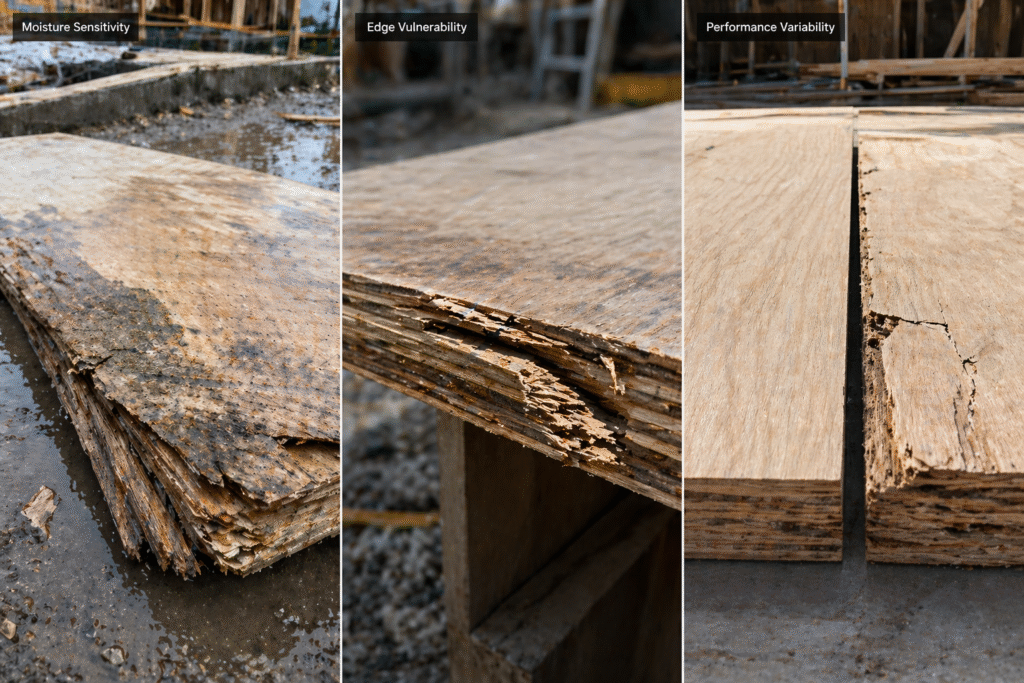
The primary concern is moisture sensitivity. While specialized variants offer water resistance, standard plywood can deteriorate under prolonged exposure to humidity or water.
Another structural weakness lies in edge vulnerability, where exposed layers may be prone to damage or delamination if not properly sealed.
In addition, performance variability between manufacturers can lead to inconsistencies in strength and durability, making material selection and quality control critical.
For builders, these constraints highlight the importance of aligning plywood specifications with environmental conditions and application requirements to avoid premature material failure.
Where Plywood Performs Best
Plywood is widely used in construction due to its balanced structural performance and versatility across applications.
| Application | Performance Rationale |
|---|---|
| Wall Sheathing | Provides structural rigidity and load distribution |
| Subflooring | Ensures a stable, load-bearing base |
| Roofing | Combines light weight with adequate strength |
| Concrete Formwork | Offers smooth surfaces and reusability |
| Interior Panels | Allows efficient installation and finishing |
These applications demonstrate how plywood delivers reliable performance in both structural and non-structural roles.
When Plywood Is the Better Option
Plywood is most effective when performance, stability, and efficiency must be balanced.
It is typically the preferred choice when:
- Large surface areas require consistent structural stability
- Projects demand cost efficiency without compromising strength
- Environmental conditions may cause solid wood deformation
- Fast installation and simplified handling are critical
Compared to alternative materials, plywood offers greater moisture resistance than MDF and better dimensional stability than solid timber, making it a practical and reliable solution in many construction scenarios.
Ultimately, plywood is best viewed as a performance-driven material, selected based on application requirements rather than convenience.
Frequently Asked Questions About Plywood in Construction
Q: What exactly is plywood and why is it considered an “engineered” wood product?
A: Plywood is an engineered wood panel constructed by bonding multiple thin layers of wood veneer (plies) together under high heat and pressure. It is designated as “engineered” because each adjacent layer is oriented with its grain direction perpendicular to the next—a technique known as cross-laminating. This intentional design overcomes the natural directional weaknesses of solid timber, providing exceptional multi-directional strength and high resistance to warping, cracking, or splitting.
Q: When should builders choose structural plywood over standard softwood options?
A: Structural plywood is specifically graded and manufactured for high load-bearing capacity and should be prioritized for critical building components such as wall sheathing, subflooring, and roofing diaphragms. While standard softwood plywood is excellent for temporary formwork or general light construction, structural-grade plywood ensures a much more stable and reliable base that meets strict building safety standards for long-term structural integrity.
Q: Is plywood better than solid wood for moisture-prone environments?
A: Yes, in many modern construction scenarios, plywood is superior to solid wood regarding dimensional stability under moisture variation. Natural timber expands and contracts significantly with changes in humidity. Plywood’s cross-grained structure counteracts this natural movement, making it much less likely to swell, shrink, or deform. For extreme moisture conditions, builders should specify marine-grade or exterior plywood, which utilizes specialized waterproof adhesives to maintain panel integrity.
Q: How does M4B support builders in selecting the right plywood for large projects?
A: M4B provides expert technical guidance to help contractors and developers match specific plywood grades and thicknesses to their unique project demands. By evaluating the balance between structural strength, environmental exposure, and bulk procurement budgets, M4B supplies factory-direct panels that ensure consistent, predictable performance across large-scale developments, significantly reducing the risk of material failure and costly rework.
Summary
Plywood is not simply a versatile material—it is a performance-driven solution engineered for consistency and reliability in construction. Its value lies in balancing strength, stability, and cost efficiency across a wide range of applications. For builders, the key is not just selecting plywood, but specifying it correctly based on structural demands, environmental conditions, and project priorities.
Articles that you may be interested in:
Top Interior Design Trends in US Residential Construction (2026)
How Do Five-Panel Doors Enhance Modern and Traditional Interiors in Residential Construction?