A thick plank may feel substantial without being the best option for a project. Part of its advertised thickness may be cushioning, and a floor that resists bending can still expand with heat, develop joint problems, or retain marks from furniture.
For builders and specifiers, the useful question is what the additional thickness changes—and which performance claims need evidence beyond a millimeter measurement.
What Does Flooring Thickness Include?
Before comparing two products, ask how each supplier states thickness. Identify the flooring body, the core, the surface layer, and any attached pad separately.
| Specification | What to check | What it does not establish on its own |
|---|---|---|
| Total product thickness | Whether attached backing or cushioning is included | Core thickness, dent resistance, or suitability for commercial use |
| Core or flooring-body thickness | The actual layer construction and measurement definition | Material stiffness, thermal movement, or joint strength |
| Vinyl wear-layer thickness | The clear wear layer above the decorative image | Scratch-proof or dent-proof performance |
| Attached-pad thickness | Material, compressibility, and compatibility with the installation system | Structural support or permission to add another pad |
| Engineered-wood top-layer thickness | The real-wood surface and product refinishing guidance | Surface hardness or an unlimited number of sanding cycles |
The term “wear layer” needs context. A vinyl wear layer is not the same construction as the real-wood top layer of engineered hardwood, and neither should be confused with the total board thickness.
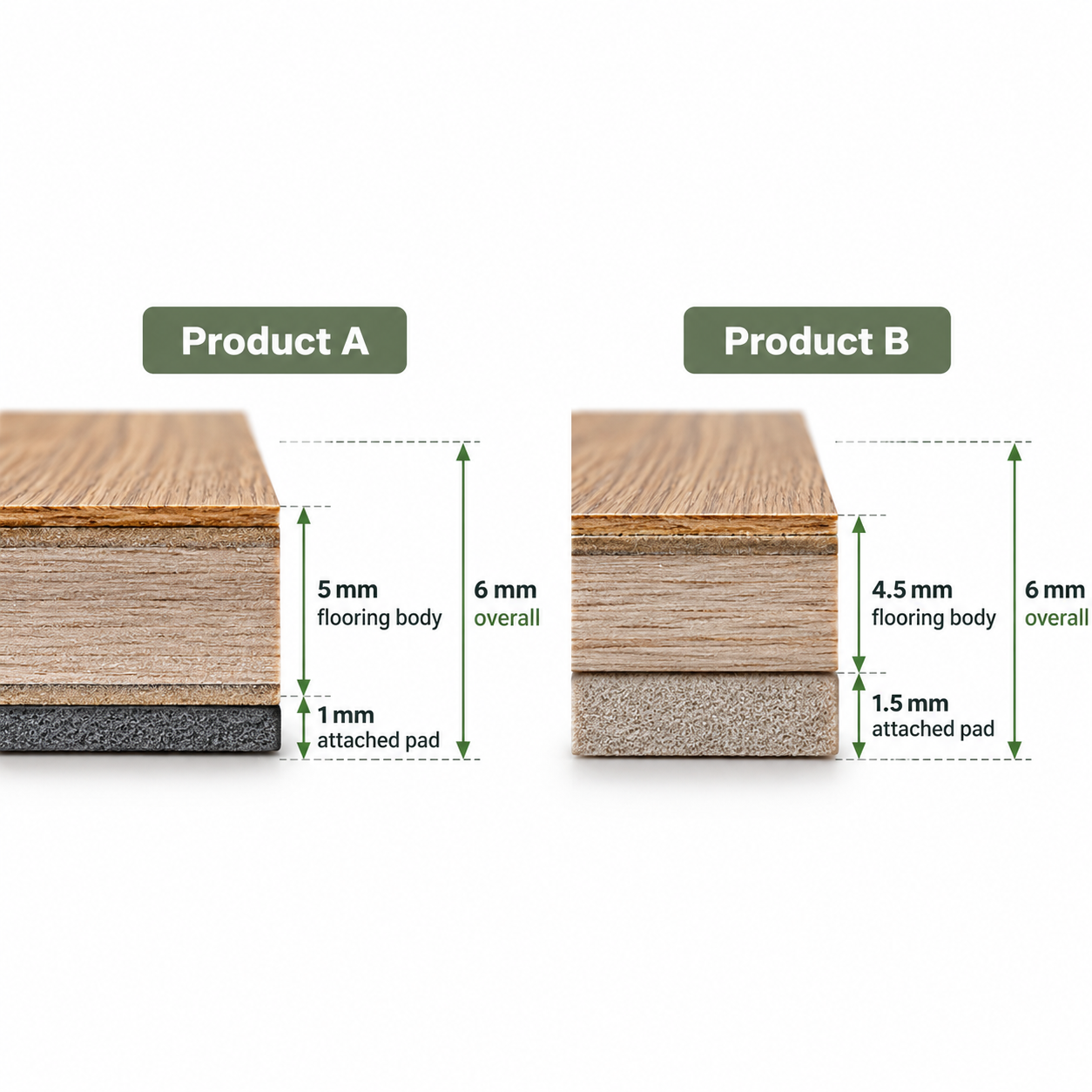
Two 6 mm Floors Can Have Different Constructions
Consider two illustrative products:
- Product A: 5 mm flooring body plus 1 mm attached pad.
- Product B: 4.5 mm flooring body plus 1.5 mm attached pad.
Both measure 6 mm overall, but their cushioning and flooring-body dimensions differ. The figures alone do not identify the stiffer or more dent-resistant product: material properties, layer construction, and test results are still needed.
When comparing the flooring collection, request a layer breakdown for each shortlisted product rather than treating the advertised total thickness as a performance grade.
Flooring Stability Has More Than One Meaning
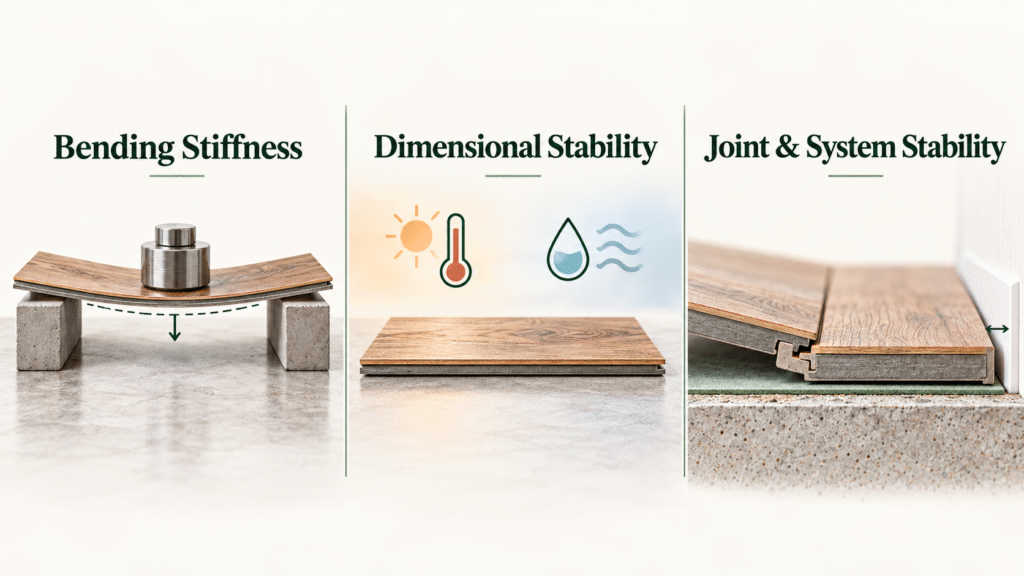
Bending Stiffness
Within a comparable material and construction, increasing the load-bearing section’s thickness can reduce bending. That can matter to how a plank behaves during handling and how a floating floor responds at its joints.
Changing the core formulation, plank dimensions, backing, or installation method changes the comparison. A thicker cushioned product should not automatically be ranked above a thinner, denser rigid-core product for every load condition.
Dimensional Stability
Dimensional stability describes how well a product retains its dimensions as conditions change. It is different from resistance to bending underfoot.
For resilient flooring, dimensional change and curling after heat exposure can be evaluated separately from thickness. ASTM F2199 is one test method for this purpose. Where product-specific results are available, check the tested construction and conditions before using them to compare products.
For wood-based floors, moisture conditions and construction also matter. Increasing overall thickness does not remove the need for suitable environmental conditions and the required installation allowances.
Joint and Installed-System Stability
A click joint depends on its profile, material, machining, and support. A thicker plank may allow a different profile, but its dimensions do not prove that the actual connection is stronger.
Ask for evidence relevant to joint performance and check the installation instructions for substrate flatness, permitted underlayment, expansion space, and fixed-object restrictions. Keep the finish floor’s performance separate from the structural capacity of the subfloor beneath it.
Does Thicker Flooring Resist Dents Better?
Not necessarily. A permanent furniture mark depends on the layers under the contact point, their response over time, the applied load, temperature, and support beneath the floor.
A thicker, more compressible layer may provide cushioning without improving resistance to a concentrated furniture load. A hard core can also sit beneath surface layers that behave differently under pressure. Compare the finished product’s indentation data rather than inferring the answer from thickness or density alone.
Furniture-Foot Area Matters
Contact pressure is load divided by contact area.
For an illustrative load of 100 pounds-force on one furniture foot:
| Contact area | Average contact pressure |
|---|---|
| 1 square inch | 100 psi |
| 4 square inches | 25 psi |
The same load produces one-quarter of the average pressure when distributed over four times the area. This calculation explains why suitable furniture protectors matter; it is not a prediction of whether a particular floor will dent or a published load limit for that floor.
Rolling equipment creates a different condition from stationary furniture. If a project uses carts or wheeled chairs, obtain the relevant product guidance or test evidence rather than treating a static-load result as approval for rolling use.
Wear, Scratching, and Indentation Are Different
Wear-through removes material over repeated use. Scratching damages the surface. Indentation compresses or deforms the flooring beneath a load.
Wear-layer thickness is relevant to the amount of wear material available, but it does not independently establish scratch, stain, or indentation resistance. Surface treatment and the complete construction need separate evaluation.
What Should Buyers Check Beyond Flooring Thickness?
Match the information to the performance question. Start with the product’s construction, intended use, and installation guidance; use product-specific test data where available to evaluate measured performance.
| Concern | What to verify | What to compare |
|---|---|---|
| Furniture dents | Indentation and recovery under a defined load | Contact area, load duration, recovery period, and any measured remaining depression |
| Prolonged stationary loads | Recovery after sustained loading | Furniture-support requirements, load conditions, and available recovery data |
| Heat-related movement or curling | Dimensional response to temperature changes | Product construction, permitted temperatures, movement allowances, and available measurements |
| Abrasion or scratching | Surface performance for the intended use | Wear layer, surface treatment, care guidance, and results for the specific property being claimed |
| Joint performance or rolling loads | Compatibility with the installation and loading conditions | Joint design, substrate support, approved padding, and guidance for wheeled equipment |
Use information appropriate to the flooring category. Resilient flooring, laminate, and engineered wood do not share one thickness-based performance scale.
Why a Thicker Plank Does Not Replace Subfloor Preparation
A rigid plank may bridge a small depression, but bridging is not the same as receiving continuous support. Movement over an unsupported area can stress the plank or its joints.
Check the actual floor for flatness and other substrate conditions against the selected product’s installation instructions. Flatness and level are different: an evenly sloping surface may be flat, while a nominally level floor can still contain local humps and dips.
Do not reduce preparation work solely because the new floor is thicker. Likewise, do not add a soft underlayment to an attached-pad product unless the flooring system permits it. The extra compression can change how the floor and its joints respond under load.
How to Choose Thickness for Residential and Commercial Projects
There is no reliable cross-material rule that labels 4–5 mm flooring “low performance” and 10 mm flooring “commercial grade.” Start with the flooring construction and the actual service conditions.
- Identify the flooring category. Compare like constructions before using millimeters to rank products.
- Define the loads and exposure. Record furniture feet, rolling equipment, expected traffic, heat exposure, and moisture conditions.
- Check the supported installation system. Confirm substrate preparation, attachment method, pad compatibility, and movement allowances.
- Verify the performance claims. Review the product’s intended use and limitations. Where test data is available, compare matching conditions against the project’s acceptance criteria.
- Compare installed cost. Include substrate preparation, approved underlayment, and installation rather than comparing material price alone.
For offices, retail spaces, or hospitality projects, keep the intended room use and load conditions in the flooring schedule. Review UWG’s commercial building-material solutions when coordinating those floor selections with the wider project package, and confirm the proposed product’s application limits before ordering.
Paying for additional thickness makes sense when the selected construction delivers a needed benefit. It is not a substitute for verified performance, and an otherwise suitable thinner product should not be rejected on thickness alone.
Conclusion
Flooring thickness affects construction and installed height, and can improve bending stiffness in a comparable product. It does not independently establish dimensional stability, dent resistance, joint strength, or commercial suitability.
Select the flooring system by its actual loads, relevant test results, substrate requirements, and total installed cost. Separating those decisions gives builders a stronger specification than choosing the thickest plank available.
Frequently Asked Questions
Is thicker flooring always more stable?
No. A thicker section can resist bending better when material and construction are comparable, but dimensional stability also depends on the product’s composition and environmental response. Joint performance and substrate support must be evaluated separately.
Is thicker flooring more resistant to furniture dents?
Total thickness alone cannot establish dent resistance. Compare the complete construction and relevant indentation results, including the load, contact area, loading time, and recovery period. Use suitable furniture protectors and follow the product’s load guidance.
Does a thicker wear layer prevent scratches and dents?
No. Wear-layer thickness, surface scratching, and indentation are different considerations. A thicker wear layer does not make the floor scratch-proof or dent-proof; surface treatment and the layers beneath it also affect performance.
Can thicker flooring be installed over an uneven subfloor?
It must still meet the selected product’s substrate requirements. A plank that bridges a low spot may lack adequate support, and adding thickness does not automatically make that condition acceptable. Measure and correct the substrate as required before installation.
What flooring thickness is best for commercial use?
There is no universal commercial thickness across SPC, WPC, laminate, and engineered wood. Choose a product approved for the intended application and compare evidence for the expected wear, furniture, rolling loads, environmental exposure, and installation system.
Does attached underlayment count toward flooring thickness?
It may be included in the advertised total. Ask the supplier to identify the flooring-body, core, wear-layer, and pad dimensions separately. Two products with the same overall thickness can have different constructions and performance.