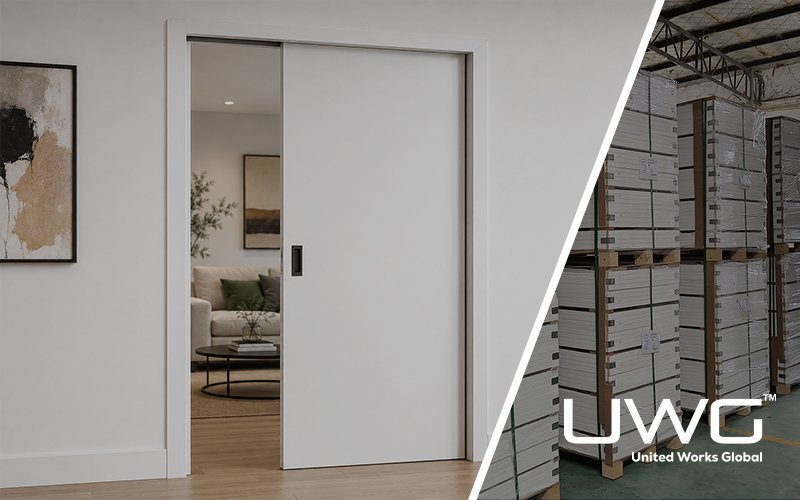
Choose pocket door hardware by matching the track and roller system to the finished door’s weight, dimensions, and pocket frame. Select compatible hangers with accessible adjustment points. For soft close, check the door-weight range, minimum width, and required direction of operation. Choose locks for the door thickness and single- or double-door configuration, then confirm the preparation. Before ordering, verify track length, wall clearance, support, and access for future servicing.
For builders, contractors, and distributors, a complete specification also needs to define what each kit includes and what must be supplied separately. This pocket door hardware guide explains the selection checks for tracks, rollers, soft-close components, guides, stops, and locks, so the parts can be ordered and installed as one compatible assembly.
Pocket Door Hardware at a Glance
Most interior pocket doors use an overhead track to support the panel while a lower guide controls sideways movement. The pocket frame creates the space into which the door retracts. These parts have different jobs, so a stronger roller cannot compensate for an unsuitable frame or inadequate track support.
| Component | Main function | What to verify |
|---|---|---|
| Track | Provides the running path for the wheel assemblies | Track profile, length, mounting arrangement, and compatible components |
| Rollers and hangers | Carry and connect the door to the running system | Rated configuration, door attachment, adjustment, and removal method |
| Soft-close mechanism | Controls movement near the closing end of travel | Compatible series, door weight, minimum width, and trigger position |
| Floor guide | Restrains lateral movement near the bottom of the panel | Guide type, door preparation, positioning, and floor clearance |
| Stops | Establish the permitted travel limits | Open and closed positions, adjustment, and coordination with dampers |
| Pulls and locks | Allow users to retrieve, operate, and secure the door | Function, door thickness, preparation, and clearance inside the pocket |
| Pocket frame | Forms the pocket assembly within the wall | Door size, wall construction, cavity clearance, and installation requirements |
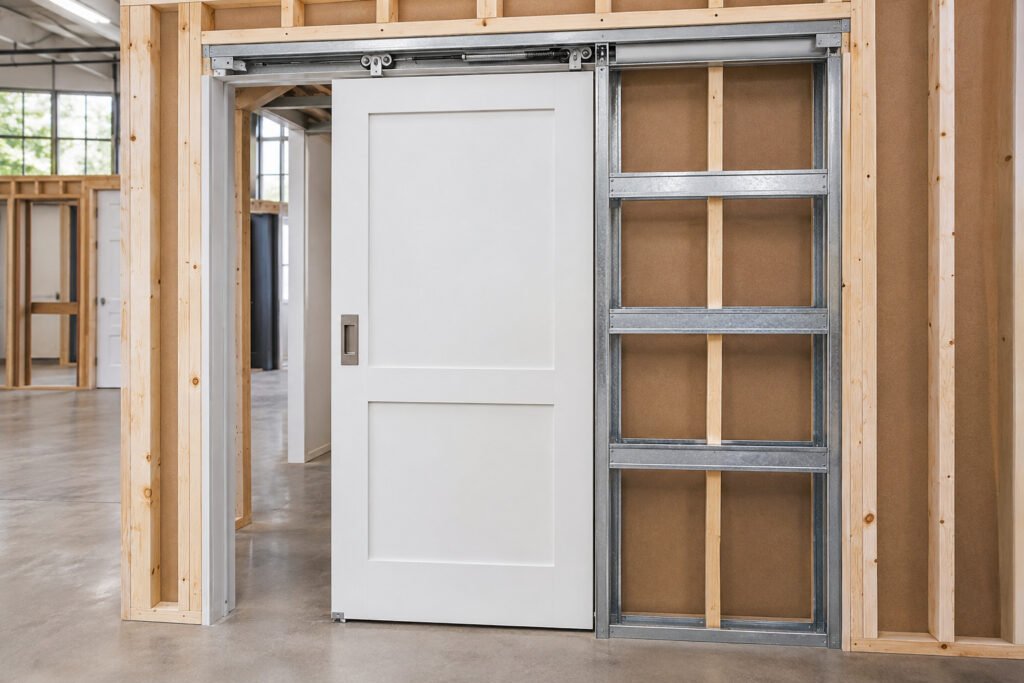
What Is Included in a Pocket Door Hardware Kit?
Track-and-Hardware Kits vs. Pocket Door Frame Kits
A pocket door frame kit usually supplies a defined group of operating components. A pocket door frame kit also provides the specified frame members that form the pocket. Neither name guarantees a finished door opening.
A track-and-hardware package may suit a project with an existing compatible pocket or a separately constructed frame. A frame kit may be more appropriate when the project needs both the pocket structure and its running hardware. Replacement packages address particular components rather than the entire opening.
| Package type | Typical scope | Confirm separately |
|---|---|---|
| Track-and-hardware kit | Track, designated hangers, and specified guides or stops | Pocket frame, support, soft operation, pulls, and locks |
| Pocket door frame kit | Specified frame members, header or track assembly, and hanging components | Door slab, jambs, casing, wall finishes, and optional accessories |
| Soft-close upgrade kit | A compatible damper or hanger assembly and designated activation parts | Existing system compatibility, required companion parts, and service access |
| Replacement component pack | Particular rollers, hangers, guides, stops, or fittings | Exact track series, mounting interfaces, and remaining components |
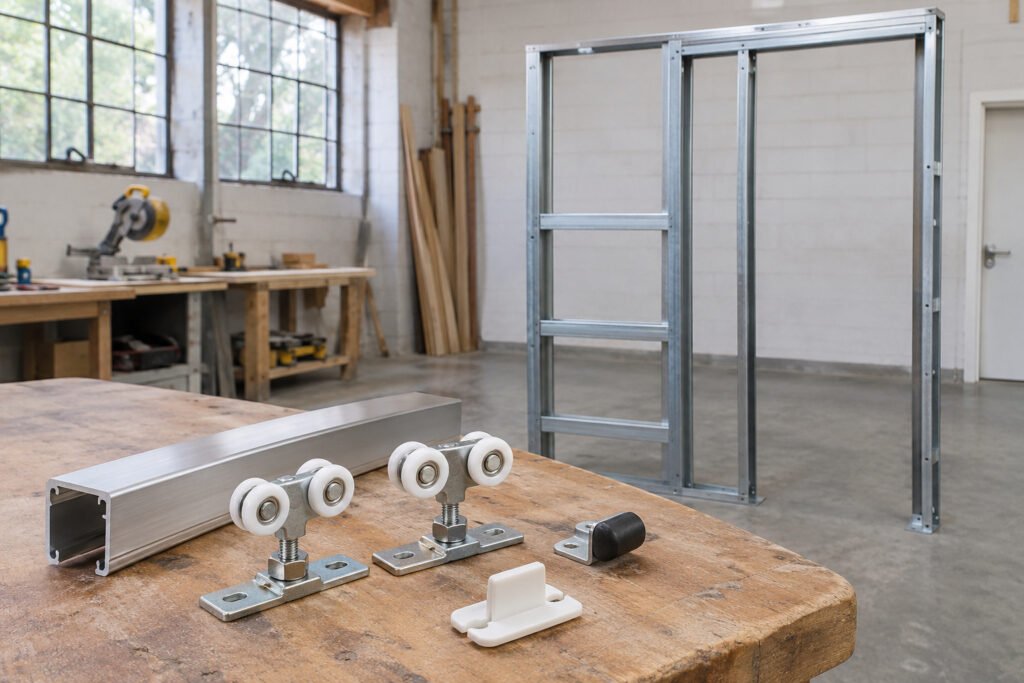
Components That May Be Sold Separately
Check the bill of materials against the selected model and options. Door slabs, jambs and casing, flush pulls, edge pulls, locks, and soft-close accessories may be separate purchases. Double-door joining components, adapters, and certain guides may also require separate ordering.
For project purchasing, identify each item as included, separately supplied, or provided on site. This makes quotations easier to compare and helps prevent missing parts from delaying installation.
Check Door Size, Weight, and Wall Conditions Before Choosing Hardware
Door Width, Height, Thickness, and Weight
Record actual panel dimensions and the weight of the finished door. Applied mirrors, glazing, decorative material, and operating hardware can change the load compared with an unfinished slab. Use the relevant door specification or a verified weight rather than estimating from width alone.
Door thickness affects more than the space inside the pocket. It also influences hanger attachment, guide selection, lock fit, and machining. Confirm that the door construction provides suitable material at the top attachment points and wherever a lock, pull, or guide groove is required. A hollow-core panel should not be assumed to accept the same preparation as a solid-core panel.
Two doors with the same nominal dimensions can therefore require different hardware. Supply the hardware manufacturer with the panel’s construction and finished weight when checking suitability.
Wall Thickness and Pocket Cavity Clearance
Distinguish structural wall thickness from finished wall thickness. Stud depth describes one part of the assembly; drywall, tile, panels, and other finishes affect the final build-up and jamb arrangement. Neither measurement alone establishes the usable cavity around the moving door.
Check the pocket’s internal clearance against the panel and its fittings. Fasteners, misplaced blocking, protruding hardware, or services within the intended travel space can obstruct movement. Electrical and plumbing arrangements need coordination with the selected pocket frame before wall closure.
A frame described for a particular wall construction still needs its own dimensional review. Confirm the specified door-thickness range, cavity arrangement, and finish requirements together.
Rough Opening vs. Door Size vs. Clear Opening
| Measurement | What it describes | Why it matters |
|---|---|---|
| Door size | The panel’s nominal or actual dimensions, as identified | Establishes the panel to be accommodated and supported |
| Rough opening | The structural opening prepared for the frame assembly | Must match the selected frame’s installation drawing |
| Clear opening | The usable passage with the completed door in its required open position | Depends on the frame, panel position, stops, and operating hardware |
Do not treat a rough opening formula from one frame series as a rule for every pocket door. Obtain the drawing for the exact door size, frame, and configuration. Also confirm whether vertical dimensions reference the subfloor or finished floor.
Clear opening needs a separate check. An exposed panel edge, pull, or stop position can limit the usable passage even when the nominal door size appears adequate.
How to Choose a Pocket Door Track System
Match the Track to the Door and Installation
Select a pocket door track system that supports the finished panel and works with the specified frame, hangers, and operating accessories. Start with the door’s actual dimensions and weight, then confirm the required travel, mounting support, and service access.
For projects coordinating pocket doors with other interior door options, keep the opening method, slab style, and hardware requirements aligned with the overall door schedule.
For a new opening, choose a frame and running-hardware combination documented to work together. For an existing pocket, identify the installed track series and profile before buying replacement parts. A similar-looking roller or rail is not enough to establish compatibility.
An aluminum track or steel track may be suitable when the complete system meets these requirements. Use the manufacturer’s documented assembly rating to select capacity; track material alone is not a load rating. Also distinguish the running track from the pocket frame: a steel frame does not necessarily use a steel track.
| Selection factor | What to check before choosing |
|---|---|
| Door dimensions and finished weight | Choose a system whose stated panel-size and weight limits accommodate the actual finished door, including applied materials. Check the rating for the intended soft-close configuration as well. |
| Existing or new installation | For replacement work, match the installed series, track profile, and mounting interfaces. For a new opening, select a compatible frame-and-hardware combination before preparing the rough opening. |
| Rollers, hangers, and accessories | Confirm approved part numbers for the selected track. If adding soft close, verify the damper, activator, hanger arrangement, and minimum door width together. |
| Track length and panel travel | Use the selected system’s sizing instructions. Confirm that the door reaches the required open and closed positions with stops, pulls, and soft-close parts fitted. |
| Mounting support | Match the track’s fixing arrangement to the specified header or frame. Resolve unsuitable support before ordering; selecting higher-capacity rollers does not correct inadequate support. |
| Finish and installation environment | Check that the specified track finish, other components, and maintenance requirements suit the intended location. Confirm suitability where moisture or other exposure is a concern. |
| Maintenance access | If future access is a priority, choose a system with a documented removal or service route through the opening or removable trim. Confirm how the door, hangers, and track can each be reached. |
How to Select the Correct Track Length
Track length must cover the required running path into the pocket, not just the visible doorway. Select the size specified for the panel and configuration, then check the final open position against the required clear opening and the means of retrieving the door.
If the available track needs shortening, choose a product that explicitly permits cut-down and follow its instructions. Recheck the locations of mounting points, stops, and soft-close activators after sizing. For bi-parting doors, use the sizing and joining arrangement specified for that double-door system rather than assuming two single-door kits can simply be combined.
Track Access and Future Replacement
Before the wall is finished, confirm the service procedure for each concealed component. A removable door does not necessarily mean the track can also be removed without opening the wall.
Where the project needs to avoid future wall repairs, favor a system with documented track access and retain the required removable jamb or trim arrangement. Keep the track series, hanger part numbers, and service instructions with the project records so maintenance staff can identify compatible replacements.
Pocket Door Rollers and Hangers: Compatibility, Adjustment, and Load Ratings
What Is the Difference Between Rollers and Hangers?
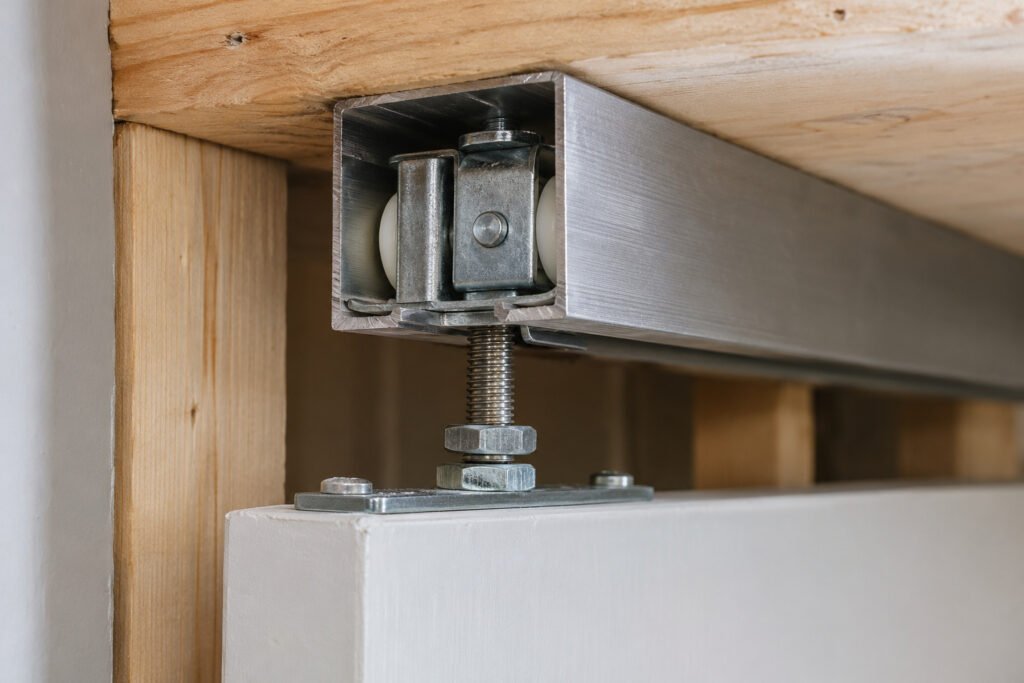
Pocket door rollers are the wheel assemblies that travel along the track. Pocket door hangers suspend the panel and connect it to those running components. Depending on the product, the terms may describe separate parts or a combined assembly.
Use the manufacturer’s exploded drawing and part numbers when ordering. A replacement advertised for a similar-looking door may have a different wheel profile, mounting plate, adjustment thread, or connection height.
What to Check Beyond Wheel Count
Wheel count is only one design feature. Check the bearing arrangement, track contact, adjustment range, door attachment, and specified retention features. Confirm how the hanger releases from the door and whether the necessary adjustment points remain accessible after installation.
For replacements, compare the complete interfaces rather than the wheel diameter alone. Parts that physically enter a track may still be unsuitable for its running surfaces or intended load.
Replacement availability also affects the purchasing decision. Retain the series, hanger number, and installation documentation so future maintenance does not depend on identifying concealed components from appearance.
When Do You Need Heavy Duty Pocket Door Hardware?
Evaluate heavy duty pocket door hardware when panel weight, dimensions, usage, or project specifications exceed the capabilities of the proposed standard system. Solid-core and oversized panels deserve particular attention, but the finished specification should determine the choice.
Check the rating for the actual combination of track, hangers, door attachment, frame, and support. Establish whether the stated capacity applies per door, per pair of hangers, or another defined unit. Do not add component ratings together to create an unsupported system capacity.
Soft operation requires another compatibility check. A track-and-hanger configuration and a soft-close version may have different limits. The selected system must accommodate both the panel and its required operating features; a heavy-duty label alone does not establish that fit.
Soft Close vs. Soft Open: What Should You Specify?
Soft Close, Soft Open, and Self-Closing Explained
These functions address different parts of door operation. Specify the required movement explicitly rather than assuming that a soft-close kit controls both ends of travel.
| Function | What it does | What to confirm |
|---|---|---|
| Soft close | Damps movement near the closing position and, where designed, draws the panel to that position | Direction, engagement point, compatible weight, and final position |
| Soft open | Damps movement near the fully open position | Pocket-end clearance, activation, and door retrieval |
| Self-closing | Uses a designated mechanism to return the door toward closed | Closing behavior, adjustment, and compatibility with other functions |
A door can have soft close without self-closing from every position. Likewise, controlled movement at the closing end does not establish controlled movement at the pocket end.
Door Weight and Minimum Width Requirements
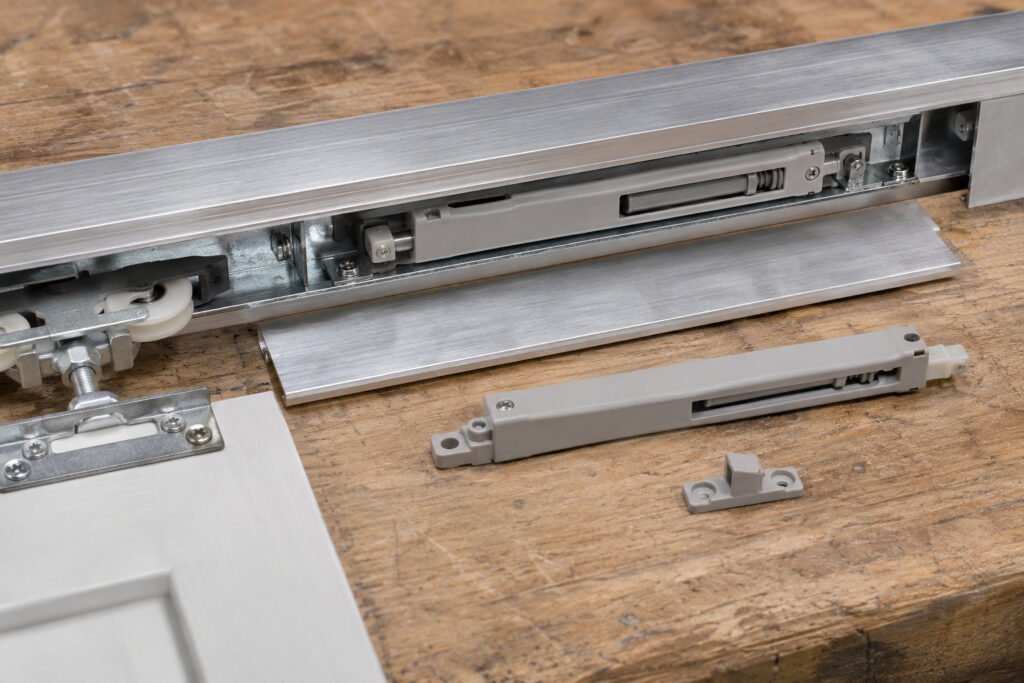
Soft-close selection depends on the specified weight range, minimum panel width, installation space, and compatible running hardware. If a manufacturer states a minimum as well as a maximum weight, check both. Space is also needed for the damper and its activation arrangement.
Confirm whether soft close, soft open, or both are included in the quotation. Check the final panel position with the pull and stop arrangement specified, especially when the design calls for the door to retract fully.
Pocket Door Floor Guides and Door Stops
What Does a Pocket Door Floor Guide Do?
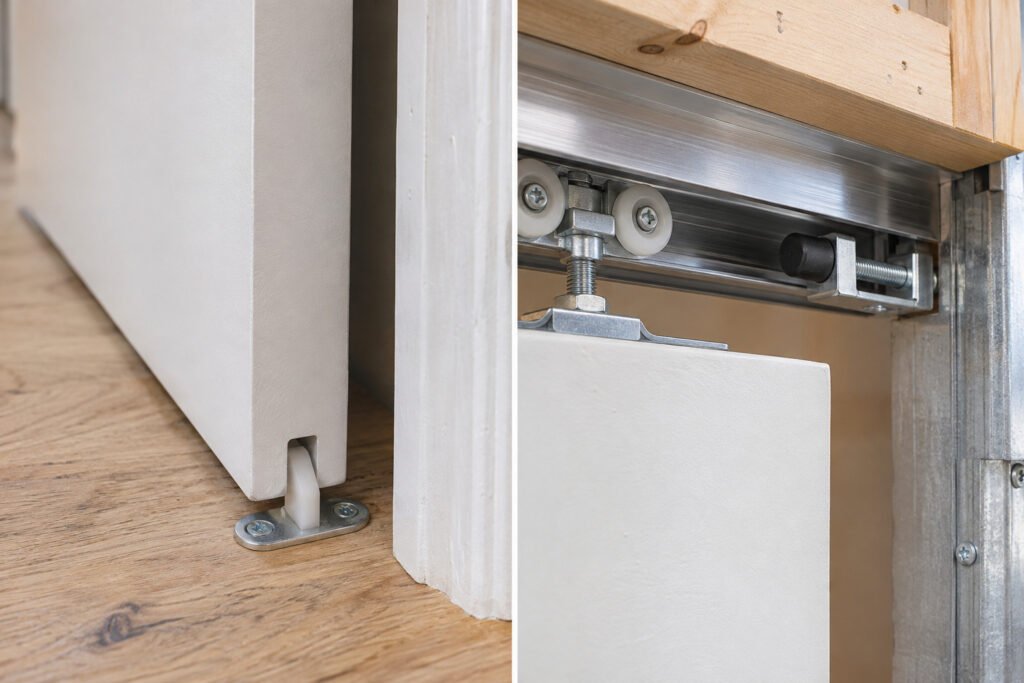
A pocket door floor guide helps restrain side-to-side movement at the bottom of the panel. In a common top-hung system, the overhead hardware carries the door’s weight; the lower guide keeps the panel on its intended path.
Guide designs differ. Some engage a prepared groove in the bottom of the door, while others guide its faces or edges. Apply the dimensions and positioning instructions for the actual guide rather than copying another system’s groove detail.
Check compatibility with the door thickness, bottom construction, finished floor, and specified clearance. Confirm engagement through the required travel, including the open and closed positions.
How Door Stops Control Travel
Door stops establish where the panel finishes its movement. At the pocket end, the setting affects how much panel remains exposed and whether the user can retrieve the door. At the closing end, it must coordinate with the jamb and locking arrangement.
Stop position also influences clear opening. Allowing more exposed panel may improve access to an operating fitting while reducing usable passage. Review both requirements against the completed assembly.
Coordinating Guides, Stops, and Soft Close
Adjust these components as a system. The panel needs to remain guided, enter the damping mechanism correctly, and reach its intended end position without an unintended collision.
Do not assume a soft-close component replaces every mechanical stop required by the manufacturer. Test both directions after adjustment and check that the door can still be operated and retrieved with its specified hardware.
Pocket Door Locks and Pulls for Single and Double Doors
Passage Pulls, Privacy Locks, and Keyed Locks
Select the operating function before the finish. A passage pull operates a nonlocking door; a privacy lock provides the specified privacy function; a keyed lock uses a key-operated arrangement. Latching and locking are separate features, so confirm exactly what the selected product provides.
A flush pull provides a recessed grip on the door face. An edge pull helps retrieve a panel from its pocket. These functions can be separate or combined within a fitting.
Check both pocket clearance and usability. Recessed appearance alone does not prove that a fitting clears the frame throughout travel. Confirm any emergency-release requirement in the selected lock specification and project requirements.
How to Choose a Double Pocket Door Lock
A double pocket door lock for a bi-parting installation must work where two panels meet in the center. The receiving component is associated with the opposing door rather than a conventional closing jamb.
Specify a compatible paired arrangement. A single-door lock and two matching decorative pulls do not automatically form a functional double-door set.
Confirm the door thicknesses, lock and receiving-component preparation, meeting-edge gap, alignment, and any handing instructions. If synchronized movement is required, specify that separately: a synchronization mechanism coordinates motion, while a lock provides its designated latching or locking function.
Check Door Preparation Before Ordering
Obtain the actual lock template before machining. Verify the cutout, edge preparation, fitting depth, door-thickness range, and available material around the preparation. For hollow-core construction, coordinate the required lock area with the door supplier.
Do not assume a standard hinged-door bore suits a recessed pocket lock. Products can use substantially different preparation patterns.
Finally, specify performance separately from appearance or key operation. Choose hardware against the actual project requirement.
Installation and Replacement Checks That Affect Hardware Performance
Check Alignment Before Closing the Wall
Verify the frame is square and plumb and the track is level, with support and fixings installed according to the specified system. Check the pocket for obstructions and confirm that wall-finish fasteners will not intrude into the panel’s path.
Coordinate the finished-floor level before setting vertical clearances. A later flooring change can affect the guide, door-bottom clearance, and lock alignment. These are installation coordination checks; the selected manufacturer’s instructions govern the actual assembly and fixing details.
Test the Complete System Before Final Finishing
Move the door through its full travel with the specified operating hardware fitted. Check for rubbing, lateral movement, inconsistent resistance, and unintended contact. Verify damper engagement and both end positions, then test the latch or lock without forcing the panels into alignment.
Confirm access to adjustment and release points before closing removable trim. For repeated openings, approving a representative assembly can help identify preparation or coordination problems before they are repeated across the project.
Identify Existing Hardware Before Buying Replacement Parts
Record the brand and series where available, photograph the track section and hanging components, and measure the relevant mounting interfaces. Include the panel dimensions, weight, adjustment requirements, and accessible service route when requesting replacement advice.
For project-wide procurement, a pocket door ordering guide can help keep the slab, frame, hardware, and release requirements coordinated.
| Symptom | What to inspect first |
|---|---|
| Door movement is rough or inconsistent | Track condition, obstructions, roller condition, alignment, and compatible parts |
| Panel moves sideways or rubs | Guide engagement, panel alignment, and pocket clearance |
| Soft close does not engage | Activator position, mechanism setting, travel, and specified weight or width limits |
| Latch does not align | Panel height, meeting or jamb alignment, stop position, and receiving-component preparation |
| Door retracts too far to retrieve | Open stop position and the specified edge-pull arrangement |
These are inspection starting points, not definitive diagnoses. Follow the maintenance instructions, including any cleaning or lubrication requirements, rather than applying a treatment intended for another system.
Frequently Asked Questions About Pocket Door Hardware
What Is Included in a Pocket Door Hardware Kit?
A pocket door hardware kit supplies the components listed for its exact model, often including a track and designated hanging hardware with specified guides or stops. Soft-close components, locks, pulls, and other accessories may be separate. Check the bill of materials and selected options; the word “kit” does not establish that the entire opening is included.
What Is the Difference Between a Hardware Kit and a Pocket Door Frame Kit?
A hardware kit primarily provides operating components. A pocket door frame kit also includes the specified members that form the pocket assembly. Package boundaries vary, and either format may exclude the door slab, jambs, trim, or locks. Select the format according to what already exists on site and what must be supplied for the opening.
Are Pocket Door Rollers and Hangers Interchangeable?
Do not assume interchangeability across brands or series. Wheel profile, track section, mounting plates, connection height, and adjustment mechanisms can differ. Identify the existing system and obtain a documented replacement or approved alternative. A component that looks similar, or fits inside the track, does not by itself establish correct operation or rated capacity.
How Do I Choose the Correct Pocket Door Track Length?
Use the sizing instructions for the exact door, frame, and operating configuration. The track must accommodate the required travel and the installed positions of hangers, stops, and soft-close parts. Do not size it from the visible doorway alone. If cutting is permitted, follow the manufacturer’s cut-down instructions and recheck the available travel afterward.
Can I Add Soft Close to an Existing Pocket Door?
Possibly, if a compatible upgrade exists and the door and installation meet its requirements. Identify the track series, hangers, panel weight, panel width, and available access first. Check required companion parts and activation space. Some systems allow an upgrade through the doorway or removable trim; others may require more extensive access or replacement work.
Do Pocket Doors Need a Floor Guide?
Common top-hung pocket door systems use a lower guide to control sideways movement while the upper hardware supports the panel. Follow the specified assembly’s guide requirements. Guide type and door preparation vary, so a groove or mounting position from another product should not be copied without checking compatibility with the door and frame.
What Lock Should I Use for Double Pocket Doors?
For two panels meeting in the center, choose a lock arrangement documented for that bi-parting configuration. Confirm the function, paired receiving hardware, door thickness, preparation, alignment, and meeting gap. Passage, privacy, and keyed versions provide different functions. Also confirm whether the required pull arrangement lets both panels retract and remain practical to retrieve.
Can Pocket Door Hardware Be Replaced Without Opening the Wall?
It depends on the component and the system’s service design. Some doors and hangers can be removed through an accessible opening, and certain systems have extractable tracks. Other repairs may require removing jambs, trim, or wall finishes. Identify the existing product and its removal procedure before ordering parts or assuming a repair will be minimally invasive.
Choose pocket door hardware in sequence: confirm the door, review the wall and frame, then coordinate running components, soft operation, guides, stops, and locks. Documenting those choices as one compatible assembly gives installers and maintenance teams a clearer specification to work from.