Why do so many multi-family construction projects experience door-related delays, change orders, and installation issues — even when the overall project schedule appears well organized?
In many cases, the problem starts long before installation begins. Without early coordination and standardization, interior door packages can quickly become one of the most complicated procurement categories in a multi-family project.
For multi-family projects, builders should standardize door types, sizes, fire ratings, hardware sets, frame conditions, finishes, and door schedules early in the preconstruction phase. Early coordination helps reduce procurement delays, improve installation accuracy, simplify project management, and support accurate drawing-based door takeoffs before production begins.
A coordinated interior door package is more than a product purchase. It is a planning strategy that affects procurement, scheduling, labor efficiency, code compliance, and project execution from start to finish.
Why Early Door Package Standardization Matters
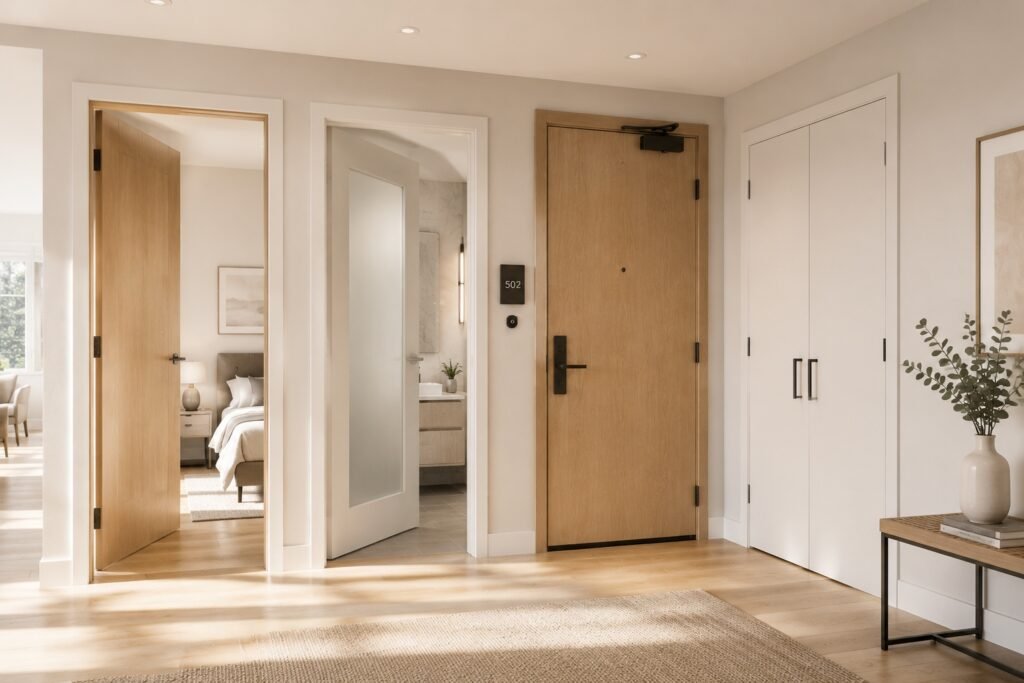
Multi-family projects involve a large number of interior openings across apartments, corridors, stairwells, utility rooms, and shared spaces. Even within one building, door requirements may vary by unit type, fire rating, hardware configuration, frame condition, or finish selection.
When these details are not standardized early, builders often face avoidable problems later in construction. Procurement teams may order inconsistent products. Installers may encounter frame mismatches or incorrect swing directions. Project managers may deal with delivery delays, missing hardware, or revised schedules that affect multiple trades.
Unlike smaller residential projects, multi-family developments operate at scale. A single mistake repeated across dozens or hundreds of units can create major cost and scheduling impacts.
That is why many builders now treat interior door packages as part of early preconstruction coordination rather than a simple material purchase.
What Should Be Standardized in a Multi-Family Door Package?
Early standardization helps create consistency across procurement, fabrication, and installation. Builders should focus on the core components that directly affect project coordination and field execution.
| Item to Standardize | Why It Matters | Project Impact |
|---|---|---|
| Door Types and Sizes | Reduces unnecessary variations across units | Simplifies ordering and installation |
| Fire Ratings | Ensures compliance with building codes | Prevents rework and inspection issues |
| Frames and Hardware | Improves compatibility between openings and hardware | Reduces field conflicts |
| Swing Directions | Confirms installation requirements early | Avoids on-site corrections |
| Finishes and Colors | Maintains design consistency | Improves project appearance |
| Door Schedules | Aligns drawings, procurement, and installation | Supports accurate coordination |
Door Types and Sizes
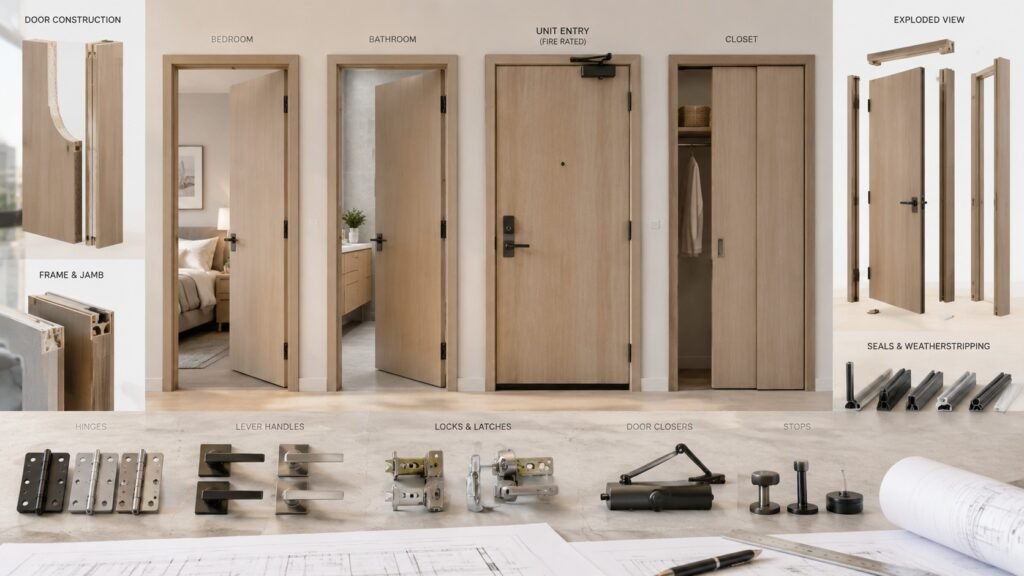
Multi-family buildings often include many door categories, such as unit entry doors, bedroom doors, bathroom doors, utility doors, corridor doors, and service room doors.
Without standardization, projects may end up with too many unique door sizes or configurations. This increases procurement complexity and creates a higher risk of ordering mistakes.
Standardizing door types and dimensions early helps simplify manufacturing, improve inventory management, and reduce installation confusion across multiple floors or buildings.
Fire Ratings and Code Requirements
Fire-rated doors are one of the most critical parts of a multi-family door package. Different openings may require different fire ratings depending on local building codes and project design.
If fire-rated requirements are identified too late, builders may face delays, failed inspections, or costly replacement orders.
Coordinating code requirements early allows project teams to align specifications, schedules, and procurement before fabrication begins.
Frames, Hardware, and Swing Directions
Door performance depends heavily on frame conditions and hardware coordination. Hinges, locks, closers, latches, and strike preparations must match both the door and the frame.
Swing direction coordination is equally important. Incorrect handing or opening direction can lead to installation delays and field modifications.
By standardizing frames, hardware sets, and swing details early, builders can reduce installation issues and improve field efficiency.
Finishes, Colors, and Door Schedules
Finishes and colors may seem like small details, but inconsistencies can become highly visible in completed apartment projects.
At the same time, the door schedule acts as the central coordination document connecting architectural drawings, quantities, hardware, ratings, and opening requirements.
A clear and updated door schedule helps suppliers, installers, and project teams work from the same information throughout the project lifecycle.
Common Problems Caused by Late Standardization
When interior door packages are not coordinated early, project teams often encounter avoidable field problems.
Common issues include:
- Door quantities that do not match updated drawings
- Incorrect swing directions
- Missing or incompatible hardware
- Fire-rated openings that were overlooked
- Frame sizes that do not match wall conditions
- Delivery sequences that do not align with installation phases
- Excessive product variations across units
- Last-minute change orders during installation
These issues can slow down construction and increase labor costs. In multi-family projects, repeated errors across multiple units can quickly multiply into major coordination problems.
Late standardization also affects communication between architects, suppliers, contractors, and installers. If every team works from different versions of schedules or drawings, project execution becomes much more difficult.
Why Drawing Takeoff Is Critical for Door Packages
Accurate drawing takeoff plays a major role in successful multi-family door procurement.
In large apartment projects, door schedules and architectural drawings often evolve throughout the design and construction process. Unit layouts may change, opening sizes may be revised, and hardware requirements may be updated multiple times before final approval.
Without a detailed drawing review, builders risk ordering incorrect quantities or overlooking important specification changes.
A proper door takeoff helps project teams verify:
- Door quantities by floor or unit type
- Opening dimensions
- Fire-rated requirements
- Hardware coordination
- Frame conditions
- Swing directions
- Schedule consistency across drawing sets
This process becomes especially important in multi-family developments where a small discrepancy can affect a large number of units.
Drawing-based coordination also supports better budgeting and procurement planning. By identifying potential conflicts early, builders can reduce ordering errors, avoid unnecessary material waste, and improve project scheduling accuracy.
How Coordinated Door Packages Improve Construction Efficiency
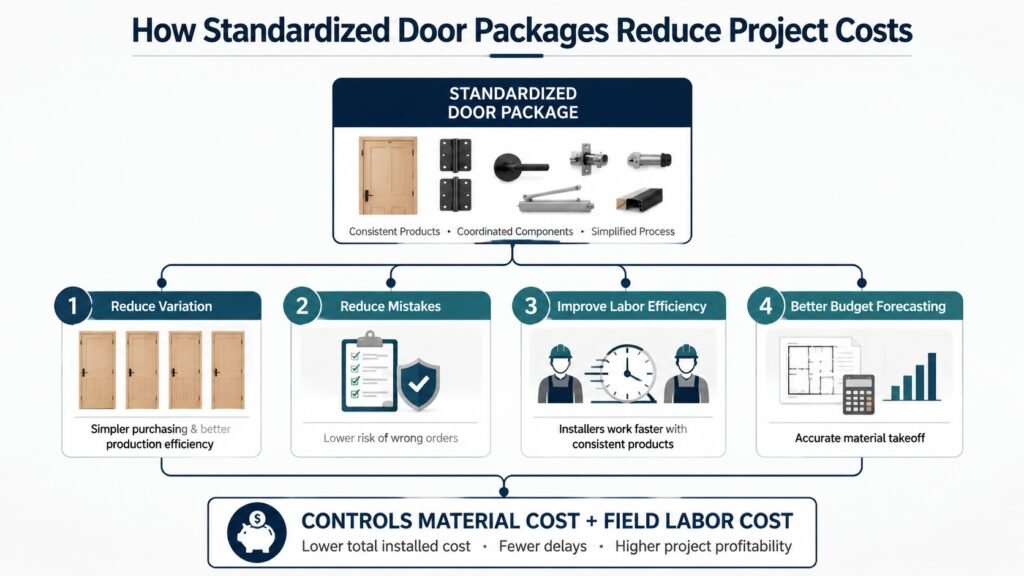
A coordinated interior door package does more than organize products. It improves overall construction efficiency across procurement, scheduling, installation, and project management.
When door packages are standardized and coordinated early, builders can benefit from:
Faster Procurement Coordination
Clear specifications and schedules help suppliers prepare quotations, approvals, and production timelines more efficiently. Fewer clarification requests mean fewer procurement delays.
Improved Installation Accuracy
Installers work more efficiently when door types, hardware sets, and swing directions are clearly organized and labeled. Consistency across units reduces field confusion and minimizes installation mistakes.
Better Schedule Management
Coordinated door packages help align material deliveries with project phases. Builders can better plan installation sequencing by floor, unit type, or building section.
Reduced Change Orders and RFIs
Many field issues come from unclear schedules or mismatched specifications. Early coordination helps reduce RFIs, redesigns, and last-minute corrections during construction.
Lower Labor and Material Waste
Standardized door packages reduce unnecessary product variations and help simplify inventory management. This improves labor productivity while reducing material waste and replacement costs.
In large-scale multi-family projects, these operational improvements can significantly impact overall project performance.
Why Work With a Door Package Supplier That Can Read Drawings?
For multi-family projects, builders often need more than a supplier that simply provides product pricing. They need a partner that understands construction drawings, door schedules, and project coordination requirements.
A supplier with drawing review capabilities can help identify inconsistencies, verify quantities, and support procurement planning before production begins.
At UWG, we support builders and contractors by helping break down architectural drawings for interior door packages. Our team reviews door schedules, floor plans, and opening details to help identify door quantities, door types, frame conditions, hardware coordination requirements, and potential specification conflicts.
This drawing-based coordination process helps improve procurement accuracy and supports smoother project execution across multi-family developments.
Our support may include:
- Door quantity takeoffs from architectural drawings
- Door schedule review and coordination
- Verification of fire-rated openings
- Hardware and frame coordination support
- Multi-floor and multi-unit quantity analysis
- Identification of specification inconsistencies
- Procurement planning support
By reviewing drawings before ordering begins, builders can gain a clearer understanding of the full interior door package and reduce the risk of costly surprises later in construction.

Frequently Asked Questions About Multi-Family Interior Door Packages
Q: Why is early standardization of interior door packages so critical for multi-family construction?
A: Multi-family developments involve hundreds of interior openings across various unit layouts, corridors, and utility zones. Without early standardization, a project accumulates an unmanageable variety of unique door sizes and hardware preps. A single uncoordinated detail can replicate into dozens of costly field mistakes, resulting in severe scheduling delays, trade friction, and expensive change orders during the installation phase.
Q: What specific components should procurement teams standardize during the preconstruction phase?
A: Teams should establish rigid standards for core opening parameters. This includes consolidating door dimensional matrices, identifying fire-rated code requirements for unit entries or utility shafts early, aligning jamb widths with structural wall types, and pre-configuring unified hardware sets (hinges, latches, locks, and closers) alongside confirmed opening swing directions.
Q: How does late-stage door package planning impact project compliance and inspections?
A: Delayed coordination frequently leads to code compliance issues, particularly regarding fire-rated door openings and ADA accessibility clearances. If fire door leaf specifications, labeled jamb frames, and compatible self-closing hardware are not synchronized prior to manufacturing, the project risks failed local building inspections, expensive structural rework, and delayed occupancy handovers.
Q: What operational value does a drawing-ready supplier like M4B bring to general contractors?
A: M4B does not just supply materials; we function as an extension of your preconstruction engineering team. Our experts perform meticulous drawing-based takeoffs directly from your architectural blueprints and door schedules. By auditing dimensions, cross-checking swing handings, and catching hardware specification conflicts before factory production starts, M4B eliminates the friction that causes field modifications.
Conclusion
Early standardization is essential for successful multi-family interior door packages. Builders who coordinate door types, fire ratings, hardware, schedules, and drawing takeoffs early can improve procurement efficiency, reduce installation issues, and maintain better control over project timelines and costs.
As multi-family construction becomes more complex, coordinated door package planning is no longer optional — it is a critical part of efficient project delivery.
Articles that you may be interested in:
What to Consider When Choosing Hardware for High-Use Interior Doors
Why Shaker Interior Doors Still Dominate New Home Projects