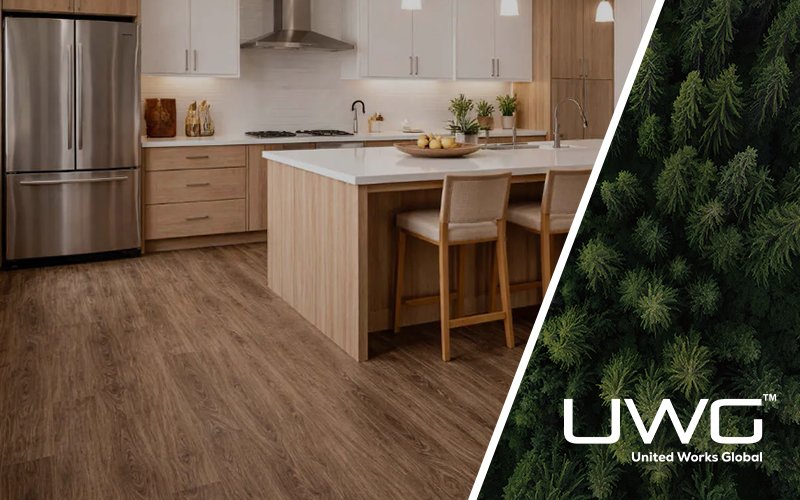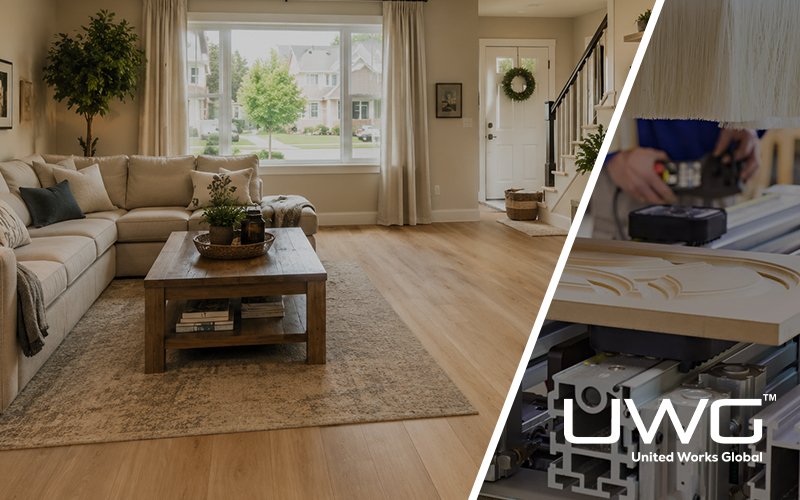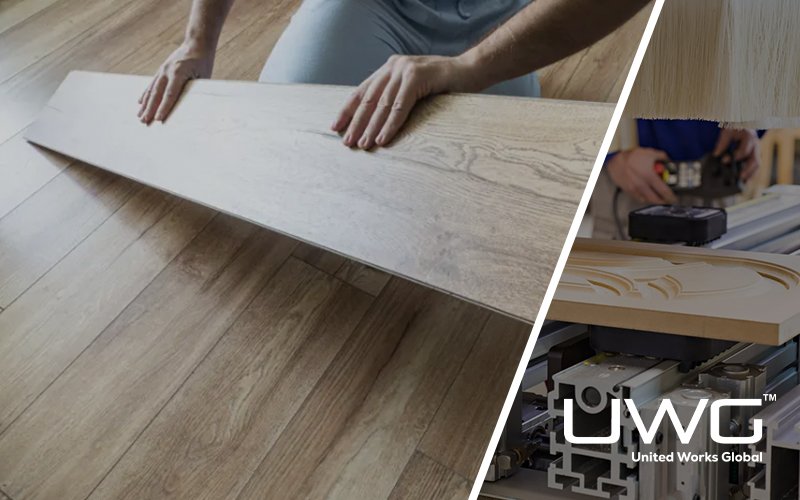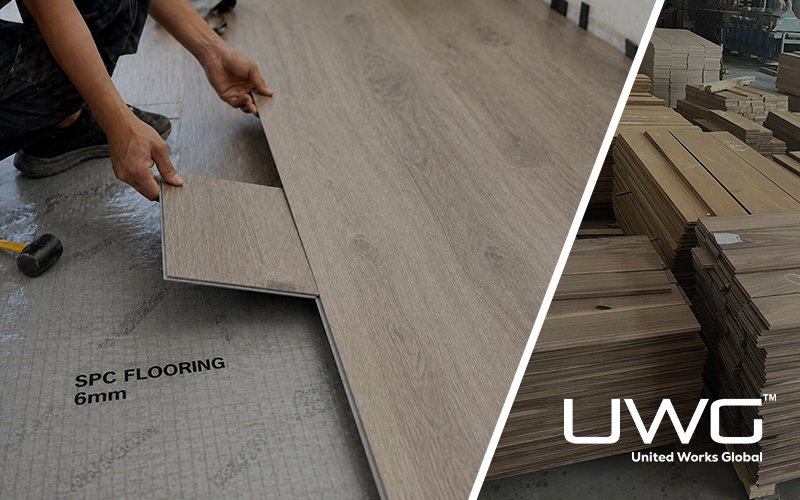

The main types of flooring used in construction include vinyl flooring, laminate, engineered hardwood, solid hardwood, tile, natural stone, carpet and concrete.
There is no single flooring material that is best for every project. The right option depends on moisture exposure, foot traffic, subfloor conditions, installation method, acoustic requirements, maintenance expectations, design goals and total installed cost.
For many residential, multifamily, hospitality and commercial projects, the decision eventually comes down to three practical categories:
- SPC flooring for rigid-core construction, moisture resistance and efficient floating installation
- Laminate flooring for cost control, consistent wood-look designs and click-lock installation
- Engineered hardwood flooring for a real-wood surface and premium appearance
LVP and LVT are also common vinyl flooring formats and may be considered for selected glue-down, renovation and commercial applications. However, this guide focuses primarily on SPC, laminate and engineered hardwood—the three flooring categories most relevant to UWG’s project supply.
Common Types of Flooring and Their Material Composition
Flooring can be classified by its surface material, core construction and installation method. Understanding these differences helps builders and project buyers compare appearance, performance and total installed cost.
| Flooring type | Basic construction | Main advantages | Important limitations | Common applications |
|---|---|---|---|---|
| SPC flooring | Vinyl surface layers over a rigid stone-plastic composite core | Moisture-resistant core, rigid construction, efficient click-lock installation and straightforward maintenance | Requires adequate subfloor flatness; performance depends on the wear layer, locking system and installation | Multifamily units, rentals, kitchens, basements and light-commercial projects |
| LVP/LVT flooring | Flexible, semi-rigid or rigid vinyl construction in plank or tile formats | Broad design selection, moisture resistance and multiple installation options | Quality varies by wear layer, core, adhesive and usage classification | Apartments, retail, hospitality, offices and renovations |
| Laminate flooring | Protective wear layer and printed décor over an HDF core | Consistent appearance, competitive cost and efficient floating installation | Standard products can be damaged by prolonged water exposure and generally cannot be refinished | Bedrooms, living spaces, apartments and dry residential interiors |
| Engineered hardwood | Real hardwood veneer over a plywood or engineered core | Authentic wood surface and improved dimensional stability compared with many solid-wood products | Higher cost; standing water may cause damage; refinishing depends on veneer thickness | Single-family homes, townhomes, premium apartments and hospitality |
| Solid hardwood | One solid piece of natural timber | Natural appearance and potential for repeated refinishing | Sensitive to moisture and environmental movement; more demanding installation | Premium residential living areas and bedrooms |
| Ceramic or porcelain tile | Fired ceramic or porcelain units installed with mortar and grout | Strong moisture and wear performance with many design options | Hard underfoot; substrate preparation and installation are labor-intensive | Bathrooms, kitchens, entrances and commercial areas |
| Natural stone | Cut stone such as marble, granite, slate or travertine | Distinctive natural appearance and long service potential | Higher material and installation cost; some materials require sealing | Luxury residential and hospitality projects |
| Carpet | Textile surface installed over backing or cushion | Comfort, warmth and sound absorption | More demanding stain, moisture and cleaning requirements | Bedrooms, offices and hospitality spaces |
| Concrete or terrazzo | Cementitious surface, sometimes containing decorative aggregate | Suitable for large spaces and heavy traffic when properly designed | Hard surface; cracking, polishing and acoustic performance require planning | Commercial, retail, institutional and industrial buildings |
| Cork or bamboo | Plant-derived flooring products manufactured as tiles or planks | Distinct appearance and potential sustainability advantages | Performance varies by construction, finish, sourcing and maintenance | Residential interiors and sustainability-focused projects |
This overview is only a starting point. Final selection should be based on the actual product specification, intended use, subfloor, installation instructions and warranty.
How Are the Most Common Flooring Types Constructed?
Products that look similar on the surface may have completely different core materials, moisture performance and installation requirements. Understanding their construction helps buyers compare quotations accurately.
SPC Flooring
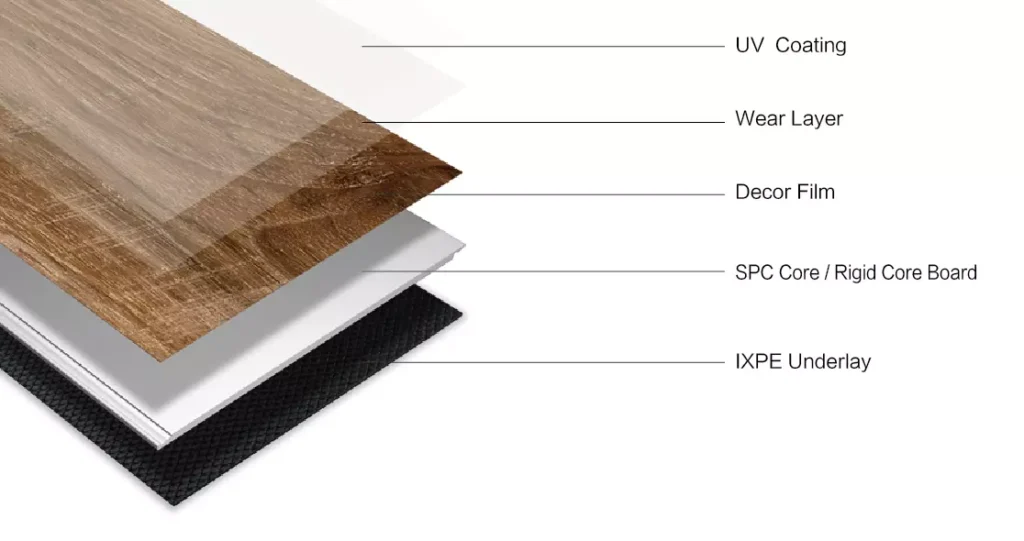
SPC stands for stone plastic composite or stone polymer composite. It is a rigid-core category within the broader vinyl flooring family.
A typical SPC plank contains:
- A protective UV coating
- A transparent wear layer
- A printed decorative film
- A rigid SPC core
- An attached IXPE or EVA pad, when included
The SPC core usually combines calcium carbonate, PVC and stabilizing ingredients. This creates a dense and rigid plank that is commonly used with a click-lock installation system.
Advantages of SPC Flooring
- Moisture-resistant rigid core
- Efficient floating installation
- Consistent wood- or stone-look designs
- Straightforward routine maintenance
- Suitable for repeated unit layouts
- Available with attached acoustic underlayment
- Good dimensional stability when properly specified and installed
Points to Confirm Before Purchasing SPC
- Total plank thickness
- Wear-layer thickness
- Core density
- Locking-system design
- Attached-pad material and thickness
- IIC and STC test results where required
- Commercial-use classification
- Subfloor flatness requirements
- Expansion and transition requirements
- Warranty limitations
A waterproof SPC core does not make the entire floor assembly or room waterproof. Water may still pass through damaged joints, perimeter gaps or service penetrations and reach the subfloor.
SPC belongs to the broader vinyl flooring category. Unlike many flexible glue-down LVP/LVT products, SPC uses a dense rigid core and is commonly installed as a floating click-lock floor.
Read the complete guide to what SPC flooring is before confirming product specifications.
Laminate Flooring
Laminate flooring is an engineered, wood-look product built around a high-density fiberboard core.
A typical laminate plank contains:
- A transparent protective wear layer
- A printed decorative layer
- A high-density fiberboard core
- A backing or balancing layer
- An attached underlayment on selected products
The decorative layer can reproduce wood, stone or other materials. Embossed textures may be added to create a more realistic surface.
Advantages of Laminate Flooring
- Competitive material cost
- Consistent wood-look designs
- Good surface wear performance when properly rated
- Efficient click-lock installation
- Broad range of colors and textures
- Suitable for repeatable residential layouts
Points to Confirm Before Purchasing Laminate
- AC or equivalent wear rating
- HDF core density
- Total plank thickness
- Edge-sealing construction
- Standard, water-resistant or waterproof classification
- Locking-system quality
- Attached-pad construction
- Residential or commercial warranty
- Expansion requirements
- Replacement-stock availability
Standard laminate flooring should not be described as waterproof. Some laminate products are manufactured with more moisture-resistant cores, sealed edges and protected locking joints, but the product documentation and applicable test method must be checked.
For a focused comparison, see SPC vs. laminate flooring.
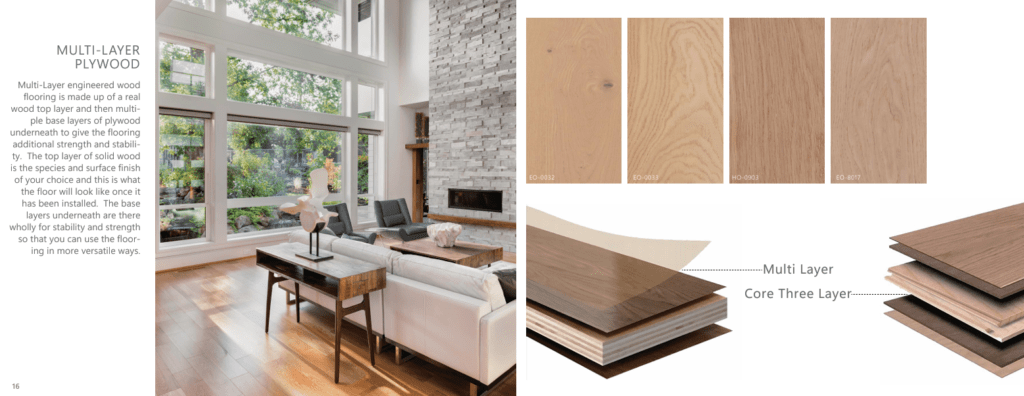
Engineered Hardwood Flooring
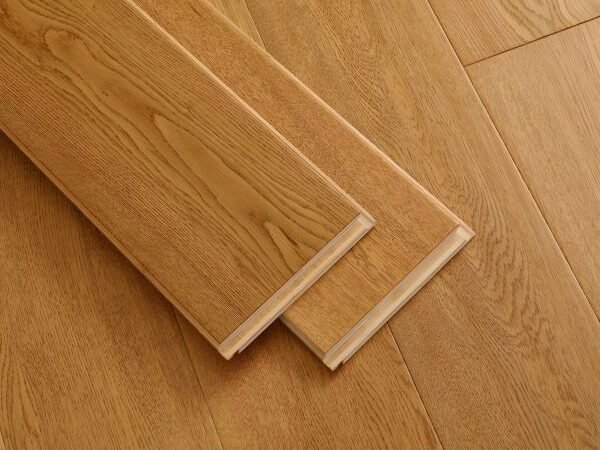
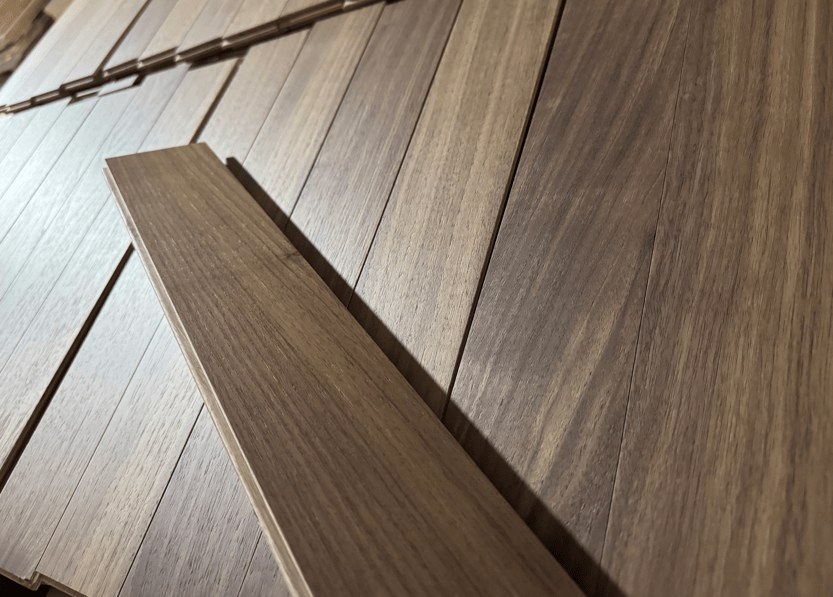
Engineered hardwood flooring has a real hardwood surface bonded to a multi-layer plywood or engineered core.
Its typical construction includes:
- A factory-applied surface finish
- A real hardwood veneer
- A cross-layered plywood or engineered core
- A balancing layer
Because the core layers are arranged in different directions, engineered hardwood generally offers better dimensional stability than comparable solid hardwood flooring. It still contains real wood and must be protected from excessive moisture and uncontrolled environmental conditions.
Advantages of Engineered Hardwood
- Genuine wood surface
- Natural variation in grain and color
- Premium residential appearance
- Better dimensional stability than many solid-wood products
- Floating, glue-down or nail-down options, depending on the product
- Some products can be refinished
Points to Confirm Before Purchasing Engineered Hardwood
- Wood species
- Veneer thickness
- Total plank thickness
- Core construction and number of plies
- Moisture content
- Surface finish
- Grade and permitted natural variation
- Installation method
- Radiant-heating approval
- Refinishing limitations
- Indoor temperature and humidity requirements
Not every engineered hardwood floor can be sanded and refinished. Refinishing potential depends on the usable veneer thickness, surface construction and manufacturer’s instructions.
Read the detailed engineered hardwood vs. laminate flooring comparison.
LVP and LVT Flooring
LVP means luxury vinyl plank, while LVT means luxury vinyl tile.
LVP commonly uses a wood-look plank format. LVT often uses square or rectangular formats that reproduce stone, ceramic or decorative tile surfaces.
These terms mainly describe product format rather than one specific core construction. LVP and LVT may use flexible, semi-rigid or rigid cores. SPC is a rigid-core vinyl flooring and may also be described as rigid-core LVP when it uses a wood-look plank format.
Flexible glue-down LVP/LVT may be considered for commercial spaces, renovations and projects where a lower finished-floor height or localized plank replacement is important.
Buyers should confirm:
- Wear-layer thickness
- Total product thickness
- Flexible or rigid-core construction
- Glue-down or click-lock installation
- Adhesive requirements
- Dimensional stability
- Rolling-load performance
- Commercial-use warranty
- Subfloor preparation requirements
For more information, read the complete guide to LVP and LVT flooring.
SPC vs. Laminate vs. Engineered Hardwood
SPC, laminate and engineered hardwood can all produce a wood-floor appearance, but they use different materials and suit different project requirements.
| Selection factor | SPC flooring | Laminate flooring | Engineered hardwood |
|---|---|---|---|
| Visible surface | Printed wood or stone design | Printed decorative design | Real hardwood veneer |
| Core | Rigid stone-plastic composite core | High-density fiberboard core | Plywood or engineered multi-layer core |
| Moisture performance | Moisture-resistant rigid core | Depends on the core and edge-sealing system | Requires moisture and humidity control |
| Common installation | Floating click-lock | Floating click-lock | Floating, glue-down or nail-down |
| Appearance | Consistent manufactured pattern | Consistent wood-look design | Natural wood grain and variation |
| Maintenance | Relatively straightforward | Straightforward in dry environments | Requires wood-appropriate maintenance |
| Repair approach | Damaged planks normally require replacement | Damaged planks normally require replacement | Local repair or refinishing may be possible |
| Budget position | Low to medium | Low to medium | Medium to high |
| Typical project fit | Multifamily, rentals, kitchens and moisture-prone interiors | Dry residential interiors and cost-controlled projects | Premium residential and hospitality projects |
Product quality varies within every category. A high-quality laminate product may outperform a low-specification SPC product in certain dry applications. Buyers should compare technical specifications instead of selecting flooring solely by category name or total thickness.
Which Flooring Type Is Best for Each Construction Project?
Multifamily and Build-to-Rent Projects
Multifamily flooring must balance installation speed, repeatable appearance, acoustic performance, maintenance and future replacement.
Common options include:
- SPC with an appropriate wear layer and acoustic pad
- Glue-down LVP for selected commercial or common-area applications
- Laminate for cost-controlled dry living spaces
- Engineered hardwood for premium units
For large developments, buyers should confirm:
- Approved sample and color range
- Production-batch consistency
- Unit-by-unit packaging requirements
- Wear-layer or AC rating
- Attached underlayment
- IIC and STC documentation
- Replacement-stock quantity
- Phased-delivery schedule
Acoustic performance must be evaluated using the complete floor-ceiling assembly. An attached pad alone does not guarantee that a project will meet its required IIC or STC value.
Single-Family Homes and Townhomes
Single-family projects normally place greater emphasis on appearance, room-to-room continuity and long-term material value.
Possible combinations include:
- Engineered hardwood in living rooms, dining rooms and bedrooms
- SPC in kitchens, lower levels and moisture-prone spaces
- Laminate in cost-controlled bedrooms and living areas
- LVP/LVT in selected laundry rooms, renovation areas or utility spaces
Before placing an order, coordinate flooring thickness with:
- Door clearances
- Stair components
- Baseboards
- Cabinets
- Appliances
- Floor transitions
- Adjacent tile
- Underfloor heating systems
Engineered hardwood may be appropriate for radiant heating only when the specific flooring and heating system are approved for use together. Maximum surface temperature and installation method must be confirmed.
Apartments and Rental Properties
SPC and laminate are commonly considered for apartments and rental properties because they can provide consistent wood-look designs and efficient floating installation.
Choose SPC when the project prioritizes:
- Moisture-resistant core construction
- Floating click-lock installation
- Standardized plank dimensions
- Straightforward routine maintenance
- Replacement of damaged planks
- Repeatable specifications across multiple units
Choose laminate when:
- The space is primarily dry
- Material cost is a leading consideration
- A convincing wood-look surface is required
- The selected wear rating matches expected traffic
- Prolonged water exposure is not expected
Glue-down LVP may be considered in areas where a lower profile or localized plank replacement is important, but it should remain a project-specific alternative rather than the default recommendation.
High-Traffic Commercial Areas
Commercial flooring should be selected according to actual operating conditions rather than broad descriptions such as “highly durable.”
Project teams should evaluate:
- Daily foot traffic
- Entrance grit and dirt
- Rolling loads
- Furniture movement
- Cleaning chemicals
- Cleaning equipment
- Slip-resistance requirements
- Downtime available for installation
- Localized repair strategy
- Commercial warranty
- Replacement-stock availability
Commercially rated SPC or LVT may be suitable for some commercial applications. Porcelain tile, terrazzo and polished concrete may be more appropriate in other environments.
A residential flooring product should not be assumed suitable for commercial use simply because it has a thick plank. Wear-layer performance, use classification, locking-system strength and warranty must all be verified.
Read the detailed guide to flooring for high-traffic areas.
Luxury Residential and Hospitality Projects
Engineered hardwood is commonly selected when natural wood appearance is central to the design.
Selection should consider:
- Wood species
- Grade and natural variation
- Veneer thickness
- Plank width and length
- Surface texture
- Sheen level
- Finish repairability
- Replacement availability
- Moisture control
- Indoor humidity
- Coordination with stairs and architectural trims
A higher material price does not automatically mean that a flooring product is better suited to the project. Performance must still match the environment, maintenance plan and installation conditions.
What Flooring Is Best for Each Room?
| Room or area | Common flooring options | Main considerations |
|---|---|---|
| Living room | Engineered hardwood, laminate, SPC or LVP | Appearance, comfort, traffic and room-to-room continuity |
| Bedroom | Engineered hardwood, laminate, LVP or carpet | Comfort, acoustics and maintenance |
| Kitchen | SPC, LVP/LVT, porcelain tile or approved engineered hardwood | Spills, cleaning, joints and slip resistance |
| Bathroom | Porcelain tile or specifically approved resilient flooring | Water management, substrate protection and slip resistance |
| Basement | SPC, LVP/LVT or tile | Concrete moisture, vapor control and floor height |
| Hallway and entry | SPC, commercial LVP/LVT, tile or rated laminate | Abrasion, dirt and concentrated traffic |
| Multifamily unit | SPC, laminate or engineered hardwood | Acoustics, replacement stock and installation efficiency |
| Retail or office | Commercial LVT, SPC, carpet tile, tile or concrete | Traffic, rolling loads, downtime and localized replacement |
| Premium residence | Engineered hardwood, solid hardwood or natural stone | Natural appearance, finish and long-term care |
Which Flooring Is Easiest to Install?
The installation method affects labor requirements, construction schedules, subfloor preparation and long-term flooring performance.
The three principal flooring installation methods are floating, glue-down and nail-down.
Floating Installation
In a floating installation, the planks connect to each other but are not individually attached to the subfloor.
Common floating-floor products include:
- SPC
- Laminate
- Selected engineered hardwood
- Selected click-lock LVP
Floating installation can reduce adhesive and fastening steps, but it still requires correct expansion space, transition planning and subfloor preparation.
Glue-Down Installation
In a glue-down installation, adhesive bonds the flooring directly to the prepared substrate.
Common glue-down products include:
- Flexible LVP
- LVT
- Selected engineered hardwood
- Selected commercial flooring systems
Glue-down installation can provide a lower finished-floor profile and a firm underfoot response. Adhesive selection, substrate porosity, moisture testing and curing conditions must be controlled.
Nail-Down or Staple-Down Installation
Mechanical fasteners secure compatible wood flooring to an approved wood subfloor.
This method is mainly used for:
- Solid hardwood
- Selected engineered hardwood
All flooring systems require the subfloor to meet the manufacturer’s requirements for:
- Flatness
- Cleanliness
- Structural stability
- Moisture
- Surface strength
- Height transitions
SPC should not be described as requiring a “perfectly level” subfloor while laminate is described as more forgiving. Both products require a sufficiently flat and stable substrate. A rigid plank cannot compensate for major dips, humps or movement underneath it.
Use the complete flooring installation methods guide for detailed project planning.
Seven Factors to Consider When Choosing Flooring
1. Moisture Exposure
Evaluate:
- Concrete slab moisture
- Indoor humidity
- Wet-area exposure
- Cleaning procedures
- Possible plumbing leaks
- Exterior water entry
Do not rely solely on marketing terms such as “waterproof.” A waterproof core does not automatically protect the subfloor or surrounding construction.
2. Traffic and Surface Wear
Consider:
- Daily foot traffic
- Pets
- Furniture movement
- Rolling loads
- Entrance dirt
- Cleaning frequency
For SPC and LVP/LVT, inspect the wear layer and commercial-use classification. For laminate, verify its applicable AC or equivalent wear rating.
3. Subfloor Conditions
Confirm whether the substrate is:
- Concrete
- Plywood
- OSB
- Existing tile
- Another finished floor
Check flatness, moisture, cracks, surface strength and structural movement before selecting the product and installation method.
4. Installation Method
Determine whether the project requires:
- Floating installation
- Glue-down installation
- Nail-down installation
- Staple-down installation
Labor availability, project schedule, floor height, acoustic requirements and future repairs may affect the decision.
5. Acoustic Performance
For multifamily and hospitality projects, evaluate the complete floor-ceiling assembly.
Request relevant test reports and confirm:
- IIC performance
- STC performance
- Underlayment type
- Concrete slab thickness
- Ceiling assembly
- Test method and assembly configuration
Do not assume that the attached pad alone will produce the same acoustic result in every building.
6. Maintenance and Replacement
Consider how the floor will be:
- Cleaned
- Repaired
- Refinished
- Replaced
- Restocked
Large projects should retain attic stock or establish a replenishment plan for future unit repairs. Product color, texture and locking profiles may change between production batches.
7. Total Installed Cost
Do not compare products using material price alone.
Include:
- Subfloor preparation
- Moisture mitigation
- Underlayment
- Adhesive or fasteners
- Transitions and trims
- Installation labor
- Material waste
- Freight
- Maintenance
- Future replacement
A lower-priced flooring product may produce a higher total installed cost if it requires extensive preparation or frequent replacement.
Flooring Specification Checklist Before Requesting a Quote
Before requesting an RFQ, confirm:
- Project type
- Installation area
- Total square footage
- Waste allowance
- Room and traffic classification
- Subfloor material
- Subfloor flatness
- Moisture-test results
- Required installation method
- Total plank thickness
- Wear-layer thickness or laminate wear rating
- Core construction
- Attached-pad requirements
- Acoustic requirements
- Slip-resistance requirements
- Plank dimensions
- Surface color and texture
- Transition profiles
- Stair components
- Certification requirements
- Packaging requirements
- Delivery schedule
- Replacement-stock plan
For SPC projects, use the more detailed SPC flooring specification checklist.
Frequently Asked Questions About Flooring Types
What are the main types of flooring?
The main flooring types include SPC, LVP/LVT, laminate, engineered hardwood, solid hardwood, ceramic and porcelain tile, natural stone, carpet, concrete, terrazzo, cork and bamboo. The right option depends on moisture, traffic, installation, maintenance and budget.
What are the three main flooring types supplied by UWG?
UWG’s primary project flooring categories are SPC, laminate and engineered hardwood. These products cover moisture-resistant rigid-core applications, cost-controlled wood-look interiors and premium real-wood projects. LVP/LVT is also available for selected applications but is not the main focus of this guide.
What is the difference between SPC and LVP/LVT?
SPC is a rigid-core form of vinyl flooring, while LVP and LVT describe vinyl products in plank or tile formats. Some LVP/LVT products are flexible and installed with adhesive, while SPC normally uses a rigid core and click-lock floating installation.
Is SPC better than laminate?
SPC generally provides a more moisture-tolerant core. Laminate can provide competitive pricing and convincing wood-look surfaces for dry interiors. The better choice depends on moisture exposure, surface wear, installation requirements and budget.
Is engineered hardwood real wood?
Yes. Engineered hardwood uses a real hardwood veneer bonded to a multi-layer structural core. Laminate uses a printed decorative layer rather than a real-wood surface.
Which flooring is best for multifamily projects?
SPC is frequently considered for multifamily projects because of its rigid construction, moisture-resistant core and installation efficiency. Laminate may suit cost-controlled dry interiors, while engineered hardwood may be selected for premium units. Acoustic performance and replacement-stock planning should also be considered.
What flooring is best for high-traffic areas?
Commercially rated SPC or LVT, porcelain tile, terrazzo and polished concrete are common high-traffic options. The correct choice depends on actual traffic, rolling loads, maintenance procedures, installation and commercial warranty.
Can flooring be installed over concrete?
SPC, laminate, glue-down LVP/LVT and selected engineered hardwood products can be installed over properly prepared concrete. Moisture testing, flatness correction and an appropriate vapor-control system may be required.
Which flooring works with radiant heating?
Selected engineered hardwood, laminate, SPC, LVP/LVT and tile products may be approved for radiant heating. Compatibility, maximum surface temperature and installation method must be confirmed with the flooring and heating-system manufacturers.
Is waterproof flooring completely waterproof?
A waterproof or moisture-resistant plank does not make the entire floor assembly or room waterproof. Water can still reach the subfloor through perimeter gaps, damaged joints, penetrations or incorrect installation.
Choose the Right Flooring for Your Project
Choosing the right flooring requires more than comparing color and unit price. The product must match the project’s moisture exposure, traffic, subfloor, installation schedule, acoustic requirements, maintenance plan and total budget.
As a practical starting point:
- Choose SPC flooring when a moisture-resistant rigid core and floating click-lock installation are priorities.
- Choose laminate flooring for dry interiors where value and consistent wood-look design are central.
- Choose engineered hardwood flooring when a real-wood surface and premium appearance justify additional specification and maintenance requirements.
- Consider LVP/LVT for selected glue-down, renovation or commercial applications where a low profile or localized replacement is important.
Explore UWG’s SPC, laminate and engineered hardwood flooring solutions, or submit your floor plan, finish schedule, quantity and project requirements for specification matching and a project quotation.
Choosing the right flooring means understanding each material’s purpose. From SPC’s waterproof durability to hardwood’s timeless elegance, each option has its place. Match design, function, and budget—and always install with care. Want lasting results? Choose smart, install right, and let the floor speak for your work.ations.