Barn doors are often chosen because they save swing space and create a distinctive interior feature, but for builders, the more important question is whether the opening and surrounding wall actually suit a surface-mounted sliding system.
A barn door that works well for a closet, pantry, or laundry room may not be the best choice for a bedroom, bathroom, or office where privacy and sound control matter more. Wall clearance, door size and weight, track capacity, structural backing, trim, and nearby electrical or cabinetry all affect whether the system will work properly.
This guide explains how barn doors work, where they are commonly used, their main benefits and limitations, and when a hinged or pocket door may be a better option.
What Is a Barn Door?
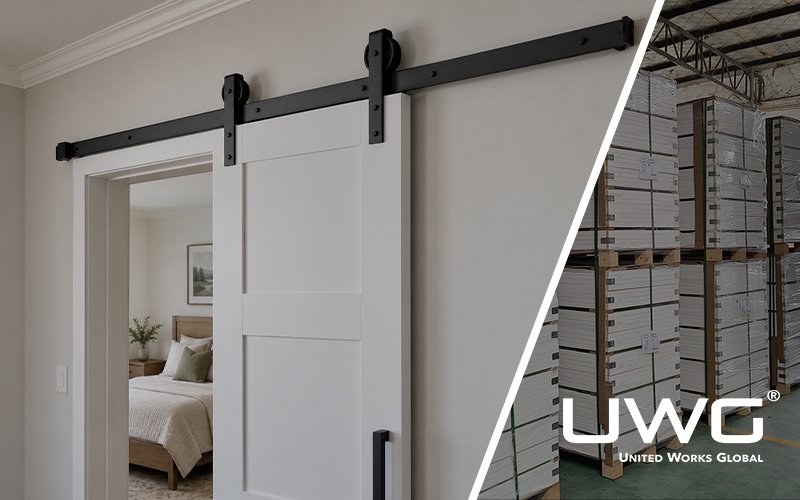
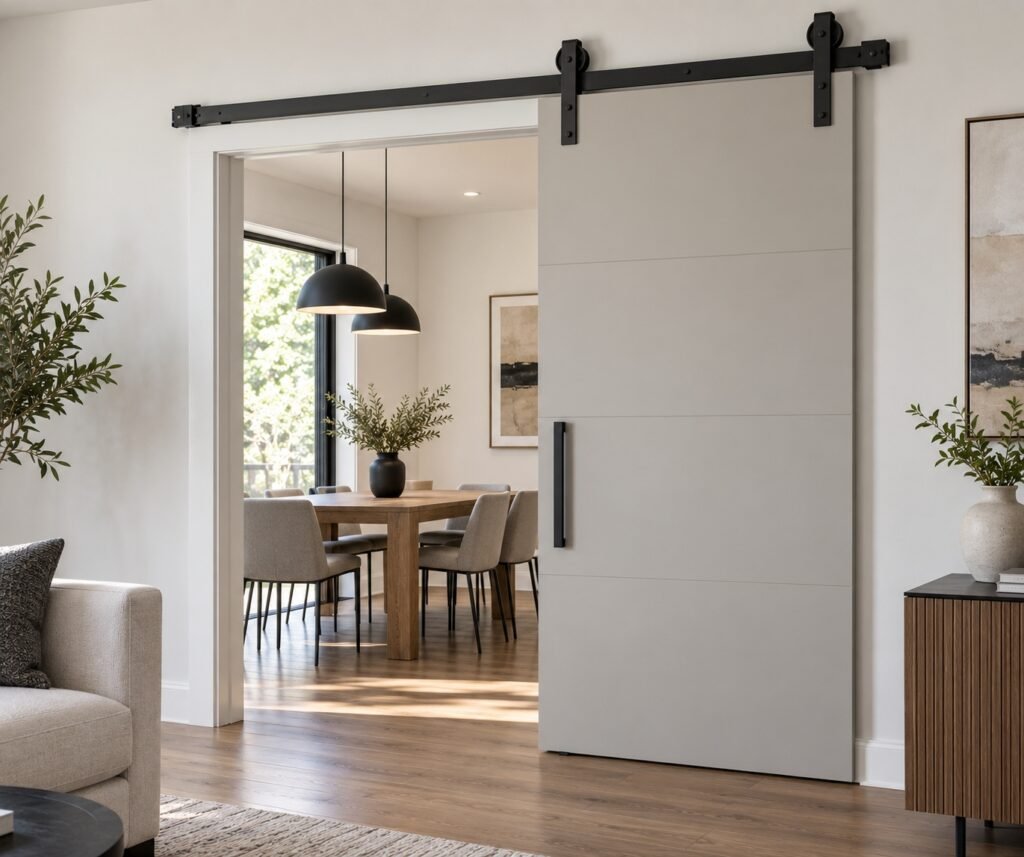
A barn door is a sliding door system in which the door panel hangs from rollers connected to a horizontal track installed above the opening. When the door opens, the panel moves across the face of the wall rather than swinging into the room or disappearing inside a wall cavity.
Although barn doors were originally used in agricultural buildings, today’s residential barn doors are available in a wide range of designs. Door options for barn door systems include:
- Shaker Door
- PVC Door
- Melamine Door
- Natural Veneer Door
- Engineered Veneer Door
A barn door is considered a complete door system.The panel, track, rollers, floor guide, stops, fasteners, wall structure, and available clearance all affect how the finished door performs.
How Does a Barn Door Work?
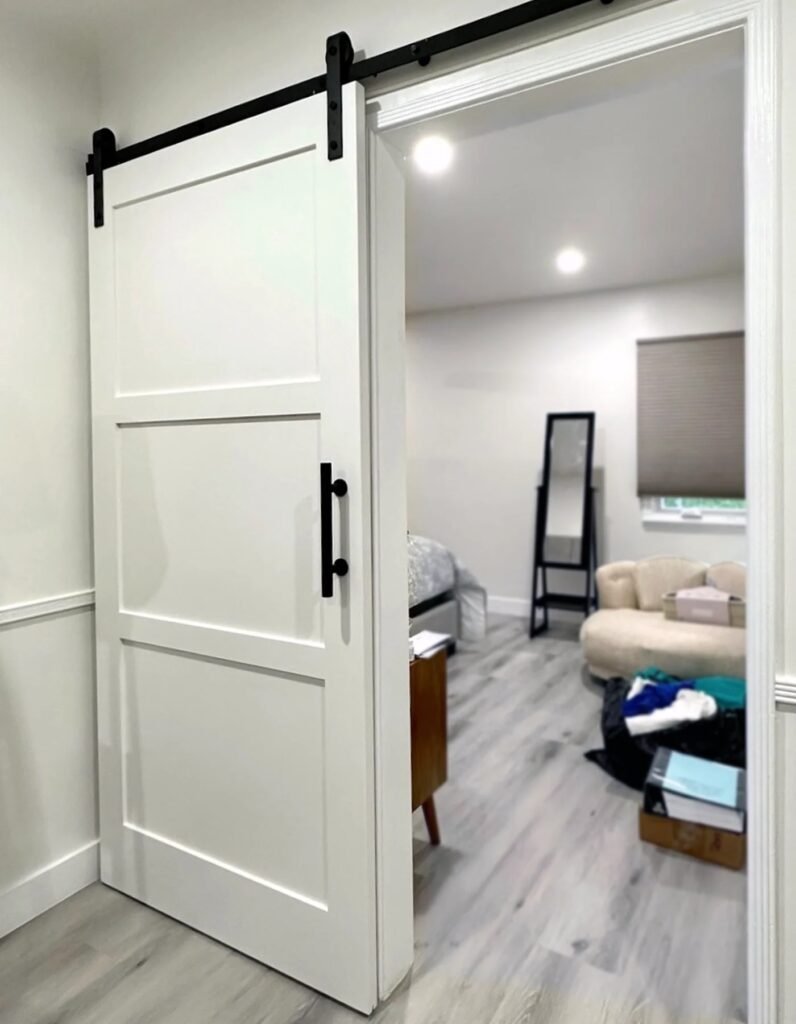
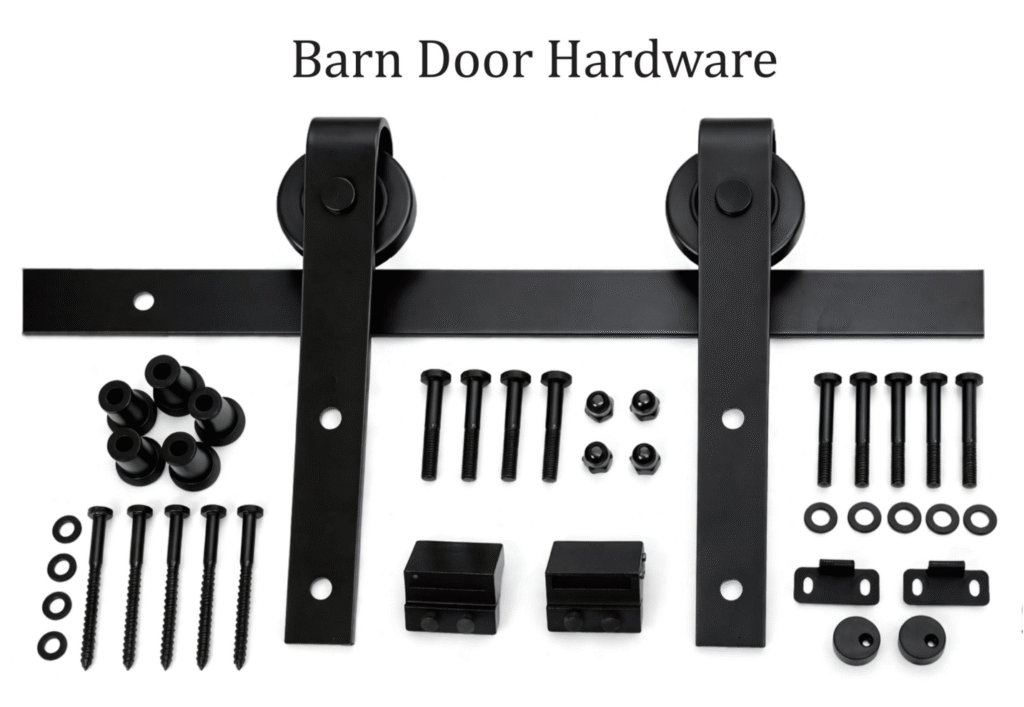
A typical barn door system consists of a door slab, overhead track, rollers or hangers, floor guide, door stops, anti-jump devices, and mounting hardware.
The rollers support the weight of the door and travel horizontally along the track. A floor guide keeps the bottom of the door aligned and prevents the panel from swinging away from the wall.
The track must be long enough for the panel to move completely away from the opening. The wall or structural support behind the track must also be strong enough to support the weight of the door and hardware.
This becomes particularly important with oversized or solid-core barn doors. A heavier door requires suitable track capacity, stronger mounting hardware, and proper structural backing.
Barn Door vs. a Regular Hinged Door
The main difference is how the two doors use space.
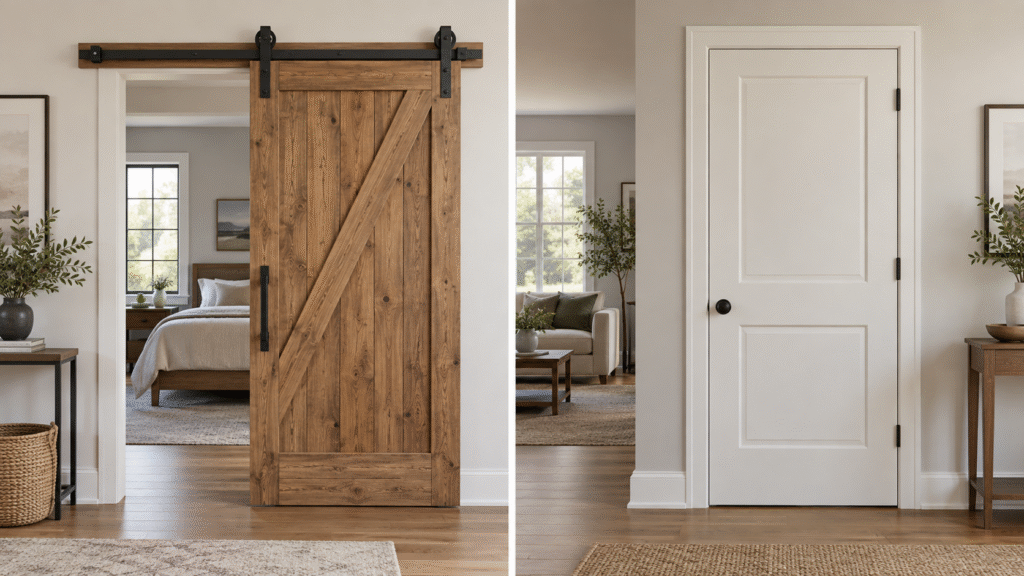
A conventional hinged door requires a clear swing area in front of or behind the doorway. A barn door eliminates that swing radius because the panel moves horizontally along the wall.
However, a barn door requires clear wall space beside the opening.
Another important difference is sealing. A hinged door closes within a jamb and against door stops, which provides better perimeter sealing. A barn door normally overlaps the opening while remaining slightly away from the wall.
For this reason, barn doors generally provide less sound control, privacy, and air sealing than properly installed hinged doors.
Where Are Barn Doors Commonly Used?
Barn doors are most useful when their sliding operation solves a specific layout or space problem.
| Application | Why It Works | Main Limitation |
|---|---|---|
| Closet | Eliminates door swing in tight rooms | Wall beside the opening must remain clear |
| Pantry | Easy access without blocking kitchen circulation | Lower air and odor sealing |
| Laundry Room | Useful where appliances reduce available floor space | Limited noise isolation |
| Home Office | Can cover a relatively wide opening | Less acoustic privacy |
| Bedroom | Saves swing space and adds visual interest | Privacy and sound control require consideration |
| Bathroom | Useful in compact layouts | Perimeter gaps can reduce privacy |
| Wide Interior Opening | Large or paired panels can cover wide openings | Heavier doors require stronger hardware |
For builders, the strongest applications are usually spaces where eliminating the swing radius creates a meaningful improvement in the floor plan without creating privacy or wall-clearance problems.
What Are the Main Benefits and Limitations of Barn Doors?
Barn doors offer several practical advantages, but most of those advantages come with a corresponding limitation. Looking at both sides together helps builders determine whether the system actually fits the project.
No Swing Clearance, but Clear Wall Space Is Required
One of the main reasons to specify a barn door is to eliminate the floor area required by a conventional door swing.
This can be particularly useful in compact bedrooms, closets, pantries, laundry rooms, or other areas where cabinetry, furniture, or appliances compete for usable space.
However, the space requirement does not disappear entirely.
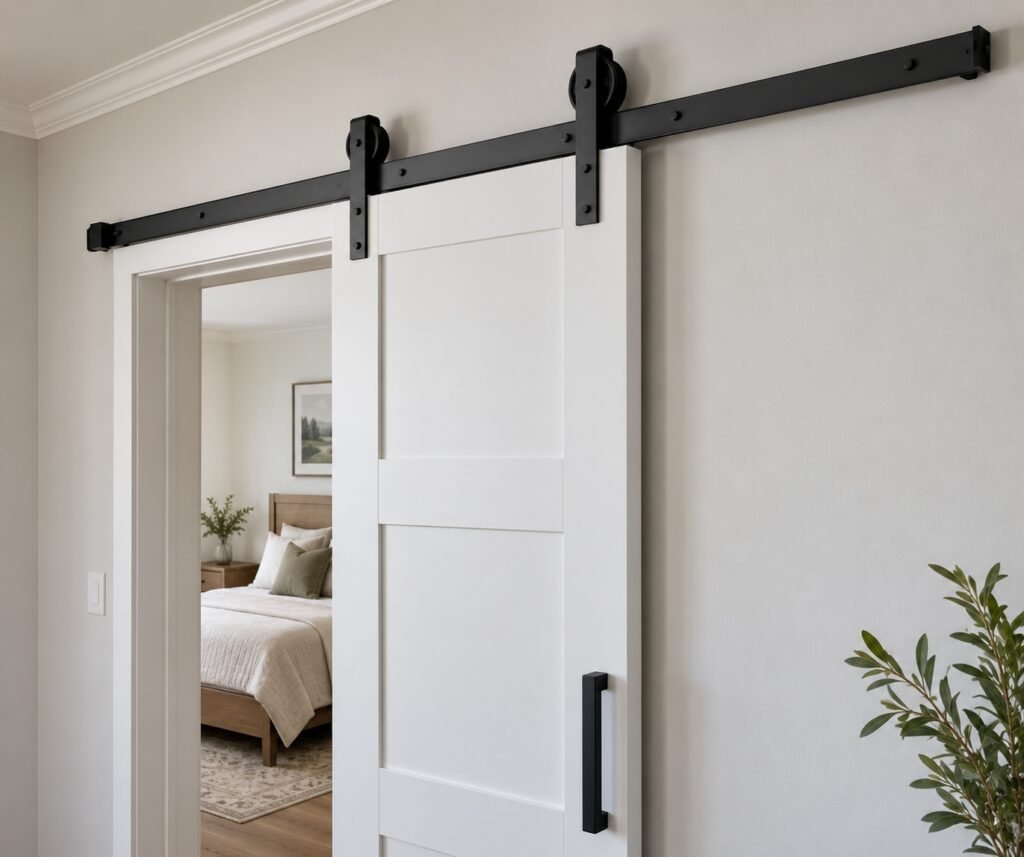
The wall beside the doorway needs to remain clear enough for the panel to slide into the open position. Light switches, outlets, artwork, shelving, cabinets, thermostats, and other wall-mounted elements can interfere with the door.
For builders, this means barn door locations should be coordinated with electrical, cabinetry, trim, and interior layouts early in the project.
Easier Retrofit, but the Door Remains on the Wall Surface
Barn doors can also work well in renovation projects because most of the system is mounted on the wall surface.
Unlike a pocket door, there is generally no need to open the wall and create an internal cavity for the door panel.
This can reduce framing modifications and simplify certain retrofit installations.
The trade-off is that both the door panel and track remain visible. When the door is open, the panel covers part of the adjacent wall.
This may work well when the barn door is intended as an architectural feature, but it can be less suitable where the project requires clean, uninterrupted wall surfaces.
Flexible for Wide Openings, but Privacy and Sound Control Are Limited
Barn door systems can accommodate relatively large panels and paired-door configurations, making them useful for wider interior openings.
This can work well between living areas, offices, closets, or other spaces where builders want a flexible opening without installing multiple hinged doors.
However, barn doors typically have gaps around the sides and bottom of the panel.
These gaps allow more light and sound to pass through than a properly installed hinged door. They can also reduce privacy.
For this reason, barn doors should be evaluated carefully for bedrooms, bathrooms, home offices, or other spaces where acoustic separation and privacy matter.
Barn Door vs. Hinged Door vs. Pocket Door
Barn doors, hinged doors, and pocket doors can all work well in residential construction, but each system uses the surrounding space differently.
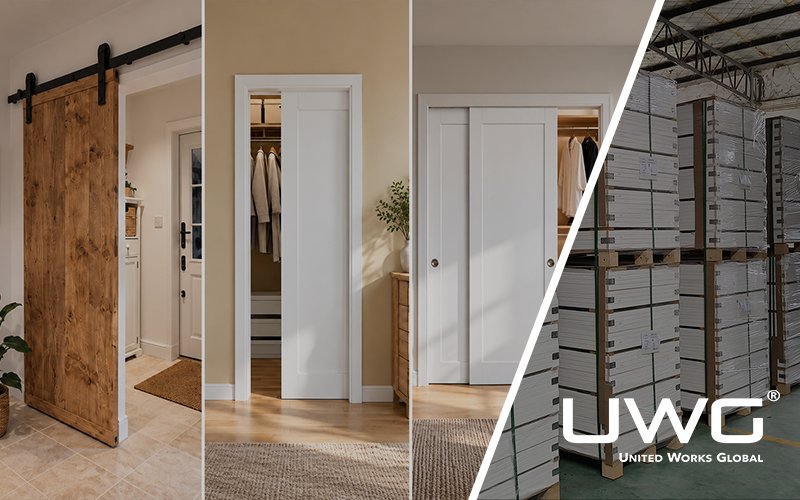
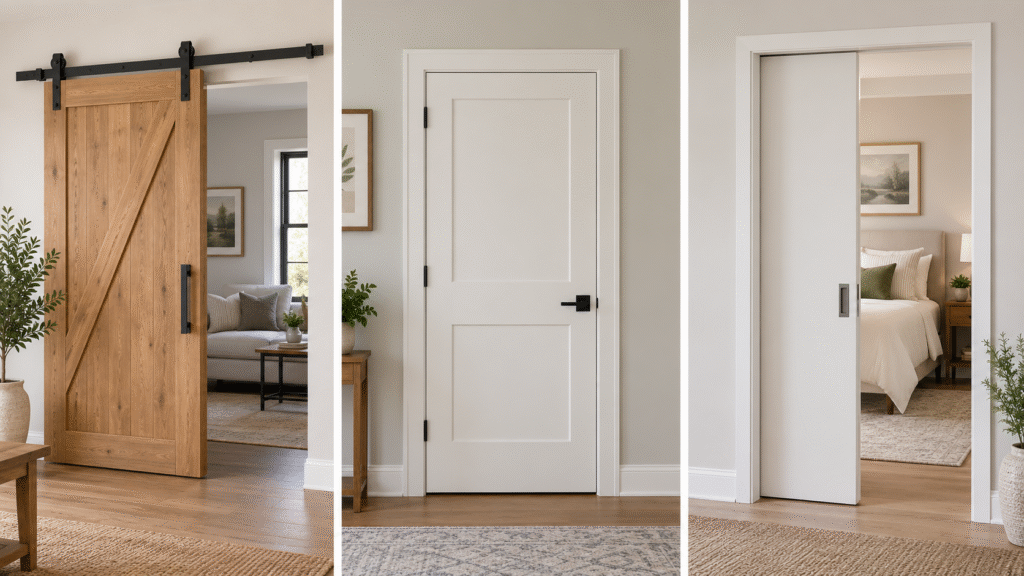
A barn door slides along the surface of the wall. It eliminates door-swing clearance and does not require a wall cavity, making it particularly useful where builders want to save usable floor space or add a sliding door to an existing opening. The main trade-offs are the need for clear adjacent wall space and lower perimeter sealing.
A hinged door requires enough room for the door to swing, but it closes within a frame and against door stops. This generally provides better privacy, sound control, air sealing, and conventional locking. For bedrooms and bathrooms where these factors are important, a hinged door often remains the more straightforward solution.
A pocket door slides completely into a cavity inside the wall. This eliminates both the swing radius and the need to keep the wall surface clear. It can be particularly useful in compact layouts, but the wall must be designed to accommodate the pocket frame and track. Installation can therefore require more coordination, especially in renovation projects.
Once you’ve narrowed down the opening system, explore our range of interior doors to compare available styles, materials, and finishes.
When Is a Barn Door the Better Choice?
A barn door can work particularly well when:
- Door-swing clearance is limited
- There is sufficient uninterrupted wall space
- A relatively wide opening needs to be covered
- The project requires a straightforward retrofit solution
- Exposed sliding hardware fits the interior design
- High levels of acoustic or visual privacy are not required
For builders, the best reason to use a barn door is usually functional. If the sliding configuration solves a genuine layout problem, the design benefit becomes an additional advantage.
When Should You Choose Another Door Type?
A hinged door is generally more appropriate when the room requires better privacy, sound control, conventional locking, or perimeter sealing.
A pocket door may be more appropriate when both floor space and adjacent wall space are limited and the wall construction can accommodate an internal sliding system.
Room function, opening size, wall construction, daily usage, and privacy requirements should therefore be considered before selecting the door system.
Barn Door Hardware and Track System
Hardware plays a major role in barn door performance. Track length, roller capacity, panel thickness, door weight, floor guides, stops, and mounting conditions should all be confirmed before ordering.
For a detailed explanation of hardware components, sizing, and selection, see our Barn Door Hardware and Track System Guide.
For oversized or solid-core barn doors, always verify the hardware load capacity against the actual door weight rather than selecting a system based only on appearance.
How to Know If a Barn Door Is Right for Your Space
Check the Door Opening and Available Wall Space
Start by measuring both the doorway and the available wall beside it.
The door panel normally needs to be wider and taller than the finished opening so that it provides sufficient overlap when closed. At the same time, enough horizontal wall space must remain available for the panel to slide fully open.
Before finalizing the location, builders should also check for:
- Electrical switches
- Outlets
- Baseboards
- Casing and other trim
- Cabinets
- Shelving
- HVAC controls
- Wall-mounted fixtures
These details are easier and less expensive to coordinate during planning than after installation.
Consider Privacy, Noise and Daily Use
The intended room function should influence the door selection.
For a pantry or closet, small perimeter gaps may have little impact on everyday use. The same gaps can become much more noticeable on a bedroom, bathroom, or home office.
Frequency of use should also be considered.
A door that operates many times each day places greater demands on rollers, bearings, stops, floor guides, and mounting hardware. For frequently used openings, hardware durability is usually more important than decorative appearance alone.
Match the Door Panel With the Right Hardware
The door slab and hardware should be specified as one compatible system.
Before ordering, confirm:
- Door width
- Door height
- Door thickness
- Door weight
- Track length
- Roller load capacity
- Wall construction
- Opening clearance
On one residential project, the door panels were selected first and the barn door hardware was confirmed later. When we reviewed the final specifications, we found that the heavier solid-core panels placed a much greater load on the track and wall structure than the lighter doors originally considered.
Instead of treating the hardware as a separate item, we went back through the door weight, panel dimensions, track length, roller capacity, and wall construction together. The hardware configuration was then adjusted to match the actual door panels before production and installation.
Therefore, before placing the order, make sure the door slab and hardware are confirmed together as one complete system. A track that works for a lightweight hollow-core door may not be suitable for a larger solid-core panel. Checking these details early can avoid hardware changes and unnecessary adjustments during installation.
Frequently Asked Questions About Barn Doors
Do Barn Doors Save Space?
Barn doors eliminate the floor space required for a conventional door swing, which can improve furniture placement and circulation in compact rooms.
However, they require clear wall space beside the opening for the panel to slide.
For this reason, a barn door changes how the surrounding space is used rather than eliminating clearance requirements entirely.
Do Barn Doors Provide Enough Privacy?
The level of privacy depends on the application and installation.
Because barn doors usually overlap the opening rather than closing inside a jamb, small gaps can remain around the perimeter. As a result, they generally provide less visual and acoustic privacy than conventional hinged doors.
For closets and pantries, this is rarely a major concern. Bedrooms, bathrooms, and home offices require more careful consideration.
Can You Lock a Barn Door?
Yes. Barn doors can use several types of locking hardware, including privacy latches and hook-style locks.
However, the lock must be compatible with a door that moves parallel to the wall. Conventional cylindrical locksets used on hinged doors are generally not directly suitable for this configuration.
Builders should therefore coordinate the lock with the track system, door thickness, and room function.
Are Barn Doors Suitable for Bathrooms?
Barn doors can be used for bathrooms, particularly where floor space is limited.
Panel overlap, gap size, locking hardware, and privacy requirements should all be considered. Where stronger privacy and sound isolation are required, a conventional hinged door may provide a more practical solution.
Are Barn Doors Still in Style?
Barn doors continue to be used in residential projects, but their appearance is no longer limited to the rustic farmhouse style.
Modern Shaker panels, painted doors, glass inserts, simple flat panels, and more minimal hardware allow sliding barn door systems to work with transitional and contemporary interiors as well.
For builders, style should be considered together with function. A barn door tends to work best when its sliding operation improves the layout rather than being selected only as a decorative feature.
Conclusion
Barn doors can save swing space, cover wide openings, and simplify certain retrofit installations, making them useful for selected residential applications.
Their main limitations are the need for clear adjacent wall space and lower privacy, sound control, and perimeter sealing compared with hinged doors. Before specifying a barn door, builders should confirm the opening size, available wall space, room function, door weight, and hardware requirements. When these conditions are properly coordinated, a barn door can provide both practical and architectural value in a residential project.