Builders, contractors, and project buyers often encounter the words molding and moulding and wonder whether they describe different products—or whether one spelling is incorrect.
Both spellings are correct. The difference is primarily regional: molding is the standard American English spelling, while moulding is commonly used in British and Commonwealth English. In architecture and construction, both terms describe shaped trim used to finish transitions, conceal gaps, protect surfaces, and add architectural detail.
Understanding the terminology is useful when reviewing drawings, comparing supplier catalogs, preparing purchase orders, or sourcing trim for projects in different markets.
| Term | Common usage | Meaning in construction |
|---|---|---|
| Molding | United States | Shaped architectural trim |
| Moulding | United Kingdom, Australia and many Commonwealth markets | The same architectural product |
| Trim | Broad construction term | Finish components used around edges, joints and openings |
| Casing | Specific trim application | Trim installed around doors and windows |
The spelling does not indicate a difference in profile, material, quality, dimensions, or installation method.
/SPR-how-to-install-crown-molding-4158725-hero-cb452ca01faa4c108cf3d2053cfc9d1d.jpg)
What Is Molding in Construction?
Architectural molding is a shaped finishing component installed along a floor, ceiling, wall, door, window, or another transition in a building.
Depending on its location and profile, molding can:
- Cover joints between finished surfaces
- Conceal installation gaps
- Protect walls and edges from routine contact
- Frame doors and windows
- Create a finished wall-to-floor or wall-to-ceiling transition
- Add depth and architectural character
- Coordinate different interior finishes
Molding may have a simple flat or eased profile, or it may include curves, steps, beads, grooves, and other decorative details.
The word “molding” can also describe a manufacturing process in which material is shaped in a mold. However, in this article, molding refers specifically to architectural and finish-carpentry products.
Is Baseboard Molding or Moulding?
Both terms are correct.
In the United States, baseboard molding is the more common spelling. In the United Kingdom and many Commonwealth markets, baseboard moulding may be used instead.
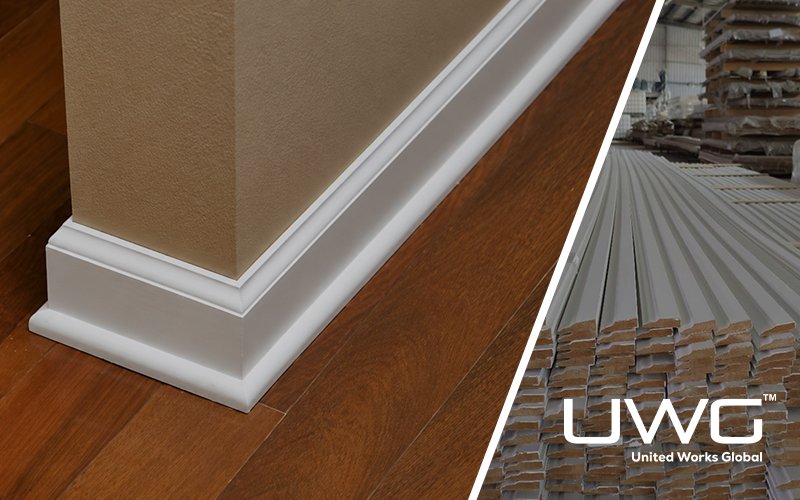
In either case, baseboard is installed along the bottom of an interior wall. It creates a finished transition between the wall and floor, helps cover the perimeter joint, and provides some protection to the lower wall.
Baseboard profiles range from plain rectangular boards to eased, stepped, Colonial, Craftsman, ogee, and other decorative designs.
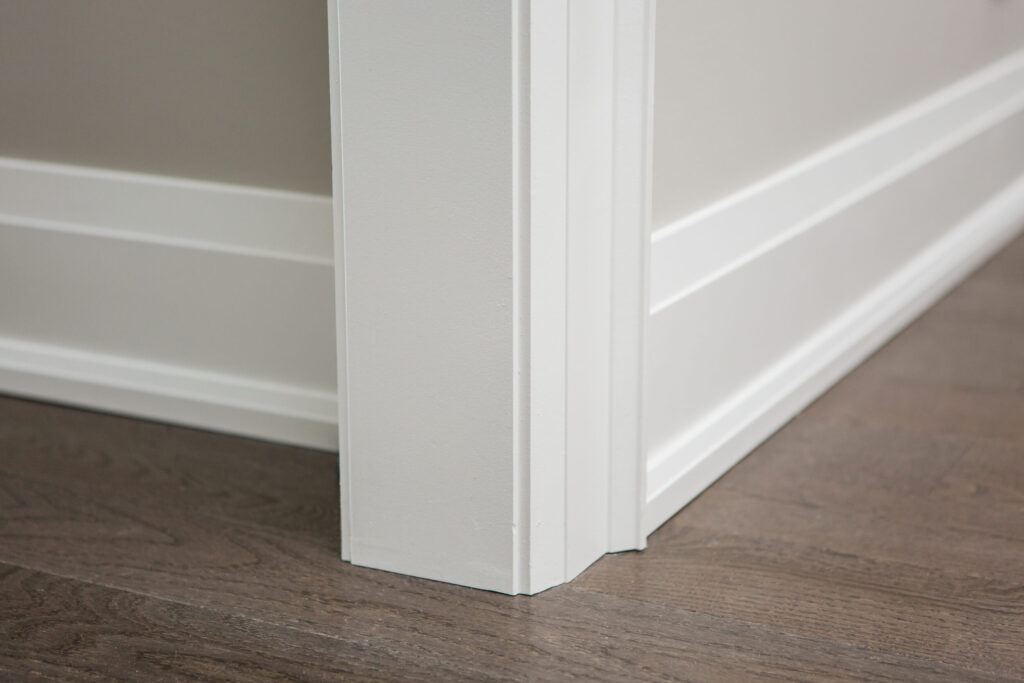
What is the meaning of the word molding?
The word molding has two primary meanings:
- Manufacturing Process: Shaping a pliable material using a mold (common in plastic or metal production).
- Architectural Feature: A decorative strip used for finishing touches in building interiors, such as crown, baseboard, or panel moldings.
In both uses, the concept involves forming or shaping something.
What Are the Most Common Types of Molding?
Architectural molding is categorized mainly by where it is installed and what function it serves. The most common types include:
| Molding type | Installation location | Main purpose |
|---|---|---|
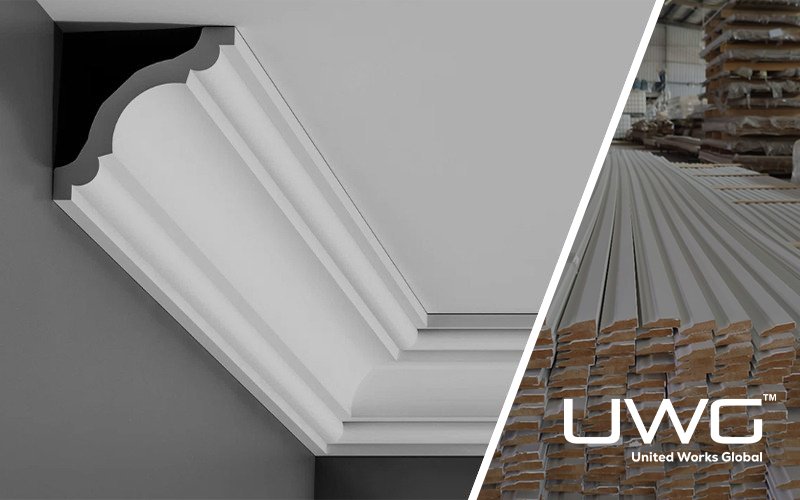
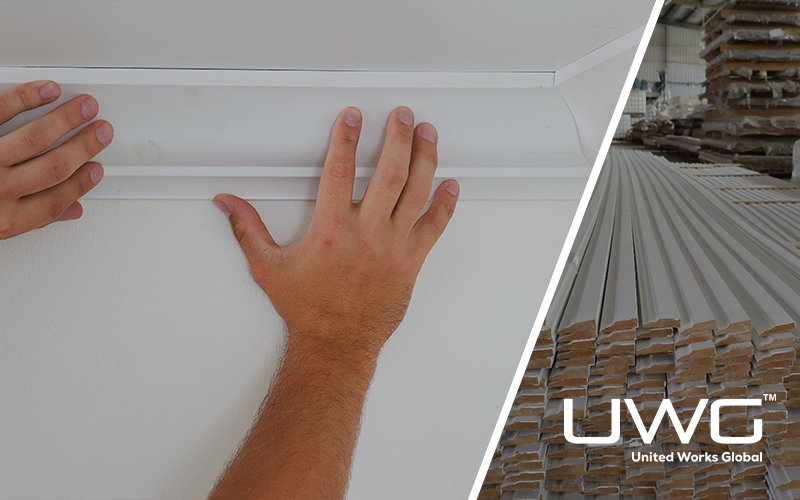
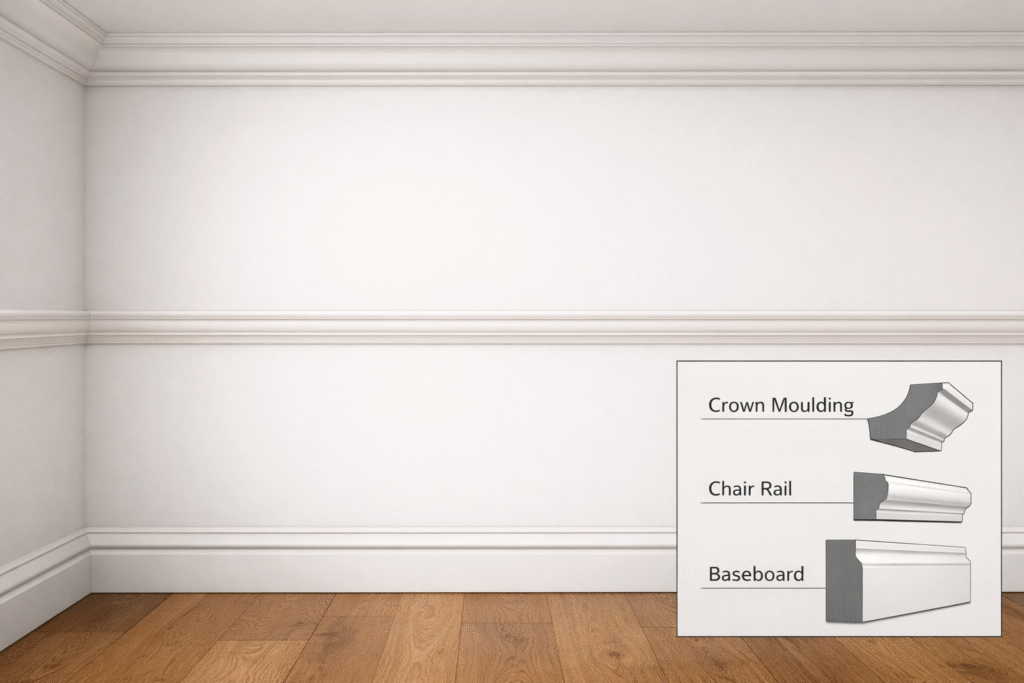
| Crown molding | Where walls meet ceilings | Creates a finished ceiling transition and adds architectural detail |
| Baseboard molding | Along the bottom of walls | Finishes the wall-to-floor transition and helps protect the lower wall |
| Door and window casing | Around doors and windows | Covers the joint between the frame or jamb and the finished wall |
| Chair rail | Horizontally across walls | Divides wall finishes and adds decorative or protective detail |
| Panel molding | Applied directly to walls or ceilings | Creates framed panels, picture-frame layouts and decorative wall patterns |
| Shoe molding and quarter round | In front of the baseboard near the floor | Helps conceal flooring perimeter gaps and minor floor-edge variation |
| Cove molding | At inside corners or surface transitions | Creates a smooth, concave transition between adjoining surfaces |
| Picture rail | Near the upper portion of a wall | Supports traditional picture-hanging systems and adds architectural detail |
These names describe the profile’s location or function—not necessarily its material. For example, baseboard, casing and crown molding may be manufactured from MDF, finger-jointed pine, solid wood, PVC or other suitable materials.
For a more detailed explanation of the primary categories, see our guide to baseboard, crown molding and casing. If you are selecting crown dimensions, refer to our molding size by ceiling height guide.
Each type comes in a variety of materials, from traditional wood to modern plastic composites.
Moulding vs. Trim: What’s the Difference?
What Is Trim?
Trim is the broadest term. It covers finishing components installed around floors, ceilings, walls, doors, windows, cabinets, and other edges or transitions.
Trim may be flat or profiled. A simple rectangular board installed around a door can still be described as trim even if it has no decorative profile.
What Is Molding?
Molding generally refers to trim with a recognizable cross-sectional shape. The profile may be flat, rounded, stepped, beveled, fluted, concave, or decorative.
Baseboard, crown molding, chair rail, panel molding, shoe molding, and quarter round are common examples.
So, all moulding is trim — but not all trim is moulding.
In practical construction terminology:
All molding can be considered trim, but not every piece of trim has a molded profile.
What Materials Are Used for Architectural Molding?
Material selection depends on the installation environment, required finish, profile complexity, budget, and expected performance.
| Material | Main characteristics | Typical applications |
|---|---|---|
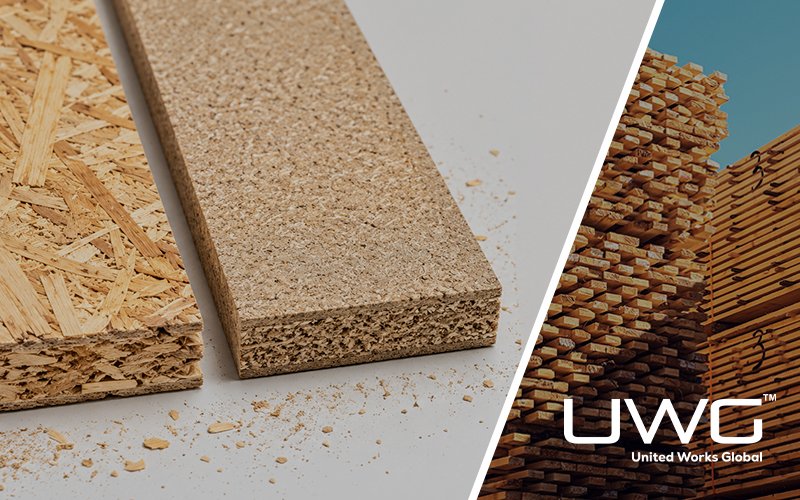
| MDF | Smooth, consistent and suitable for painted finishes | Dry interior baseboard, casing, crown and wall molding |
| Finger-jointed pine | Wood-based, machinable and commonly supplied primed | Painted casing, baseboard and general interior trim |
| Solid wood | Natural grain and suitability for stained finishes | Premium, traditional and stain-grade projects |
| PVC | Low water absorption and suitable for many damp or exterior applications | Bathrooms, basements and exterior trim when appropriately rated |
| Polyurethane | Lightweight and capable of detailed decorative profiles | Decorative crown and ceiling features |
| Plaster | Supports intricate traditional details | Restoration and specialized decorative interiors |
| Engineered wood | Manufactured for consistency or dimensional stability | Selected flat-stock, casing, jamb and trim applications |
MDF Moulding
MDF is commonly used for paint-grade interior molding because it provides a smooth and consistent surface.
It is generally most appropriate for dry interior spaces. Standard MDF should not be described as waterproof, and its cut edges, joints, and fastening points must be properly finished.
Wood Moulding
Solid wood and finger-jointed pine provide familiar woodworking and installation characteristics.
Solid wood is frequently selected when natural grain or a stained finish is required. Finger-jointed products are commonly used for painted trim. Moisture content, grade, priming, finishing, acclimation, and installation conditions should be confirmed.
PVC Moulding
PVC may be appropriate for damp or exterior environments when the particular product is rated for the intended application.
It should not simply be described as “the best material” for every bathroom or kitchen. Thermal movement, fastening, backing, joints, temperature exposure, and applicable installation instructions must still be considered.
For a more detailed comparison, see our interior moulding materials guide.
What Is the Purpose of Wall Molding?
Wall molding can serve both functional and decorative purposes.
Depending on the profile and installation, it may:
- Cover transitions or joints
- Protect portions of the wall
- Frame wall sections
- Divide different colors or surface finishes
- Add depth to otherwise flat walls
- Support wainscoting or decorative panel layouts
- Reinforce a traditional, Craftsman, Colonial, transitional, or modern design
However, molding should not automatically be described as structural. Most decorative interior profiles are finish components rather than load-bearing parts of a building.
The performance of a wall-molding installation depends on the substrate, material, dimensions, fastening, joint treatment, finish, and environmental conditions.
How Should Builders Choose Molding?
Selecting molding involves more than choosing an attractive profile.
Identify the application
First determine whether the product will be used as:
- Baseboard
- Crown molding
- Door or window casing
- Chair rail
- Panel molding
- Shoe molding
- Quarter round
- Wall molding
- Exterior trim
The installation location affects the required profile, dimensions, material, finish, fastening, and moisture performance.
Match the material to the environment
MDF may work well for standardized paint-grade trim in dry interiors. Wood or finger-jointed products may suit projects requiring wood machining or finishing characteristics. PVC or another rated material may be more appropriate for damp or exterior locations.
The profile name alone does not determine moisture resistance or durability.
Confirm the dimensions and profile
Purchase documents should specify:
- Profile drawing or reference number
- Thickness
- Width or height
- Length
- Edge and surface details
- Projection where applicable
- Material and grade
- Required finish
A description such as “5-inch white molding” is usually not detailed enough for accurate production or procurement.
Coordinate the full trim package
Baseboard, casing, crown molding, shoe molding, wall trim, door jambs, and transition components should be planned together.
The profiles do not need to be identical, but their scale, material, surface finish, and architectural style should be coordinated.
Molding Specification Checklist for Project Buyers
Before requesting a quotation, confirm:
- Molding type and installation location
- Profile drawing, profile number or approved sample
- Material and grade
- Thickness, width and length
- Interior, exterior, dry or damp exposure
- Primed, painted, stained or unfinished surface
- Color and sheen requirements
- Linear footage or piece quantities
- Waste allowance
- Matching baseboard, casing and accessory profiles
- Packaging and labeling requirements
- Delivery phases and project schedule
- Required testing or compliance documents
- Sample and approval procedures
For larger projects, drawings, finish schedules, door schedules, quantity takeoffs, and approved samples should be reviewed together before production.
Frequently Asked Questions
What is the difference between molding and moulding?
There is no difference in product meaning. Molding is the standard American English spelling, while moulding is the British and Commonwealth spelling.
What is molding in a house?
Molding is architectural trim installed around floors, ceilings, walls, doors, and windows. Common examples include baseboard, crown molding, casing, chair rail, panel molding, shoe molding, and quarter round.
Is molding exactly the same as trim?
Not exactly. Trim is the broader category of finish components. Molding generally refers to trim with a defined cross-sectional profile. The terms nevertheless overlap in everyday construction use.
Is casing a type of molding?
Casing is trim installed around door and window openings. It may have a molded decorative profile or may be manufactured as simple flat stock.
What materials are commonly used for architectural molding?
Common materials include MDF, finger-jointed pine, solid wood, PVC, polyurethane, plaster, and selected engineered wood products. The appropriate material depends on the application, finish, moisture exposure, dimensions, and budget.
What is the main purpose of wall molding?
Wall molding can cover transitions, protect wall areas, divide finishes, frame decorative sections, and add architectural depth. Its exact function depends on the molding type and installation.
Should U.S. builders use “molding” or “moulding”?
“Molding” is generally the more natural spelling for U.S. specifications and buyer-facing content. “Moulding” remains common in international catalogs and within parts of the millwork industry. Whichever spelling is selected should be used consistently.
Source Molding and Trim for Your Project
Whether it is spelled molding or moulding, the purchase specification must identify the correct profile, material, dimensions, finish, quantities, and installation environment.
UWG supplies molding and trim products for builders, contractors, developers, distributors, and project buyers. Products can be coordinated around project drawings, finish schedules, approved samples, quantity requirements, packaging, and delivery phases.
Explore the UWG Moulding & Trim Guide or submit your drawings and project requirements for a coordinated quotation.