There is no single best cabinet material for every component.
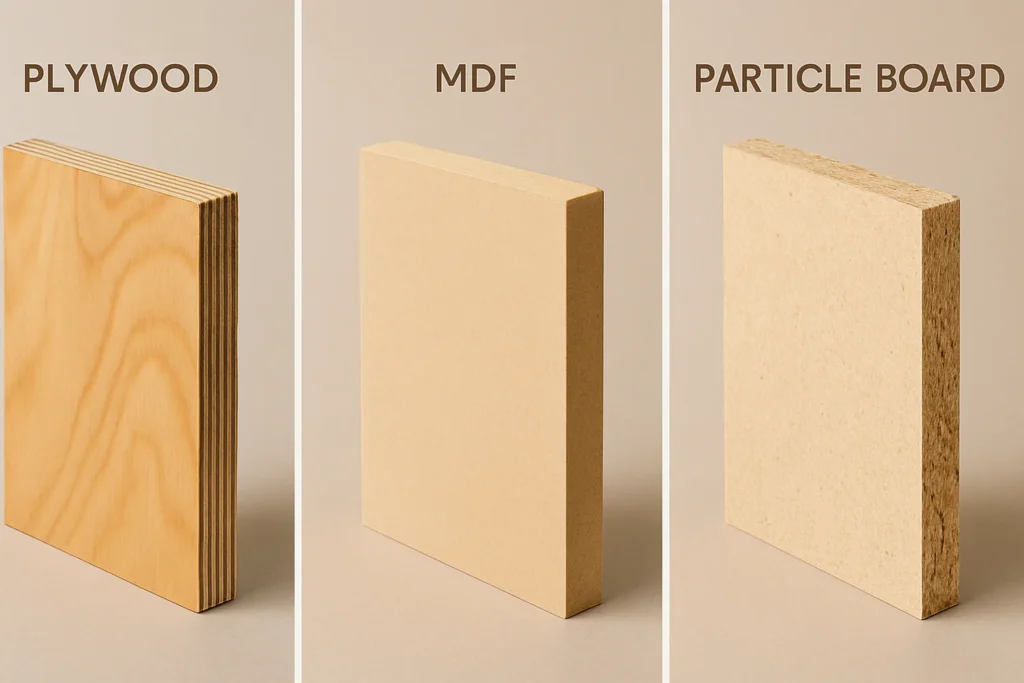
Plywood is commonly selected for cabinet boxes because of its strength-to-weight ratio and fastener holding. MDF provides a smooth, uniform surface for painted doors and routed profiles. Particleboard supports cost-controlled cabinet construction when its density, thickness, edge sealing and hardware are properly specified. Solid wood is commonly used for face frames, door frames and premium exposed components.
The right material therefore depends on where it is used—not simply whether one board is described as “premium” or “budget.”
For builders, developers and project buyers, cabinet material selection affects:
- Structural performance
- Door and drawer alignment
- Fastener holding
- Moisture-related risk
- Surface finish
- Installation efficiency
- Shipping weight
- Replacement requirements
- Total project cost
This guide compares the principal kitchen cabinet materials and explains how to specify them for cabinet boxes, doors, shelves, drawers and different construction projects.
What Are Kitchen Cabinets Made Of?
Most kitchen cabinets use several materials rather than one material throughout the entire assembly.
A cabinet may combine:
- Plywood for the cabinet box
- MDF for painted doors and decorative panels
- Solid wood for face frames or door rails and stiles
- Plywood or solid wood for drawer boxes
- Wood veneer, melamine, laminate or paint as the visible surface
- Metal for hinges, drawer slides and connecting hardware
For example, describing a cabinet as “solid wood” may refer only to the face frame or door frame. The cabinet box, center panel, shelves and drawer bottoms may use different engineered materials.
Buyers should request a component-by-component material schedule instead of relying on one general product label.
Cabinet Materials Comparison
| Material | Construction | Main advantages | Important limitations | Common cabinet applications |
|---|---|---|---|---|
| Plywood | Thin wood veneers bonded in alternating grain directions | Good strength-to-weight ratio, reliable fastener holding and suitable structural performance | Quality varies by core, veneer grade, thickness and manufacturing; edges require finishing | Cabinet boxes, shelves, sink cabinets, wall cabinets and drawer boxes |
| MDF | Fine wood fibers bonded under heat and pressure | Smooth, uniform surface; clean CNC machining; well suited to painted and routed doors | Heavy; exposed edges can absorb moisture; repeated fastener adjustment can damage the core | Painted doors, routed profiles, slab fronts, end panels and decorative components |
| Particleboard | Wood particles bonded and pressed into panels | Flat, economical and suitable for standardized production | Lower edge and fastener strength than many plywood products; exposed edges are vulnerable to moisture | Cost-controlled boxes, shelves and melamine-faced panels in dry applications |
| Solid wood | Natural timber cut and machined into cabinet components | Natural appearance, repairable finish and strong exposed framing | Higher cost, natural variation and seasonal dimensional movement | Face frames, door rails and stiles, drawer fronts and premium exposed components |
| HDF | Refined wood fibers compressed to a higher density than standard MDF | Dense, smooth and suitable for selected thin or precision components | Heavy and still requires protection from prolonged moisture exposure | Selected door skins, back panels and specialty components |
Material names alone do not determine cabinet quality. A well-designed cabinet made from properly specified engineered panels may outperform a poorly constructed cabinet made from low-grade plywood.
Plywood Cabinets
Plywood is made by bonding thin wood veneers with the grain direction alternating between layers. This cross-layered construction helps distribute loads and control dimensional movement.
Furniture-grade plywood is widely used for cabinet boxes, shelves, wall cabinets and drawer boxes.
Advantages of Plywood
- Good strength relative to its weight
- Reliable screw and dowel holding when properly specified
- Suitable for structural cabinet components
- Less heavy than MDF of a comparable thickness
- Available with prefinished, painted or veneered surfaces
- Often preferred for wall-hung and high-use cabinet boxes
Limitations of Plywood
Plywood quality varies considerably.
Buyers should not assume that every plywood cabinet has the same performance. Important differences include:
- Veneer species
- Number and thickness of plies
- Core voids
- Face grade
- Panel thickness
- Adhesive system
- Moisture content
- Surface finish
- Edge treatment
Lower-quality plywood may contain voids, uneven layers or inconsistent faces. Exposed plywood edges also require edge banding, a finished reveal or another approved treatment.
Plywood is more moisture-tolerant than many standard fiber-based panels, but it is not waterproof. Prolonged leaks can still cause swelling, veneer separation, staining or finish failure.
Best Uses for Plywood
Plywood is commonly considered for:
- Base and wall cabinet boxes
- Sink base cabinets
- Tall and pantry cabinets
- Long or heavily loaded shelves
- Drawer boxes
- Structural rails
- Cabinets requiring reliable fastener holding
UWG’s RTA and custom kitchen cabinet solutions include project-specific material options for residential, multifamily and commercial construction.

MDF Cabinets
MDF, or medium-density fiberboard, is manufactured from refined wood fibers bonded under heat and pressure.
Its uniform core does not have the natural grain, knots or internal layering found in solid wood and plywood. This makes MDF particularly useful where a smooth painted finish or detailed routed profile is required.
Advantages of MDF
- Smooth, grain-free surface
- Consistent density
- Clean CNC routing and machining
- Suitable for painted cabinet doors
- Good dimensional consistency
- No natural grain telegraphing through painted finishes
- Efficient production of repeatable door profiles
Limitations of MDF
MDF is dense and relatively heavy. This can affect packaging, handling, hinge selection and door size.
Unsealed edges and machining points can absorb moisture more quickly than finished surfaces. Proper priming, painting, edge sealing and hardware preparation are therefore important.
MDF also requires suitable fasteners and boring specifications. Repeated removal and reinsertion of screws can weaken the connection.
MDF should not automatically be described as waterproof or moisture-proof. Moisture-resistant MDF products may be available, but their grade and test documentation must be confirmed.
Best Uses for MDF
MDF is commonly used for:
- Painted Shaker doors
- Routed one-piece doors
- Painted slab doors
- Decorative end panels
- Fillers and finished panels
- Molded or CNC-machined profiles
- Selected cabinet components in controlled interior environments
MDF is not inherently a “cheap substitute” for plywood. For a smooth painted door, it may be the more appropriate material because it avoids natural grain and joint movement showing through the finish.
To compare door designs that can be produced using MDF, solid wood and veneered panels, see the cabinet door profile guide.
Particleboard Cabinets
Particleboard, sometimes called furniture board or chipboard, is manufactured from wood particles bonded and pressed into panels.
Its performance depends on:
- Panel density
- Thickness
- Internal bond strength
- Edge quality
- Surface laminate
- Edge banding
- Fasteners
- Cabinet joint design
High-quality furniture board should not be evaluated in the same way as very low-density commodity particleboard.
Advantages of Particleboard
- Competitive material cost
- Flat and consistent surface
- Efficient standardized production
- Suitable substrate for melamine and laminate
- Consistent thickness
- Useful for cost-controlled, high-volume cabinet programs
Limitations of Particleboard
Particleboard generally has lower edge strength and repeated fastener-holding performance than properly specified cabinet-grade plywood.
If water reaches an unfinished edge or damaged joint, the board may swell and lose strength. Edge banding, sealed penetrations and correct sink-area detailing are therefore important.
Corners and edges can also be damaged during transport or assembly if packaging and connectors are inadequate.
Best Uses for Particleboard
Properly specified particleboard may be used for:
- Cost-controlled cabinet boxes
- Upper cabinets in dry areas
- Melamine-faced panels
- Short shelves with controlled loading
- Multifamily and rental projects with standardized specifications
- Components where edges are fully protected
Particleboard should be selected using measurable specifications rather than price alone.
Solid Wood in Cabinet Construction
Solid wood is commonly associated with premium cabinets, but an entire cabinet does not need to be made from solid wood to achieve a high-quality result.
Solid wood is often used for:
- Face frames
- Door rails and stiles
- Drawer fronts
- Decorative moldings
- Exposed trim
- Selected drawer boxes
Common species include maple, oak, birch, cherry and walnut.
Advantages of Solid Wood
- Natural grain and color
- Repairable and refinishable surface
- Strong exposed framing
- Premium appearance
- Suitable for stained and clear finishes
Limitations of Solid Wood
Solid wood naturally expands and contracts as moisture and humidity change. Wide solid-wood panels may move, cup or develop visible joint lines if the construction does not accommodate seasonal movement.
This is why many well-designed cabinet doors combine solid-wood rails and stiles with a veneered or engineered center panel.
Solid wood is not automatically the best choice for cabinet boxes or large slab doors. Plywood, MDF or veneered engineered panels may provide better stability for those components.
Core Material vs. Surface Finish
One of the most common cabinet-material mistakes is treating a surface finish as if it were the panel’s core material.
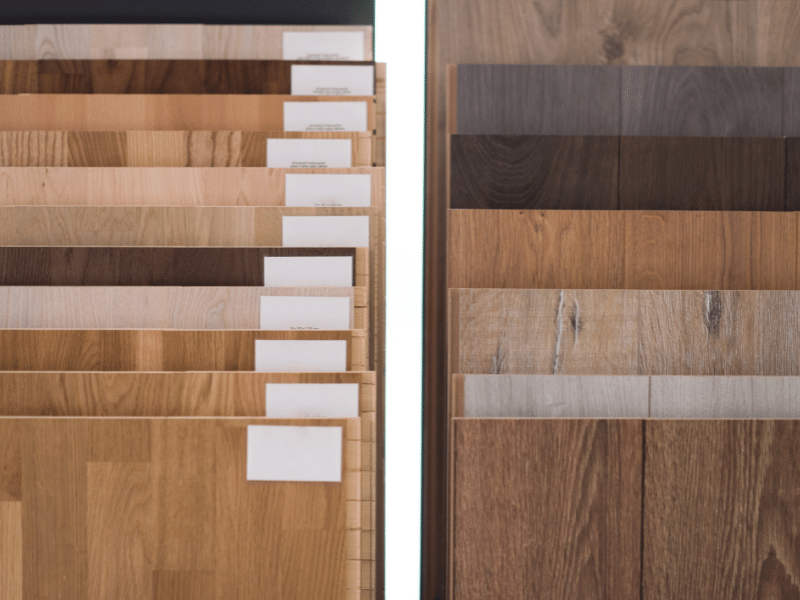
Terms such as melamine, laminate, thermofoil and wood veneer normally describe the visible surface. The substrate underneath may be plywood, MDF, particleboard or another engineered panel.
Melamine and TFL
Melamine-faced board normally consists of decorative paper impregnated with resin and bonded to a panel substrate.
The substrate may be:
- Particleboard
- MDF
- Plywood, depending on the product
Melamine provides a consistent, easy-to-clean surface, but its structural performance still depends on the core panel and edge treatment.
High-Pressure Laminate
High-pressure laminate, or HPL, is manufactured separately and bonded to a substrate. It is frequently used where surface wear, color consistency and cleaning performance are important.
Wood Veneer
Wood veneer is a thin layer of natural wood bonded to a stable substrate.
Possible substrates include:
- Plywood
- MDF
- Particleboard
A veneered panel provides a real-wood appearance while reducing some of the movement associated with a wide solid-wood panel.
Do not claim that every veneered panel “combines the strength of plywood with wood grain.” That statement is only accurate when the veneer is actually bonded to a plywood core.
Thermofoil and PVC Film
Thermofoil or PVC film can be vacuum-formed over compatible MDF door profiles. This creates a consistent finished surface without conventional spray painting.
Performance depends on film quality, adhesive, edge wrapping, temperature exposure and manufacturing control.
Painted Finishes
Paint is frequently applied to MDF or solid-wood cabinet doors. The appearance and durability depend on surface preparation, primer, coating system, curing and quality control—not simply the core material.
What Is the Best Material for Each Cabinet Component?
| Cabinet component | Common material choices | What buyers should confirm |
|---|---|---|
| Cabinet box | Plywood or furniture-grade particleboard | Thickness, core quality, edge treatment, fasteners and back construction |
| Sink base cabinet | Properly finished plywood or moisture-resistant engineered panel | Sealed edges, plumbing penetrations, leak protection and base detailing |
| Painted cabinet doors | MDF, solid wood or hybrid construction | Door size, routed profile, primer, paint system and hinge preparation |
| Stained doors | Solid-wood frame with solid or veneered center panel | Species, grade, grain variation, moisture content and finish |
| Slab doors | MDF, veneered MDF, plywood or laminated engineered panel | Flatness, edge banding, maximum door size and hinge quantity |
| Shelves | Plywood or engineered board | Span, thickness, loading and edge reinforcement |
| Drawer boxes | Plywood, solid wood or engineered panels | Bottom thickness, joint construction and slide capacity |
| Drawer bottoms | Plywood, MDF or HDF depending on design | Thickness, groove engagement and expected load |
| Face frames | Solid wood or selected engineered components | Joint construction, species, moisture content and finish |
| Back panels | Plywood, MDF or HDF | Thickness, attachment method and structural role |
| Toe kicks | Plywood or moisture-protected engineered board | Floor exposure, sealing and impact protection |
The best cabinet specification normally uses different materials in different positions.
Best Cabinet Materials by Project Type

Multifamily and Build-to-Rent Projects
Multifamily cabinets require:
- Repeatable dimensions
- Consistent color and finish
- Controlled material cost
- Efficient installation
- Durable hardware
- Replacement-part availability
- Resistance to frequent tenant use
Possible material strategies include:
- Plywood boxes with painted MDF doors
- Furniture-grade engineered boxes with fully sealed melamine surfaces
- Plywood sink cabinets combined with cost-controlled dry-area boxes
- Standardized door and hardware specifications across multiple units
For multifamily projects, buyers should evaluate complete cabinet construction rather than upgrading one visible material while ignoring hardware, joints, edge banding and replacement planning.
Single-Family Homes
Single-family projects often require a balance of durability, appearance and design flexibility.
A common specification may include:
- Plywood cabinet boxes
- MDF painted doors
- Solid-wood face frames or door frames
- Veneered panels for natural wood finishes
- Plywood or solid-wood drawer boxes
Material selection should coordinate with the desired door profile, overlay and framed or frameless construction.
Luxury Residential Projects
Luxury cabinets may use:
- Furniture-grade plywood boxes
- Solid-wood face frames
- Solid-wood or premium veneered doors
- Thick veneers
- Custom paint systems
- Premium drawer-box construction
- Higher-capacity hinges and drawer slides
However, “all solid wood” is not automatically the best specification. Stable engineered panels may still be preferable for painted doors, wide slab panels and large finished ends.
Cost-Controlled Renovations
For renovations and rental properties, furniture-grade engineered panels can support cost control when:
- The panel density is appropriate
- Edges are completely protected
- Sink and plumbing areas receive additional moisture protection
- Hardware matches the substrate
- Replacement components remain available
Reducing cost should not mean removing specifications. A clearly defined engineered-panel cabinet is safer than a vague “wood cabinet” description.
Does Cabinet Style Determine the Material?
Cabinet style influences material selection, but style and material are not the same thing.
Examples include:
- Shaker doors may use solid-wood frames, MDF or one-piece routed MDF.
- Slab doors may use painted MDF, wood veneer, melamine or laminate.
- Raised-panel doors may use solid wood, MDF or hybrid construction.
- Glass-front doors normally require a framed door structure.
- Frameless cabinets may use plywood or engineered panels.
Shaker remains one of the most widely specified cabinet door styles because it works across traditional, transitional and modern interiors. However, material should still be selected according to finish, door size and project requirements.
For a full style comparison, use the cabinet door profile guide instead of expanding the style discussion in this material article.
Framed vs. Frameless Cabinet Materials
Framed cabinets use a face frame attached to the front of the cabinet box. The face frame is commonly made from solid wood or another suitable structural material.
Frameless cabinets do not have a front face frame. Door hinges and other hardware attach directly to the side panels, making panel quality, thickness and fastener holding especially important.
Neither construction is automatically superior.
Framed cabinets may suit:
- Traditional kitchens
- Renovations with irregular walls
- Projects requiring exposed face-frame details
Frameless cabinets may suit:
- Modern kitchens
- Full-access storage
- Standardized layouts
- Projects requiring clean full-overlay doors
Read the complete framed vs. frameless cabinet comparison for layout and installation guidance.
Cabinet Material Specification Checklist
Before ordering cabinets, confirm:
- Material used for each cabinet component
- Cabinet-box panel thickness
- Plywood core and face grade
- MDF or particleboard density
- Shelf material, thickness and maximum span
- Back-panel material and thickness
- Door material and construction
- Drawer-box and drawer-bottom materials
- Surface finish or laminate
- Edge-banding material and thickness
- Sink-base and toe-kick moisture protection
- Hinge and drawer-slide specifications
- Fastener and connector system
- Formaldehyde-emission documentation
- Color and finish approval sample
- Replacement-part availability
- Packaging and delivery method
- Warranty limitations
For projects in the United States, buyers should request applicable formaldehyde-emission documentation, including compliance with relevant EPA TSCA Title VI and CARB requirements where applicable.
Door dimensions, overlay and hinge boring must also match the selected material and cabinet construction. See the standard cabinet door size guide and cabinet overlay guide before ordering replacement or custom doors.
Frequently Asked Questions About Cabinet Materials
What is the best material for kitchen cabinet boxes?
Furniture-grade plywood is commonly preferred for cabinet boxes that require good structural strength and fastener holding. Properly specified furniture board can also perform well in dry, cost-controlled applications. Panel thickness, edge protection, joints and hardware are as important as the material name.
Is MDF good for kitchen cabinets?
MDF is well suited to painted doors, routed profiles, slab fronts and decorative panels because it has a smooth and consistent surface. It must be properly sealed and protected from prolonged moisture, especially at machined edges.
Is plywood waterproof?
No. Plywood may tolerate kitchen humidity and occasional moisture better than many standard fiber-based panels, but it is not waterproof. Prolonged leaks can still cause swelling, delamination and finish damage.
Is particleboard suitable for kitchen cabinets?
Furniture-grade particleboard can be suitable for cost-controlled cabinet boxes and melamine-faced panels in dry applications. Performance depends on density, thickness, edge banding, fasteners and protection from leaks.
Is solid wood the best cabinet material?
Solid wood is valuable for face frames, door frames and premium exposed components, but it is not automatically best for every cabinet part. Plywood may be more practical for boxes, while MDF may provide a smoother painted-door surface.
What is a melamine cabinet?
A melamine cabinet normally uses a resin-impregnated decorative surface bonded to a panel substrate. The underlying core may be particleboard, MDF or another panel, so buyers should confirm both the surface material and the core.
What is the best material for painted cabinet doors?
MDF is frequently used for painted cabinet doors because its uniform, grain-free surface supports smooth paint and clean routing. Solid wood and hybrid constructions may also be appropriate depending on the door style and desired finish.
What cabinet material is best for multifamily projects?
Plywood and properly specified furniture-grade engineered panels can both be used in multifamily projects. The best solution depends on budget, unit volume, moisture exposure, hardware, installation method and replacement strategy.
Choose the Right Cabinet Materials for Your Project
The best cabinet is rarely made from one material throughout.
A practical project specification may use:
- Plywood for structural cabinet boxes
- MDF for painted doors and routed profiles
- Solid wood for face frames and exposed door components
- Veneered or laminated panels for decorative surfaces
- Properly specified furniture board for cost-controlled dry applications
The final decision should consider component function, moisture exposure, finish, hardware, installation, project positioning and total lifecycle cost.
Explore UWG’s RTA, project and custom kitchen cabinet solutions, or submit your cabinet schedule, floor plan, finish requirements and project quantity for material matching and quotation.