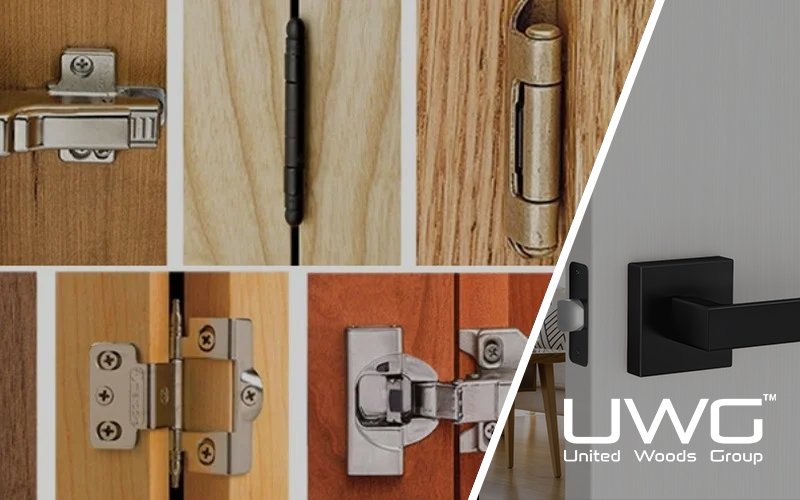
Cabinet hinges connect cabinet doors to the cabinet box or face frame and control how the doors open, close and align. Common types include concealed, face-frame, soft-close, self-closing and specialty hinges. Straight-arm, half-cranked and full-cranked hinges are commonly used for full-overlay, half-overlay and inset cabinet doors.
Although most cabinet hinges remain hidden during everyday use, they have a major influence on how a finished cabinet performs. The hinge affects the door position, opening path, closing action, alignment and clearance around adjacent doors, walls and appliances.
Understanding the main cabinet hinge types is useful for builders, cabinet buyers and project teams because similar-looking hinges are not necessarily interchangeable. Cabinet construction, door overlay, hinge-arm shape, mounting plate and opening angle all contribute to the final result.
This guide explains how cabinet hinges work, the differences between common hinge types and the basic terminology used when discussing complete kitchen cabinet systems.
What Is a Cabinet Hinge?
A cabinet hinge is the mechanical connection between a cabinet door and the cabinet box or face frame.
It allows the door to rotate between open and closed positions while supporting the door’s weight and maintaining its intended position.
Depending on the hinge system, it may also provide:
- Automatic closing
- Soft-close damping
- Side adjustment
- Height adjustment
- Depth adjustment
- Opening-angle control
- Quick door removal
- Concealed installation
Cabinet hinges should not be considered separately from the cabinet design. The same door may require a different hinge depending on whether the cabinet is framed or frameless, full overlay or inset.
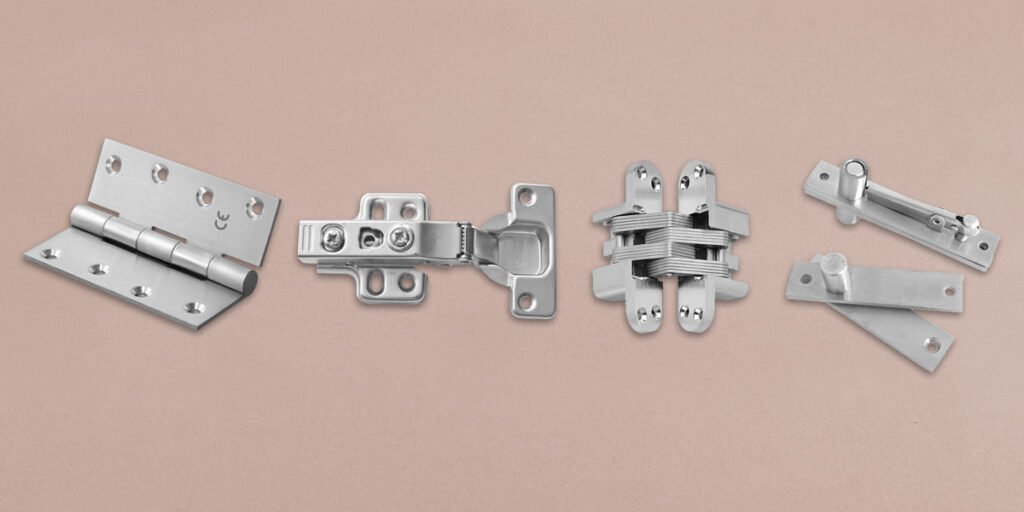
What Are the Main Parts of a Concealed Cabinet Hinge?
A concealed cabinet hinge usually consists of several connected components.
Hinge Cup
The hinge cup is the round recessed section installed into the back of the cabinet door.
A 35 mm cup is common in concealed cabinet hinge systems, but not every 35 mm hinge uses the same cup depth, fixing-hole pattern or drilling position.
Hinge Arm
The hinge arm connects the cup to the mounting plate.
Its shape helps determine whether the door is positioned as:
- Full overlay
- Half overlay
- Inset
Common hinge-arm configurations include straight-arm, half-cranked and full-cranked designs.
Mounting Plate
The mounting plate attaches the hinge to the cabinet side panel or face frame.
The plate is an important part of the complete hinge system. Its height and position can affect the final overlay and door alignment.
A hinge and mounting plate should therefore be selected as compatible components rather than as unrelated parts.
Adjustment Screws
Many concealed hinges include adjustment screws that allow the installer to move the cabinet door in several directions.
These adjustments help create consistent gaps between doors and align the door with the cabinet.
Closing Spring
A self-closing hinge normally contains a spring mechanism that pulls the cabinet door toward the closed position.
The spring provides closing force but does not necessarily slow the door.
Soft-Close Damper
A soft-close damper reduces the speed of the door near the end of closing.
Depending on the hinge model, the damper may be:
- Integrated into the hinge
- Adjustable
- Switchable
- Installed as a separate component
What Are the Main Types of Cabinet Hinges?
Cabinet hinges can be classified according to their visibility, cabinet construction, door position, opening function and application.
Concealed European Hinges
Concealed European hinges are recessed into the back of the cabinet door and are normally hidden when the door is closed.
They are widely used in modern kitchen cabinets because they can offer:
- Clean exterior appearance
- Multiple overlay configurations
- Three-way adjustment
- Clip-on door installation
- Soft-close options
- Different opening angles
- Framed or frameless applications
The term “European hinge” generally describes the concealed cup-hinge system. It does not identify one specific overlay, opening angle or mounting plate.
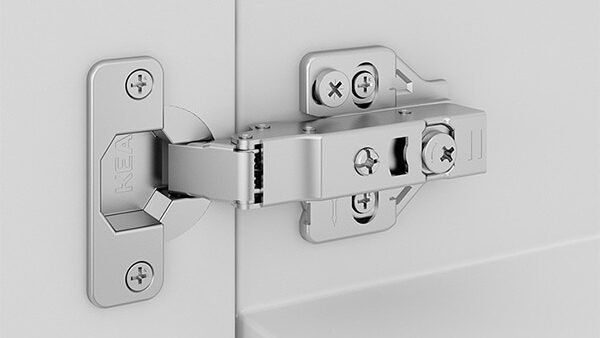
Compact Face-Frame Hinges
Compact hinges are commonly used on framed cabinets.
They are designed to attach to the face frame and are often produced for a specific door overlay. Some are concealed when the cabinet door is closed.
Compact hinges can simplify face-frame installations, but the frame width, overlay and door thickness still need to match the selected hinge.
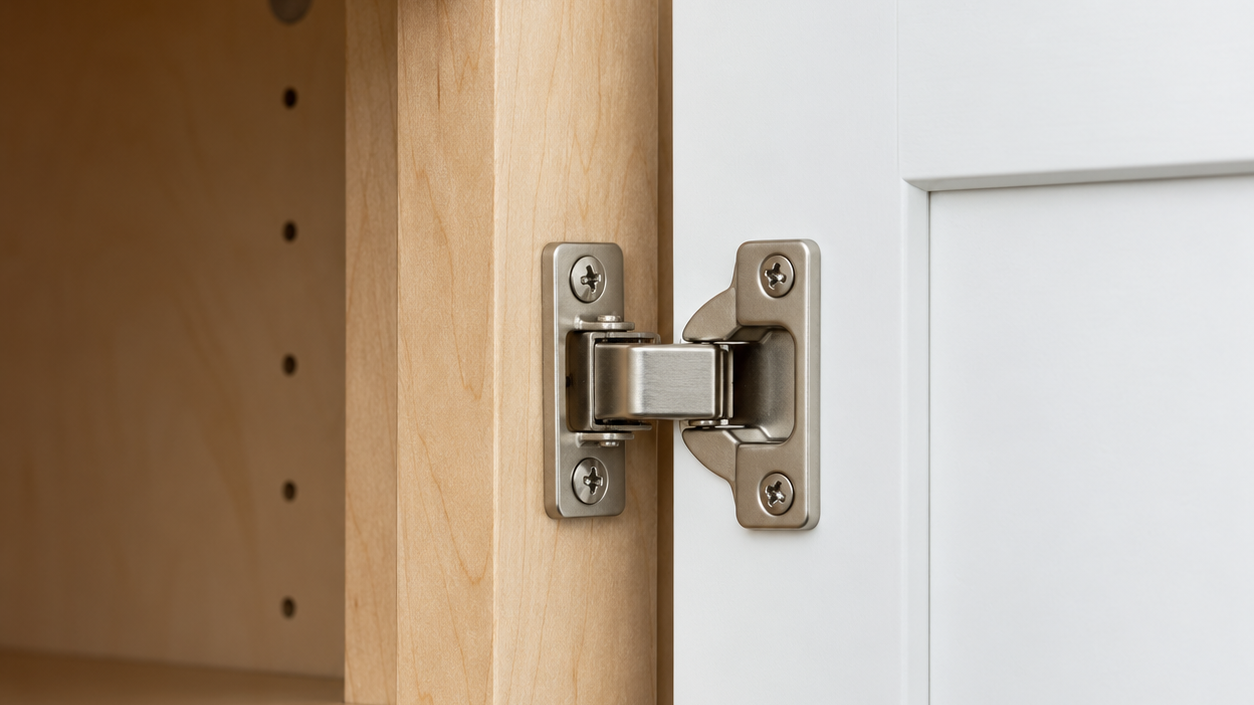
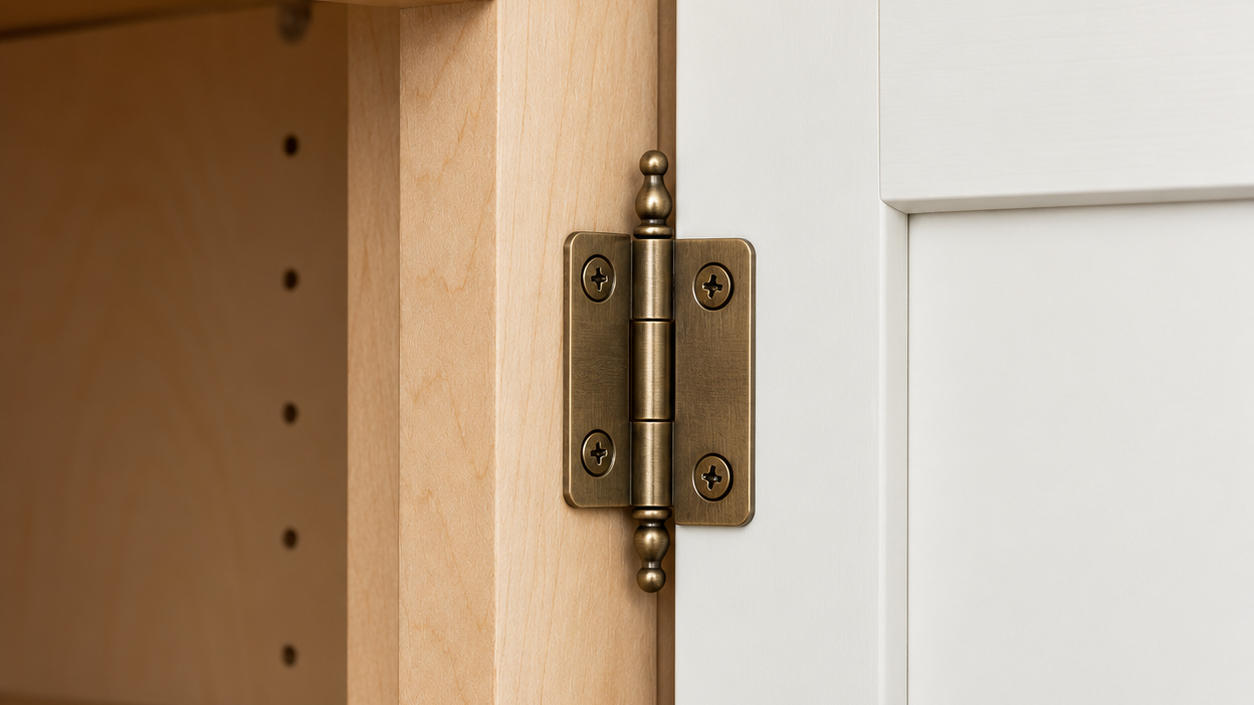
Traditional Exposed Hinges
Exposed hinges remain visible when the cabinet door is closed.
Examples can include:
- Butt hinges
- Surface-mounted hinges
- Decorative hinges
- Semi-concealed hinges
These hinges are often used in traditional, decorative or specialty cabinet designs where the hardware contributes to the appearance.
Soft-Close Hinges
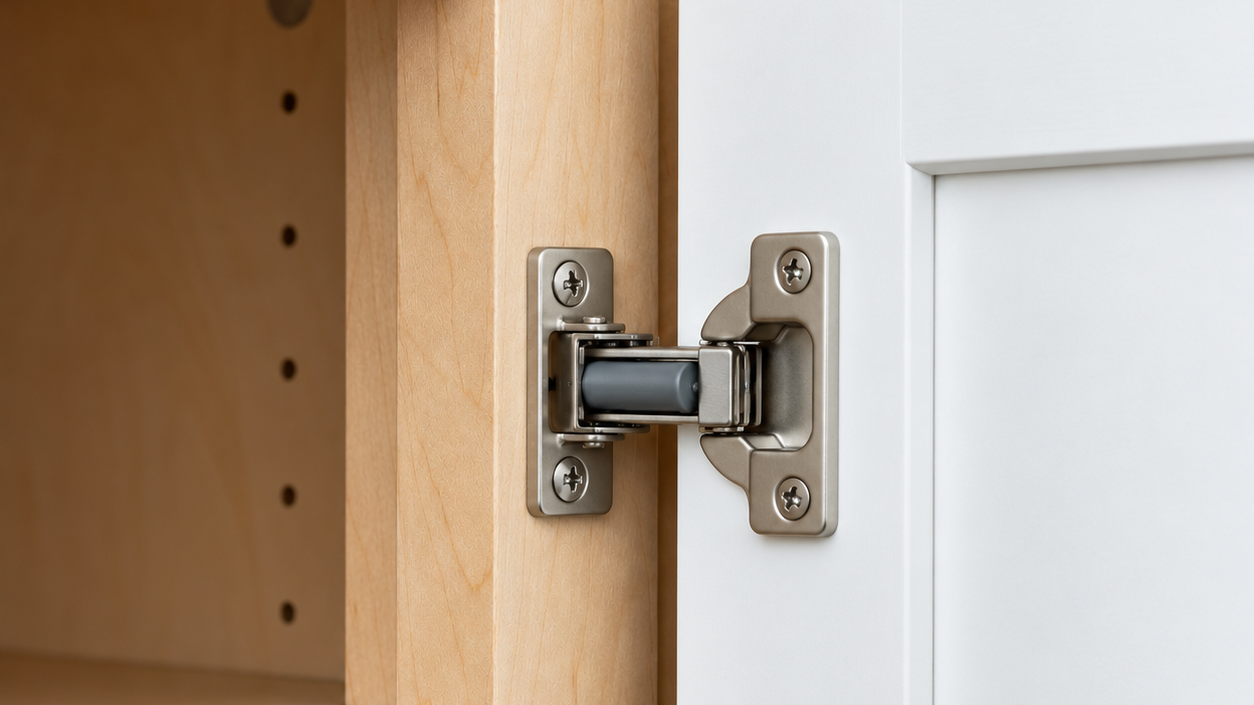
Soft-close hinges use a damping system to slow the cabinet door during the final stage of closing.
This can help:
- Reduce slamming noise
- Create a smoother closing action
- Reduce impact between the door and cabinet
- Provide a more controlled user experience
Soft close describes a function, not a complete hinge type or quality grade. The hinge must still match the cabinet and door configuration.
Self-Closing Hinges
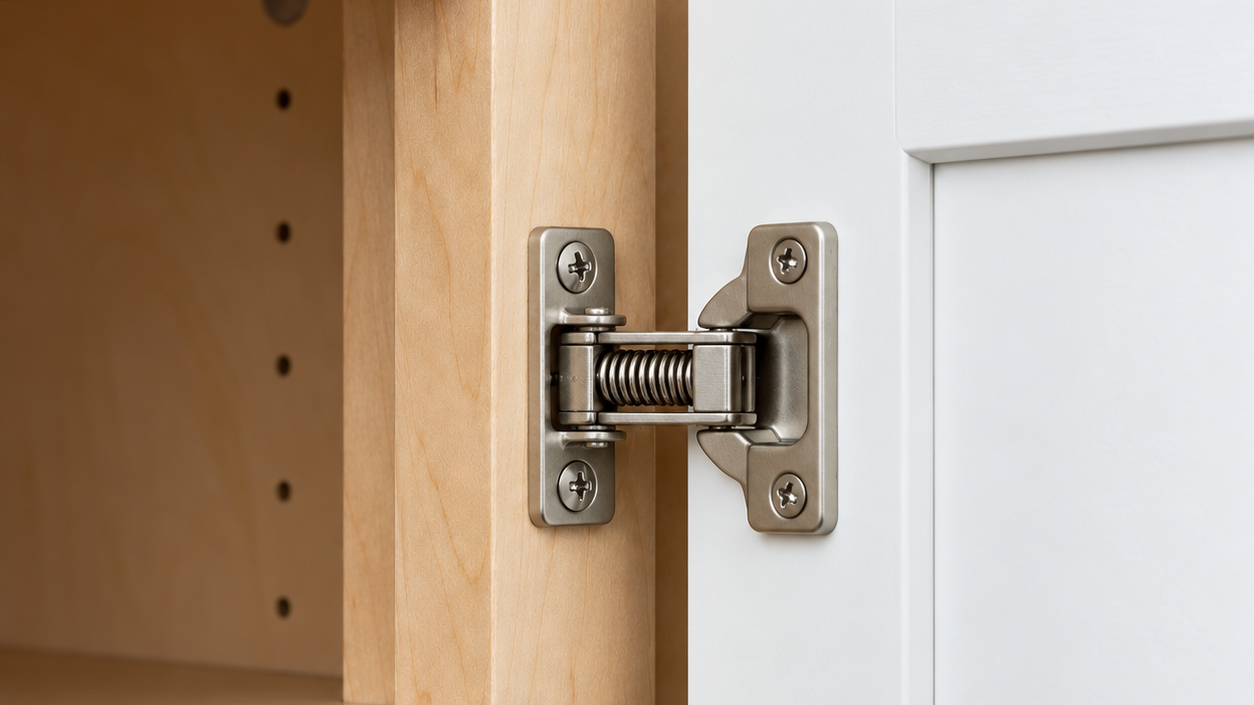
Self-closing hinges use spring force to pull the door closed after it reaches a certain point.
A self-closing hinge does not necessarily include soft-close damping. Some hinge systems combine both functions, while others provide only one.
Wide-Angle Hinges
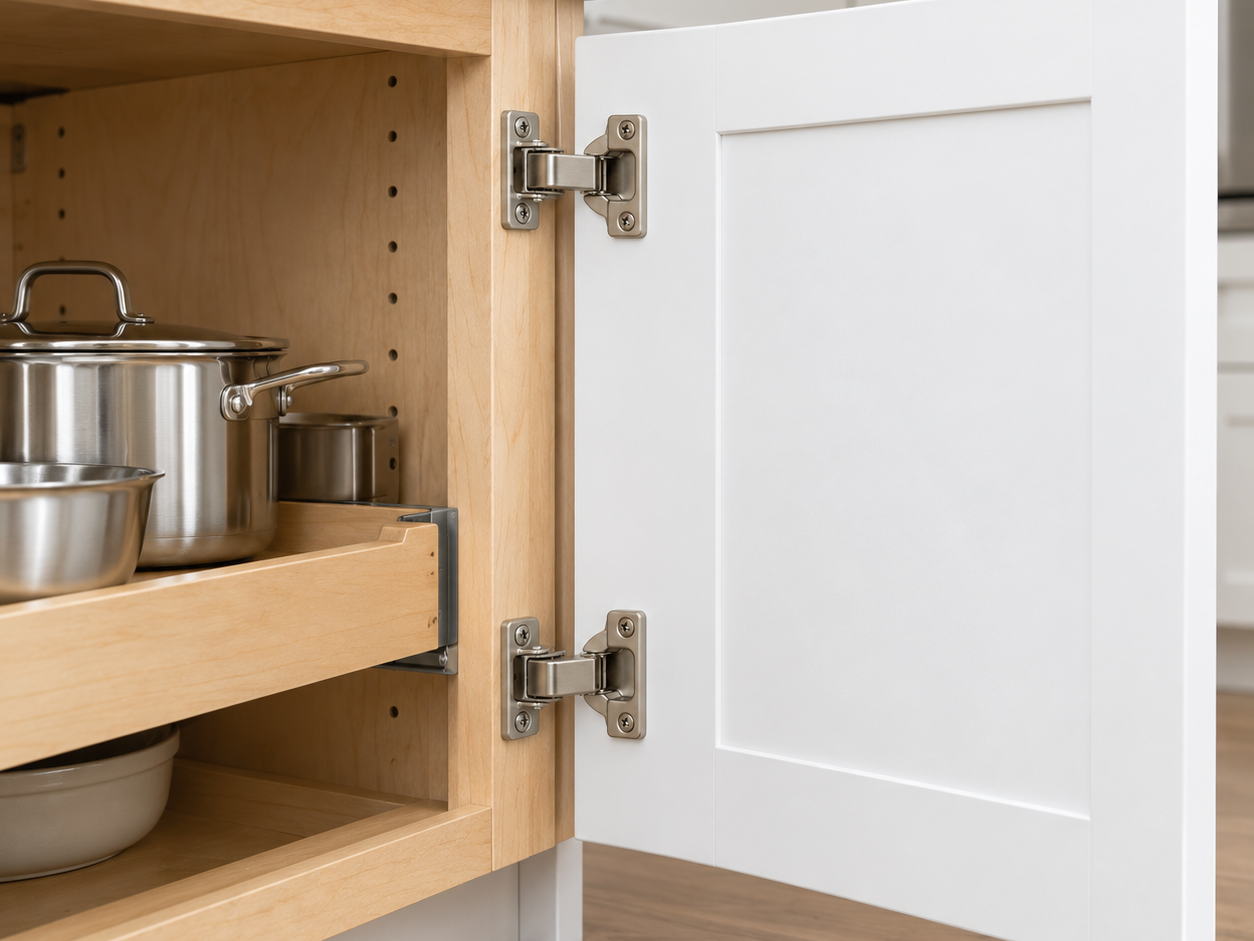
Wide-angle hinges allow cabinet doors to open farther than conventional hinges.
They may be used when the project requires:
- Better access to the cabinet interior
- Internal drawers behind the door
- Pull-out storage systems
- Corner cabinet access
- Clearance around adjacent panels
A wider opening angle is not always better. The door and handle must still clear nearby walls, cabinets and appliances.
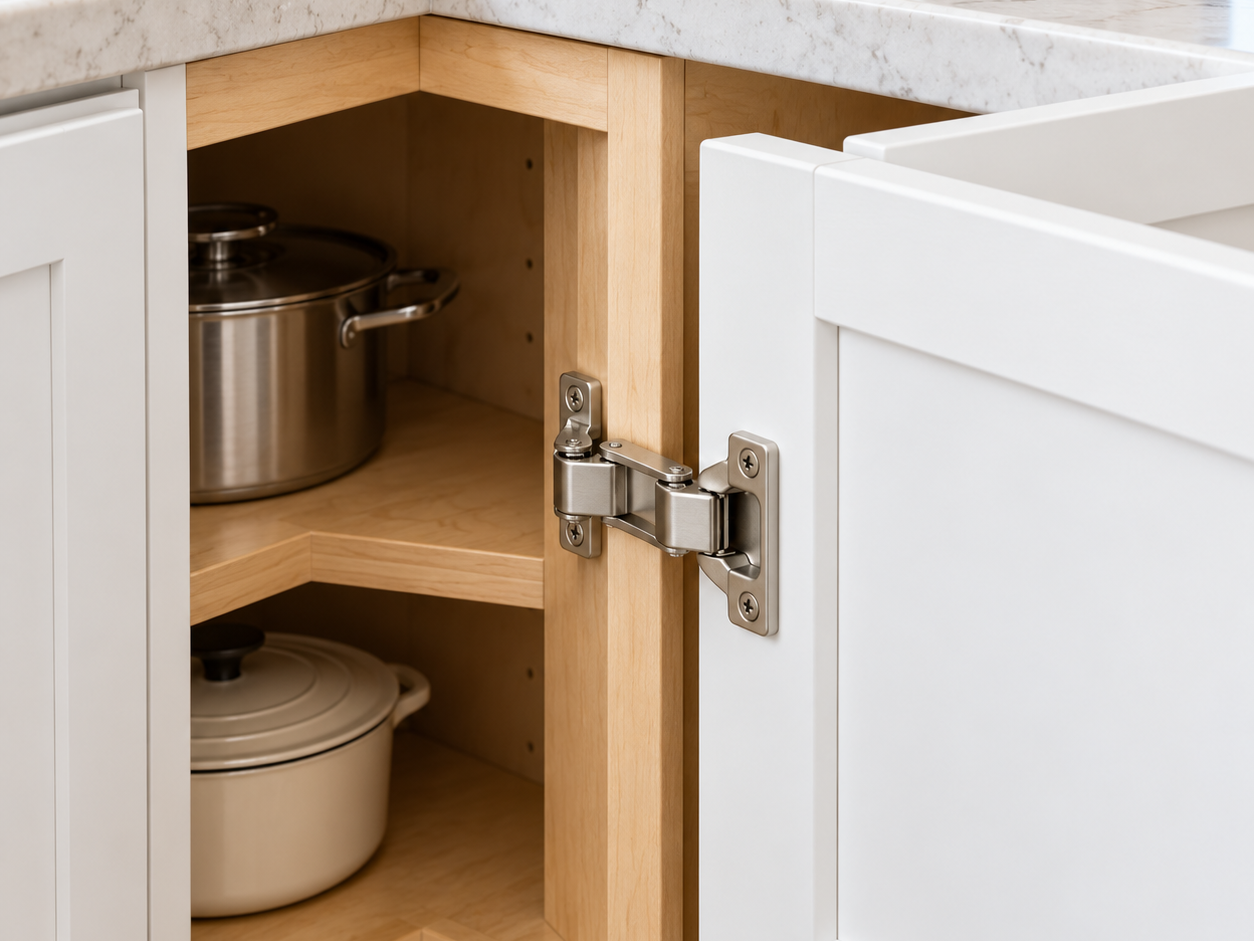
Blind-Corner and Angled Hinges
Blind-corner and angled cabinets often require specialized hinges because the doors do not operate from a conventional straight cabinet side.
These hinges may be designed for:
- Blind-corner cabinets
- Diagonal corner cabinets
- Folding corner doors
- Positive or negative cabinet angles
- Doors mounted to unusual panel positions
The cabinet angle and door movement should be confirmed from drawings or a physical sample.
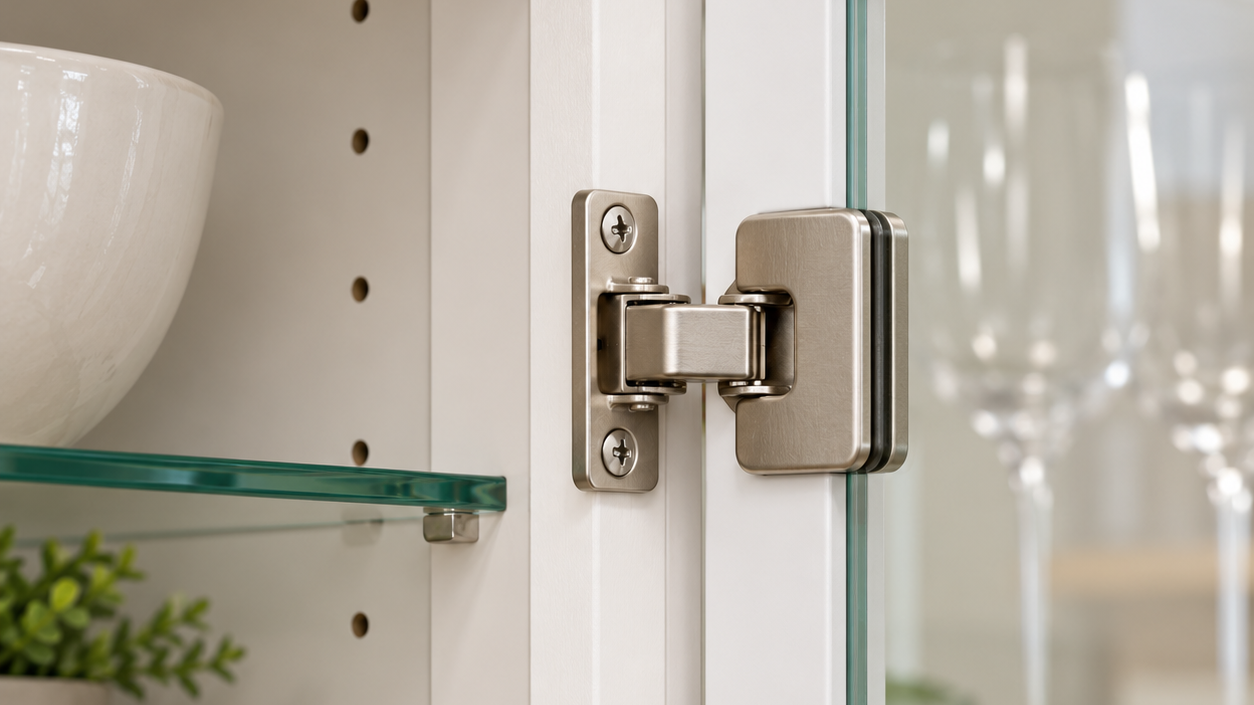
Glass-Door Hinges
Glass cabinet doors may require hinges designed specifically for drilled, clamped or framed glass.
The hinge must correspond to:
- Glass thickness
- Door dimensions and weight
- Tempered-glass requirements
- Hole or cutout preparation
- Edge clearances
- Opening angle
A standard hinge intended for wood or MDF doors should not be assumed suitable for glass.
What Do Full Overlay, Half Overlay and Inset Mean?
Overlay describes how the cabinet door sits in relation to the cabinet opening, face frame or side panel when the door is closed.
Full-Overlay Cabinet Doors
A full-overlay door covers most of the cabinet side panel or face frame.
This creates a more continuous cabinet front with relatively small visible gaps between adjacent doors.
Full-overlay applications are common in:
- Modern frameless cabinets
- Full-overlay face-frame cabinets
- Contemporary kitchens
- Multifamily cabinet packages
- Cabinets designed for narrow and consistent door gaps
“Full overlay” describes the general door position. It does not specify one universal overlay measurement.
Half-Overlay Cabinet Doors
A half-overlay application commonly occurs when two cabinet doors share one center partition in a frameless cabinet.
Each door covers part of the shared panel, allowing both doors to operate from the same divider.
Half overlay is not necessarily the same as every partial-overlay face-frame application.
Partial-Overlay Cabinet Doors
A partial-overlay door covers only part of the cabinet face frame, leaving a visible section of the frame around the door.
Partial overlay is common in traditional framed cabinets.
Because several overlay dimensions may be described as partial overlay, the actual measurement is more useful than the name alone.
Inset Cabinet Doors
An inset door sits inside the cabinet opening instead of covering the front edge.
Inset construction creates a flush and carefully fitted appearance, but it requires consistent clearances around the door.
Cabinet squareness, door dimensions, hinge geometry and installation accuracy are especially important in inset applications.
For a broader explanation, see Full Overlay vs. Partial Overlay vs. Inset Cabinet Doors.
Straight-Arm, Half-Cranked and Full-Cranked Hinges
The shape of a concealed hinge arm helps position the door in relation to the cabinet.
In some manufacturing markets, these hinge configurations are called:
- Straight bend
- Medium bend
- Large bend
For international and North American technical communication, clearer terms are:
- Straight-arm or zero-crank hinge
- Half-cranked hinge
- Full-cranked hinge
| Hinge-arm type | Common supplier term | Typical application | Door position |
|---|---|---|---|
| Straight-arm or zero-crank | Straight arm / straight bend | Full overlay | Door covers most of the cabinet side or face frame |
| Half-cranked | Medium bend | Half overlay | Two doors commonly share one center partition |
| Full-cranked | Large bend | Inset | Door sits inside the cabinet opening |
These are common relationships, but they should not be treated as universal interchangeability rules.
The final door position is also affected by:
- Mounting-plate height
- Hinge-cup position
- Door thickness
- Cabinet construction
- Adjustment range
Straight-Arm Hinges
A straight-arm or zero-crank concealed hinge is commonly used for full-overlay doors.
The relatively straight hinge arm positions the door so that it covers most of the cabinet side or face frame.
However, the exact overlay can vary depending on the mounting plate and cup location.
Half-Cranked Hinges
A half-cranked hinge is commonly used for half-overlay doors.
This configuration is frequently found where two doors share one center panel. The hinge arm moves each door into a position that covers part of the shared partition.
Full-Cranked Hinges
A full-cranked hinge is commonly used for inset doors.
This is sometimes called a large-bend hinge because the hinge arm has a more pronounced crank. The geometry allows the door to sit inside the cabinet opening rather than in front of the cabinet edge.
“Large-bend hinge” is useful informal terminology, but it is not a complete product specification. Different manufacturers may use different arm geometries and mounting plates.
Framed vs. Frameless Cabinet Hinges
Cabinet construction changes where the hinge is mounted.
Framed Cabinets
A framed cabinet has a face frame attached to the front of the cabinet box.
Depending on the cabinet and hinge design, the hinge may attach:
- Directly to the face frame
- Through a face-frame mounting plate
- To an internal cabinet component
- With a compact hinge designed for a specific overlay
Framed cabinets can use full-overlay, partial-overlay or inset doors.
Frameless Cabinets
A frameless cabinet has no separate front face frame. The hinge mounting plate normally attaches directly to the cabinet side panel.
Frameless construction is commonly paired with concealed European hinges because these systems provide adjustment and support several door positions.
Framed and frameless cabinets may look similar from the front while requiring different mounting hardware.
See Framed vs. Frameless Cabinets for a complete cabinet-construction comparison.
What Is the Difference Between Soft-Close and Self-Closing Hinges?
Soft-close and self-closing describe different functions.
| Function | What It Does |
|---|---|
| Self-close | Uses spring force to pull the door toward the closed position |
| Soft-close | Uses damping to reduce the closing speed |
| Combined system | Pulls the door closed and controls the closing speed |
| Free-swing | Allows the door to move without a self-closing spring |
A soft-close hinge often includes a self-closing spring, but this should be confirmed from the actual product specification.
Soft-close performance may also be affected by:
- Door size
- Door weight
- Number of hinges
- Damper adjustment
- Installation alignment
Some integrated dampers can be adjusted or switched off to suit different door sizes.
What Do Cabinet Hinge Opening Angles Mean?
The opening angle describes how far the cabinet door can rotate from its closed position.
Cabinet hinges are available with different opening angles for different applications.
Common categories include:
- Standard-opening hinges
- Restricted-opening hinges
- Wide-angle hinges
- Corner-cabinet hinges
- Folding-door hinges
Exact angles depend on the hinge model.
Standard Opening Angles
Standard concealed hinges commonly provide enough movement for conventional wall, base and vanity cabinets.
They are suitable when the door does not need to clear internal drawers or specialized storage hardware.
Wide Opening Angles
A wide-angle hinge may be useful when:
- The cabinet contains internal drawers
- A pull-out system must move past the open door
- The user needs greater access
- A corner cabinet requires a wider movement path
Opening-Angle Restrictors
Some hinge systems can use a restrictor to reduce the maximum opening angle.
Restrictors may help prevent:
- Handles hitting adjacent walls
- Doors striking appliances
- Two doors colliding
- Excessive movement in confined spaces
The restrictor must match the selected hinge system.
How Are Concealed Cabinet Hinges Adjusted?
Many concealed hinges can be adjusted in three directions.
Side Adjustment
Side adjustment moves the door horizontally.
It is used to create consistent gaps between adjacent cabinet doors.
Height Adjustment
Height adjustment moves the door up or down.
It helps align the top and bottom edges of several doors installed in one cabinet run.
Depth Adjustment
Depth adjustment moves the door closer to or farther from the cabinet.
It helps control how the closed door sits against the cabinet and can affect opening clearance.
Adjustment is intended for final alignment. It should not be used to compensate for incorrectly sized doors, inaccurate drilling or an out-of-square cabinet box.
Are All 35 mm Cabinet Hinges the Same?
No. A 35 mm cup diameter is common, but it does not make all concealed cabinet hinges interchangeable.
Hinges with the same cup diameter may still have different:
- Cup depths
- Fixing-hole patterns
- Cup-edge distances
- Hinge-arm shapes
- Mounting plates
- Opening angles
- Door-thickness limits
- Adjustment ranges
- Closing functions
When replacing a hinge, compare the complete hinge and mounting-plate system rather than the cup diameter alone.
How Many Hinges Does a Cabinet Door Need?
The number of hinges depends on the door and hinge system.
Relevant factors include:
- Door height
- Door width
- Door thickness
- Door material
- Total weight
- Expected use
- Hinge capacity
- Mounting condition
- Added glass, mirrors or decorative components
A small lightweight door and a tall MDF door may require different hinge quantities.
The selected hinge manufacturer’s capacity information should be used instead of applying one fixed rule to every cabinet door.
Common Cabinet Hinge Problems
Cabinet Door Sagging
A sagging door may result from:
- Loose mounting screws
- Incorrect hinge quantity
- Excessive door weight
- Weak screw holding
- Damaged mounting plates
- Inaccurate cabinet installation
Adjustment may temporarily realign the door, but the underlying fastening or capacity problem should also be checked.
Uneven Gaps Between Doors
Uneven gaps can be caused by:
- Side adjustment
- Incorrect door dimensions
- Misaligned mounting plates
- Out-of-square cabinet boxes
- Inconsistent drilling
- Cabinet installation movement
Door Does Not Close Completely
Possible causes include:
- Incorrect hinge type
- Obstructed hinge movement
- Misaligned mounting plate
- Door or handle interference
- Damaged spring mechanism
- Incorrect inset clearance
Soft Close Stops Working
A soft-close function may stop working because of:
- Damper adjustment
- Damaged damping mechanism
- Door weight outside the intended range
- Incorrect hinge quantity
- Dirt or physical obstruction
- General product wear
Door Hits an Adjacent Wall or Cabinet
This usually relates to the opening path rather than the closing function.
Possible solutions include:
- Using an opening-angle restrictor
- Adjusting the cabinet filler
- Changing handle projection
- Reviewing hinge geometry
- Repositioning the cabinet
- Using a more suitable specialty hinge
Screws Become Loose
Loose screws may result from:
- Repeated use
- Incorrect fastener type
- Insufficient material thickness
- Damaged screw holes
- Excessive door weight
- Misaligned hinges placing stress on the fasteners
The repair should address the condition of the door or cabinet material, not only retighten the screw.
Replacement Hinge Does Not Fit
A replacement hinge may have the same general appearance but a different:
- Cup depth
- Fixing-hole pattern
- Hinge arm
- Mounting plate
- Overlay
- Opening angle
The original model number and drilling dimensions should be checked whenever possible.
What Should Be Confirmed for a Complete Cabinet Project?
Builders do not need to turn every cabinet project into a separate hinge engineering exercise. However, several basic conditions should be confirmed before production:
- Framed or frameless construction
- Full-overlay, half-overlay, partial-overlay or inset door position
- Door material and thickness
- Door dimensions and approximate weight
- Required opening clearance
- Soft-close requirements
- Hinge and mounting-plate compatibility
- Door and cabinet machining
For repeated cabinet layouts, approving one complete cabinet sample can help confirm:
- Door alignment
- Gap consistency
- Opening movement
- Soft-close action
- Hardware clearance
- Installation method
Cabinet hinges should be coordinated with the cabinet doors, drawer slides, pull-out accessories and other hardware as part of one complete cabinet system.
How Cabinet Hinges Fit Into the Complete Hardware Package
Hinges are only one part of a kitchen cabinet hardware package.
A complete package may include:
- Cabinet hinges
- Drawer slides
- Drawer boxes
- Pull-out baskets
- Corner cabinet systems
- Waste-bin pull-outs
- Lift-up mechanisms
- Handles and pulls
- Shelf supports
- Joining and mounting hardware
For a broader overview, read the Kitchen Cabinet Hardware Buying Guide.
For complete cabinet construction, finish and project options, visit UWG’s kitchen cabinet systems for builders.
Frequently Asked Questions About Cabinet Hinges
What is the most common type of cabinet hinge?
Concealed European-style hinges are widely used in modern kitchen cabinets. They are hidden when the door is closed and can support several overlays, opening angles, mounting options and soft-close functions.
What is a large-bend cabinet hinge?
A large-bend cabinet hinge is a supplier term commonly used for a full-cranked concealed hinge. It is generally associated with inset cabinet doors, although the final door position also depends on the mounting plate and cup position.
What is the difference between full-overlay and inset hinges?
A full-overlay hinge positions the door in front of the cabinet edge so that it covers most of the side panel or face frame. An inset hinge positions the door inside the cabinet opening.
What is a half-overlay cabinet hinge?
A half-overlay hinge is commonly used when two doors share one center partition. Each door covers part of the shared panel while leaving enough clearance for both doors to operate.
Is half overlay the same as partial overlay?
Not always. Half overlay commonly refers to two doors sharing a partition in frameless cabinetry. Partial overlay often refers to a door covering part of a face frame. The actual hinge and overlay dimensions may differ.
Are soft-close and self-closing hinges the same?
No. A self-closing hinge uses spring force to pull the door closed. A soft-close mechanism slows the door near the end of closing. Some hinges combine both functions.
Are all 35 mm cabinet hinges interchangeable?
No. Hinges with a 35 mm cup can still have different cup depths, fixing patterns, mounting plates, hinge arms, overlays and opening angles.
Can concealed cabinet hinges be adjusted?
Many concealed hinges provide side, height and depth adjustment. The exact adjustment range and method depend on the hinge and mounting plate.
Do framed and frameless cabinets use the same hinges?
Sometimes they can use related hinge systems with different mounting plates, but they should not be assumed identical. Framed cabinets may require compact hinges or face-frame mounting plates, while frameless hinges normally mount directly to the cabinet side panel.
How many hinges should a cabinet door have?
The required quantity depends on the door’s dimensions, material, weight, expected use and hinge capacity. The hinge manufacturer’s capacity guidance should be followed.
Conclusion
Cabinet hinges connect the door to the cabinet and control its position, movement, closing action and alignment.
The most important distinctions include concealed versus exposed hinges, framed versus frameless mounting, soft-close versus self-close functions and full-overlay, half-overlay or inset door positions.
Straight-arm, half-cranked and full-cranked hinges are commonly associated with these different overlays, but the mounting plate, cup position and cabinet construction also influence the final result.
For builders and project buyers, hinges perform best when they are coordinated with the cabinet doors, drawer slides, storage accessories and installation requirements as part of a complete cabinet system.