Builders sourcing materials from Asia often face a tough choice: China or Vietnam? Costs fluctuate, delivery delays happen, and supply chain risks can derail projects. Understanding the real differences is critical. This guide breaks down cost, lead time, and risk to help you make informed sourcing decisions.
China generally offers lower building material costs at scale, faster lead times due to highly integrated supply chains, and more consistent quality control across complex products. Vietnam, while still developing its manufacturing ecosystem, provides key advantages in lower tariff exposure through free trade agreements and can help optimize total landed cost in certain markets. The best choice depends on project size, material complexity, and trade conditions—China is typically favored for large, time-sensitive, and technically demanding projects, while Vietnam is better suited for tariff-sensitive sourcing strategies and supply chain diversification.
To help you make the right decision, I’ll break down the differences in cost, lead time, and risk, and explain the reasons behind them based on real sourcing logic.
What Defines Building Material Sourcing in China vs Vietnam?
Before comparing, it’s important to clearly define what we mean by building materials sourcing.
In international construction projects, commonly sourced materials include:
- Structural steel and rebar
- Aluminum profiles and façade systems
- Ceramic tiles and stone
- Furniture Components
- Prefabricated components
From our experience, sourcing is not just about buying materials—it’s about managing an entire supply chain system.
China: Integrated Industrial Ecosystem
China’s biggest advantage lies in its industrial clustering.
For example, in a single region, you can find:
- Raw material suppliers
- Processing factories
- Surface treatment plants
- Packaging and logistics providers
This creates:
- Faster coordination
- Lower production cost
- Better quality consistency
In one façade project we handled, switching between suppliers in China took less than 48 hours because everything was locally interconnected.
Vietnam: Emerging but Fragmented Supply Chain
Vietnam is still developing this ecosystem.
Many manufacturers depend on:
- Imported raw materials (often from China)
- External processing services
- Limited local supporting industries
This leads to:
- Longer coordination cycles
- Higher dependency risks
- Less flexibility in customization
This structural gap is the root cause behind most cost, lead time, and risk differences.
Cost Comparison: China vs Vietnam Building Materials
Landed Cost Comparison Table
| Factor | China | Vietnam |
|---|---|---|
| Base material cost | Lower (mass production) | Slightly higher |
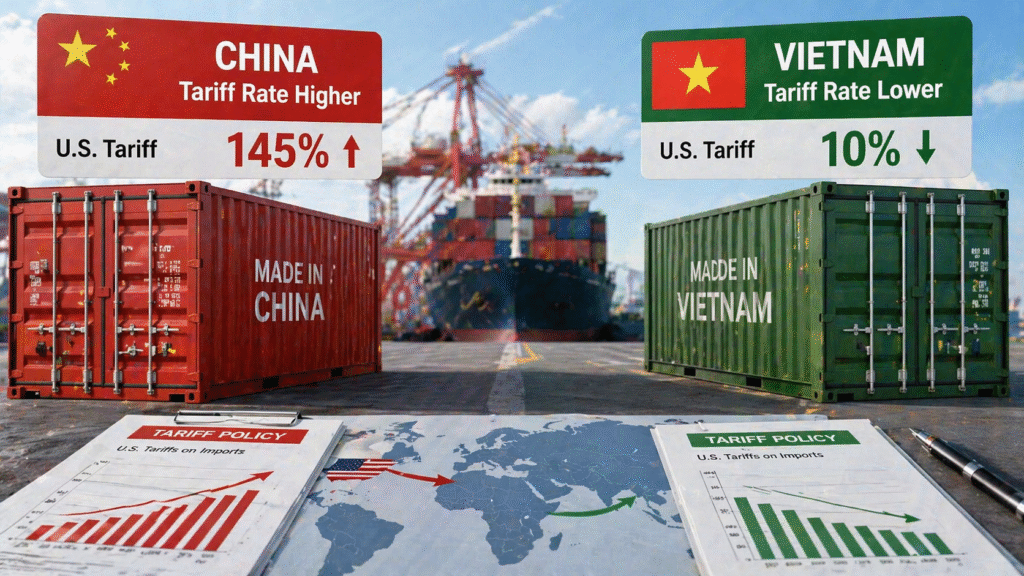
| Tariffs (US/EU) | High (Section 301, anti-dumping) | Lower (FTA benefits) |
| Production efficiency | Very high | Moderate |
| Rework / defect cost | Low | Medium risk |
| Logistics cost | Competitive | Slightly higher variability |
| Total landed cost | Can increase significantly | Often competitive |
Understanding the Real Cost: Landed Cost vs Factory Price
A common mistake I see is focusing only on EXW or FOB prices.
In reality, what matters is:
Total Landed Cost = Product + Shipping + Tariffs + Risk Cost
🇨🇳 China Cost Advantage (Base Price)
China remains cheaper because of:
- Large-scale production
- Automation and efficiency
- Strong supplier competition
According to global construction cost insights (Arcadis, 2025), mature markets with integrated supply chains tend to deliver lower unit costs at scale.
🇻🇳 Vietnam Cost Advantage (Tariffs)
Vietnam’s strength is not production cost—it’s trade policy advantage.
Thanks to agreements like:
- CPTPP
- EVFTA
- RCEP
Vietnam exports often benefit from:
- Reduced or zero tariffs
- Better access to Western markets
Real Case Insight
In one U.S. project involving aluminum curtain walls:
- China supplier:
- Unit price: 10% lower
- Tariff added: +25%
- Vietnam supplier:
- Unit price: higher
- Tariff: near zero
Final result: Vietnam was 15–18% cheaper overall
But this only worked because:
- The Vietnam supplier met origin rules
- The project timeline allowed longer lead time
How Do Tariffs Impact China vs Vietnam Material Costs?
Tariffs are not just a cost—they are a strategic decision factor.
🇨🇳 China Tariff Risks
China exports often face:
- Section 301 tariffs (U.S.)
- Anti-dumping duties (steel, aluminum)
- Policy volatility
These can:
- Increase cost unpredictably
- Reduce competitiveness
- Affect long-term contracts
🇻🇳 Vietnam Tariff Advantages
Vietnam benefits from:
- Preferential trade agreements
- Lower duty rates
- Positive trade positioning
This makes Vietnam especially attractive for:
- U.S. projects
- EU construction imports
Technical Explanation: Rules of Origin
This is where many buyers make mistakes.
To qualify for tariff benefits:
- Products must meet local content requirements
- Processing must be substantial
If not:
- Goods may be classified as Chinese origin
- Tariffs will still apply
We’ve seen cases where shipments were reclassified at customs, causing unexpected duty costs.
Lead Time Comparison: Which Country Delivers Faster?
Lead Time Comparison
| Stage | China | Vietnam |
|---|---|---|
| Production speed | Fast | Moderate |
| Raw material availability | High | Medium |
| Logistics efficiency | Advanced | Developing |
| Shipping frequency | Very high | Lower |
| Reliability | High | Medium |
China Lead Time Advantage
China excels due to:
- Ready access to raw materials
- Highly optimized production lines
- Frequent global shipping routes
According to Cushman & Wakefield , supply chain maturity directly impacts delivery reliability and speed.
Vietnam Lead Time Challenges
Vietnam often faces:
- Raw material delays
- Limited production slots
- Port congestion
In one door procurement project:
- China delivery: 40 days
- Vietnam delivery: 55–70 days
The delay came from material sourcing + scheduling constraints
Risk Comparison: Supply Chain, Quality, and Stability
Pros & Cons Analysis
🇨🇳 China
Advantages:
- Mature quality control systems
- Strong engineering capability
- Reliable large-scale production
Risks:
- Tariff exposure
- Geopolitical uncertainty
- Overdependence
🇻🇳 Vietnam
Advantages:
- Lower tariff exposure
- Alternative sourcing option
- Growing industrial base
Risks:
- Quality inconsistency
- Limited technical depth
- Supply chain fragility
Real Project Scenario
In a mixed sourcing project:
We used:
- China → structural components
- Vietnam → secondary materials
Challenges encountered:
- Vietnam required additional inspections
- Communication gaps increased coordination time
Final insight: Vietnam reduced tariff cost, but increased management complexity
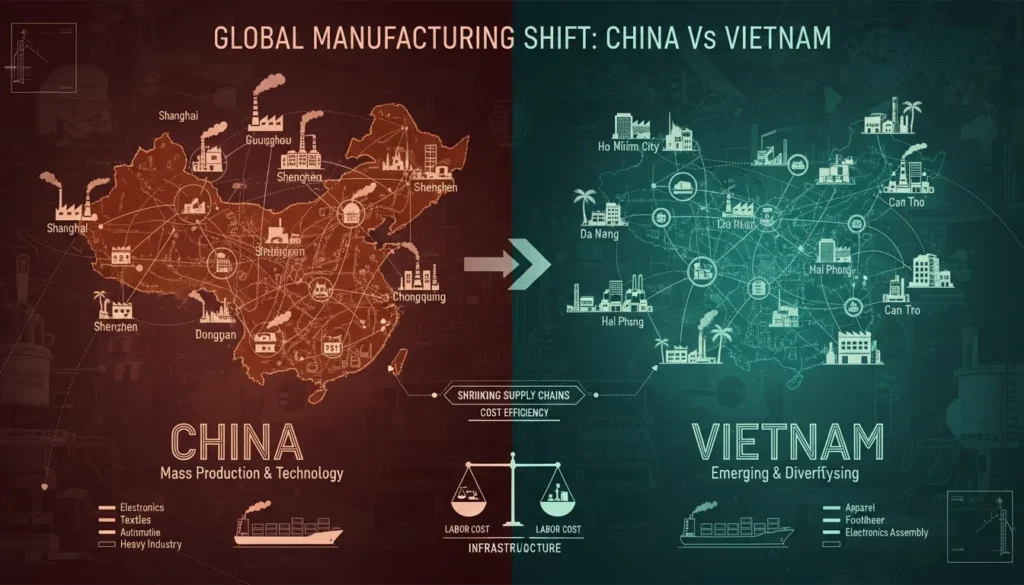
Why Do These Differences Exist?
The differences are not accidental—they are structural.
Industrial Depth
- China has a complete manufacturing ecosystem.
- Vietnam is still building one.
Raw Material Supply
- China: mostly domestic
- Vietnam: heavily imported
Infrastructure
China:
- World-class ports
- Dense logistics network
Vietnam:
- Improving but uneven
Experience in Global Projects
China suppliers:
- Extensive export experience
- Familiar with international standards
Vietnam suppliers:
- Still scaling capabilities
How should builders decide whether to import from China or from Vietnam?
From a practical perspective, your decision should depend on project priorities.
Choose China When:
- You need speed and reliability
- Your project is complex or large-scale
- Quality consistency is critical
Choose Vietnam When:
- Tariffs significantly impact cost
- You want supply chain diversification
- Materials are relatively standardized
Frequently Asked Questions About Sourcing: China vs. Vietnam
Q: Which country offers lower building material costs: China or Vietnam?
A: China typically offers lower base production costs due to mass-scale automation and a highly integrated industrial ecosystem. However, for builders and developers in the U.S., Vietnam often delivers a more competitive total landed cost. This is because Vietnam-made materials benefit from lower tariff exposure under various free trade agreements, which can often offset their slightly higher raw manufacturing prices.
Q: How do lead times compare between Chinese and Vietnamese building material suppliers?
A: China generally provides faster and more reliable lead times. Its mature supply chain allows for rapid raw material sourcing and high-frequency shipping routes. Vietnamese manufacturers often rely on imported components—frequently from China—which can lead to longer coordination cycles and extended timelines, particularly for complex façade systems or highly customized cabinetry orders.
Q: What are the primary risks when sourcing construction materials from Vietnam?
A: The primary risks in Vietnam include fragmented local supply chains, potential quality inconsistencies, and strict “rules of origin” compliance. To qualify for significant tariff benefits, products must meet specific local processing requirements. If not managed carefully, goods may be reclassified at customs, leading to unexpected anti-dumping duties. M4B mitigates these risks by managing rigorous local quality control and verifying origin documentation before any shipment.
Q: When should a developer choose China over Vietnam for their project?
A: Developers should prioritize China when project speed, technical complexity, and massive scale are the deciding factors. China’s deep engineering expertise and ready-to-use infrastructure make it the superior choice for time-sensitive, high-volume commercial projects. Vietnam is the preferred strategic choice for builders looking to diversify their global supply chain and minimize long-term tariff risks on more standardized building materials.
Summary
China remains the most efficient and reliable source for building materials, especially for large and complex projects. Vietnam offers strong tariff advantages and diversification opportunities. The smartest sourcing strategy is to evaluate total landed cost and combine both markets when necessary.
Articles that you may be interested in:
Barn Doors for Interiors: Materials, Tracks, and Installation Tips
Trending Door Materials: MDF, Veneered, Fiberglass, and Steel