When specifying painted cabinets for residential projects, builders often face a common question: should they choose solid wood or MDF? Both materials are widely used in painted cabinet doors, but they differ significantly in cost, finish quality, durability, and long-term performance.
For builders, the right choice depends on project positioning, budget goals, and homeowner expectations. This article compares solid wood and MDF from a builder’s perspective, helping you determine which material delivers the best value for your painted cabinet program.
For most painted cabinet projects, MDF is often the better choice because it provides a smoother paint finish, greater dimensional stability, and a lower risk of paint-line cracking than solid wood. These advantages make MDF especially suitable for production housing, multifamily projects, and budget-conscious residential construction. Solid wood remains a strong option for luxury homes and custom cabinetry where premium material perception and structural strength are priorities. For many builders, a hybrid construction using solid wood frames and MDF center panels offers the best balance of appearance, performance, and cost.
What Are Solid Wood Cabinets?
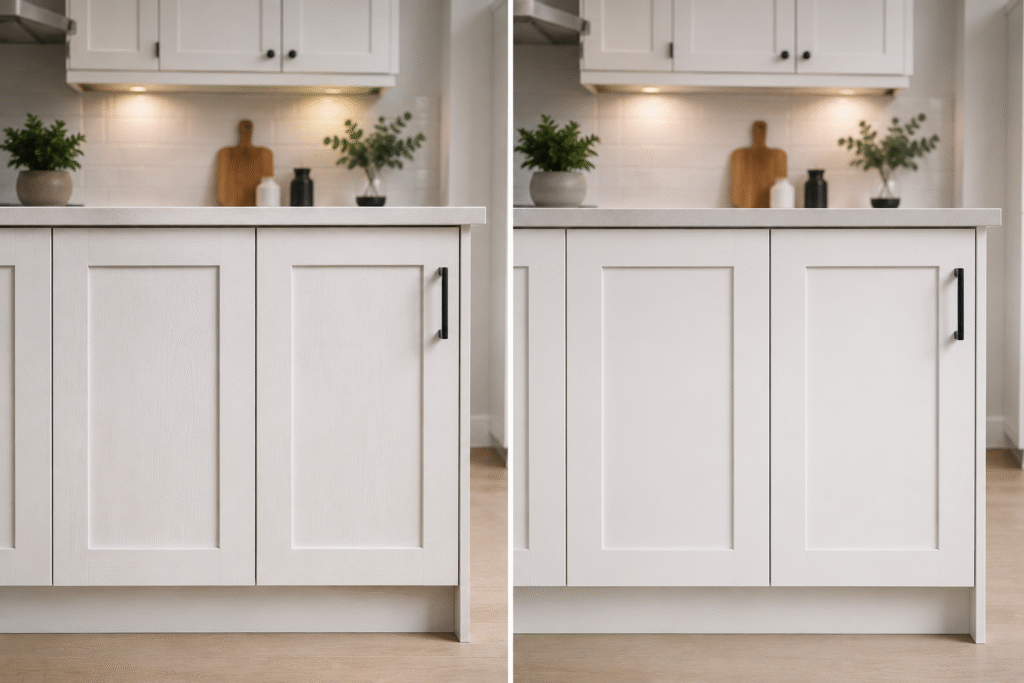
Solid wood cabinets are made using natural hardwood components such as maple, oak, birch, cherry, poplar, or walnut. In painted cabinet applications, solid wood is commonly used for cabinet door frames, rails and stiles, decorative moldings, face frames, and other structural parts.
However, it is important for builders to understand that “solid wood cabinets” do not always mean every part of the cabinet is made from solid hardwood. In modern cabinet manufacturing, even premium cabinet lines often combine solid wood with plywood, MDF, or other engineered wood materials to improve stability and reduce movement.
For painted cabinets, this distinction matters. Natural wood has strength and premium appeal, but it also expands and contracts with humidity changes. That movement can affect painted finishes over time, especially around door joints.
What Is MDF?
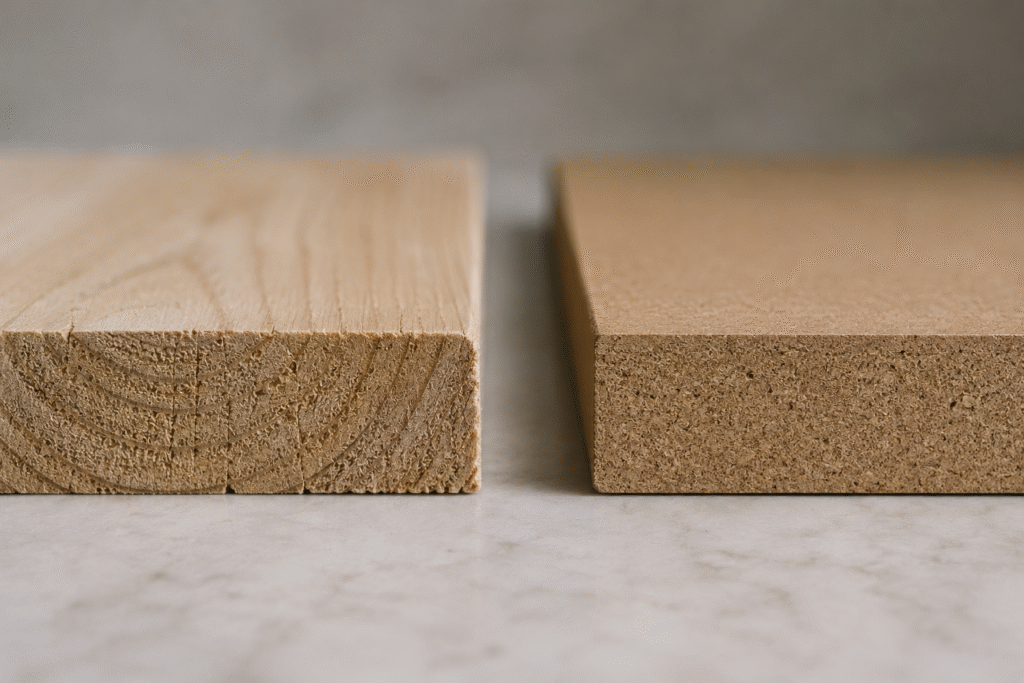
MDF, or Medium-Density Fiberboard, is an engineered wood product made by compressing wood fibers, resin, and wax under heat and pressure. Unlike solid wood, MDF has no natural grain direction. It has a smooth, uniform surface and consistent density throughout the panel.
These characteristics make MDF one of the most common materials for painted cabinet doors, drawer fronts, and flat decorative panels.
For builders working on painted cabinet packages, MDF is often attractive because it provides a clean paint surface, stable performance, and predictable quality across large production runs.
Solid Wood vs. MDF
| Feature | Solid Wood | MDF |
|---|---|---|
| Paint Finish Smoothness | Good | Excellent |
| Surface Consistency | Moderate | Excellent |
| Grain Visibility | May show through paint | No grain |
| Paint Crack Resistance | Moderate | High |
| Dimensional Stability | Moderate | High |
| Moisture Resistance | Better when sealed | Moderate |
| Weight | Usually lighter | Heavier |
| Structural Strength | High | Moderate |
| Screw-Holding Strength | Strong | Moderate |
| Cost | Higher | Lower |
| Premium Perception | Higher | Moderate |
| Best Use | Luxury/custom projects | Painted production cabinets |
Why MDF Is Often Preferred for Painted Cabinets
1. MDF Provides a Smoother Painted Finish
For painted cabinets, surface quality is one of the most important performance factors. MDF has no natural grain, knots, or mineral streaks, so the paint finish usually looks smoother and more consistent than painted solid wood.
This is especially important for:
- White painted cabinets
- Light gray cabinets
- Matte finishes
- Modern flat-panel cabinet doors
- Shaker-style painted cabinet doors
In our project experience, builders often prefer MDF cabinet doors for large residential programs because the finish remains more consistent from one home to another. When a builder is ordering hundreds or thousands of cabinet doors, small differences in wood grain or paint absorption can become a major quality-control issue.
2. MDF Reduces the Risk of Paint-Line Cracking
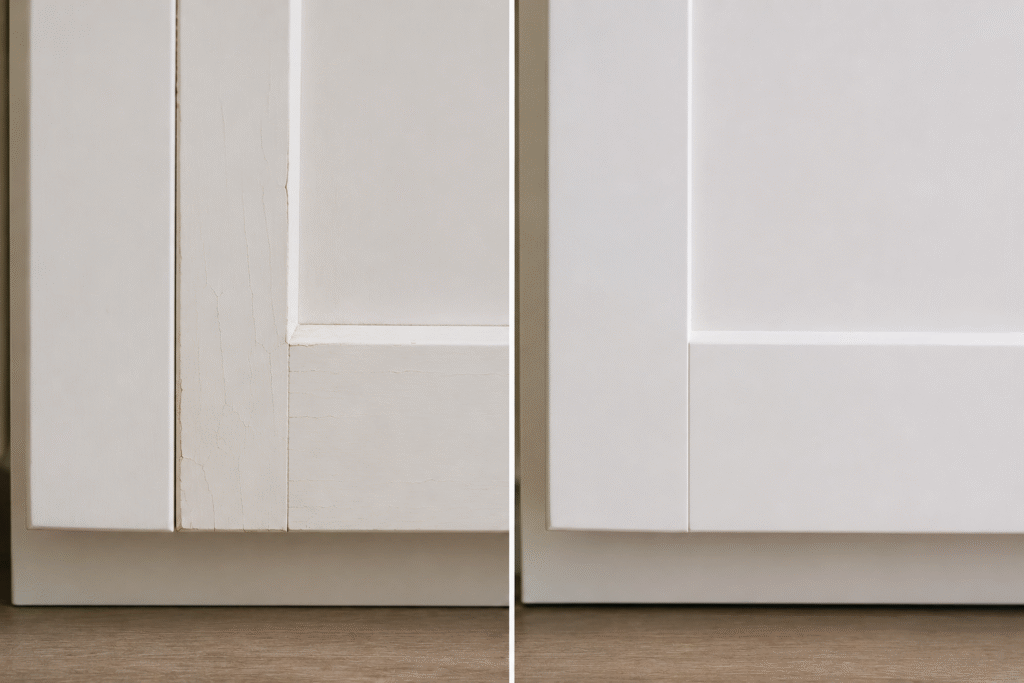
One of the most common problems with painted solid wood cabinet doors is hairline cracking at the joints. This usually happens because solid wood expands and contracts as humidity changes.
In a traditional five-piece cabinet door, the rails, stiles, and center panel may move slightly over time. When the painted finish cannot move at the same rate, small cracks can appear at the joints.
MDF is more dimensionally stable because it does not have the same natural grain movement as solid wood. This makes MDF a strong choice for builders who want to reduce finish-related warranty claims.
For painted cabinet programs, this is one of the biggest practical advantages of MDF.
3. MDF Offers Better Consistency for Large Builder Projects
Builders need materials that perform consistently across multiple homes, units, or phases. MDF provides:
- Uniform density
- Predictable machining
- Consistent paint absorption
- Stable profiles
- Fewer natural material variations
This makes MDF especially useful for production housing, multifamily construction, townhome communities, and build-to-rent projects.
In large-scale cabinet programs, consistency is not just an aesthetic issue. It affects installation, replacement parts, service calls, and long-term homeowner satisfaction.
Why Builders Still Choose Solid Wood
1. Solid Wood Has Stronger Premium Perception
Many homeowners still associate solid wood with higher quality and better craftsmanship. Even when MDF performs better under paint, solid wood may still carry stronger marketing value in luxury homes or custom residential projects.
For builders targeting higher-end buyers, solid wood can help support a premium product story.
This is especially true when cabinet specifications are part of the home’s sales presentation.
2. Solid Wood Provides Better Structural Strength
Solid wood generally offers better impact resistance and screw-holding strength than MDF. This can be useful for:
- Larger cabinet doors
- Decorative cabinet components
- Furniture-style cabinetry
- High-use areas
- Custom built-ins
While MDF performs well for most painted cabinet doors, solid wood can still be the better choice for structural parts or applications where strength is more important than paint smoothness.
3. Solid Wood Works Well for Custom Cabinet Details
Some custom profiles, decorative edges, and specialty cabinet details are easier to produce with solid wood. For high-end custom homes, wood species, grain characteristics, and craftsmanship can become part of the overall design value.
However, for painted cabinets, builders should still consider how the natural movement of solid wood may affect the paint finish over time.
Pros and Cons of Solid Wood for Painted Cabinets
Advantages
Strong Premium Appeal
Solid wood is still widely recognized as a high-value cabinet material, especially in custom and luxury homes.
Better Structural Strength
It provides strong screw-holding ability and good impact resistance.
Good Repairability
Minor damage can often be sanded, repaired, and repainted.
Suitable for High-End Custom Work
Solid wood is a strong choice for decorative details, specialty profiles, and premium cabinet programs.
Disadvantages
Higher Cost
Solid wood usually costs more than MDF, especially when using hardwood species.
Higher Risk of Paint Cracking
Natural wood movement can cause hairline cracks at joints over time.
Grain May Show Through Paint
Some wood species require more surface preparation to achieve a smooth painted finish.
More Material Variation
Color, grain, density, and movement can vary from board to board.
Pros and Cons of MDF for Painted Cabinets
Advantages
Excellent Paint Finish
MDF provides a very smooth surface, making it ideal for painted cabinet doors.
No Grain Telegraphing
Because MDF has no natural grain, the painted surface looks cleaner and more uniform.
Better Dimensional Stability
MDF reduces the risk of joint movement and paint-line cracking.
More Cost-Effective
MDF is usually more affordable than solid hardwood, helping builders control cabinet package costs.
Strong Consistency
It is well suited for large residential projects where repeatable quality is important.
Disadvantages
Heavier Material
MDF is typically heavier than solid wood, which may affect handling and installation.
Lower Moisture Tolerance
If MDF is not properly sealed, it can swell when exposed to excessive moisture.
Lower Premium Perception
Some homeowners still view MDF as less valuable than solid wood, even when it performs better for painted finishes.
Lower Screw-Holding Strength
MDF does not hold screws as strongly as solid wood, especially near edges.
Frequently Asked Questions About Painted Cabinet Materials
Q: Why is MDF often considered superior to solid wood for painted cabinet doors?
A: MDF is highly favored for painted cabinetry because it is extremely stable and does not expand or contract significantly with changes in humidity. This stability prevents the common issue of hairline cracks appearing in the paint at the joints, which frequently occurs with solid wood doors as they naturally move over time.
Q: Does solid wood offer any advantages over MDF for painted cabinetry?
A: Solid wood provides a more substantial, authentic feel and is generally more durable against heavy physical impact. It is also the better choice for cabinet frames or structural components where screw-holding power and load-bearing strength are critical requirements that fiberboard materials cannot match.
Q: How does the cost of MDF compare to solid wood for cabinet projects?
A: MDF is typically more cost-effective than solid wood, making it a strategic choice for large-scale multi-family projects where maintaining a uniform, high-end painted aesthetic while controlling material costs is essential. Solid wood represents a premium investment due to the higher cost of raw timber and the additional processing required for consistent finishing.
Q: Are there any specific finishing considerations when using these materials? A: MDF provides a perfectly smooth, uniform surface that takes paint exceptionally well, resulting in a flawless finish. Solid wood surfaces have natural grain patterns that can sometimes “telegraph” through the paint, and their natural movement requires the use of specialized flexible primers or construction techniques to maintain a high-quality aesthetic in long-term service.
Conclusion
For painted cabinets, MDF is usually the better choice for builders focused on smooth finish quality, cost control, and long-term stability. Solid wood remains valuable for luxury and custom projects where premium material perception and structural strength are important.
In many residential cabinet programs, the best solution is hybrid construction: solid wood frames combined with MDF center panels. This approach gives builders a practical balance of appearance, performance, cost, and reduced warranty risk.
Articles that you may be interested in:
Shaker Cabinets vs Flat Panel Cabinets: Which Style Fits Your Project?
How to Choose Between Framed and Frameless Cabinets for Renovations?