
Few products demonstrate the power of standardization in residential construction better than the 30-inch interior door. Despite the availability of multiple door widths, this size continues to account for a significant share of interior door demand across the United States.
Its popularity extends beyond homeowner preference. Builders rely on it as a practical specification for standard floor plans, manufacturers prioritize it in production, and distributors benefit from its consistent turnover and broad market acceptance. Together, these factors have helped establish the 30-inch door as a benchmark within the residential door industry.
For wholesalers, understanding why this size dominates the market provides valuable insight into demand trends, inventory planning, and future purchasing decisions. So what has allowed the 30-inch interior door to maintain its position as the industry’s preferred standard for decades?
30-inch interior doors remain the most common choice because they offer the best balance of functionality, space efficiency, cost-effectiveness, and compatibility with standard residential construction. Their widespread adoption throughout the supply chain has also made them one of the most accessible and commercially viable door sizes in the U.S. market.
How Standardization Shaped the Interior Door Market
The dominance of 30-inch interior doors cannot be understood without looking at the role of standardization in residential construction.
Over the past several decades, American builders have increasingly relied on standardized building components to improve efficiency, reduce construction costs, and simplify project planning. Interior doors became part of this broader movement. Rather than designing every opening around custom dimensions, builders adopted a limited range of door sizes that could be used across multiple room types.
This standardization created significant advantages throughout the supply chain:
- Manufacturers could streamline production and improve output efficiency.
- Distributors could manage inventory more predictably.
- Contractors could reduce installation complexity on job sites.
- Builders could simplify planning across repeated floor plans.
As a result, a handful of door sizes emerged as industry standards, with 30-inch doors becoming the preferred choice for most residential applications.
For wholesalers, this standardization remains one of the primary reasons why demand for 30-inch interior doors continues to outperform many alternative sizes.
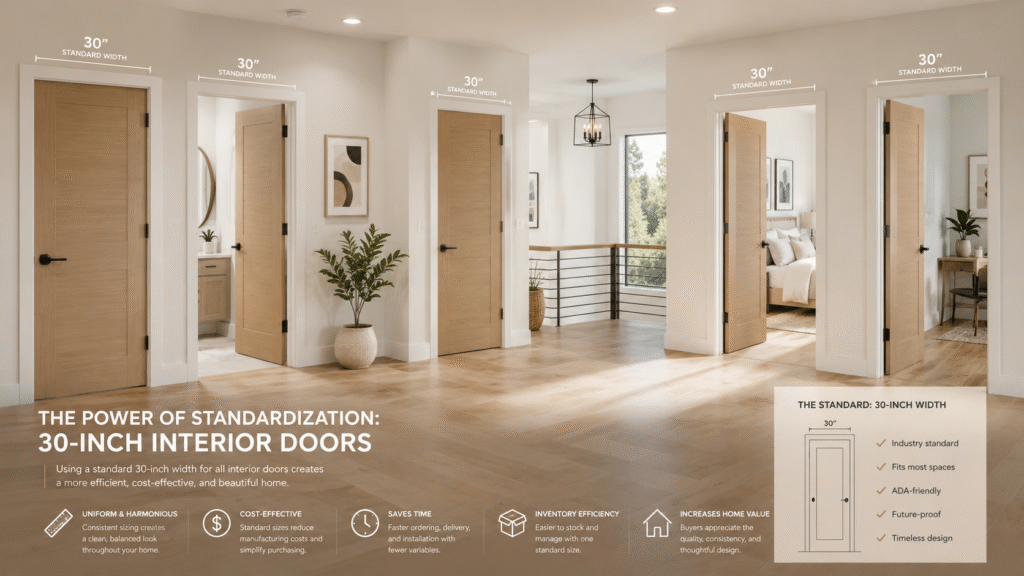
Where 30-Inch Doors Fit Within Our Standard Interior Door Size System
Although several interior door widths are used in the U.S. housing market, most standard residential projects can be served efficiently through a focused size system built around 28-inch, 30-inch, and 32-inch doors.
| Door Width | Typical Application | Market Demand |
|---|---|---|
| 28 Inches | Small bathrooms, closets, laundry rooms, and compact secondary spaces | Moderate |
| 30 Inches | Bedrooms, bathrooms, home offices, and standard living spaces | High |
| 32 Inches | Larger bedrooms, upgraded homes, and projects requiring wider clearance | Growing |
Within this size system, each width serves a clear purpose.
A 28-inch interior door is often used where space is limited, especially in smaller rooms or secondary areas that do not require wide daily access.
A 32-inch interior door provides added clearance and is commonly selected for larger rooms, upgraded layouts, or projects where builders want to improve comfort and long-term usability.
The 30-inch door sits at the center of this system. It provides sufficient clearance for everyday residential use while remaining compatible with the room dimensions found in most American homes. Unlike narrower options, it rarely feels restrictive. Unlike wider alternatives, it does not require additional wall space or significantly increase framing requirements.
This balance has allowed 30-inch doors to occupy the strongest position within the standard residential interior door market. As production builders sought repeatable solutions that could work across thousands of homes, the 30-inch door naturally emerged as the default specification.
Why 30-Inch Doors Continue to Dominate the Market
The success of 30-inch interior doors is not tied to a single advantage. Instead, it results from a combination of factors that benefit builders, manufacturers, distributors, and homeowners alike.
From a construction perspective, 30-inch doors provide an effective balance between accessibility and space efficiency. They offer comfortable daily access without requiring the additional wall space associated with wider door openings, making them compatible with most residential floor plans.
Several factors continue to support their dominant market position:
- Practical clearance: 30-inch doors provide enough space for everyday residential use.
- Space efficiency: They work well in standard bedrooms, bathrooms, home offices, and secondary rooms.
- Cost control: They avoid the added framing and material requirements often associated with wider openings.
- Production efficiency: High-volume manufacturing helps reduce costs throughout the supply chain.
- Contractor familiarity: Installers are accustomed to working with this size across standard residential projects.
Perhaps most importantly, decades of widespread adoption have created a strong ecosystem around the 30-inch standard. Manufacturers prioritize production, distributors maintain larger inventories, and contractors are accustomed to working with the size. This creates a self-reinforcing cycle that continues to strengthen its market position.
For wholesalers, these factors translate into predictable demand, faster inventory turnover, and lower stocking risk compared with less common door sizes.
Why 30-Inch Doors Make Sense for Wholesalers
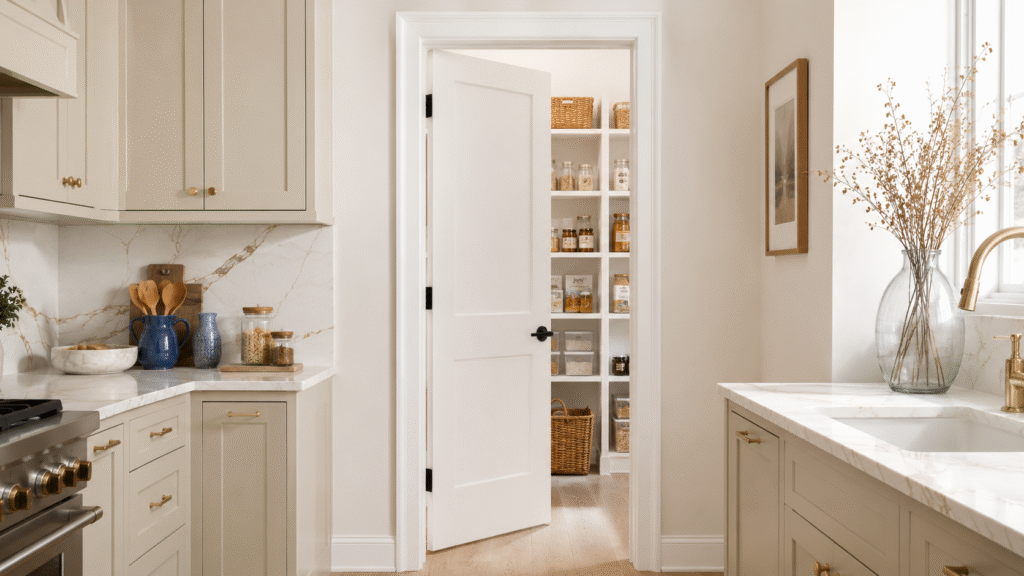
For wholesalers, the appeal of 30-inch interior doors extends beyond their popularity with builders. Their widespread use creates a level of demand predictability that is difficult to match with less common sizes.
Because 30-inch doors are specified in a large percentage of residential projects, they typically move through inventory faster and require less warehouse space relative to sales volume. This helps distributors maintain healthier inventory turnover while reducing the risk of overstocking slow-moving products.
At the same time, 30-inch doors work best when positioned as part of a broader standard size offering. Wholesalers can use 30-inch doors as the core inventory size while supporting them with 28-inch and 32-inch options for different project needs.
The 28-inch door can serve compact spaces such as closets, small bathrooms, laundry rooms, and secondary areas. The 32-inch door can serve larger rooms, upgraded homes, and projects where builders want to provide more comfortable clearance. Together, these three sizes allow wholesalers to cover a wide range of standard residential applications without relying heavily on custom dimensions.
This combination of consistent demand, efficient inventory management, and dependable supply makes the 30-inch interior door one of the most commercially attractive products in the residential door market.
How 28-, 30-, and 32-Inch Doors Support Different Project Needs
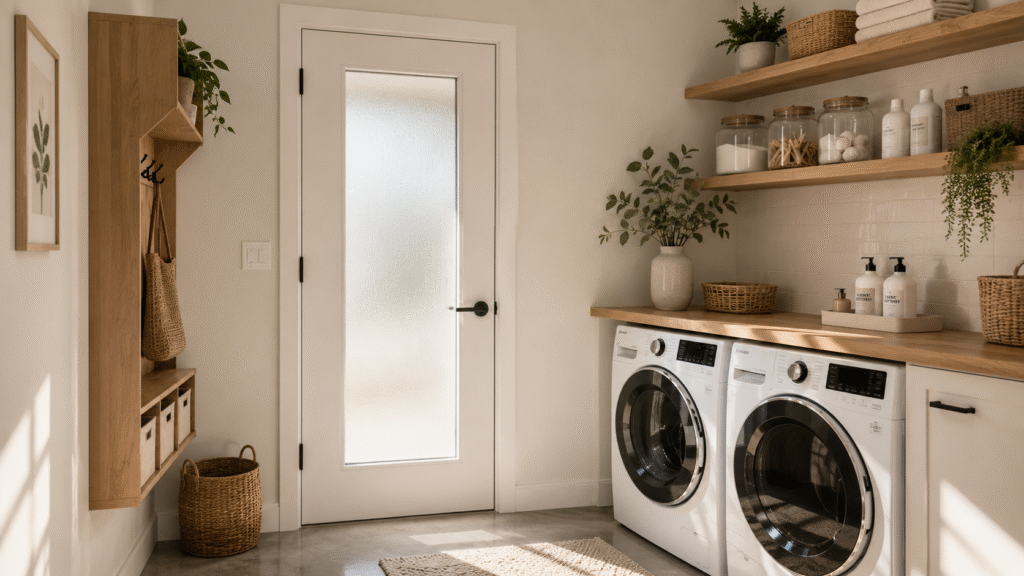
While 30-inch doors remain the core size, 28-inch and 32-inch doors also play important roles in residential construction.
A 28-inch door is often selected for tighter layouts where saving wall space is important. It is especially useful for lower-traffic rooms or functional areas where a full-width opening is not necessary. For wholesalers, this size can serve as a practical supporting product for builders working on compact floor plans or cost-sensitive projects.
A 30-inch door remains the most versatile option. It works across bedrooms, bathrooms, home offices, and many everyday interior applications. This makes it the most reliable stock size for high-volume residential demand.
A 32-inch door provides a wider opening and is gaining attention in upgraded homes, larger bedrooms, and layouts designed with greater comfort or long-term usability in mind. Although it may not replace the 30-inch standard in mainstream residential construction, it can help wholesalers support builders who need a more flexible product range.
For distributors, the key is not to treat wider doors as a direct threat to 30-inch demand. Instead, 28-inch, 30-inch, and 32-inch doors should be managed as a coordinated standard size system. This approach gives builders practical options for different room types while helping wholesalers keep inventory focused, predictable, and commercially efficient.

Frequently Asked Questions About Standard Vinyl Window Sizes
Q: What are the primary benefits of specifying standard vinyl window sizes over custom ones?
A: Standard vinyl window sizes provide lower upfront material costs, significantly shorter factory lead times, and highly simplified framing and installation processes. Additionally, they streamline the procurement pipeline across large-scale projects and make future unit replacements much easier to source without structural modifications.
Q: How do you read standard window size notation codes like 2030 or 3050?
A: Window size notation uses a four-digit code where the first two digits represent the nominal width in feet and the last two digits represent the nominal height in feet. For example, a code of 2030 translates directly to a nominal window size that is 2 feet wide by 3 feet high.
Q: What is the critical difference between a rough opening and the actual window size?
A: The rough opening is the raw framed opening built into the wall structure, while the actual window size refers to the physical manufactured dimensions of the window unit itself. To allow adequate space for proper leveling, shimming, and insulation during installation, the actual window unit is manufactured to be slightly smaller than the rough opening.
Q: When is it necessary for a builder to use custom vinyl window sizes?
A: Custom window sizes are typically required when standard dimensions cannot fulfill specific design or structural limitations. Common examples include renovation projects with existing non-standard openings, high-end custom home designs, large structural feature or picture windows, and unique architectural layouts.
Conclusion
The dominance of the 30-inch interior door is not simply the result of tradition—it is the outcome of decades of industry standardization.
For builders and wholesalers, its value comes from a practical balance of functionality, space efficiency, cost control, and reliable availability. While 28-inch and 32-inch doors remain important supporting sizes for compact spaces and upgraded layouts, the 30-inch door continues to sit at the center of the standard residential door size system.
As housing trends evolve, different door sizes may gain traction in specific applications. However, the 30-inch interior door remains the benchmark of the American residential market and is likely to retain that position for years to come.
Articles that you may be interested in:
1-3/8″ vs. 1-3/4″ Interior Doors: Which Thickness Should You Choose for Your Projects?
How to Balance Style and Function When Selecting Interior Doors for Large-Scale Projects