
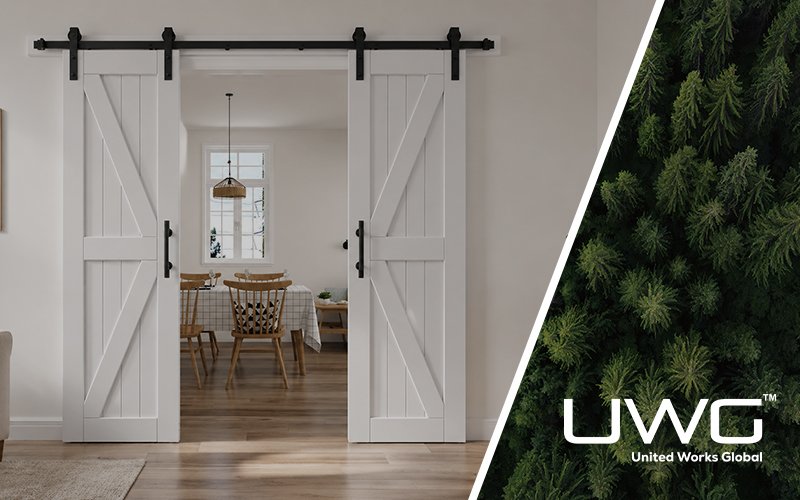
Barn doors are no longer used only for farmhouse-style interiors. In residential projects, they are now commonly used for bedrooms, closets, laundry rooms, pantries, bathrooms, basements, and multi-family housing.
For builders and project buyers, choosing the right barn door style is not just about appearance. The door style can affect project cost, installation efficiency, hardware selection, finish quality, and long-term customer satisfaction.
Among the most common options, molded barn doors, shaker barn doors, and K-frame barn doors each serve different project needs. Some are better for cost control, while others are more suitable for design-focused homes or feature spaces. This guide compares the three styles from a builder’s perspective and helps identify where each option works best.
What Is a Barn Door?
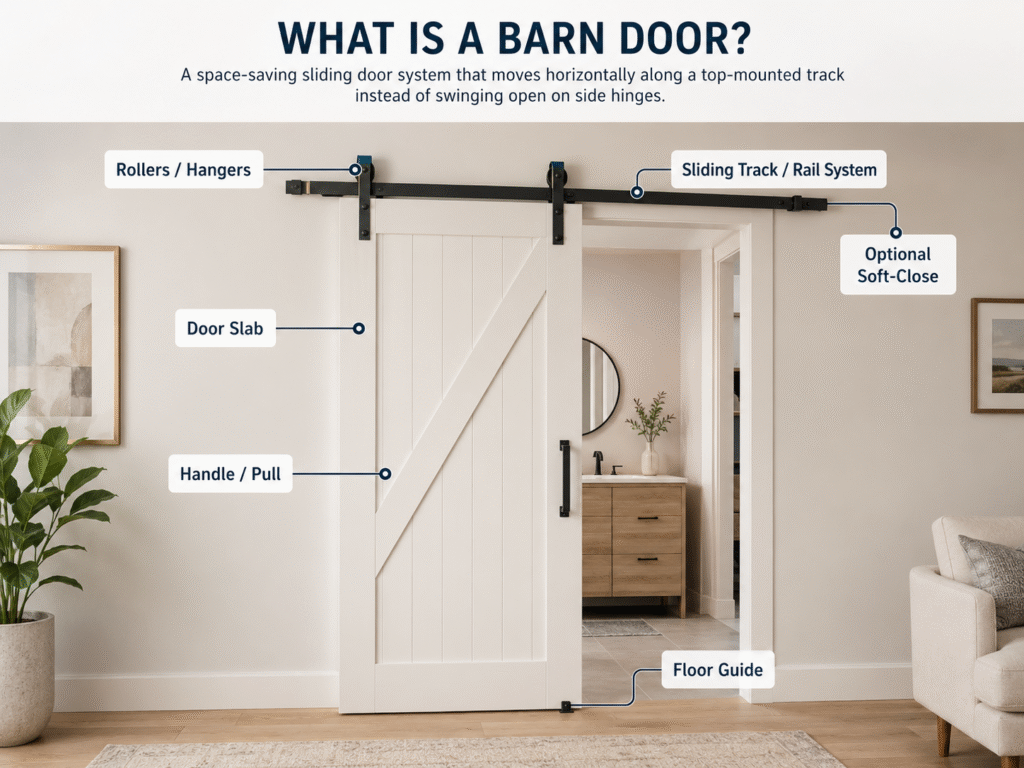
A barn door is an interior sliding door system that moves horizontally along a top-mounted track instead of swinging open on side hinges. Because it does not require swing clearance, it is often used in areas where space efficiency and visual impact are both important.
A typical barn door system includes:
- Door slab
- Sliding track or rail system
- Rollers or hangers
- Floor guide
- Handle or pull
- Optional soft-close mechanism
In this article, the focus is mainly on the door slab style, not the hardware system. The slab style determines the appearance, surface finish, weight, and suitability of the door for different residential applications.
Molded vs Shaker vs K-Frame Barn Doors
| Factor | Molded Barn Door | Shaker Barn Door | K-Frame Barn Door |
|---|---|---|---|
| Design Style | Simple, basic, traditional | Clean, modern, versatile | Rustic, farmhouse, decorative |
| Best For | Budget projects, rentals, apartments | Residential developments, modern homes | Farmhouse homes, feature spaces |
| Cost Level | Low to medium | Medium | Medium to high |
| Visual Impact | Moderate | Clean and refined | Strong and decorative |
| Project Flexibility | High | Very high | Medium |
| Surface Finish Requirement | Moderate | High | High |
| Hardware Requirement | Standard | Standard to medium-duty | Medium to heavy-duty |
| Main Risk if Poor Quality | Weak edges, cheap appearance | Cracks, visible joints, poor primer | Warping, rough joints, heavy panel issues |
| Builder Recommendation | Good for cost control | Best overall balance | Best for design-focused areas |
Molded Barn Doors
Definition
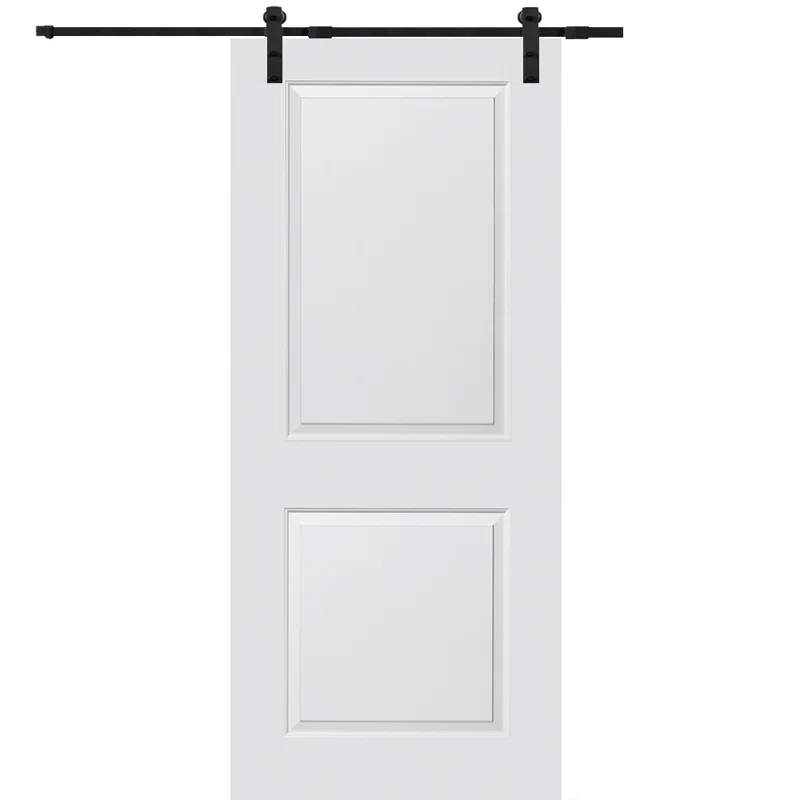
A molded barn door is usually made with molded door skins or formed panels that create a fixed surface pattern. This style is commonly used in budget-conscious residential projects, rental homes, apartments, and multi-family developments.
Molded barn doors are often selected when the project needs a clean, standardized look at a controlled cost.
Advantages for Builders
- More cost-effective than shaker or K-frame styles
- Suitable for large-scale procurement
- Consistent appearance across multiple units
- Relatively lightweight and easy to handle
- Practical for closets, storage rooms, laundry rooms, and secondary spaces
For builders working on apartments, rental properties, or entry-level housing, molded barn doors can help simplify purchasing and control the overall door package budget.
Potential Drawbacks and Risk Points
- Visual quality is usually more basic
- May not look premium enough for master bedrooms, model homes, or high-end spaces
- Low-quality molded panels may have weak edges
- Very lightweight doors may feel less solid when sliding
- Surface patterns may limit design flexibility
The main risk is using molded barn doors in the wrong location. A low-cost door may be acceptable for a secondary closet, but it can reduce the perceived value of a feature area.
Shaker Barn Doors
Definition
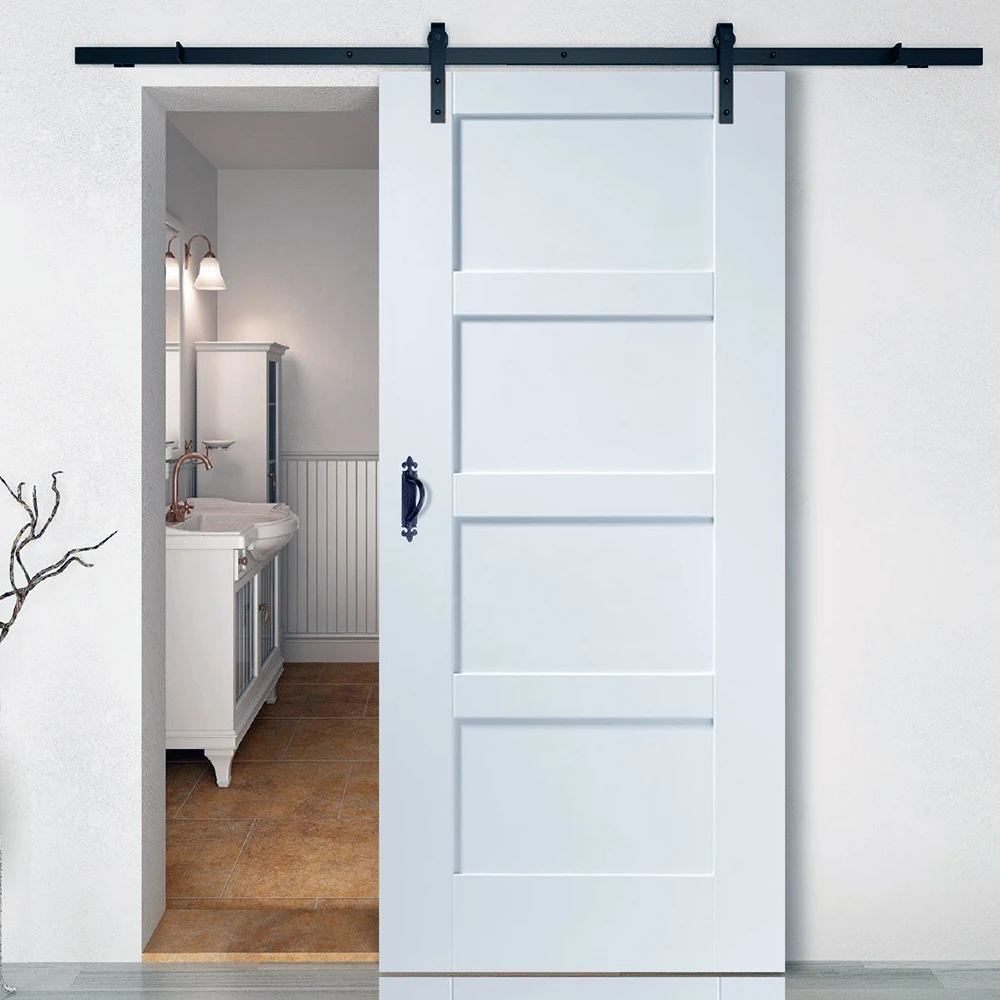
A shaker barn door features a clean frame-and-panel design, usually formed by rails and stiles around one or more flat or recessed panels. Its simple lines make it one of the most versatile barn door styles for residential projects.
Shaker barn doors work well with modern farmhouse, transitional, and modern interiors. They are also easy to coordinate with shaker interior doors, cabinets, trims, and other millwork components.
Advantages for Builders
- Clean and timeless design
- More refined appearance than molded doors
- Works with many residential styles
- Suitable for bedrooms, closets, bathrooms, laundry rooms, and open-plan spaces
- Easy to match with shaker doors, cabinetry, and moldings
- Good balance between cost, appearance, and project flexibility
For most residential projects, shaker barn doors are often the safest choice because they are not too plain and not too decorative. They can fit both mid-range and higher-end interiors without looking overly styled.
Potential Drawbacks and Risk Points
- Requires good material stability
- Poor MDF quality may lead to cracking or edge issues
- Visible joints can affect the finished appearance
- Poor primer may increase sanding and repainting work
- Large panels need better structural control to reduce warping risk
- Batch consistency is important for multi-unit projects
For builders, the key is to check surface smoothness, joint tightness, primer quality, and dimensional consistency. Since barn doors are exposed on the wall, defects are more noticeable than on some standard swing doors.
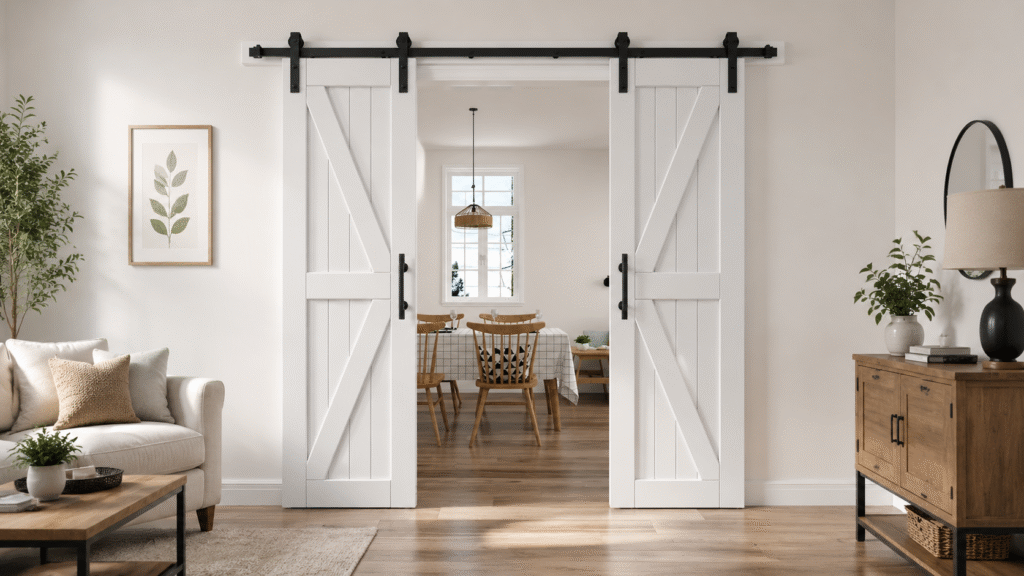
K-Frame Barn Doors
Definition
A K-frame barn door has a bold decorative frame structure with diagonal bracing that forms a shape similar to the letter “K.” This style is strongly associated with farmhouse, rustic, country, and cottage-style interiors.
K-frame barn doors are often used as feature doors in pantries, laundry rooms, closets, basements, vacation homes, and farmhouse-style residential projects.
Advantages for Builders
- Strong visual impact
- Creates a clear farmhouse or rustic design feature
- Works well in selected spaces such as pantries, laundry rooms, basements, and feature walls
- Adds character to model homes or design-focused areas
- More decorative than molded or basic shaker styles
K-frame barn doors are useful when the project needs a statement piece. They can make a simple space feel more customized and visually memorable.
Potential Drawbacks and Risk Points
- Style is strong and not suitable for every project
- Overuse can make the interior feel too heavy or too rustic
- Heavier panels may require stronger hardware and better wall support
- Poorly joined diagonal braces are easy to notice
- Low-quality products may develop cracks, open joints, or warping
- Not ideal for minimal, modern, or apartment-style interiors
The main builder risk is applying K-frame doors too broadly. A K-frame barn door can work beautifully as a feature door, but using it throughout an entire project may reduce design flexibility.
How Builders Should Choose the Right Barn Door Style
The best barn door style depends on the project’s budget, target market, design direction, and installation conditions.
Choose Molded Barn Doors If:
- The project is budget-driven
- The doors are used in secondary spaces
- The project includes rental units or apartments
- Standardization is more important than premium appearance
- Lightweight handling and simple installation are priorities
Molded barn doors are practical when cost control is the main concern. However, they should be used carefully in high-visibility areas.
Choose Shaker Barn Doors If:
- The project needs broad design compatibility
- The home uses modern, transitional, or modern farmhouse interiors
- The builder wants a cleaner and more refined look
- The doors need to match shaker interior doors, cabinetry, or trims
- The project requires a balance between cost and quality
For many residential projects, shaker barn doors are the best overall choice. They offer a clean look, strong flexibility, and better perceived value than molded doors.
Choose K-Frame Barn Doors If:
- The project has a farmhouse, rustic, or country-style design
- The door is intended to be a feature element
- The space needs stronger visual character
- The project can support heavier hardware if needed
- The style is used selectively rather than throughout the entire home
K-frame barn doors are best for design-focused spaces, not for every room. Builders should also confirm that the door weight, wall support, and hardware system are suitable before installation.
Common Selection Mistakes to Avoid
Choosing Only Based on Unit Price
A lower door price does not always mean a lower project cost. If the door requires extra sanding, repainting, adjustment, or replacement, the total cost can quickly increase.
Ignoring Hardware Compatibility
Heavier barn doors need suitable track hardware and proper wall support. If the hardware is too light or the wall is not reinforced, the door may slide poorly, create noise, or become unsafe over time.
Overusing a Strong Style
K-frame barn doors can look attractive in the right space, but they may feel too heavy if used throughout an entire project. Builders should match the door style to the room function and overall interior design.
Overlooking Surface Finish Quality
For primed or painted barn doors, surface quality is critical. Rough primer, visible joints, uneven edges, or poor sanding can create extra work for installers and painters.
Not Considering Bulk Consistency
In multi-unit residential projects, consistency matters. Door size, profile, primer, surface texture, and joint quality should remain stable across batches. Inconsistent products can cause delays, visual mismatch, and customer complaints.
Frequently Asked Questions About Barn Door Styles
Q: What is the most cost-effective barn door style for high-volume residential projects?
A: For large-scale developments or budget-conscious renovations, Molded Barn Doors are the superior choice. These doors utilize high-definition molded MDF skins over a lightweight core, providing a consistent look and reliable performance at a fraction of the cost of solid wood. Their lighter weight also puts less stress on the sliding hardware, extending the system’s overall maintenance cycle.
Q: Why are Shaker-style barn doors preferred for modern and transitional interiors?
A: Shaker barn doors feature a recessed panel design with clean, geometric lines that appeal to a wide demographic. Their simplicity allows them to blend seamlessly into modern, minimalist, or transitional spaces. For builders, specifying Shaker barn doors is a strategic move to increase a property’s “perceived quality” and resale value without the complex detailing required by more traditional designs.
Q: When should a builder choose a K-Frame barn door over a simple panel design?
A: A K-Frame barn door is a statement piece typically used to anchor a specific design theme, such as Modern Farmhouse or Industrial. The “K” bracing provides significant structural rigidity and a bold rustic aesthetic. Builders should specify K-Frame styles for main living areas or master suites where the door functions as a piece of architectural art, creating a high-impact first impression for potential buyers.
Q: How does M4B ensure the structural integrity of different barn door styles?
A: M4B engineers its barn doors using high-stability materials, such as LVL-reinforced stiles and high-density MDF panels. This multi-layer construction prevents warping and twisting—a common failure point for sliding doors. By partnering with M4B, contractors receive factory-direct barn doors that are pre-milled for standard hardware, ensuring a fast, trouble-free installation across every unit of the project.
Conclusion
For most residential projects, shaker barn doors offer the best overall balance. They are clean, versatile, and suitable for a wide range of interiors. Molded barn doors are a practical option for budget-focused projects, while K-frame barn doors are best used selectively in farmhouse or feature spaces.
The key is to choose the barn door style based on project application, not just appearance. Builders should consider the room type, target market, door weight, hardware system, finish quality, and batch consistency before making a final decision.
A well-selected barn door can improve both function and design value. A poorly matched one can increase installation work, reduce perceived quality, and create unnecessary after-sales problems.
Articles that you may be interested in:
Why Is Matte Black Barn Door Hardware Becoming So Popular?
Barn Doors for Interiors: Materials, Tracks, and Installation Tips