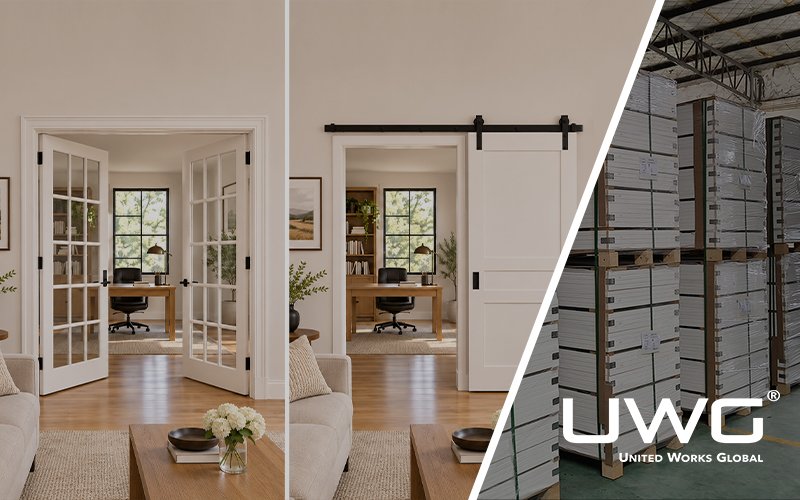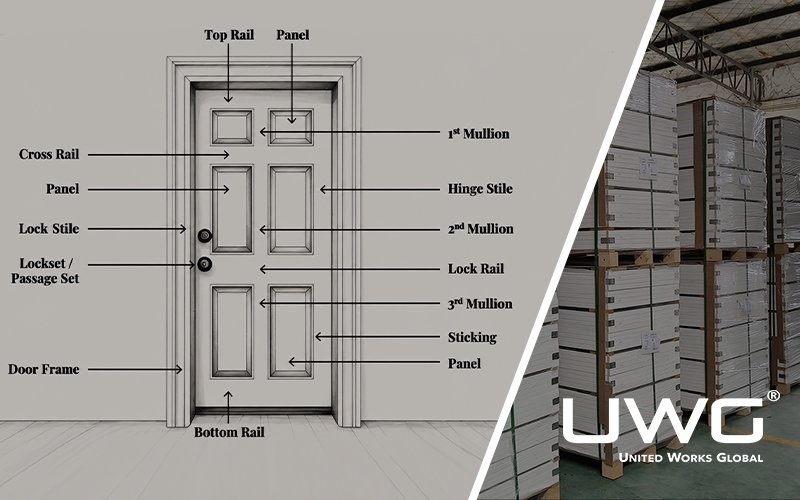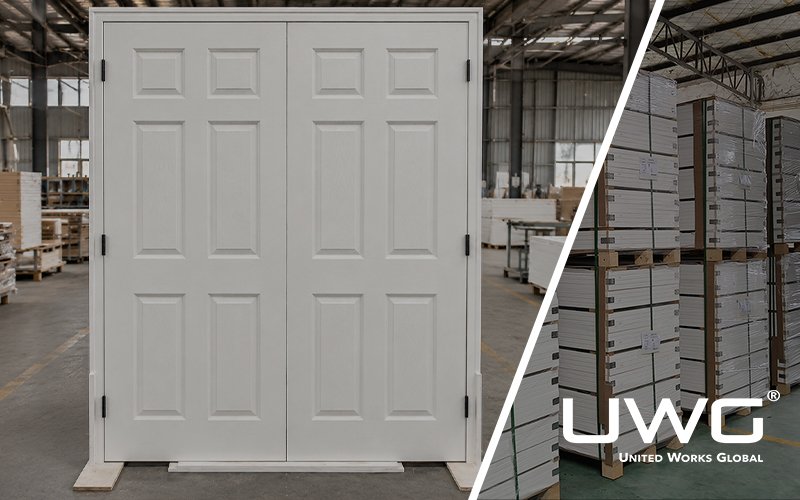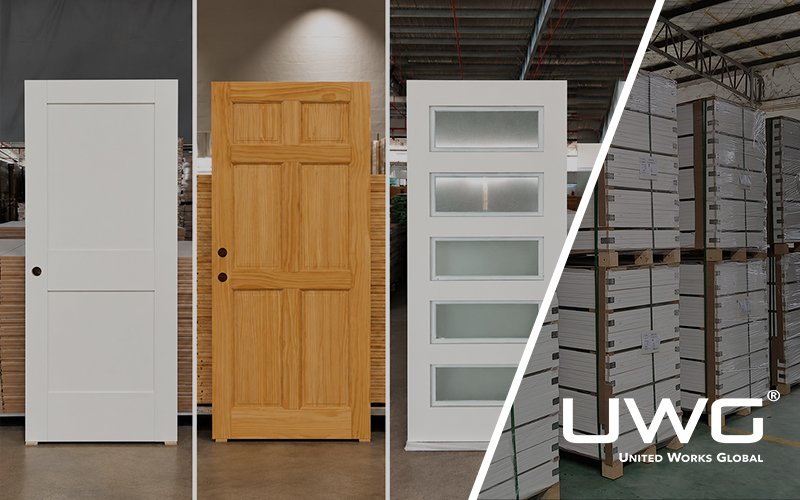
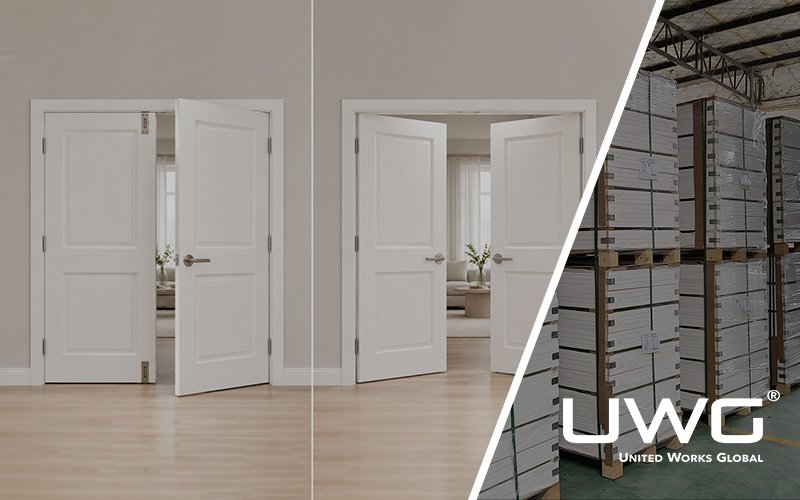
Choosing the right hardware for an interior double door depends on how the two door leaves are intended to operate. Some configurations use an active leaf and an inactive leaf, while others allow both leaves to open regularly. Each arrangement requires different hardware combinations to ensure proper operation and closure.
This guide explains the functions of flush bolts, astragals, ball catches, latches, locks, and dummy trim, and how to select compatible components for different double door configurations. It also covers key considerations for hardware selection, door preparation, and frame coordination to help avoid installation issues and incompatible components.
Understanding Interior Double Door Hardware
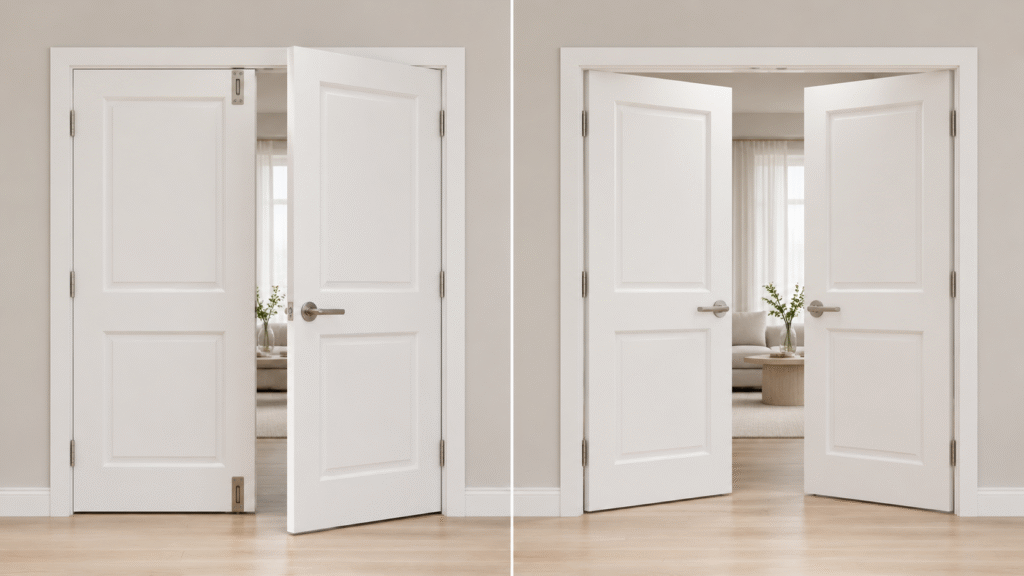
Two common residential approaches are an active/inactive pair and a pair with both leaves intended for regular use.
Active/inactive pair: The active leaf carries the operating handle and latch or lock. Flush bolts can hold the inactive leaf in position until a wider opening is needed. The inactive leaf is releasable, not necessarily a permanently fixed panel.
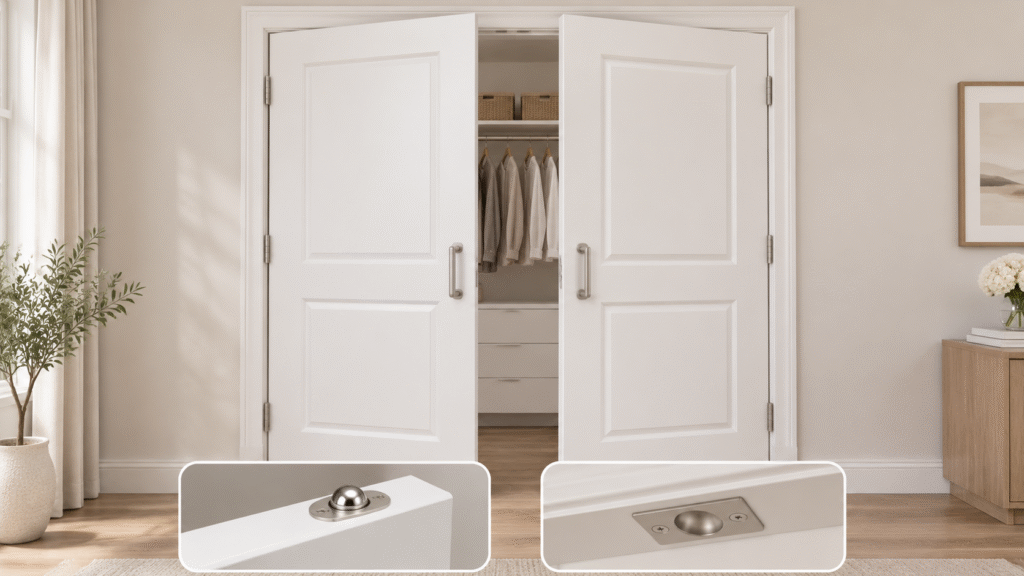
Both-active pair: Both leaves are used regularly. For a non-locking pair, a ball catch is typically installed at the top of each leaf, engaging with a strike in the head jamb to hold the doors closed. Dummy trim can be used as pulls because no latch operation is required. Other applications may use suitable coordinated latching hardware.
Even when both leaves operate independently, their meeting edges must be designed to avoid obstructing each other’s movement.
Choose hardware for double doors by function rather than room name. An interior French door can use either approach: its glazed design does not determine whether it needs ball catches, a passage latch, or a privacy lock.
For more information on interior door hardware beyond double-door applications, see our complete interior door hardware guide.
Double Door Flush Bolts: Securing the Inactive Leaf
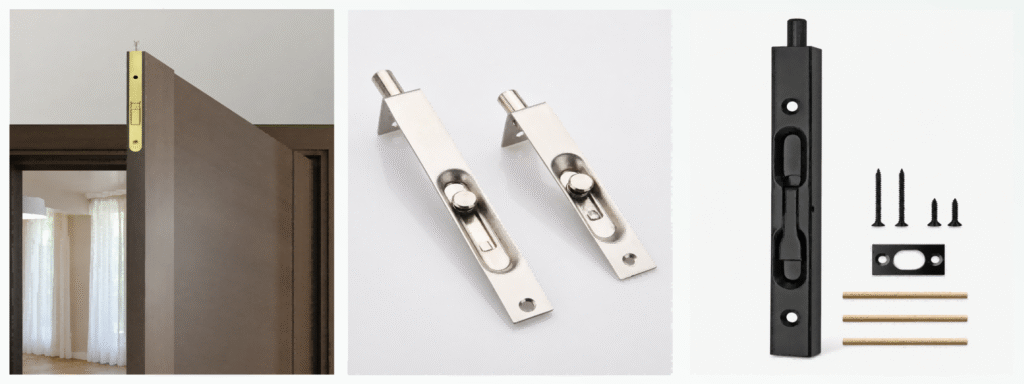
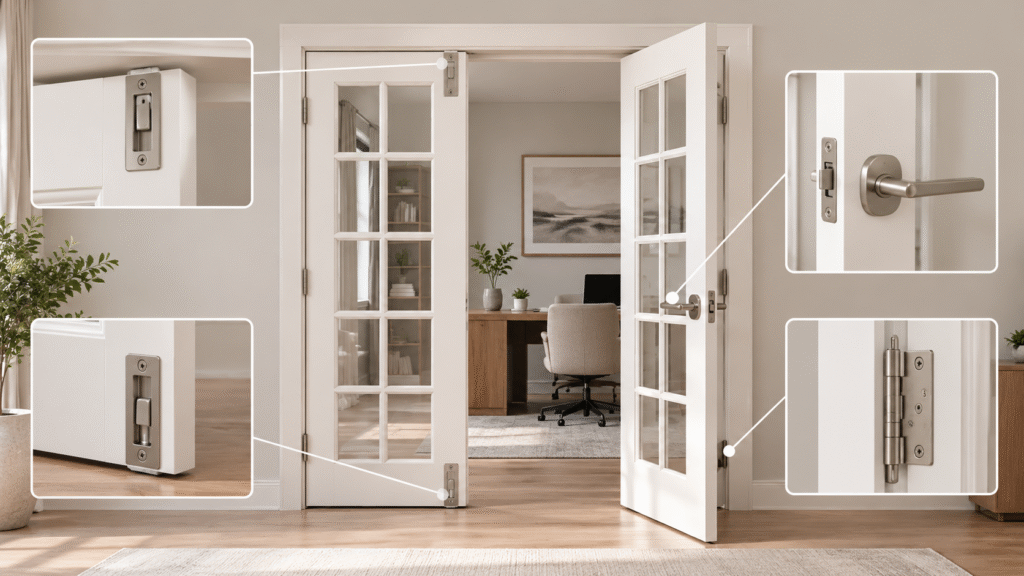
Flush bolts for double doors hold the inactive leaf against suitable receiving components. Common top and bottom arrangements engage the head jamb and a floor or sill receiver. Check both the bolt preparation and the receiving locations.
Manual and Automatic Flush Bolts
Manual flush bolts are operated directly, often through an edge-mounted lever or slide. They suit compatible residential pairs where the inactive leaf is opened occasionally.
Automatic flush bolts use a mechanism coordinated with the other leaf. Depending on the model, active-leaf movement triggers engagement or release. Automatic and constant-latching products have different mechanisms, so use the specified model’s instructions.
Some arrangements require the inactive leaf to close before the active leaf. Where sequence control is needed, a compatible coordinator controls the order while door closers provide the closing movement. This is a product and assembly decision, not a requirement for every double door.
Flush bolts secure the inactive leaf; they do not replace the active leaf’s specified latch or lock. Suitability for egress, accessible routes, or rated openings must be checked for the actual assembly.
Double Door Astragals: Managing the Center Gap
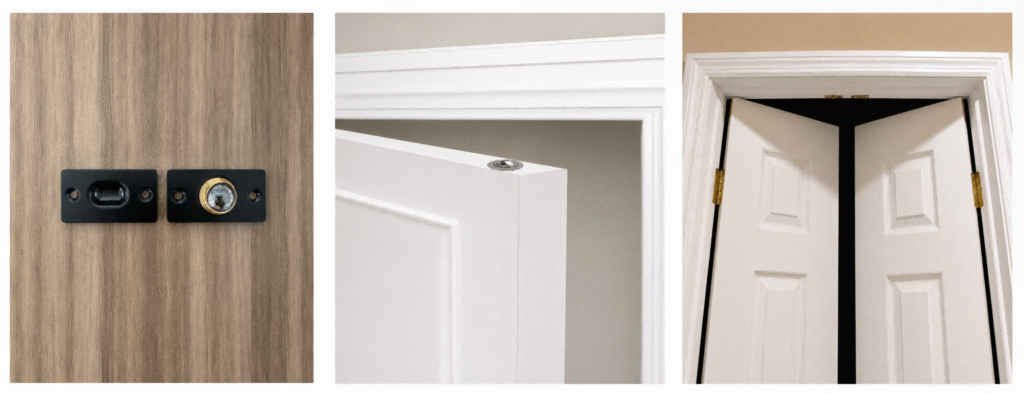
A double door astragal is a component at the meeting edges that covers or manages the center gap. Its profile may reduce visible light passage, provide a stop or meeting detail, or accommodate specified seals.
Overlapping Profiles and Other Meeting-Edge Solutions
An overlapping astragal extends across the adjacent leaf and can determine which door opens or closes first. Other compatible profiles or paired meeting-edge components can manage the gap without the same obstruction.
Flat and T-shaped describe profile geometry, not mutually exclusive performance categories. Sealing features are another specification: an ordinary cover strip does not establish fire, smoke, or acoustic performance.
When Is an Astragal Needed?
Use an astragal for double doors where the selected meeting detail calls for gap coverage or a particular closing relationship. A compatible ball-catch closet pair may use simple meeting edges without an overlapping strip.
Confirm overlap direction, mounting face, push/pull orientation, door thickness, clearance, and latch engagement from the product section drawing. Neither the profile name nor the leaf carrying it is enough to determine the sequence.
Double Door Ball Catches: Closure Without Locking
A ball catch for double doors typically uses a spring-loaded ball at the door’s top edge and a receiving strike in the head jamb. Closing engages the ball; pulling the door overcomes the spring resistance.
Ball catches provide convenient non-locking retention for suitable closets, pantries, and decorative openings. They work with dummy trim because the handle does not need to retract a latch. Check the catch support, strike alignment, and adjustment: too much resistance makes operation difficult, while too little may allow unintended opening.
One catch on each leaf does not overcome an obstructing astragal. Ball catches are also not substitutes for privacy locks, security hardware, or required positive latching.
Locks, Latches, and Dummy Trim
Choose the interior double door lock or latch function before selecting its appearance.
| Function | What It Does | Typical Selection Need |
|---|---|---|
| Passage latch | Holds the door closed with an operating latch but does not lock | Closure without privacy or keyed access |
| Privacy lock | Provides temporary privacy, typically operated inside the room | Bedrooms or bathrooms, with appropriate emergency release where required |
| Keyed lock | Provides key-controlled access | An office or storage room requiring restricted access; confirm the required release function |
| Dummy trim | Provides a non-operating pull without operating a latch | Catch-operated doors or a suitable inactive leaf |
In an active/inactive pair, the active leaf’s latch engages a strike in the inactive edge, astragal, or another compatible receiving assembly. Coordinate that strike with the inactive-leaf bolts before machining.
Locks for double doors must match the intended operation; passage hardware does not become locking hardware because it is installed on a French door. For dummy trim, specify whether each leaf needs a pull on one face or both faces, and whether the supplier sells individual pieces or double-sided sets.
How to Choose a Double Door Hardware Set
The following combinations are starting points for selection, not universal installation rules or company bills of materials. When selecting the door style and hardware together, review the available interior door options and coordinate them with the intended pair configuration.
| Application | Possible Combination | Main Decision |
|---|---|---|
| Double closet | Ball catches and dummy trim | Non-locking retention and the intended operation of both leaves |
| Interior French door | Catch-operated pair, or inactive bolts with an active latch or lock | Glazed appearance does not determine locking function |
| Double bedroom door | Compatible inactive-leaf bolts and an active privacy lock | Privacy, inside release, and coordinated meeting edges |
| Private office | Passage or keyed function with suitable inactive-leaf hardware | Closure only or controlled access |
| Decorative divider | Ball catches or other suitable holding hardware | Clearance and independent operation where needed |
| Special commercial opening | Project-specific hardware | Applicable egress, accessibility, and rated-assembly requirements |
Example A: A Non-Locking Closet Pair
For a compatible closet pair with two regularly used leaves, an illustrative package includes:
- Two ball catches: one per leaf.
- Two compatible head-jamb receiving components: one per catch.
- Dummy trim on the required handle faces.
One pull on one face of each leaf means two pulls total. Pulls on both faces of both leaves mean four pulls total, or two double-sided sets if packaged that way. Confirm the supply unit rather than equating a handle with a complete set.
Flush bolts and conventional locksets are generally unnecessary for this arrangement. An astragal can be omitted where the meeting detail allows it. Hinges remain necessary; identify whether they are included in the door package or ordered separately.
Example B: An Active/Inactive Home-Office Pair
For interior French door hardware with one everyday operating leaf, a possible package includes:
- Top and bottom flush bolts on the inactive leaf, with compatible receivers.
- A passage latch or suitable lock on the active leaf, with its strike.
- An astragal where the selected meeting detail requires one.
- Compatible hinges for both leaves.
- Closers and a coordinator only where the selected mechanism or assembly requires controlled closing.
In a compatible sequence, the inactive leaf closes first and the active leaf follows. To obtain the full opening, open the active leaf and release the inactive bolts as the selected mechanism requires. Specify privacy hardware in place of passage hardware if privacy is needed and the complete arrangement supports it.
For a broader overview of available configurations and operating styles, see our guide to interior double door configurations.
What to Confirm Before Door and Frame Preparation
Construction and Hardware Support
Treat core construction and door type as separate dimensions. A molded door can be hollow-core or solid-core; its face design does not identify the available fixing material.
Check support at each installation point: top-edge material for catches, edge support for locks and bolts, and suitable material for strikes and receivers in the leaf, jamb, or sill. Use the actual construction drawing rather than assuming one reinforcement size suits every door.
Handing, Meeting Edges, and Operation
Record active/inactive designations, the handing convention, swing direction, push/pull sides, astragal mounting face and overlap, and the required opening and closing sequence. Where both leaves must operate independently, confirm that neither the hardware nor the meeting detail blocks that operation.
Models, Templates, and Included Components
Obtain the selected manufacturer’s preparation templates before machining. Bore size, backset, mortise dimensions, bolt throw, and strike position vary by model. Generic names such as flush bolt or ball catch are insufficient for accurate preparation.
| Purchasing Item | Confirm |
|---|---|
| Model and specification | Manufacturer, exact model, function, and compatibility |
| Material and finish | Actual material and coordinated visible finishes |
| Receiving components | Latch strikes, bolt receivers, catch strikes, and their preparation |
| Fasteners | Required screws and mounting hardware, including what is supplied |
| Dummy trim | Required faces per leaf and single- or double-sided supply |
| Supply unit | Individual pieces, pairs, or complete sets |
| Hinges and stops | Required components and whether included or ordered separately |
| Closing control | Closers and coordinator where the assembly requires them |
Mark included and separately purchased items on the quotation and drawings. For regulated openings, coordinate the hardware with the approved assembly and project requirements; names such as automatic flush bolt or sealing astragal do not establish compliance.
Before finalizing hardware preparation, confirm the leaf dimensions and opening measurements using our double door size and opening dimensions guide.
Frequently Asked Questions
Can the Two Leaves Use Different Hardware?
Yes. An active/inactive pair can use an operating latch or lock on one leaf and flush bolts on the other. A catch-operated closet may instead use matching catches and dummy trim on both leaves. The components must fit the intended operation and meeting detail.
How Does an Astragal Affect Opening Order?
An overlap can physically prevent one leaf from moving first. A compatible active/inactive arrangement may close inactive first and active second, then open active first. Confirm the actual sequence from the section and installation drawing, including mounting face, swing, and overlap direction.
What Matters When Replacing Existing Hardware?
Check function, leaf designation, handing, door thickness, internal support, bore and backset, bolt throw, strike locations, and astragal orientation. Match the receiving components as well as the visible hardware. Similar appearance does not establish compatibility.
Can Both Leaves Have Locks?
Some coordinated systems allow locking hardware on both leaves. Installing conventional locks independently can create conflicting latch points or meeting-edge problems. Confirm the whole system and applicable requirements; for many residential active/inactive pairs, one active lockset with appropriate inactive-leaf hardware is simpler.
Conclusion
Select interior double door hardware around operation first: non-locking catch retention, or an active latch or lock coordinated with a secured inactive leaf. Then match the astragal, receiving parts, fixing support, and preparation templates. A complete scope covering trim faces, supply units, hinges, and any closing control helps prevent missing parts and incompatible machining.