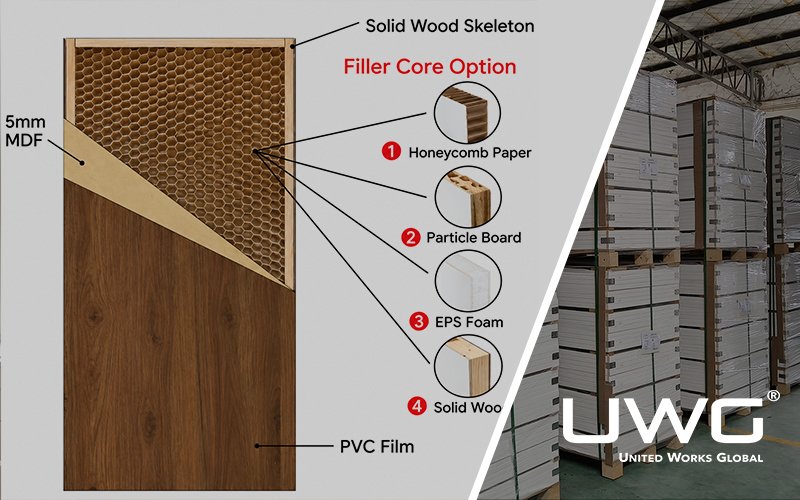
A wood-veneered door combines a thin real-wood face, a supporting substrate, an internal core, and a perimeter frame. The veneer creates the visible grain, while the layers beneath it determine how the door is built and prepared for use.
For builders, the practical task is to specify these components separately. This guide explains their roles, compares face materials and core structures, and shows what to confirm before approving samples and production drawings.
What Is Veneer Door Construction?
A wood-veneered door uses a thin layer of real wood bonded to a supporting panel rather than solid timber throughout the leaf. In a typical sandwich construction, the core sits between two face panels, with stiles and rails forming the perimeter frame.
Read the construction from one face to the other: veneer, substrate, core, opposite substrate, and opposite veneer. The perimeter frame surrounds the core rather than forming another layer across the face.
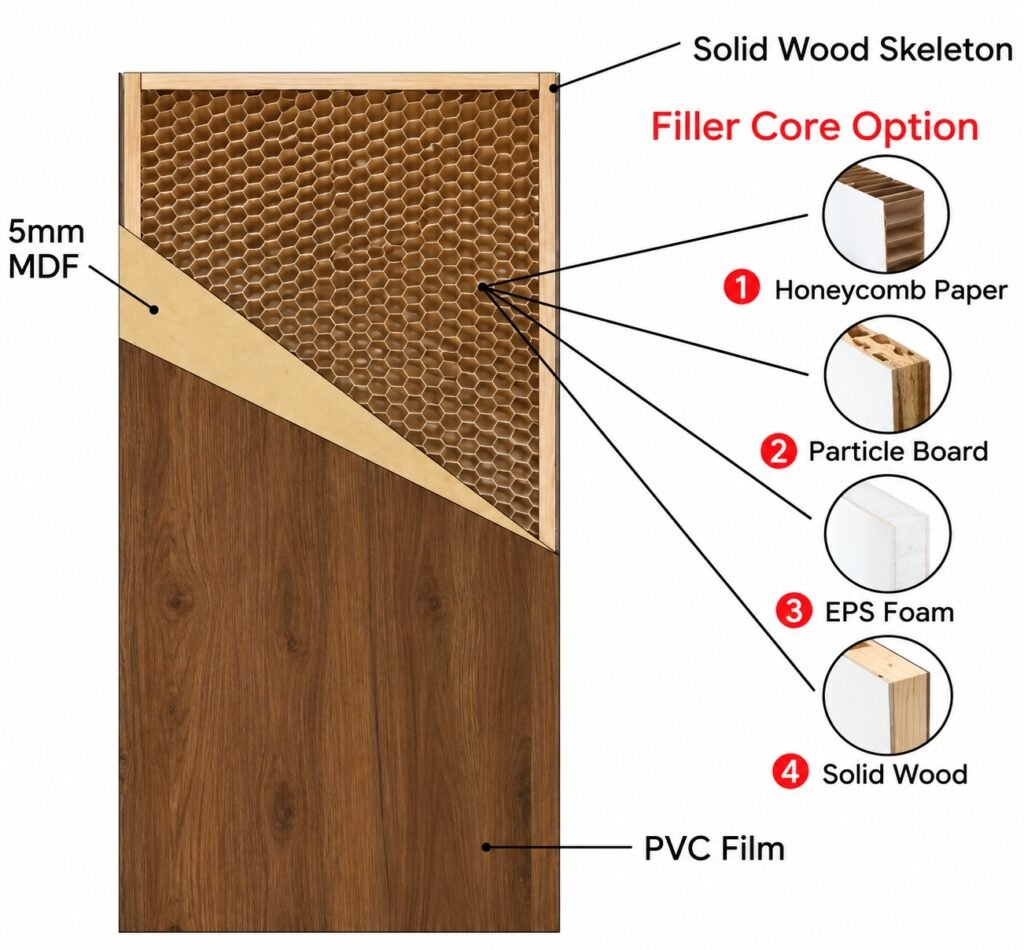
| Component | Position | Structural role |
|---|---|---|
| Wood veneer | Outermost decorative layer on the face | Provides the visible wood grain and receives the specified finish |
| Face substrate | Directly beneath the veneer | Provides a continuous base for bonding and supports the face |
| Core | Between the two face panels | Fills the internal space and contributes to weight and rigidity |
| Stiles and rails | Around the core at the sides, top, and bottom | Form the perimeter frame and accommodate hardware support where designed |
How Is the Veneer Bonded to the Door?
Veneer sheets are arranged into the required face pattern and bonded to the selected substrate with a suitable adhesive and pressing process. Pressing brings the layers into contact while the bond forms; the appropriate heat, pressure, and curing conditions depend on the materials and adhesive system. The approved construction should identify how the face panels and internal assembly are bonded, as well as what each layer contains.
How Does Wood Veneer Differ from PVC and Melamine?
A woodgrain appearance does not identify the surface material. Natural veneer and engineered veneer contain wood; PVC and melamine surfaces use decorative materials that can reproduce a woodgrain pattern.
| Surface | What it is | What changes for specification |
|---|---|---|
| Natural wood veneer | Thin sheets of real wood cut from timber | Species, natural variation, leaf matching, stain, and clear finish shape the result |
| Engineered or reconstituted wood veneer | Wood processed and reassembled to create a selected grain or color pattern | Approve the particular pattern and finished sample rather than specifying only a natural species name |
| PVC film | A decorative plastic film bonded to a supporting panel | Specify the film design, texture, color, and application details |
| Melamine surface | Decorative paper impregnated with melamine resin and bonded to a panel | Specify the decorative paper design, texture, and panel construction |
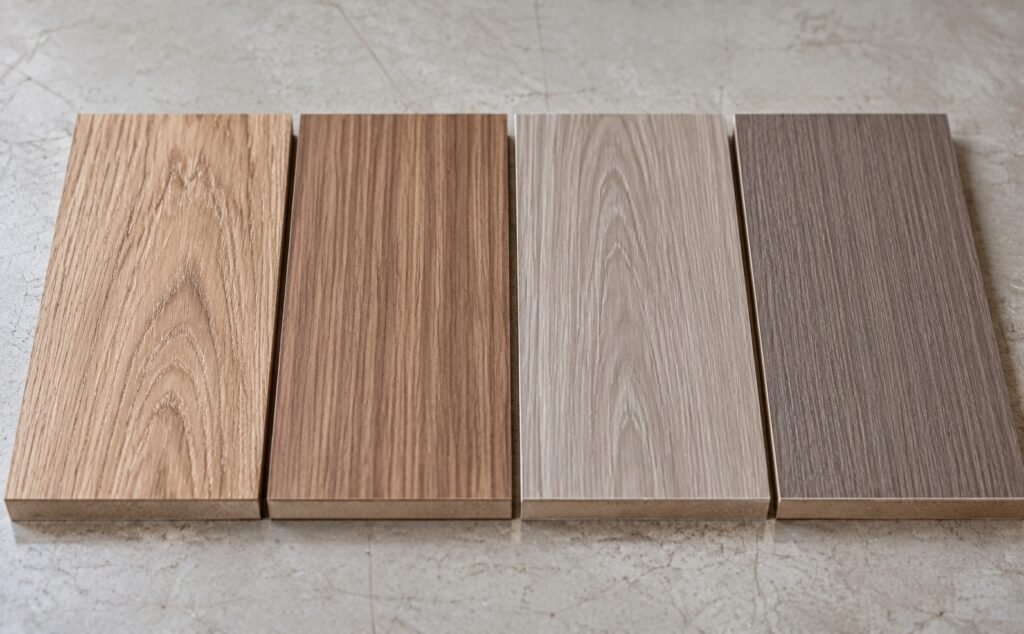
Our standard PVC-faced door configuration uses 5 mm MDF on each side beneath the decorative PVC film. This is the thickness of each MDF face panel, not the film or the complete door leaf. Wood-veneered doors should have their own substrate specification.
What Does the Wood Veneer Face Contribute?
The face determines the door’s visible wood character. Species selection, the arrangement of veneer leaves, and the finishing process each affect that appearance.
Common Wood Veneer Species for Doors
- Oak is often selected for its distinct grain.
- Walnut is associated with brown tones and a rich wood appearance.
- Maple generally offers a finer, more restrained grain.
These are examples of veneer species, not a statement that every product range includes them.
Choose the species first, then review a finished sample: a stain or clear coating can change the apparent color and contrast of the same wood.
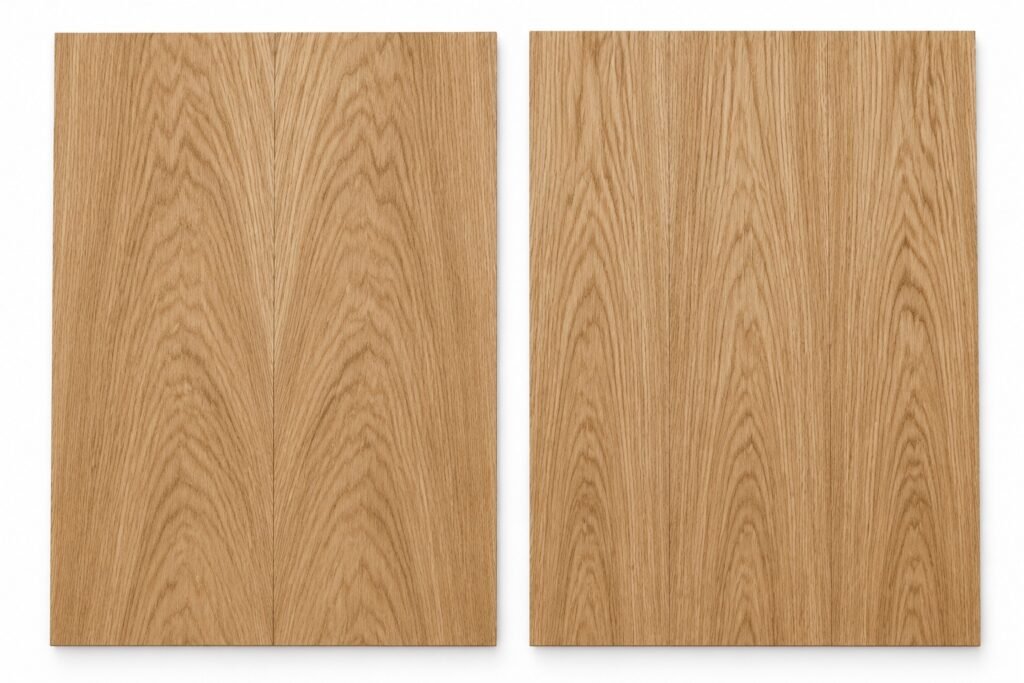
How Are Veneer Leaves Matched?
- Book matching turns alternate leaves so adjacent pieces form a mirrored pattern.
- Slip matching places leaves in sequence without turning alternate pieces, creating a repeated grain arrangement.
The matching method concerns how pieces are arranged across the face; it is separate from the wood species and the direction of the grain.
How Can a Project Control Appearance Across Multiple Doors?
Approve grain direction, matching method, color, and sheen together. Where doors are visible side by side or along a corridor, identify which openings need coordinated faces and agree on acceptable natural variation using finished samples. Natural wood should not be specified as having an identical printed pattern on every leaf.
What Does the Face Substrate Do, and When Is MDF Used?
The substrate carries the decorative face and provides a bonding surface. Its material and thickness are separate choices from the core and the overall door thickness.
Why Is MDF Used?
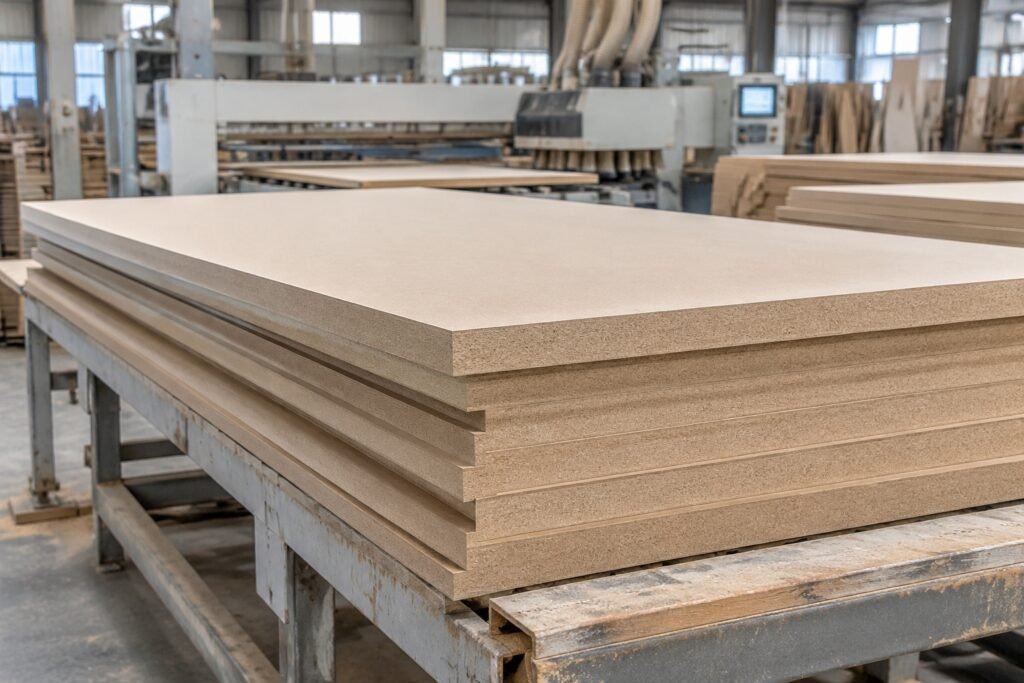
Medium-density fiberboard is made from wood fibers bonded into a panel. As a face substrate, its useful characteristics include:
- A smooth bonding surface: the fine surface provides an even base for thin veneer.
- A relatively uniform structure: it avoids the knots and pronounced grain of a solid timber face panel.
- Consistent machining: the fiber structure supports controlled cutting and profiling when the panel grade and tooling suit the work.
- Compatibility with several finishes: suitable MDF panels can carry wood veneer, decorative film, or a painted finish using the appropriate bonding and finishing process.
These benefits explain why MDF is widely used as a substrate. They do not make standard MDF suitable for sustained moisture exposure.
How Should MDF, HDF, and Other Substrates Be Selected?
MDF is a practical option for many interior face applications.
HDF has a more densely compacted fiber structure and can be selected where the construction calls for a denser panel or particular machining characteristics. Other engineered panels, including plywood in some designs, provide alternative constructions with their own bonding and finishing requirements.
Selection therefore involves more than choosing the higher-density name. Confirm the specified panel grade, thickness, moisture suitability, bonding system, and intended use. A moisture-resistant grade and a higher-density grade describe different properties; HDF is not automatically waterproof.
For a dry interior, focus on the approved face quality, construction, and machining requirements. For humid locations, also confirm the board’s moisture suitability, edge sealing, protection of machined openings, and site conditions. A surface film or veneer cannot protect an unsealed cut edge by itself.
In a coastal residential project, MDF-substrate doors passed the initial sample review, but some installed leaves later developed slight edge swelling and changes in flatness. The team checked installation, construction, and site conditions, identifying persistent humidity, uneven ventilation, and possible moisture entry around cut edges and hardware openings.
For later batches, the team changed from standard MDF to HDF and strengthened perimeter sealing and sealing after lock machining. Follow-up inspections reported improved edge condition and dimensional stability, without the earlier concentration of swelling problems.
The useful lesson is to agree on substrate suitability, sealing, and the actual service environment before production. Because both the substrate and sealing changed, this project does not isolate density as the cause of improvement.
How Does the Core Affect Veneer Door Construction?
The core occupies the space inside the perimeter frame. It supports the face panels as part of the bonded assembly and contributes to the leaf’s weight and rigidity. The face material can remain similar while the internal construction changes substantially.
| Core | Internal construction | Practical difference for selection |
|---|---|---|
| Honeycomb | An expanded cellular infill sits between the face panels within the frame | Provides a lightweight construction; hardware fixing relies on the designed frame or blocking rather than the paper cells |
| Tubular chipboard | A particle-based board contains regularly spaced internal tubular voids | Removes part of the material while retaining a board structure; confirm actual weight and the layout around machined areas |
| Solid particleboard | Particleboard infill occupies the core without the deliberate tubular voids of tubular board | Adds a more continuous particle-based infill; confirm leaf weight and the hinge and handling requirements |
| Solid or laminated wood-based core | Timber pieces or laminated wood elements are assembled inside the leaf | Species, piece arrangement, joints, and moisture control affect the resulting construction |
Honeycomb is commonly chosen where low weight and budget are priorities. Tubular and solid particleboard constructions offer different combinations of material content and weight. Compare equivalent door sizes, face panels, and hardware preparation before treating one configuration as an upgrade. When reviewing interior door options, confirm the complete construction rather than relying on the decorative face alone.
What Can the Core Tell You About Performance?
Core construction helps explain physical differences, but an acoustic or fire rating belongs to the documented door assembly. For a specified rating, check the matching leaf construction, frame, seals, hardware, and installation requirements in the applicable evidence. A core name alone does not establish that rating.
How Do Perimeter Structure and Edge Treatment Differ?
The internal perimeter frame supports the door construction; the visible edge treatment finishes the exposed perimeter. They serve different purposes even when both use wood-based materials.
Stiles, Rails, and Hardware Support
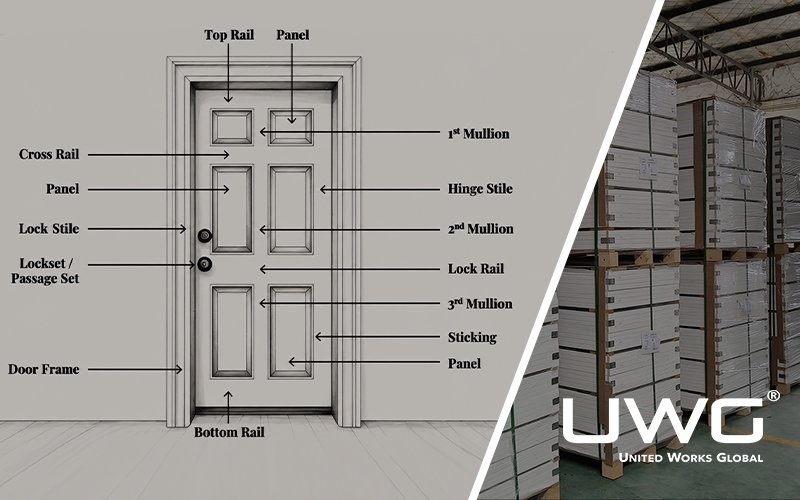
Stiles run vertically along the sides, and rails run horizontally at the top and bottom. Lock blocks or other reinforcement can provide localized support for hardware. Their positions and dimensions determine where specified fixings and machining can be accommodated.
Before production, match the hinge and lock schedule to the construction drawing. Confirm the fixing zones, lock-block position, machining depth, and any permitted trimming allowance. Trimming or moving hardware outside the designed support area can change the suitability of the preparation.
Visible Edge Treatment and Sealing
Edges may use veneer, timber lipping, or another specified finish. Lipping finishes an edge and can provide material for the intended edge detail; its permitted machining depends on the actual design.
Confirm how the top, bottom, side edges, and hardware cutouts are protected. Where machining takes place after finishing, specify who restores the required seal. A finished face sample does not show these concealed details.
What Should Builders Confirm Before Production?
Use the approved specification and drawings to lock the construction before ordering:
- Face: surface material, veneer species or decorative design, specified veneer thickness and whether it is measured before or after sanding, matching, grain direction, color, and sheen.
- Substrate: material, grade, thickness on each side, and compatibility with the face and expected humidity.
- Core: actual internal configuration and complete leaf weight at the specified size.
- Perimeter: stile and rail construction, edge material, lock blocking, and trimming limits.
- Preparation: hardware locations, machining dimensions, fixing support, and sealing after machining.
- Approval evidence: finished samples, construction drawings, and assembly documentation for any required performance rating.
A surface sample approves appearance; it does not replace a construction drawing. Keep both tied to the same production specification so an attractive sample does not conceal a change of substrate, core, or edge detail.
Frequently Asked Questions
Is a Wood-Veneered Door the Same as a Solid Wood Door?
No. Wood veneer describes the thin real-wood face. Beneath it, the door can contain a panel substrate and an engineered core rather than solid timber throughout.
Does Every Wood-Veneered Door Use MDF?
No. MDF is one substrate option. HDF or another suitable panel can be used when specified by the construction design. Confirm the material beneath the veneer separately from the internal core.
Is a Woodgrain PVC Door a Natural Wood Veneer Door?
No. PVC film can reproduce a woodgrain pattern, but its decorative surface is plastic rather than a thin sheet of real wood. Specify the surface material explicitly even if a catalog groups both under decorative doors.
Does a 5 mm MDF Face Mean the Door Is 5 mm Thick?
No. In our standard PVC-faced configuration, each side has a 5 mm MDF face panel. The complete leaf also includes the core, perimeter structure, and surface layers; overall thickness is a separate specification.
Can Wood-Veneered Doors Be Used in Humid Locations?
Suitability depends on the specified substrate grade, bonding and finishing system, sealed edges and cutouts, and expected exposure. Confirm the construction for the actual location before ordering; a wood face or an HDF label alone is insufficient.
Conclusion
Specify a wood-veneered door as a complete construction: face, substrate, core, perimeter frame, and edge detail. Approve appearance through samples and concealed components through drawings, then align hardware preparation and moisture protection with the intended installation.