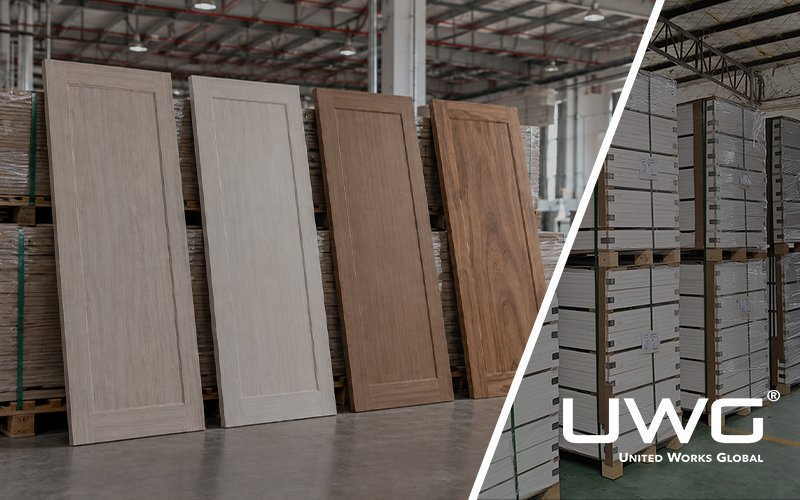
The surface material of an interior door affects more than its appearance. It also influences how the door can be designed, how it performs in daily use, how consistent a large production batch will look, and how much the finished door will cost. For builders, developers, and distributors buying doors in volume, these differences can directly affect both project budgets and product positioning.
PVC, melamine, engineered wood veneer, and natural wood veneer are four common options. Instead of asking which material is simply “better,” buyers should first consider the door design, project type, expected appearance, budget, and production quantity.
What Are the Four Common Interior Door Surface Materials?
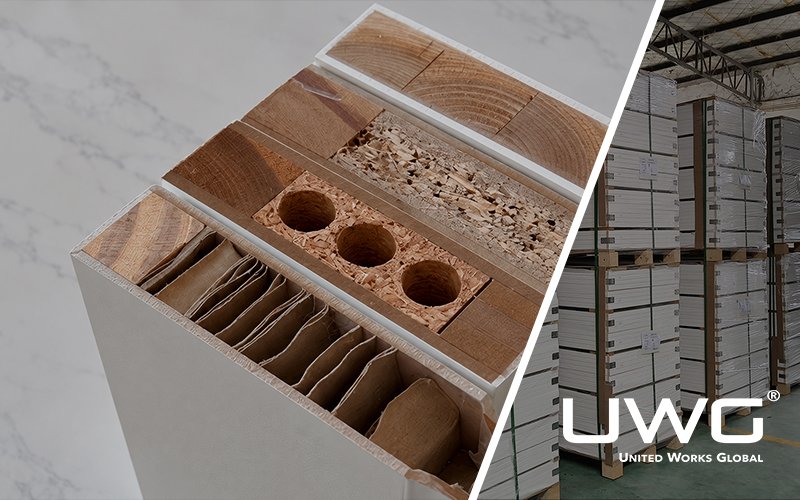
A door surface material is the visible decorative surface applied over the door substrate. It is different from the door core: the surface primarily determines the surface appearance and finish, while the core affects characteristics such as weight, stability, sound performance, and hardware holding capability.
PVC Door Surface
PVC door surface is a synthetic decorative film commonly vacuum-pressed onto MDF or another prepared substrate. It is available in solid colors, wood grains, and different surface textures.
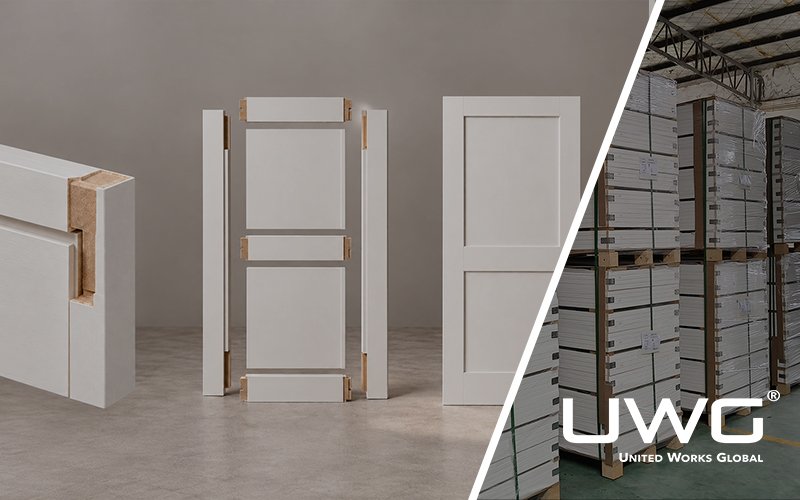
An important advantage of PVC is not just moisture resistance but forming flexibility. During vacuum pressing, the heated PVC film can follow routed grooves, recessed areas, and other profiles machined into the MDF surface.
This makes PVC particularly useful for doors with more decorative surface designs. For example, if an MDF door face includes grooves or three-dimensional profiles, PVC would generally be a more practical option than melamine.
From a manufacturing perspective, we would therefore prioritize PVC when the project requires:
- Routed MDF door faces
- Recessed or raised decorative details
- Wood-grain finishes over shaped surfaces
- Easy-to-clean surfaces
- Large quantities with repeatable decorative patterns
For simple flat doors, however, PVC’s forming capability may provide little additional value, and a simpler surface material such as melamine may be more economical.
Melamine Door Surface
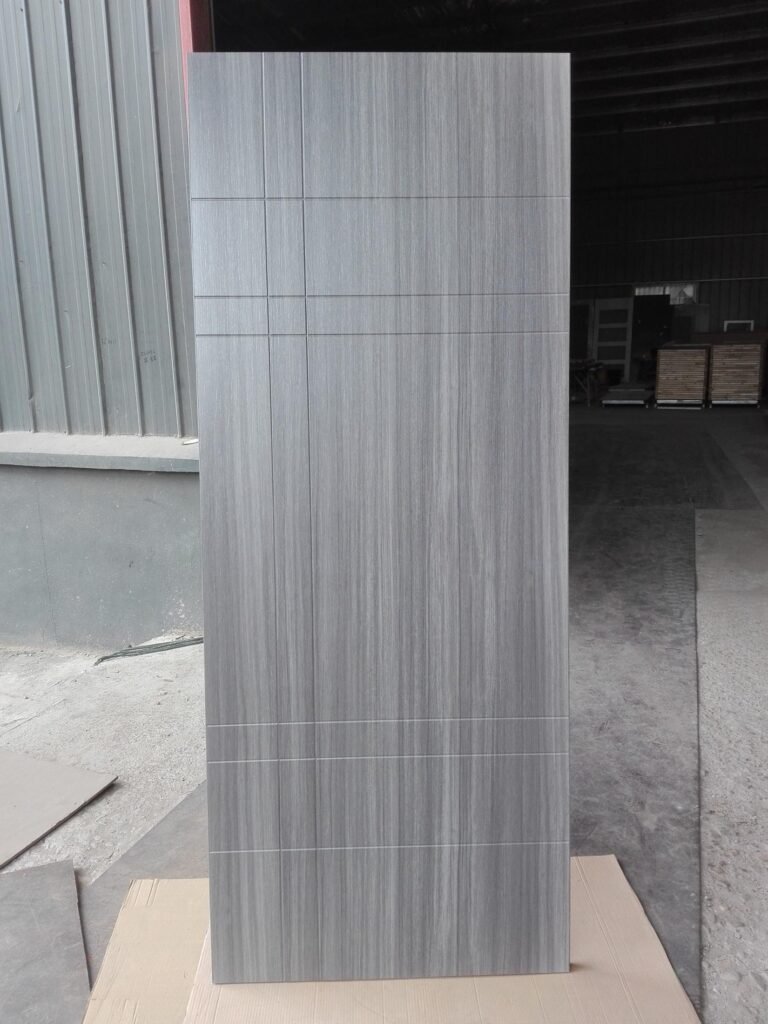
Melamine surfaces are typically made from decorative paper impregnated with resin and bonded to a wood-based panel.
Compared with PVC, melamine is particularly suitable for flat decorative surfaces. It provides a hard, finished face without requiring complicated surface finishing, which makes it practical for simple contemporary door designs.
Its limitation is forming ability. Melamine does not wrap around routed profiles in the same way as vacuum-pressed PVC. Therefore, when the door design includes deep grooves or complex three-dimensional details, PVC is usually the more practical choice.
For flat-panel doors used in apartments, offices, student housing, and other cost-sensitive projects, melamine can be a very efficient specification. If the design is simple and the buyer’s priority is controlling the cost per door, there may be little reason to pay for a more complicated surface system.
Engineered Wood Veneer
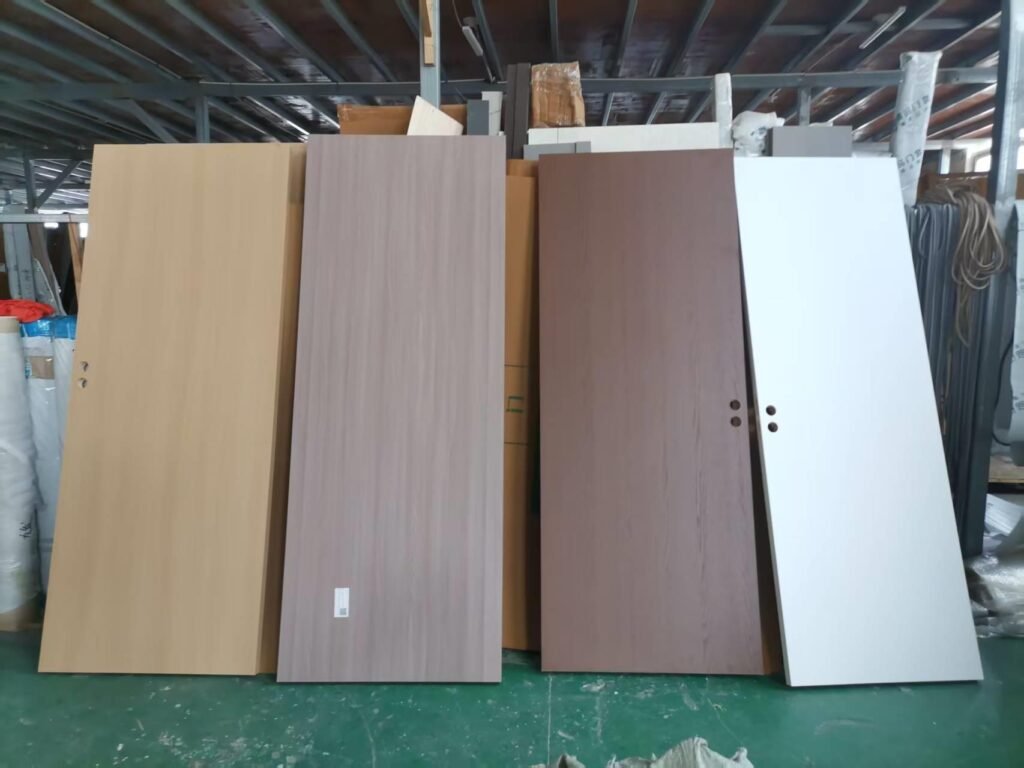
Engineered wood veneer, also called reconstituted veneer, is manufactured from real wood that is processed and reconstructed into designed grain patterns.
Its practical value becomes more obvious as project quantity increases.
Suppose a hotel requires the same walnut-style finish across guestrooms on multiple floors. Natural walnut veneer may show considerable variation from sheet to sheet. Engineered veneer makes it easier to control the visual range while still maintaining a wood-based appearance.
For this reason, engineered veneer is often a strong choice for mid- to high-end projects where the designer wants a wood look but the contractor also needs predictable production results.
It is particularly worth considering for hotels, offices, multifamily developments, and other projects where many doors will be viewed within the same interior design scheme.
Natural Wood Veneer
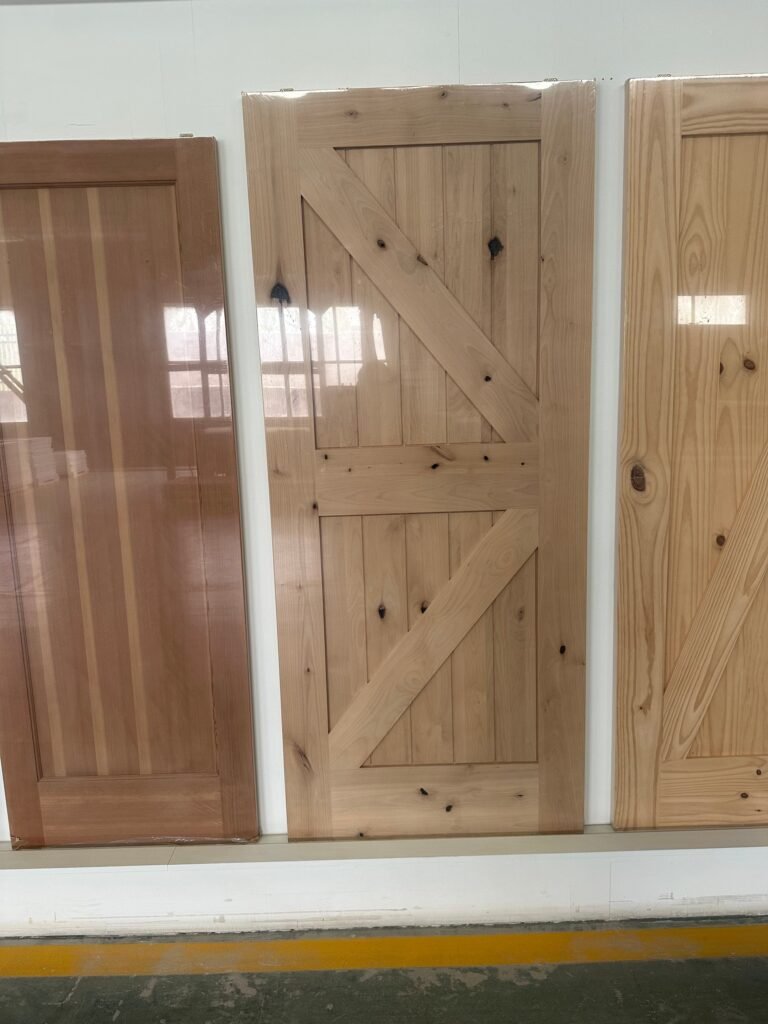
Natural wood veneer is sliced from real timber and bonded to the door substrate. Oak, walnut, maple, ash, and other species can all produce distinctive appearances.
Natural veneer should be selected for a different reason from the other three materials: the natural variation itself is part of the design value.
A premium custom home, boutique hotel, or executive interior may benefit from genuine grain patterns that are not perfectly repeated from door to door.
However, buyers need to accept that natural wood is not a printed pattern. One walnut veneer door will not necessarily match another exactly.
Therefore, we would normally recommend natural veneer when the project values authentic material and premium appearance more than strict visual uniformity. If the specification instead requires hundreds of nearly identical wood-grain doors, engineered veneer is usually easier to control.
PVC vs. Melamine vs. Engineered vs. Natural Wood Veneer: Key Differences
The material should first be matched to the door design and project positioning, rather than selected only by price.
| Factor | PVC | Melamine | Engineered Veneer | Natural Wood Veneer |
|---|---|---|---|---|
| Surface Type | Film | Resin-impregnated decorative surface | Reconstructed wood veneer | Real wood veneer |
| Complex Profiles | Very suitable for vacuum-pressed routed MDF | Better for flat surfaces | Depends on door construction | Depends on door construction |
| Moisture Resistance | Good | Moderate to good | Depends on finish | Depends heavily on finish |
| Wear Resistance | Good for normal use | Hard surface suitable for regular use | Depends on coating | Depends on coating |
| Design Flexibility | High for shaped MDF surfaces | Best for simpler flat designs | Strong wood-design flexibility | Limited by natural wood characteristics |
| Batch Control | Good | Good | Very good for wood-look projects | Natural variation expected |
| Relative Cost | Low–Medium | Low–Medium | Medium | Medium–High |
| Practical Choice | Routed/molded MDF doors | Economical flat doors | Large wood-look projects | Premium natural interiors |
A simple selection rule can therefore be useful:
Complex routed or molded door face → PVC
Flat surface + cost-sensitive project → Melamine
Wood appearance + large quantity → Engineered Veneer
Authentic wood + premium project → Natural Veneer
Which Interior Door Surface Material Is the Most Durable?
Durability should not be reduced to one ranking. A hotel may care about scratches and cleaning, while a humid residential environment may place more emphasis on moisture. The complete door construction also matters.
Moisture Resistance
PVC provides good surface moisture resistance because the film itself is non-porous. It is therefore a practical choice for many residential interiors where cleaning or humidity is a concern.
However, specifying PVC does not make the entire door waterproof.
Water can still enter through exposed edges, lock machining, hinge preparation, damaged areas, or poorly sealed joints. A PVC-faced MDF door with poorly protected edges can still experience moisture-related problems.
For projects where moisture exposure is expected, we would therefore check the surface, substrate, edge sealing, and machining protection together, rather than selecting the door based only on the PVC label.
Scratch and Wear Resistance
Melamine’s relatively hard surface makes it practical for doors exposed to normal daily contact, especially when the project needs an economical finished surface.
PVC is also suitable for normal residential use, but its performance depends on film quality, thickness, adhesion, and surface treatment.
With engineered and natural veneer, the coating system becomes more important. The veneer provides the appearance; the topcoat provides much of the protection.
When comparing veneer door quotations, buyers should therefore ask what finishing system is being applied instead of comparing only the veneer species or pattern.
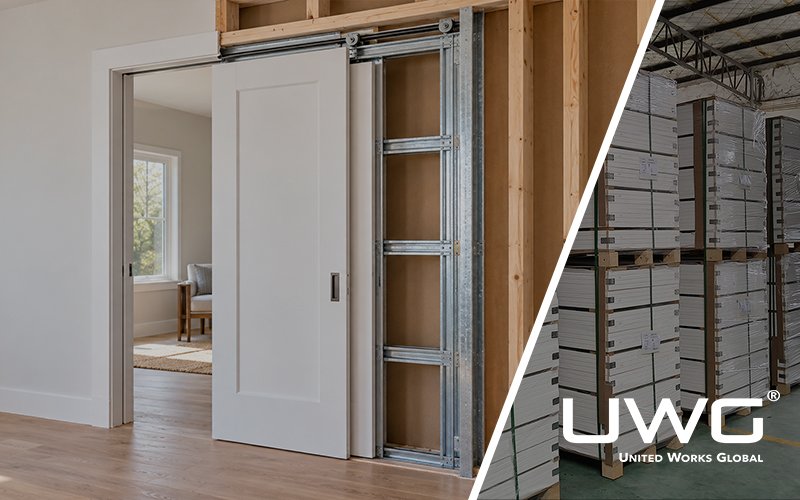
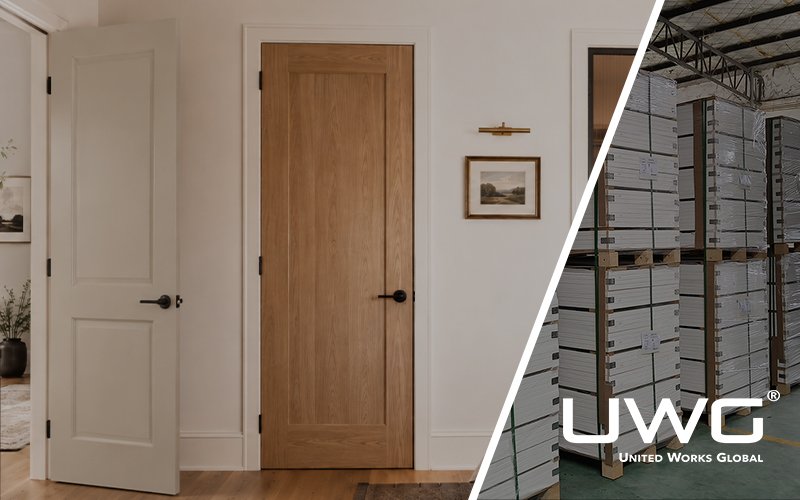
Since the surface is only one part of the complete door specification, it should be considered together with the door construction, style, and opening configuration. These different combinations can be seen across our range of interior doors.
Color and Finish Stability
This issue becomes important when doors are installed side by side or across multiple project phases.
For manufactured decorative surfaces, buyers should keep an approved sample or finish code for repeat orders. Even with PVC or melamine, different production lots can have slight variations.
With natural veneer, the purchasing approach should be different. Instead of requiring every door to be identical, the buyer and supplier should agree on an acceptable range of grain and color before mass production.
Which Door Surface Is Best for Different Projects?
The easiest way to select a surface is to start with the actual project, not the material.
Multifamily and Apartment Projects
For standard multifamily projects, we would usually start by considering PVC or melamine, and then make the final decision according to the door design.
If the project uses simple flat doors and the developer is highly price-sensitive, melamine can be the more efficient solution.
If the door has routed grooves, recessed panels, or decorative MDF profiles, PVC becomes more attractive because vacuum pressing allows the decorative film to follow the shape of the door face.
For an upgraded apartment project requiring a more convincing wood appearance, engineered veneer can move the product into a higher visual category without introducing as much natural variation as real veneer.
Hotels and Commercial Projects
Hotels require more careful segmentation.
A budget hotel with simple flat doors may prioritize melamine for cost and maintenance. A project requiring decorative molded surfaces may use PVC. A higher-positioned hotel that wants a coordinated walnut or oak appearance across hundreds of guestrooms may benefit more from engineered veneer.
Natural veneer makes more sense when the project specification specifically values genuine wood rather than simply a “wood look.”
Commercial buyers should also remember that the surface is only one part of the specification. Fire rating, STC requirements, door core, hardware preparation, frame construction, and applicable codes may be more important than the decorative surface for certain openings.
High-End Residential and Custom Homes
Natural veneer becomes much easier to justify in high-end residential projects because buyers are often paying for the character of the material itself.
If a designer specifically wants the natural differences between oak or walnut pieces, replacing natural veneer with a printed decorative surface may reduce the intended visual effect.
But “high-end” does not automatically mean natural veneer.
For a modern luxury project where the designer wants every door to have almost the same grain and tone, engineered veneer may actually produce a better project result.
The decision should therefore be based on the design intention:
Natural individuality → Natural veneer
Controlled premium wood appearance → Engineered veneer
What Should Builders and Distributors Consider Before Choosing a Door Surface ?
Project Budget and Target Market
Material selection should reflect what the end customer is actually willing to pay for.
For an entry-level apartment door, adding an expensive natural veneer may increase cost without creating enough additional value for the developer. For a luxury custom home, however, the difference between a printed wood grain and genuine walnut veneer may be important to the buyer.
For distributors, this means the best material also depends on the product’s intended position in the market.
Appearance and Batch Consistency
For volume orders, one sample is not enough to define the entire production expectation.
Before mass production, buyers should confirm:
- Color
- Grain pattern
- Grain direction
- Texture
- Gloss level
- Acceptable variation
- Matching requirements between doors
For phased projects, keeping an approved physical sample is particularly useful.
With engineered veneer, PVC, and melamine, the objective is usually to control visual differences. With natural veneer, the objective is instead to define how much natural variation is acceptable.
That distinction can prevent unnecessary disputes after delivery.
Door Core and Construction
Surface material should never be used as a substitute for the complete door specification.
A PVC-faced door, for example, could have honeycomb, particleboard, tubular particleboard, or another internal structure. Two doors with the same PVC finish can therefore have very different weights, prices, sound performance, and hardware holding capabilities.
When comparing quotations, buyers should check:
surface + substrate + core + edge construction + thickness + machining + frame + hardware preparation.
This is especially important when one supplier’s quotation is significantly cheaper. The difference may come from the internal construction rather than the decorative surface.
Frequently Asked Questions About Interior Door Surface Materials
Is PVC or Melamine Better for Interior Doors?
Look at the door design first.
For a flat, simple door, melamine can be a cost-effective choice. For a door with routed grooves, recessed patterns, or more complex MDF profiles, PVC is generally more suitable because the film can be vacuum-pressed over the shaped surface.
Therefore, the decision should not be based only on moisture resistance or price.
What Is the Difference Between Engineered Veneer and Natural Wood Veneer?
Both are wood-based, but they serve different design purposes.
Engineered veneer is reconstructed to create a controlled appearance, making it useful when many doors need similar grain and color. Natural veneer retains the original characteristics of real timber, making every door more individual.
For 200 hotel room doors requiring a coordinated walnut appearance, we would normally consider engineered veneer first. For a custom residence where genuine walnut character is part of the design, natural veneer may be the better specification.
Which Interior Door Surface Material Is the Most Moisture-Resistant?
PVC is generally one of the first options to consider when surface moisture resistance is important.
However, the overall door still depends on the substrate, edge sealing, adhesive, machining, and installation environment. Buyers should avoid interpreting “PVC surface” as “waterproof door.”
Which Door Surface Is Best for High-Traffic Commercial Projects?
For a cost-sensitive commercial project with relatively simple flat doors, melamine can be a practical starting point because of its hard finished surface.
If the project requires more decorative door profiles, PVC may be more appropriate. If appearance is a major design requirement, engineered veneer can provide a more premium solution, but the protective coating should also be specified carefully.
For high-traffic areas, the door core and edge construction should be evaluated together with the surface.
Does Door Surface Material Affect the Price of an Interior Door?
Yes, but the surface is only one part of the cost.
Melamine can be economical for simple flat doors. PVC may involve additional MDF profiling and vacuum-pressing processes when decorative designs are required. Engineered veneer introduces a more sophisticated wood appearance, while natural veneer prices can vary considerably according to wood species, grade, matching, and finishing requirements.
Door thickness, size, core, machining, frame, hardware preparation, packaging, and order quantity can sometimes create a larger price difference than the surface itself.
Conclusion
There is no single door surface material that should be used for every interior door project. A more practical approach is to match the surface to the door design and end use.
For routed or molded MDF doors, PVC is usually the first material we would consider because vacuum pressing works well with shaped surfaces. For simple flat doors where cost control matters, melamine can be more efficient. For large projects requiring an upgraded wood appearance, engineered veneer provides useful visual control. And when genuine wood character is part of the project’s value, natural veneer remains the appropriate choice.
For builders and distributors, the final specification should still go beyond the surface. Door core, substrate, edge treatment, machining, finishing, frame, hardware, and batch requirements should be evaluated together before comparing prices or approving mass production.