Interior double doors offer flexible access, wider openings, and a balanced appearance for residential and commercial projects. However, choosing the right pair involves more than selecting a design.
Builders must consider how the doors operate, whether the dimensions fit the opening, and which components are included in the order.
This Interior Double Doors Buying Guide covers the essential decisions for selecting, comparing, and purchasing double doors for construction projects.
What Should Builders Consider When Choosing Interior Double Doors?
Both-Active vs. Active/Inactive Configurations
The first decision is how the two leaves will operate.
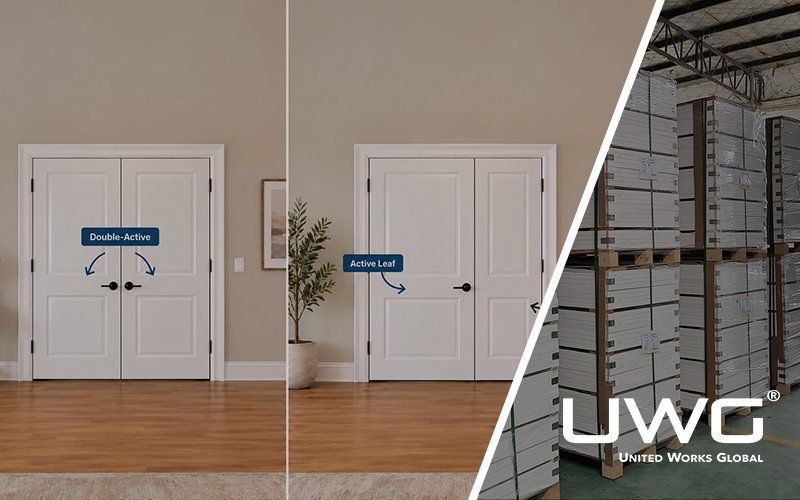
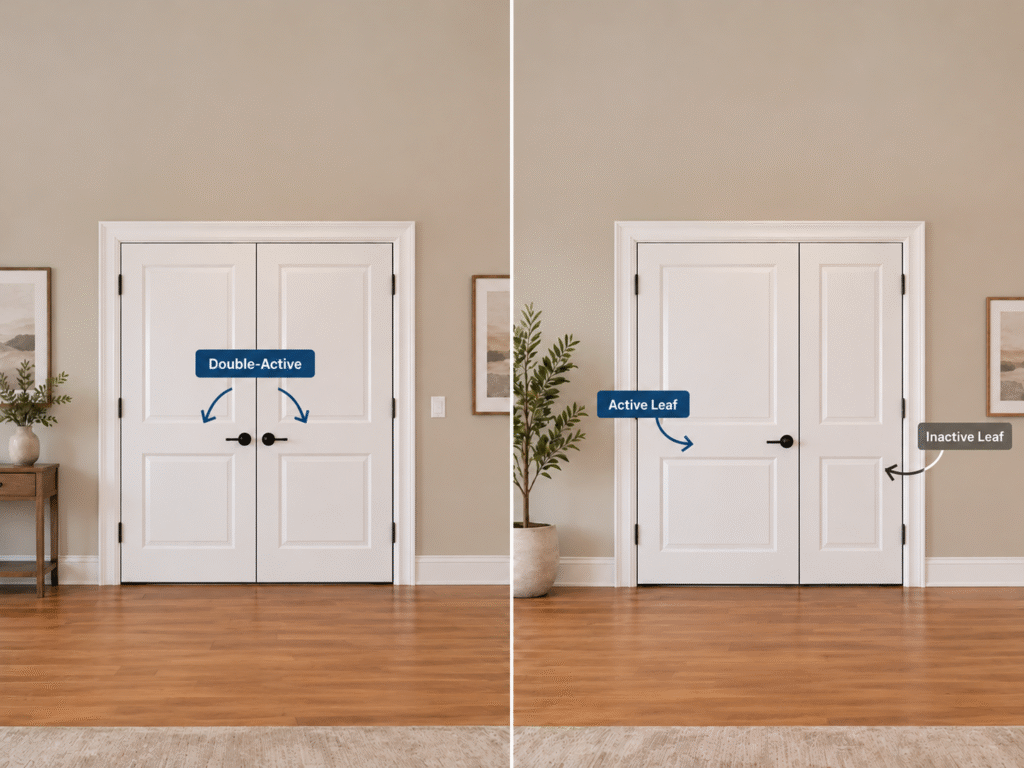
Both-active configurations provide two operable leaves for everyday use. If independent opening is required, specify hardware and meeting-edge details that allow either leaf to open while the other remains closed.
Active/inactive configurations use one leaf for regular passage. The second leaf normally remains secured but can be released when a wider opening is needed.
Either configuration may have equal or unequal leaf widths. Builders should identify each leaf’s operating function and, for active/inactive pairs, determine how the inactive leaf will be released.
Both-active operation does not automatically require a particular catch or locking system.
Door Styles and Design Options
Different interior double door styles suit different architectural and functional requirements.
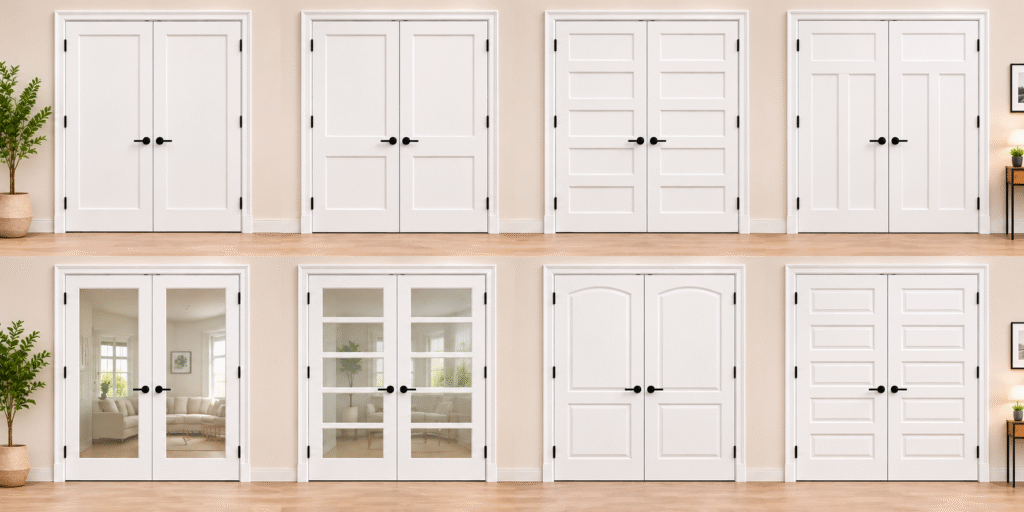
- Shaker double doors: Recessed-panel designs suited to bedrooms, offices, and contemporary homes.
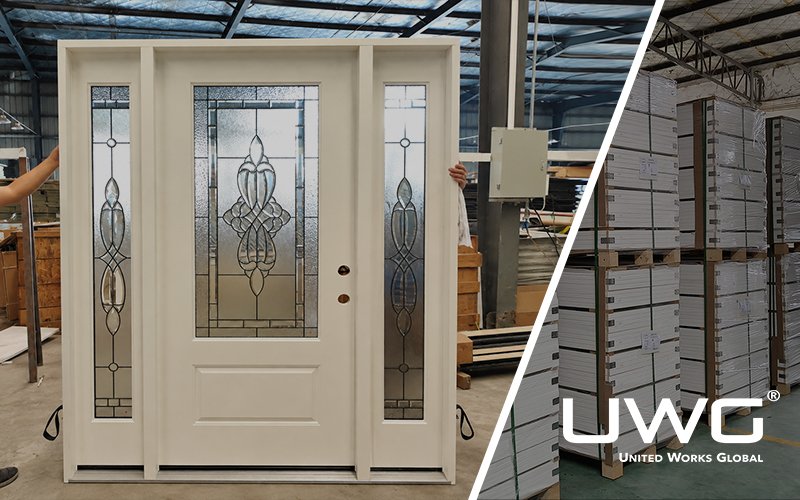
- Glass double doors: Provide daylight and visual connections between rooms.
- French double doors: Typically feature framed glass panels and are a common glazed-door style.
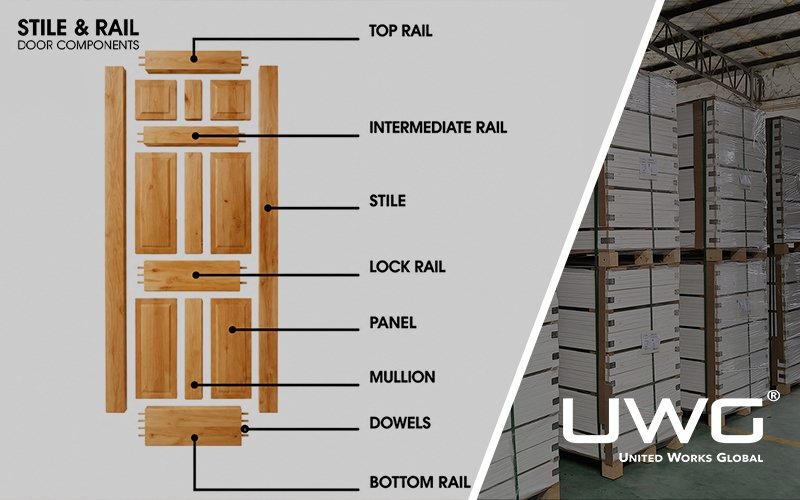
- Flat-panel double doors: Use flat panels within a stile-and-rail framework for a simple appearance suited to modern interiors.
- Dutch double doors: Have horizontally divided leaves that require specialized operating hardware.
These categories can overlap. French doors are a type of glazed door, while Dutch construction describes a divided-leaf arrangement.
For privacy-focused rooms, opaque panels are often suitable. Glazed doors are useful where natural light and visibility are priorities.
Leaf Sizes, Clear Opening, and Rough Opening Requirements
Correct measurements are essential when selecting interior double door sizes.
Builders should distinguish between:
- Individual leaf width: The width of each door leaf.
- Nominal pair width: The combined nominal widths of both leaves.
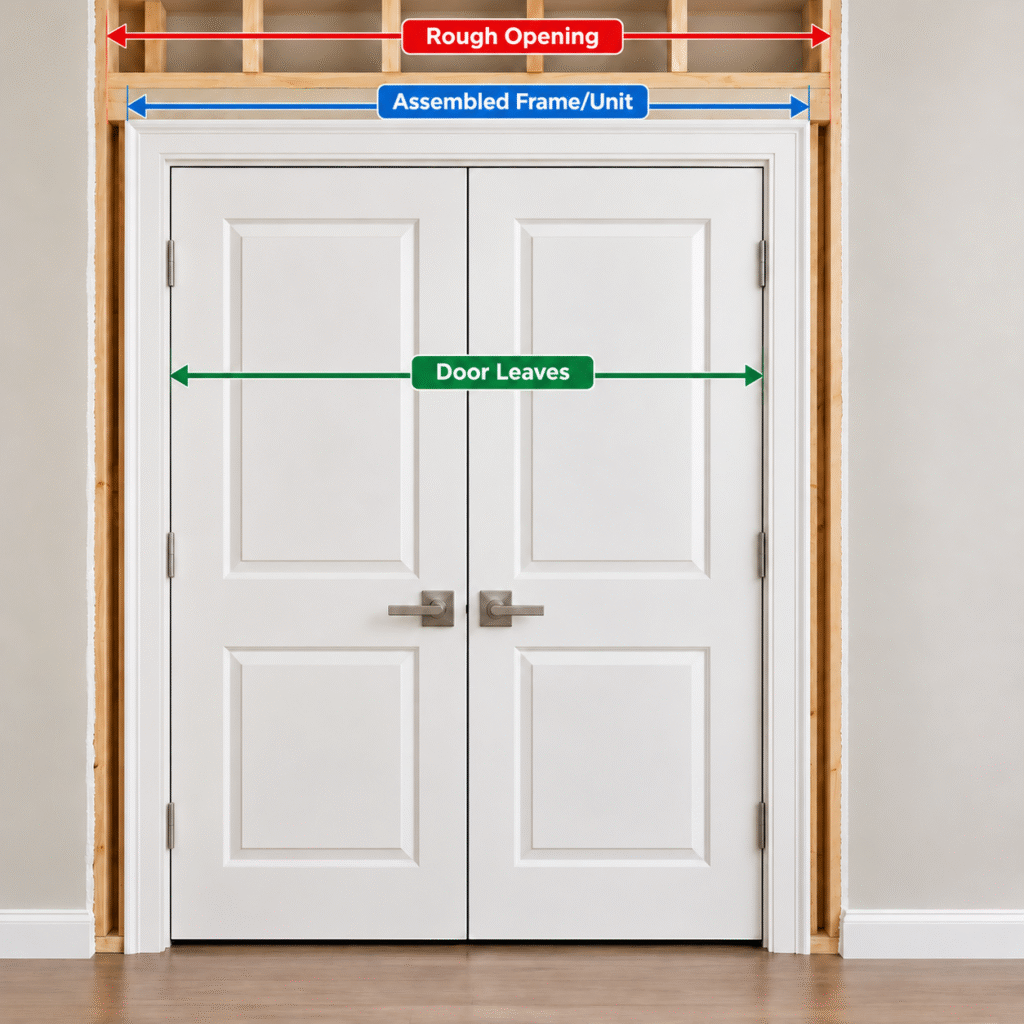
- Frame and rough opening: The overall frame dimensions and unfinished opening required for installation.
- Clear opening width: The usable passage width with the door open.
For example, two nominal 30-inch leaves form a nominal 60-inch pair, but the actual passage width depends on the frame, door thickness, and opening angle.
Rough opening allowances must follow the selected manufacturer’s requirements rather than a universal formula.
Where the U.S. ADA Standards apply, at least one active leaf must satisfy the applicable clear-width and maneuvering-clearance requirements under ADA Standards §404.2.2–404.2.4. The general minimum clear width is 32 inches, measured between the face of a swinging door and the stop with the door open 90 degrees. Openings more than 24 inches deep require at least 36 inches of clear width; other applicable conditions and exceptions must also be checked.
Door Swing and Handing
Double door swing influences circulation and available floor space.
In-swing and out-swing configurations should be selected according to room layouts, furniture placement, and applicable building requirements.
Double door handing determines the specified opening orientation and related hardware preparation.
Because handing conventions may differ between manufacturers, builders should use approved opening diagrams rather than relying on descriptions alone.
Interior Double Door Construction and Hardware
Door Materials and Core Construction
Door construction influences weight, durability, acoustic performance, and cost.
Hollow-core doors use lightweight internal structures and are often considered for budget-sensitive residential applications.
Solid-core doors contain denser internal materials, generally providing greater mass and potentially improved sound separation.
MDF and HDF may be used as facing substrates or other door components, while wood veneer provides a decorative surface. Confirm the core separately in the product specification. For a broader explanation of interior door materials, including face materials and core construction, see our materials guide.
Builders should compare actual product specifications rather than assuming that solid-core doors are made entirely from solid wood.
Double Door Hardware and Accessories
Proper double door hardware supports reliable operation and secure closing.
Key components include:
- Hinges: Support each leaf according to its size and weight.
- Locks and latches: Provide the specified operating and locking functions.
- Flush bolts: Typically secure an inactive leaf to the frame head or floor.
- Astragal: Covers or manages the meeting joint between two leaves.
- Catches: Hold leaves in the intended closed position where appropriate.
These components serve different functions and may be used together.
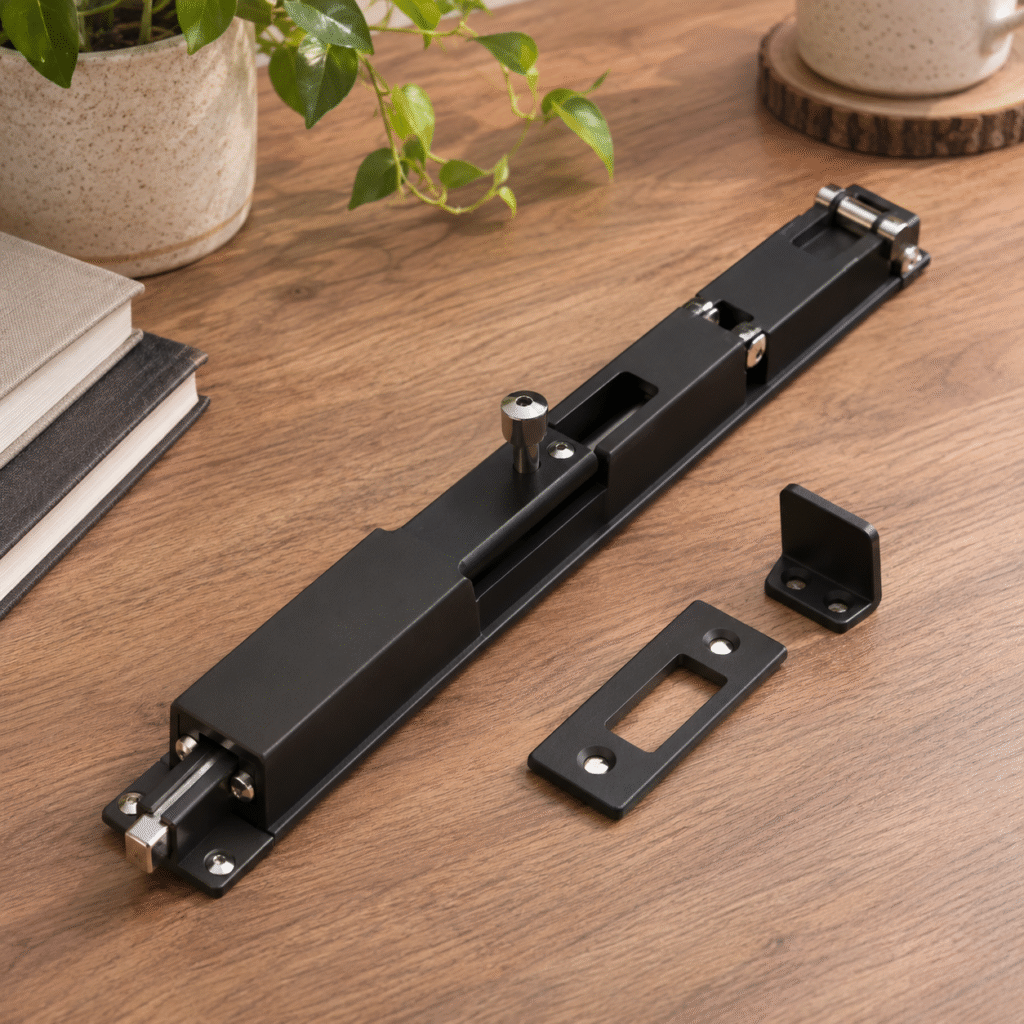
For example, an inactive leaf may be secured by flush bolts while a compatible lockset controls access through the active leaf.
Hardware selection must account for door construction, meeting-stile details, and the intended operating configuration.
When coordinating these construction and hardware choices across multiple openings, the broader interior door collection provides an overview of available door styles and configurations.
Frame and Installation Considerations
Accurate installation is essential for double-door alignment.
Builders should verify jamb dimensions, hinge locations, floor clearance, and meeting-stile gaps.
Incorrect preparation or uneven frames can cause rubbing, inconsistent clearances, and latching difficulties.
Where factory machining is specified, approved drawings should establish the required preparation and alignment details before production.
Cost Factors When Purchasing Interior Double Doors
Compare Prices for the Same Specification and Supply Scope
The lowest quoted price does not necessarily represent the lowest project cost.
Door dimensions, construction, glazing, finishes, and factory preparation all influence pricing.
Contractors should compare quotations against identical product specifications and clearly defined supply scopes.
Evaluating total delivered costs and installation-related expenses provides a more reliable basis for supplier selection.
Shipping, Packaging and Bulk Purchasing
Shipping arrangements can significantly affect the delivered cost of double interior doors.
Prehung assemblies generally occupy more transportation space, while separate slabs and knock-down frames may improve packing efficiency.
However, additional on-site assembly can increase labor and coordination requirements.
For bulk purchases, compare freight, packaging protection, container utilization, installation labor, and potential replacement costs.
The most economical option depends on the complete project requirements, not simply the price per door.
What Builders Should Confirm Before Placing a Bulk Order
A complete purchasing checklist helps construction teams coordinate specifications, production, and delivery.
Project Door Schedule and Opening Measurements
Record approved opening dimensions, door quantities, locations, and accessibility requirements in the project door schedule.
Verify that scheduled information matches the manufacturer’s drawings, including the specified operating configuration and handing, before production.
Product Specifications and Hardware Requirements
Confirm that approved specifications and hardware schedules identify the required components, quantities, finishes, and machining details for each opening.
Resolve discrepancies between drawings, hardware specifications, and purchase orders before manufacturing.
Slab Pairs, Machined Doors, and Prehung Supply
Builders should confirm both the supply format and the machining scope:
- Slab pairs: Door leaves supplied separately from the frame.
- Machined doors: Door leaves prepared for specified hardware installation.
- Prehung units: Door leaves assembled into a frame with an agreed level of factory preparation.
Machining can be specified for separately supplied slabs or prehung units. Confirm the opening configuration and included accessories for the selected supply format.
Frame, Accessories and Packaging Inclusions
Check itemized supply and packing lists against the approved order to identify missing or incorrectly allocated components.
Confirm the inclusion of required jambs, stops, casing, and hardware.
Packaging labels should identify door styles, dimensions, quantities, and corresponding accessories to simplify on-site distribution.
Delivery Requirements and Project Coordination
Coordinate production schedules, shipping arrangements, and delivery quantities with construction progress.
For multi-unit developments, organizing labels by building, floor, or floor plan can reduce sorting mistakes.
The following checklist summarizes essential purchasing confirmations:
| Item | What to Confirm | Potential Risk |
|---|---|---|
| Dimensions | Approved leaf, frame, and opening measurements | Incorrect fit |
| Configuration | Both-active or active/inactive | Unsuitable operation |
| Handing | Approved opening diagrams | Incorrect machining |
| Hardware | Compatible specifications and quantities | Missing components |
| Supply format | Agreed assembly and preparation scope | Incomplete delivery |
| Packaging | Labels, quantities, and pallet details | Site delays |
FAQ
What Is the Standard Size for Interior Double Doors?
Available sizes vary by manufacturer and door style. Specify the width, height, and thickness of each leaf, including whether the pair uses equal or unequal widths. Final dimensions must match the selected frame and project opening.
Do Interior Double Doors Need an Astragal?
Not always. Astragal requirements depend on the meeting-stile design, latching arrangement, desired gap coverage, and applicable performance requirements.
Do Flush Bolts Lock the Entire Double-Door Pair?
Not necessarily. Flush bolts generally secure the inactive leaf. Locking the complete opening depends on the active leaf’s lockset, strike arrangement, and compatible hardware.
When Should Builders Consider Solid-Core Double Doors?
Solid-core doors are worth considering where greater mass, a substantial closing feel, or improved sound separation is desired. Actual performance depends on the complete door assembly, including frames, seals, and installation.
Conclusion
Selecting interior double doors requires coordinated decisions about operating configurations, dimensions, construction, and hardware.
For builders and contractors, accurate specifications and clearly defined supply scopes help reduce purchasing errors, control project costs, and support efficient installation across residential and commercial developments.