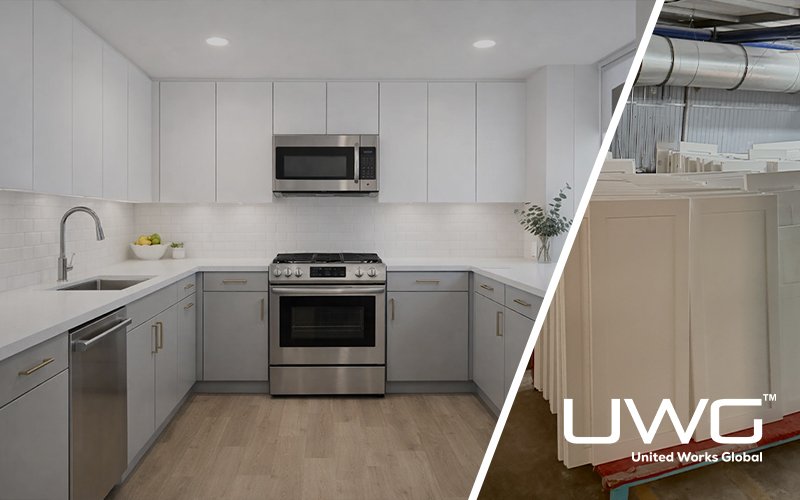
Selecting between framed and frameless cabinets is a critical decision in renovation projects. The choice directly affects structural performance, installation efficiency, and usable space. With two fundamentally different construction systems available, how can builders determine which option delivers the best long-term value?
Framed cabinets incorporate a front face frame that enhances structural rigidity and allows greater installation tolerance, making them suitable for traditional or high-load applications. Frameless cabinets, or European-style cabinets, eliminate the face frame to provide a streamlined appearance and up to 10–15% more usable storage space. While framed systems are generally more cost-effective and forgiving on-site, frameless cabinets require higher precision and are better suited for modern, space-optimized designs.
A proper evaluation requires balancing structural behavior, cost efficiency, and installation precision against the specific conditions of each project.
What is the Difference Between Framed and Frameless Cabinets?
The fundamental difference lies in how structural loads are distributed and reinforced within the cabinet system.
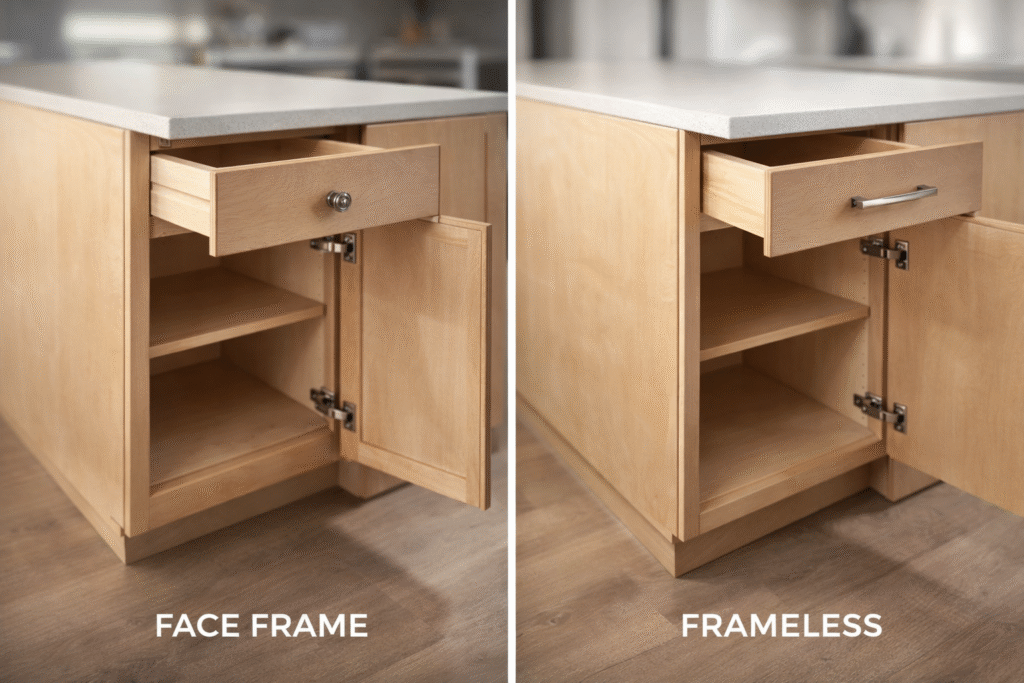
In framed cabinets, a solid wood face frame is mechanically fastened to the front edges of the cabinet box, creating an additional load-bearing layer. This frame improves torsional rigidity and helps maintain squareness under stress, especially in environments with uneven walls or variable loads. It also serves as a stable anchoring surface for hinges and door hardware, reducing long-term alignment issues.
In contrast, frameless cabinets rely entirely on the cabinet box for structural integrity. Without a face frame, rigidity is achieved through thicker side panels (typically 18–19mm), precision machining, and engineered joinery systems such as dowels or confirmat screws. This design requires tighter manufacturing tolerances and accurate installation to prevent racking or misalignment.
From an engineering perspective:
- Framed cabinets use a redundant reinforcement system (frame + box)
- Frameless cabinets depend on a single-structure load distribution model
This distinction directly affects not only strength, but also installation tolerance, hardware performance, and long-term dimensional stability.
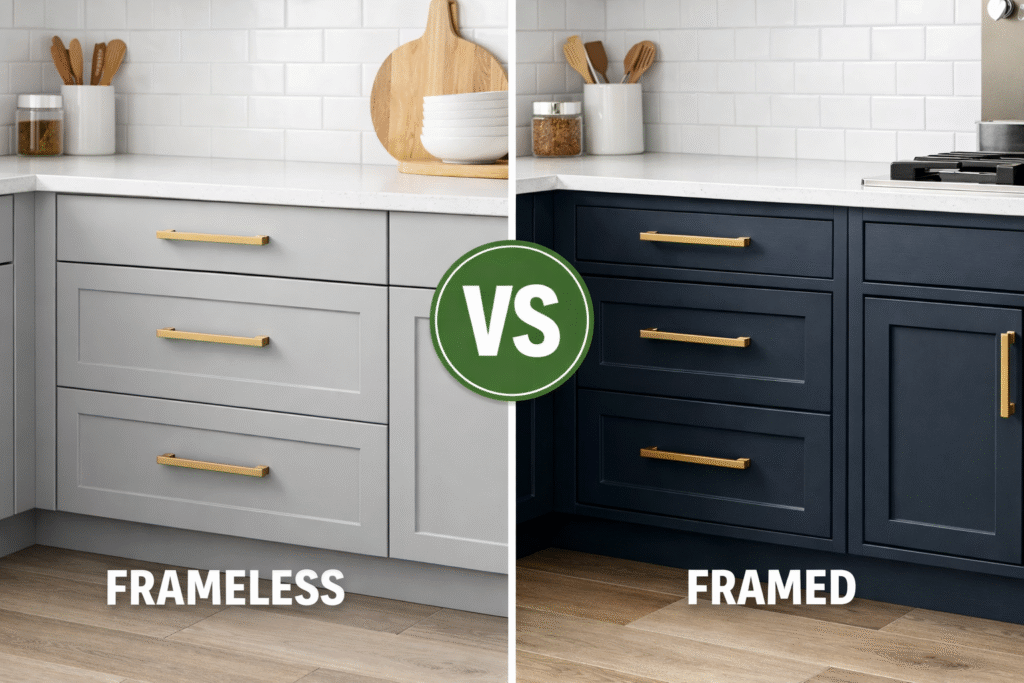
Framed vs Frameless Cabinets Pros and Cons
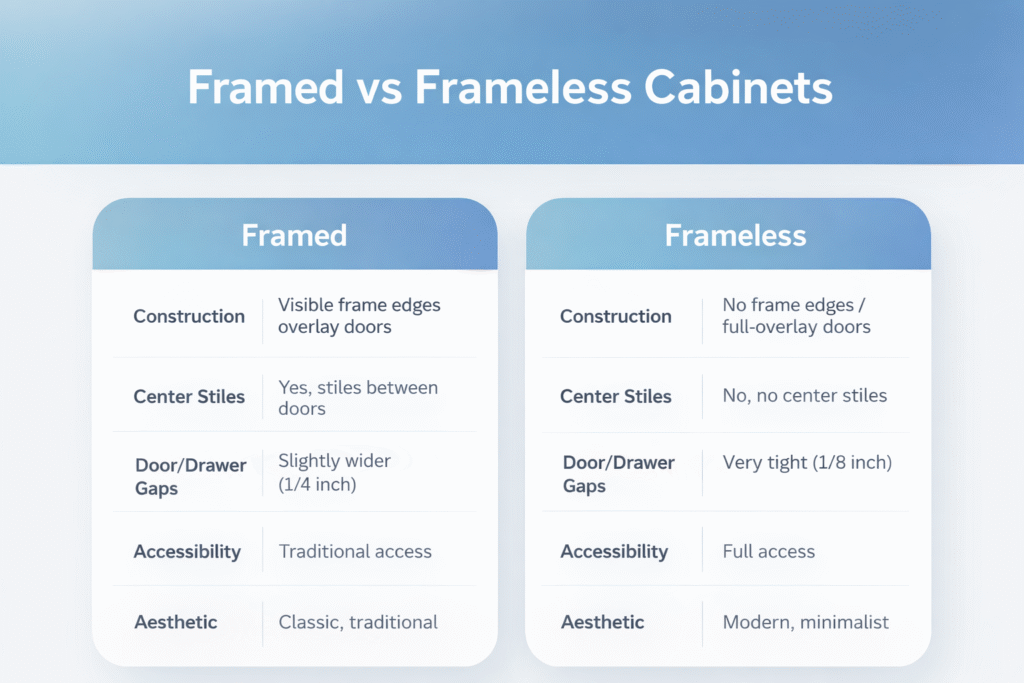
Rather than a purely aesthetic decision, choosing between framed and frameless cabinets involves evaluating structural performance, installation tolerance, and spatial efficiency under real-world conditions. Each system reflects a different engineering priority: framed cabinets emphasize reinforcement and adaptability, while frameless cabinets prioritize precision and maximum internal accessibility.
For builders, the decision should be based on how each system responds to job site variables such as wall irregularities, load demands, and hardware alignment requirements.
The comparison below highlights the key technical and economic differences:
| Evaluation Criteria | Framed Cabinets | Frameless Cabinets |
|---|---|---|
| Structural System | Face frame acts as a front load-bearing reinforcement, improving torsional rigidity | Load is distributed through the cabinet box panels without additional frontal support |
| Load Resistance | Better resistance to racking and deformation under heavy loads | Dependent on panel thickness and joinery quality for structural stability |
| Manufacturing Tolerance | More forgiving; minor deviations can be absorbed by the face frame | Requires high-precision machining; low tolerance for dimensional errors |
| Installation Adaptability | Easier to install in uneven or out-of-plumb wall conditions | Demands precise leveling and alignment during installation |
| Storage Efficiency | Reduced access due to center stiles and frame obstruction | Provides 10–15% more usable space with full-access openings |
| Hardware Integration | Hinges mount to face frame, allowing flexible adjustment | Uses concealed European hinges requiring exact drilling and positioning |
| Cost Structure | Generally lower due to simpler construction and tolerances | Higher due to precision manufacturing and hardware systems |
| Design Application | Suitable for traditional, transitional, or heavy-duty environments | Preferred for modern, minimalist, and space-optimized designs |
From a performance standpoint, frameless cabinets offer measurable gains in storage efficiency (up to 15%), while framed cabinets provide greater resilience in less controlled installation environments.
Are Frameless Cabinets Better Than Framed Cabinets?
Frameless cabinets are not inherently superior; the optimal choice depends on project conditions, performance requirements, and installation constraints rather than aesthetics alone.
From a contractor’s perspective, the decision can be simplified into three key criteria:
- Site Conditions In projects where walls are uneven or installation tolerances are difficult to control, framed cabinets provide greater flexibility and reduce alignment risks. Frameless systems, by contrast, require near-perfect leveling and precise measurements.
- Load and Usage Requirements For high-load or heavy-use environments, framed cabinets offer additional structural reinforcement through the face frame. Frameless cabinets perform well in residential settings but rely more heavily on material quality and joinery precision.
- Design and Space Priorities When maximizing internal space and achieving a modern, seamless appearance is critical, frameless cabinets are typically the preferred solution.
In practice, experienced builders rarely treat this as a binary choice. Instead, they select frameless cabinets for precision-driven, design-focused projects, and framed cabinets for environments where structural tolerance and durability are the primary concerns.
Do Frameless Cabinets Have More Storage Space?
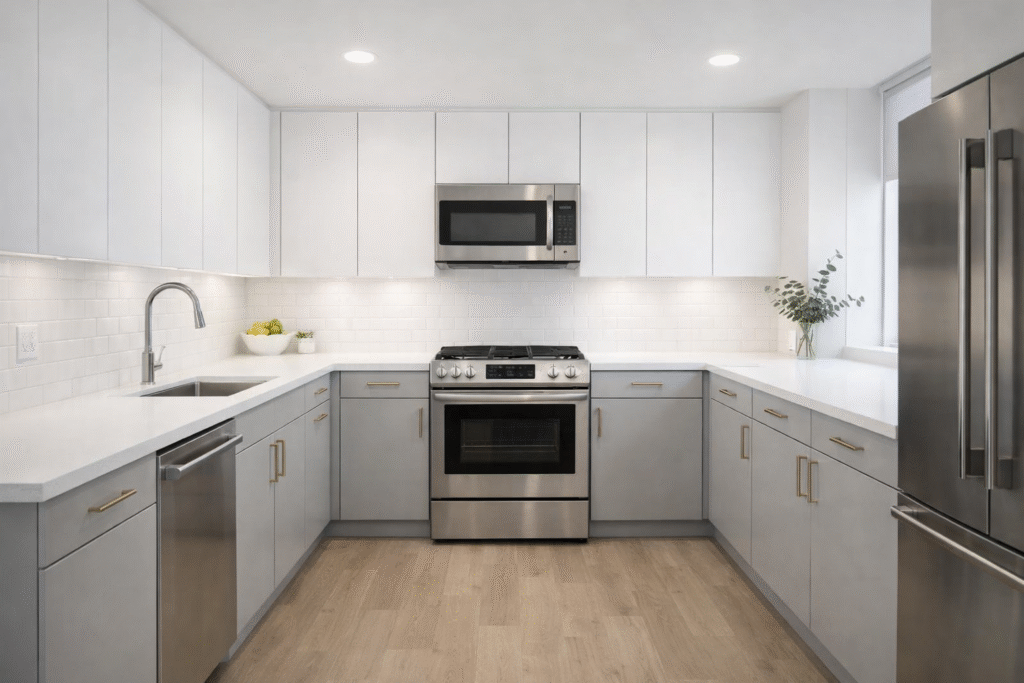
Yes—typically 10–15% more usable space.
By eliminating the face frame, frameless cabinets allow for full-width openings and wider drawer boxes, improving access and internal capacity. This makes them especially effective in small kitchens or space-constrained renovations.
Are Framed Cabinets More Durable?
Generally, yes—particularly in demanding environments.
The face frame provides additional structural reinforcement, improving resistance to warping and long-term deformation. As a result, framed cabinets are better suited for high-traffic, heavy-load, or less precise installation conditions.
Frameless cabinets can perform equally well but depend heavily on material thickness, joinery quality, and installation accuracy.
Framed vs Frameless Cabinets Cost: Which is More Cost-Effective?
Based on pricing from Home Depot, framed cabinets typically range from $100–$300 per linear foot, while frameless cabinets range from $150–$400 per linear foot, depending on materials and finishes.
In most renovation projects, framed cabinets are approximately $800–$1,000 less per kitchen.
Cost-effectiveness depends on priorities:
- Lower upfront cost → framed cabinets
- Higher space efficiency and modern design → frameless cabinets
Builders should also factor in installation labor, as frameless systems require tighter tolerances and more precise alignment.
Face Frame vs Frameless Hinges: What Builders Should Know
Hinge systems differ fundamentally based on cabinet construction, affecting both installation precision and long-term alignment.
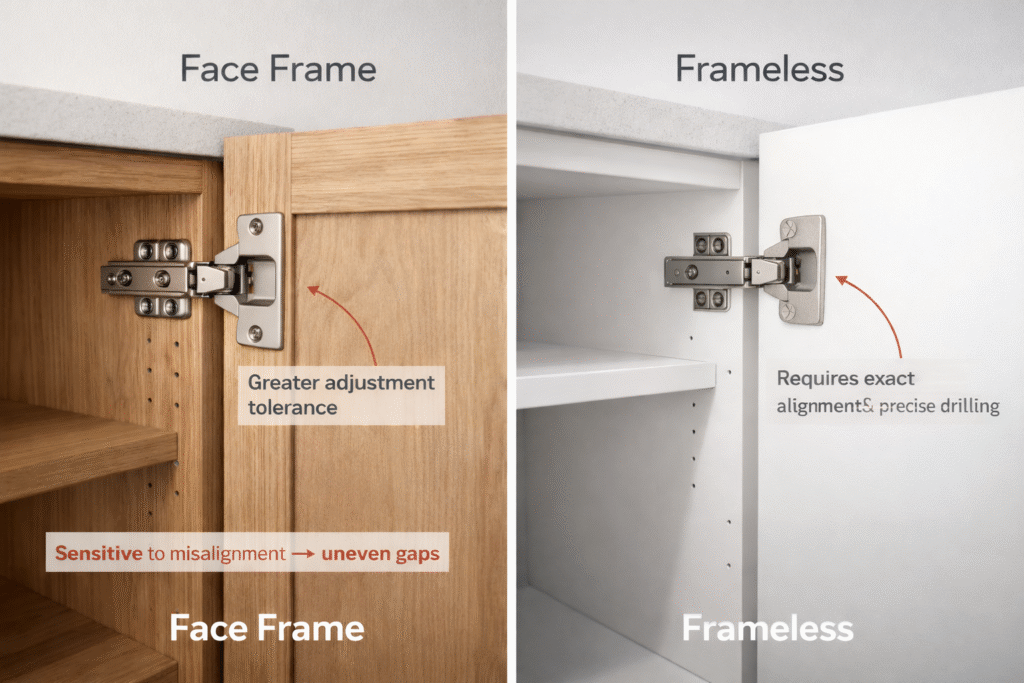
- Framed cabinets use hinges mounted to the face frame, allowing greater adjustment flexibility and tolerance during installation.
- Frameless cabinets rely on European concealed hinges, which require precise drilling and exact alignment to function properly.
As a result, frameless systems are more sensitive to installation errors, where minor misalignment can lead to uneven gaps or premature hardware wear.
Frameless Cabinets vs Full Overlay: What’s the Difference?
Frameless refers to the cabinet construction method (no face frame), while full overlay describes the door configuration (doors cover most of the cabinet front).
Framed cabinets can also use full overlay doors, but frameless systems typically depend on full overlay to achieve a consistent, seamless appearance.
For builders, distinguishing these terms is essential to avoid specification and ordering errors.
Frequently Asked Questions About Framed vs. Frameless Cabinets
Q: What is the main structural difference between framed and frameless cabinets?
A: The main difference lies in how the cabinet supports weight. Framed cabinets feature a solid wood face frame attached to the front of the cabinet box, providing extra structural reinforcement and serving as a secure mounting point for hinges. Frameless cabinets (often called European-style) do not have this front frame; they rely entirely on thicker side panels and precision joinery for structural stability.
Q: Do frameless cabinets actually provide more storage space?
A: Yes. Because frameless cabinets eliminate the front face frame and the center stiles found in traditional cabinets, they offer full, unobstructed access to the cabinet interior. This design typically provides up to 10% to 15% more usable storage space and allows for wider drawer boxes, making them highly efficient for smaller kitchens.
Q: Which type of cabinet is easier to install during a home renovation?
A: Framed cabinets are generally easier and more forgiving to install, especially in older homes or renovations where the walls and floors may be uneven or out-of-plumb. The rigid front face frame helps absorb minor deviations. Frameless cabinets require near-perfect leveling, highly accurate measurements, and precise alignment, making the installation process more demanding.
Q: Are framed cabinets more durable than frameless cabinets?
A: Because of the additional solid wood face frame, framed cabinets generally offer better resistance to racking and deformation under heavy loads, making them exceptionally durable in high-traffic environments. However, a high-quality frameless cabinet built with thick, premium materials (like 18mm or 19mm plywood or MDF) and engineered joinery can also deliver excellent long-term durability.
Summary
There is no one-size-fits-all solution when choosing between framed and frameless cabinets. The decision ultimately depends on project conditions, performance requirements, and design priorities.
Framed cabinets provide greater structural tolerance and reliability in challenging installations, while frameless cabinets offer superior space efficiency and a streamlined modern look.
For builders, the key is not which system is “better,” but which one aligns most effectively with the functional demands and constraints of the project.
Articles that you may be interested in:
Types of Kitchen Cabinets: Shaker, Slab, and Frame Cabinets Explained
How Many Cabinets Does a Typical Two-Bedroom Apartment Need?