Builders often struggle to choose the right bifold door hardware for different projects. A lightweight system may reduce installation time, while a heavy-duty setup delivers stronger long-term performance. Choosing the wrong system can lead to alignment issues, premature wear, and costly callbacks.
Lightweight bifold door hardware is ideal for residential closets and interior applications where smooth operation and easy installation matter most. Heavy-duty bifold hardware is better suited for larger or heavier door panels in commercial and high-traffic environments. Builders should compare load capacity, door thickness, hardware components, and installation requirements before selecting the right bifold door system.
Both systems offer unique advantages. Below, we compare their applications, included components, and installation process to help builders choose the right solution.
What Is a Lightweight Bifold Door Hardware System?
A lightweight bifold door hardware system is designed for interior residential applications such as closets, wardrobes, laundry rooms, and compact storage spaces. These systems prioritize smooth operation, simple installation, and a clean modern appearance.
Our lightweight bifold door hardware system supports door panels weighing up to 40 lbs. (18 kg) and accommodates door thicknesses from 19 mm to 45 mm.
The system uses a top-hung track design that helps save floor space while maintaining stable door movement. Compared with traditional bifold systems, this modern configuration provides a cleaner look and easier adjustment during installation.
Common applications include:
- Closet doors
- Wardrobe systems
- Residential interiors
- Apartment projects
- Lightweight MDF or wooden panels
Builders often prefer lightweight bifold systems because they are faster to install and easier to maintain in residential projects.
What Components Are Included in the Lightweight System?
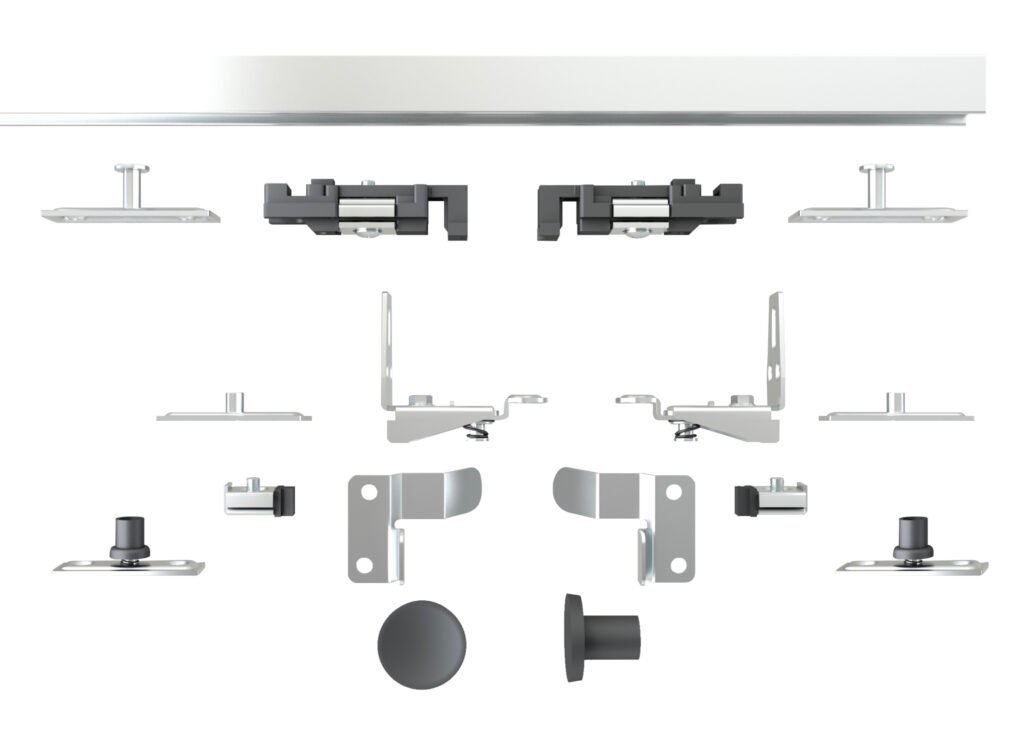
The lightweight bifold hardware kit includes all major installation components required for a standard 2-panel bifold setup.
Included components:
- Aluminum top track
- Pivot bracket
- Top pivot plate
- Bottom pivot plate
- Track stop
- Door pull
- Mounting screws
- Adjustment wrench
The adjustable track stop helps improve door alignment and allows smooth opening and closing. The included pivot system also simplifies horizontal door adjustment after installation.
For builders handling multiple installations, having all components included in one kit can significantly reduce labor time and on-site preparation.
How to Install the Lightweight Bifold Hardware
The lightweight system is designed for quick installation with minimal tools. According to the installation manual, the process can be completed in several straightforward steps.
Step 1 — Install the Top Track
Mount the aluminum track to the head jamb approximately 19 mm from the front edge. Ensure the track is centered properly before fastening screws.
Step 2 — Install Pivot Plates
Attach the top and bottom pivot plates to the door panel according to the specified dimensions in the installation guide.
Step 3 — Secure the Bottom Pivot Bracket
Install the bottom pivot bracket on the side jamb. Proper alignment is important to ensure smooth operation.
Step 4 — Insert Door Panels
Insert the top pivot into the track bracket and secure the bottom pivot into the bracket socket. Adjust the alignment using the included wrench.
Step 5 — Install Door Pull and Track Stop
Install the pull handle and adjust the track stop position to create proper closing tension.
This system is especially useful for builders seeking faster installation in residential developments or multifamily projects.
What Is a Heavy-Duty Bifold Door Hardware System?
Heavy-duty bifold door hardware is designed for larger, heavier, or higher-traffic applications where long-term durability is critical.
Compared with lightweight systems, heavy-duty hardware uses reinforced pivot points and stronger structural components to support wider openings and heavier wood panels.
Our heavy-duty bifold hardware system is suitable for:
- Commercial interiors
- Large residential openings
- Solid wood doors
- Multifamily developments
- High-frequency use environments
The BF30 / 2400 series also supports both 2-panel and 4-panel configurations.
Builders often choose heavy-duty systems when structural stability and long-term performance are more important than minimal hardware visibility.
What Components Are Included in the Heavy-Duty System?
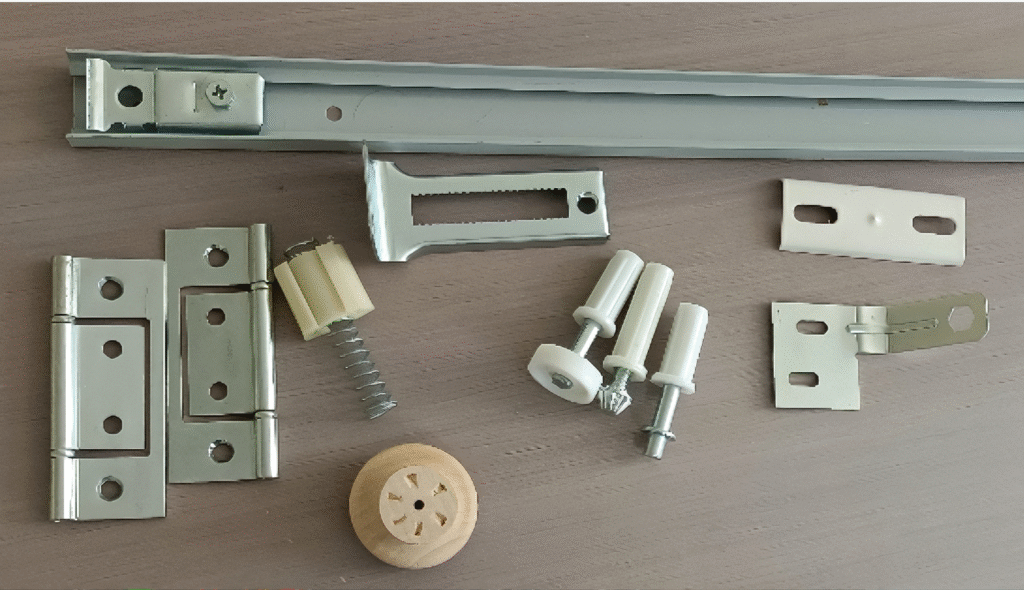
The heavy-duty bifold hardware system includes reinforced components for enhanced support and alignment.
Included components:
- Top pivots
- Bottom pivots
- Top track
- Jamb bracket
- Door aligners
- Snugger
- Door knob
- Mounting hardware
The aligners help maintain panel positioning during operation, while the snugger improves door closure and minimizes movement when the door is shut.
These additional stabilizing components make heavy-duty systems more suitable for demanding commercial projects.
How to Install the Heavy-Duty Bifold Hardware
The heavy-duty installation process focuses on structural stability and precise adjustment.
Step 1 — Insert Top and Bottom Pivots
Install the pivots into the pre-drilled holes on the door panels.
Step 2 — Mount the Track and Jamb Bracket
Fasten the top track securely to the opening header and install the jamb bracket on the floor side.
Step 3 — Position the Door Panels
Insert the top pivot into the track bracket and engage the bottom pivot with the jamb bracket.
Step 4 — Adjust Door Height and Alignment
Lift the panels slightly and adjust the threaded pivot stem to achieve proper height and alignment.
Step 5 — Install Aligners and Snugger
Install the aligners on the guide door and insert the snugger into the track for improved stability.
Builders working on commercial installations should always verify wall strength and structural support before installation.
Lightweight vs Heavy-Duty: Which One Should Builders Choose?
| Feature | Lightweight System | Heavy-Duty System |
|---|---|---|
| Application | Residential interiors | Commercial & large openings |
| Door Weight Capacity | Up to 40 lbs / 18 kg | Higher load support |
| Installation | Faster and simpler | More structural adjustment |
| Appearance | Modern minimalist | Traditional heavy-duty |
| Maintenance | Low maintenance | High durability |
| Best For | Closets & wardrobes | Solid wood & high-traffic doors |
For residential builders, lightweight bifold hardware can improve installation efficiency while delivering a clean modern look.
For commercial contractors or builders handling heavier door panels, heavy-duty bifold hardware provides better long-term reliability and stability.
Selecting the correct bifold door hardware system ultimately depends on door weight, opening size, project type, and expected usage frequency.
Frequently Asked Questions About Bifold Door Hardware
Q: What is the main structural difference between lightweight and heavy-duty bifold hardware?
A: The difference lies primarily in the track material and roller quality. Lightweight systems typically use thin-gauge aluminum tracks and nylon rollers, designed for doors weighing up to 30–50 lbs per panel. Heavy-duty systems utilize high-gauge steel or reinforced aluminum tracks paired with precision ball-bearing rollers, enabling them to support panels exceeding 100–150 lbs while maintaining a smooth, silent glide.
Q: When should a builder specify a heavy-duty bifold system over a standard one?
A: Builders should prioritize heavy-duty systems for large room dividers, solid wood folding doors, or any high-traffic entryway. While lightweight hardware is cost-effective for residential closets, heavy-duty hardware is a strategic “insurance” against the most common bifold door callbacks: track jumping, sagging panels, and hardware failure under the stress of daily commercial or multi-family use.
Q: Does the door core material influence the type of hardware needed?
A: Absolutely. Hollow-core doors are lightweight and work well with standard residential kits. However, if your project specifies solid-core MDF or natural wood bifold doors, the significant increase in weight per square foot requires a heavy-duty hardware system. Using lightweight tracks for heavy solid doors will cause the rollers to flat-spot and the track to bend over time, leading to operational failure.
Q: How does partnering with M4B help builders optimize their folding door systems?
A: M4B provides integrated hardware solutions that are factory-tested for compatibility with various door weights and dimensions. By sourcing through M4B, contractors receive standardized kits that include heavy-duty pivots and tracks engineered for rapid installation. This one-stop approach ensures that every bifold door in a large-scale development operates with the same high level of reliability and consistency.
Conclusion
Both bifold hardware systems serve different construction needs. Lightweight systems are ideal for residential interiors and quick installations, while heavy-duty hardware delivers stronger support for larger or high-traffic applications. Builders who choose the correct system can improve installation efficiency, reduce maintenance issues, and deliver better long-term performance.
Articles that you may be interested in: