Interior double doors are widely used in homes, apartments, offices, and other interior spaces where a wider opening or a balanced architectural appearance is desired. However, choosing a double door involves more than selecting two matching door slabs. Buyers also need to consider how the two leaves operate, door construction, swing direction, clear opening, hardware, jamb preparation, and whether the doors will be supplied as slabs or complete prehung units.
For builders, contractors, distributors, and project buyers, defining these details before ordering can reduce installation problems and unnecessary field modifications. This guide explains the main interior double door types, configurations, construction options, hardware arrangements, applications, and purchasing considerations.
What Are Interior Double Doors?
Interior double doors use two door leaves within a single framed opening. Depending on the configuration, both leaves may operate regularly, or one may serve as the primary active leaf while the second remains secured until a wider opening is required.
A Double Door Is a Configuration, Not One Door Style
“Double door” describes how the doors are arranged rather than one specific door design. The two leaves can be Shaker, molded panel, louvered, glass, or other interior door styles.
This distinction is particularly important when preparing specifications or requesting quotations. Simply asking for an “interior double door” does not provide enough information for accurate production. The manufacturer may still need the leaf sizes, construction, active/inactive configuration, swing direction, jamb specification, and hardware preparation.
Interior Double Doors vs. French Doors
Interior double doors and French doors are not necessarily the same thing.
French doors generally refer to doors with substantial glazed areas, while double doors describe the two-leaf configuration itself. Therefore, French doors can be double doors, but double doors do not have to be French doors.
For example, a pair of two-panel Shaker doors installed in one opening is an interior double-door unit, but it would not normally be described as a French door.
Common Types of Interior Double Doors
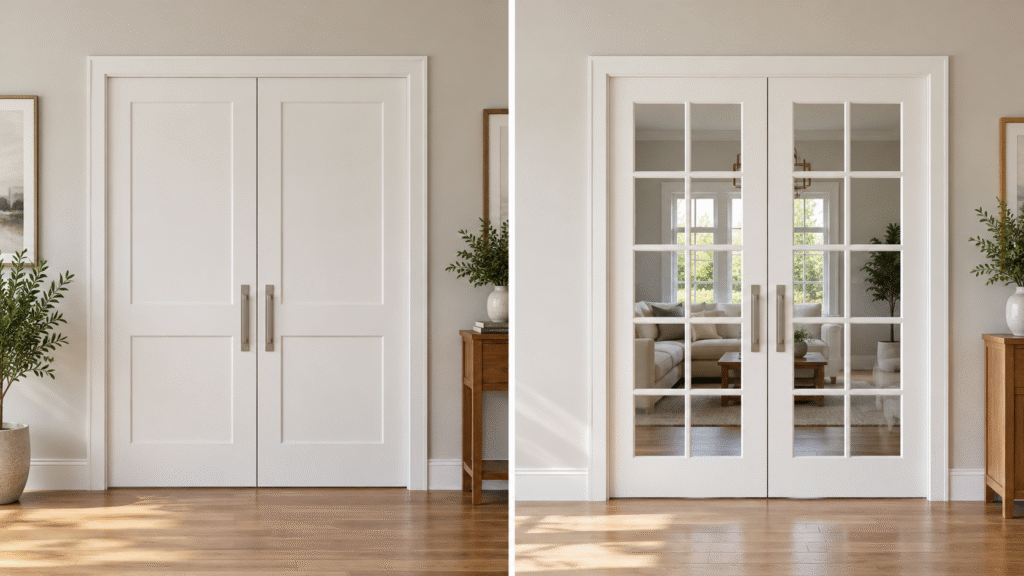
Shaker Double Doors
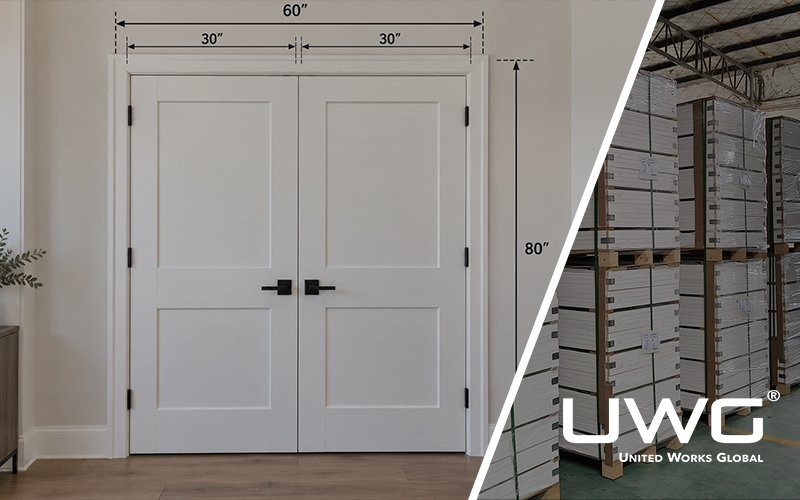
Shaker doors feature clean rails, stiles, and recessed flat panels. One-panel, two-panel, and multi-panel designs can all be configured as double doors.
Their simple geometry works well in modern, transitional, and contemporary interiors. For projects with repeated openings, Shaker designs can also provide a consistent appearance across bedrooms, offices, closets, and common areas.
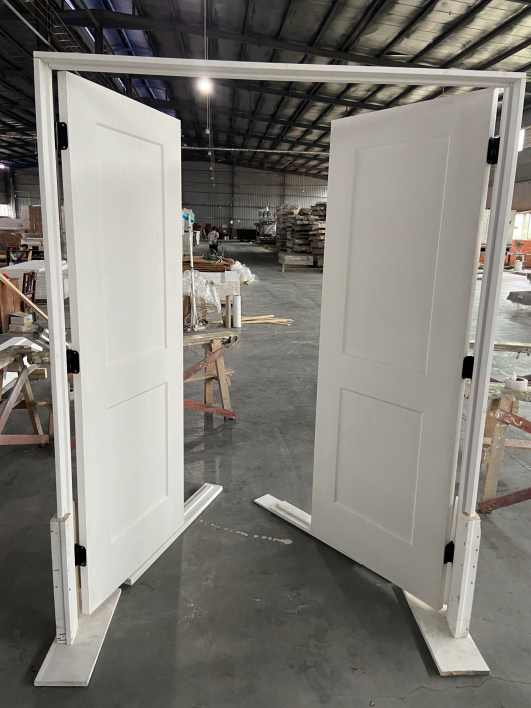
Panel and Molded Double Doors
Molded doors are another common option for residential and multifamily applications. Door skins can be manufactured in two-panel, four-panel, six-panel, and other designs.
Depending on the required performance and budget, they may use hollow-core or solid-core construction.
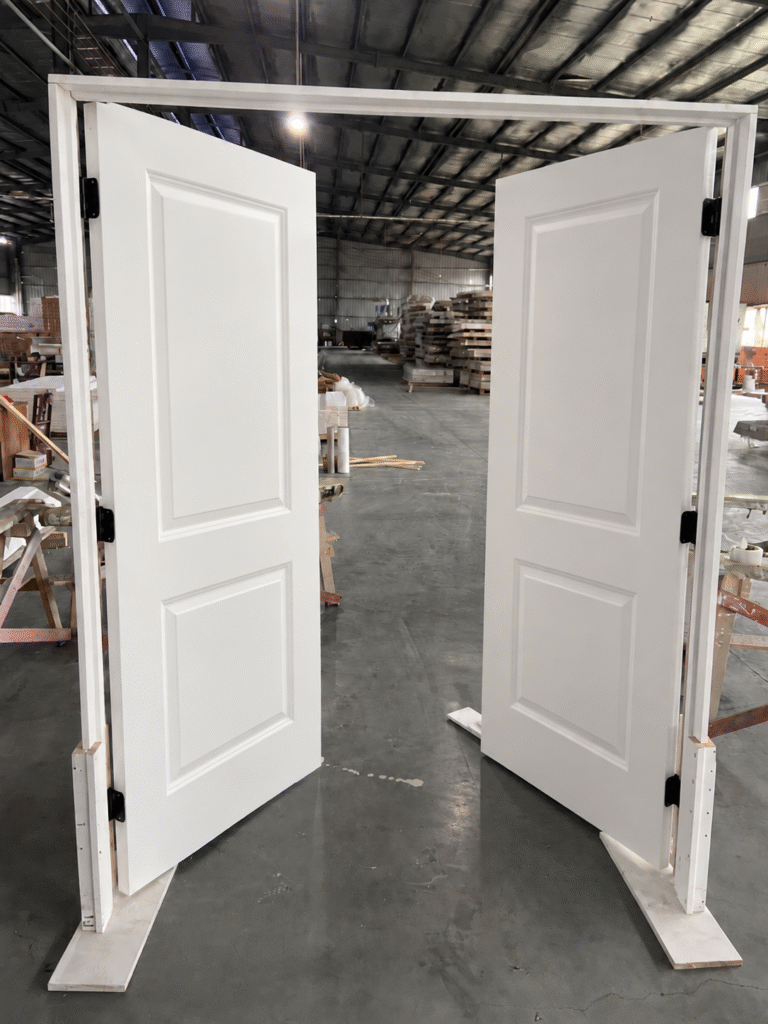
Glass and French-Style Double Doors
Glass double doors are useful where visual connection and natural light are important. They are frequently used between living areas, home offices, libraries, and other shared spaces.
Clear glass provides maximum visibility, while frosted or obscure glass can provide more privacy without completely blocking light.
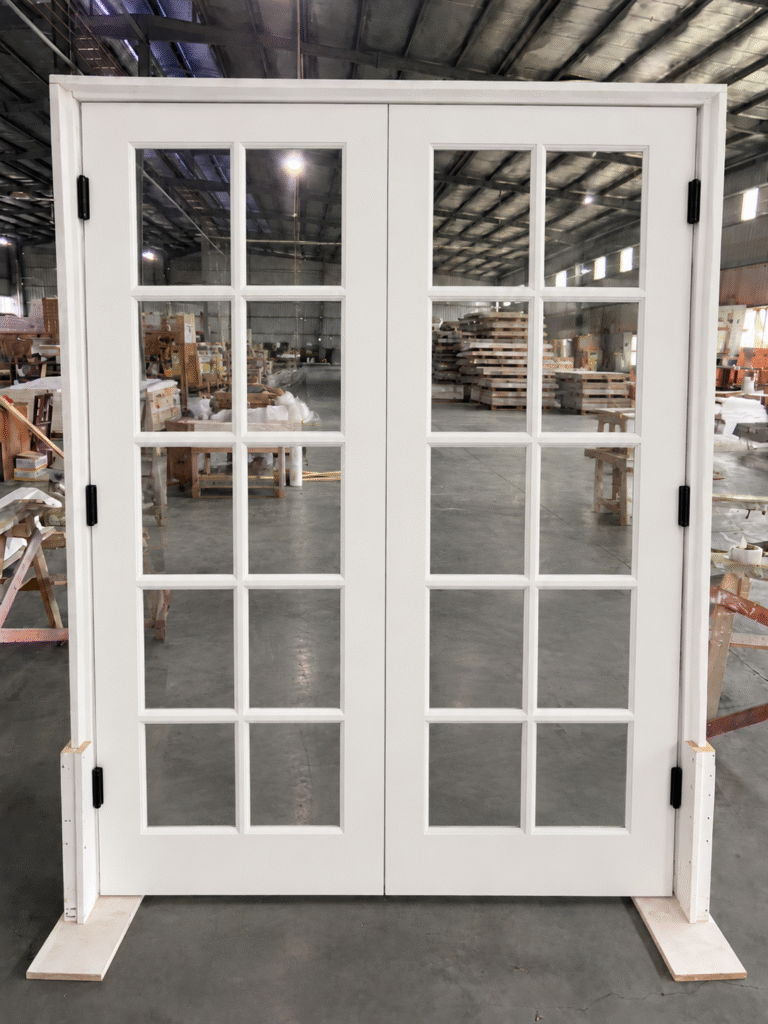
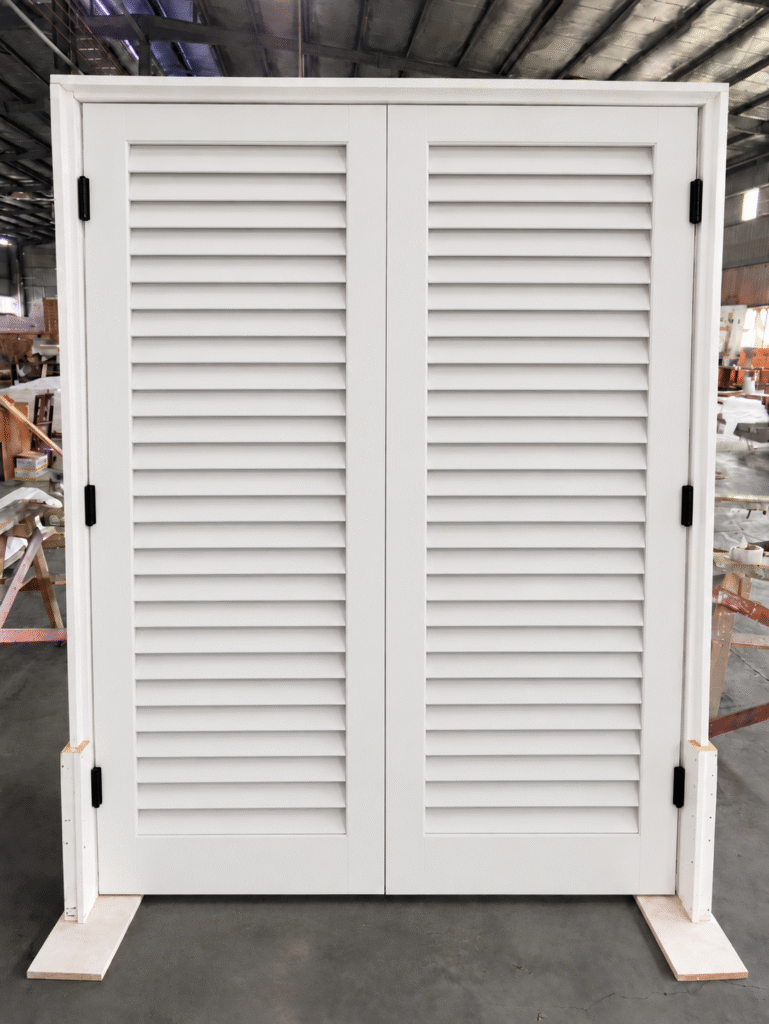
Louvered Double Doors
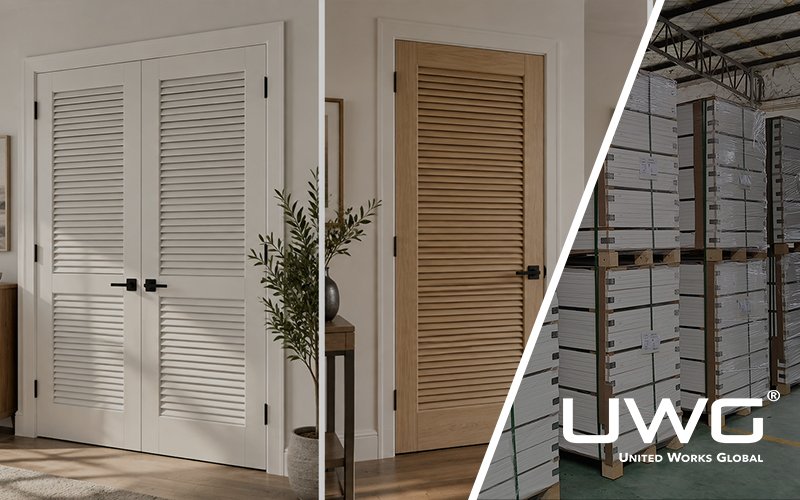
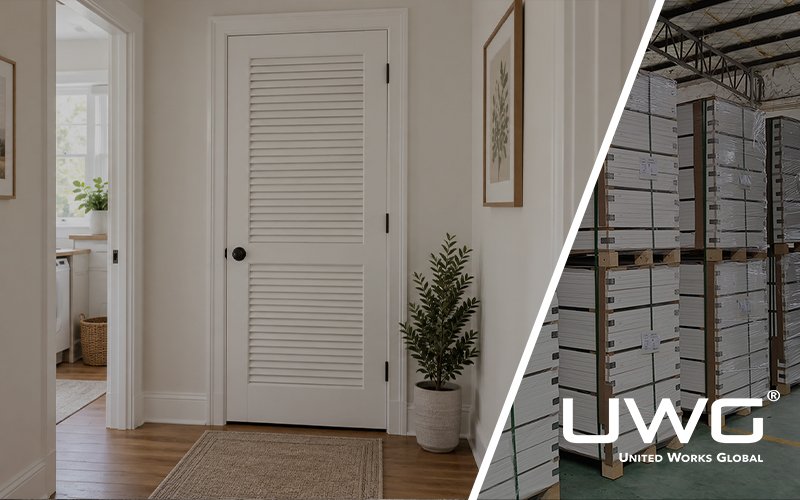
Louvered doors incorporate horizontal slats that allow airflow through the opening. They are commonly considered for closets, utility areas, and other spaces requiring ventilation.
Before specifying them, buyers should determine whether ventilation, privacy, or both are required.
Common Interior Double Door Configurations
Door style determines appearance, while configuration determines how the pair actually operates.
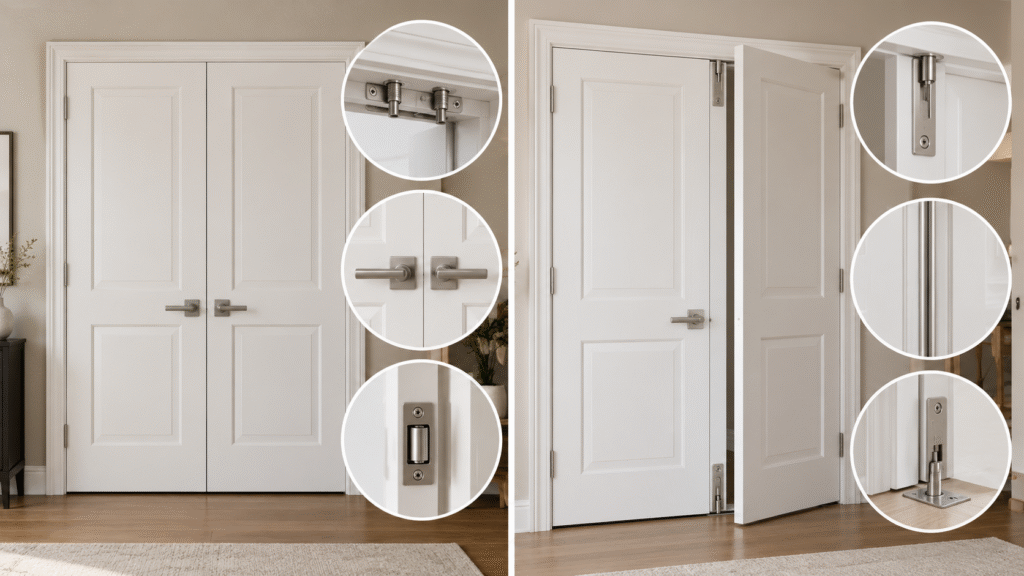
Both-Active Pairs With Catches
In a both-active configuration, both leaves can operate independently. Ball catches, roller catches, or magnetic catches may be used to hold the doors in the closed position without a conventional latch between the two leaves.
This arrangement can work well for closets, pantries, storage openings, and other ordinary interior applications where users frequently need access through both leaves.
However, catch-operated pairs are generally suited to non-rated interior openings that do not require positive latching, security locking, or controlled egress. Fire-rated openings, required egress doors, or openings with specific locking requirements should not automatically be specified with simple catches. Their hardware must instead be selected according to the applicable code and listed door assembly.
Active and Inactive Pairs With an Astragal
Another common arrangement has one active leaf and one inactive leaf.
The active leaf is used for normal passage. The inactive leaf remains secured and can be released when the full opening is required. An astragal may be installed along the meeting edge, while flush bolts are commonly used to secure the inactive leaf.
However, flush bolts should not be treated as universally interchangeable hardware. Manual flush bolts, automatic flush bolts, coordinators, astragals, and other components may be subject to additional requirements depending on the opening.
For fire-rated or egress openings, the inactive-leaf bolts, coordinator, astragal, and latching arrangement must comply with the applicable code and the listed door assembly.
Equal-Leaf vs. Unequal-Leaf Pairs
Double doors do not always require two leaves of identical width.
An equal-leaf pair might use two 30-inch doors to create a 60-inch nominal pair. An unequal-leaf arrangement may combine a wider primary leaf with a narrower secondary leaf.
The appropriate proportion depends on the opening, required daily passage width, appearance, accessibility requirements, and project design.
Swing Direction and Room-Side Coordination
For interior applications, the important question is not simply whether a door is described as inswing or outswing. Drawings should establish which room the pair opens toward, which leaf is active, and whether the swing interferes with furniture, cabinets, switches, walls, or circulation paths.
These details should be coordinated before machining and production.
Interior Double Door Configuration Comparison
| Feature | Both-Active Pair | Active/Inactive Pair |
|---|---|---|
| Daily operation | Either leaf can be used | One primary leaf normally used |
| Both leaves independently operable | Yes | Inactive leaf normally requires release |
| Typical closing method | Ball, roller, or magnetic catches | Latch/strike plus inactive-leaf securing hardware |
| Astragal | Not always required | Common depending on design |
| Flush bolts | Generally not used for basic catch pairs | Often used, subject to application/code |
| Typical application | Ordinary non-rated interior openings | Openings needing controlled primary passage |
| Key item to confirm | Catch and hardware requirements | Astragal, bolts, latch and active leaf |
The final configuration should be selected according to how people will actually use the opening rather than appearance alone.
Where Are Interior Double Doors Commonly Used?
Closets, Pantries and Storage Openings
Double doors provide broad access to closets and storage spaces. Both-active configurations can be particularly convenient when users regularly need access to the entire opening.
Home Offices, Libraries and Living Areas
Shaker, panel, and glass double doors can separate rooms without making the opening feel visually narrow. Glass designs are especially useful when maintaining light between spaces is desirable.
Bedrooms and Other Privacy-Sensitive Rooms
For spaces requiring greater privacy, solid doors are generally more suitable than clear-glass designs. Solid-core construction can also be considered when improved sound control is a project priority.
Multifamily and Repeated Project Openings
In apartment, townhouse, and other repeated-unit projects, standardizing door sizes, handing, hardware preparation, and configurations can simplify manufacturing and installation.
A clear door schedule is particularly valuable when dozens or hundreds of similar openings are involved.
How Hardware Changes Interior Double Door Operation
Hardware should follow the operating configuration of the pair rather than being selected independently.
Catches and Dummy Hardware for Both-Active Pairs
Both-active doors may use ball catches, roller catches, or magnetic catches to hold the leaves closed. Dummy knobs or levers can also be used when a conventional latch is unnecessary.
Again, these solutions are primarily appropriate for ordinary non-rated openings where positive latching, security locking, or controlled egress is not required.
Astragals and Flush Bolts for Active/Inactive Pairs
For active/inactive pairs, the inactive leaf may use top and bottom flush bolts. An astragal can coordinate the meeting edge between the leaves and support the intended closing arrangement.
The specific hardware must still be checked against the application. In fire-rated, egress, or other code-regulated openings, the bolt and latching arrangement cannot simply be selected based on convenience.
Operating Handles, Locks and Strike Preparation
If one leaf uses an operating lever or lock, the manufacturer needs to know the required bore preparation, backset, strike location, active leaf, and related machining requirements.
Confirming these details before production is especially important for factory-machined or prehung doors.
Interior Double Door Construction Options
Hollow-Core, Solid-Core and Stile-and-Rail Construction
Hollow-core doors are lightweight and commonly selected for applications where cost and basic room separation are the main considerations.
Solid-core doors are heavier and can provide a more substantial feel and improved sound control. Stile-and-rail construction is another option commonly associated with traditional wood and engineered door designs.
Solid Wood, MDF and Engineered Wood Options
Interior doors may incorporate solid wood, MDF, engineered wood, molded skins, or combinations of these materials.
The appropriate construction depends on the required design, performance, finish, budget, and project specifications.
Interior Double Door Type Comparison
| Door Type | Privacy | Light | Typical Characteristics | Common Applications |
|---|---|---|---|---|
| Shaker | High | Low | Clean recessed panels | Bedrooms, offices, closets |
| Molded Panel | High | Low | Multiple molded designs | Residential and multifamily |
| Glass/French-Style | Depends on glass | High | Glazed panels | Offices, libraries, living spaces |
| Louvered | Lower | Low | Allows ventilation | Closets, storage, utility areas |
How to Choose Interior Double Doors
Start with the room rather than the door design. Determine how the opening will be used every day and whether one or both leaves need to operate regularly.
Next, confirm the leaf width, required clear opening, and available swing space. Door leaves should not interfere with nearby walls, cabinets, furniture, or circulation areas.
For standard double door dimensions, leaf width combinations, and rough opening requirements, see our Double Door Sizes: Leaf Width and Rough Opening Guide.
Where U.S. accessibility requirements apply, at least one active leaf of a double-leaf doorway must provide the required clear width and maneuvering clearance without relying on the inactive leaf for normal passage. In other words, designers should not assume that users can routinely open both leaves together simply to obtain an accessible clear opening.
Construction is another important consideration. Hollow-core doors may be appropriate for basic applications, while solid-core construction may be preferred when weight, feel, durability, or sound control is more important.
Privacy and light should also influence the style selection. Solid Shaker or molded doors provide greater visual privacy, while glass doors allow more light between rooms.
Finally, coordinate the operating configuration, hardware, and interior design. A visually suitable door can still create installation or compliance problems if the active leaf, catches, astragal, lock preparation, or swing direction is incorrect.
What to Confirm Before Ordering Interior Double Doors
Decide Between Slab-Only, Machined and Prehung Supply
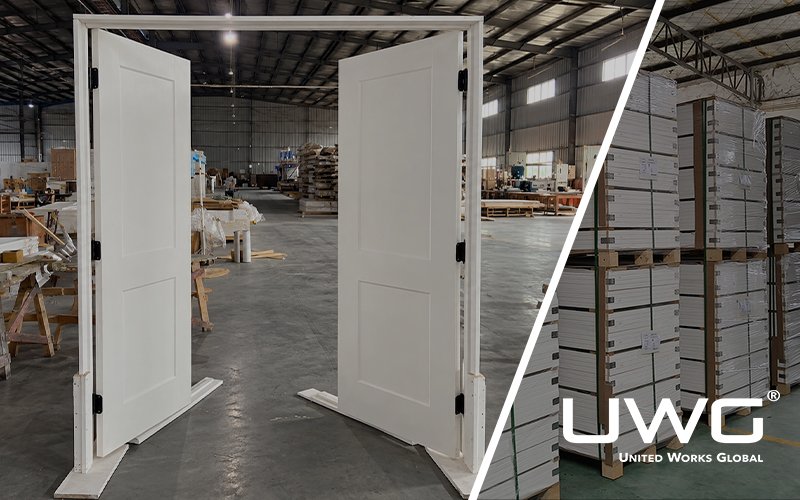
A slab-only order provides the door leaves without the complete frame assembly. A machined door may include factory preparation for hinges, locks, or other hardware. A prehung double door is supplied as a coordinated door-and-frame unit with the leaves prepared and fitted to the jamb.
For large projects, defining the supply scope clearly helps prevent misunderstandings in quotations.
For a closer comparison of factory preparation, installation work, and supply options, see our Prehung Door vs. Slab Door guide.
Confirm Door Handing, Active Leaf and Swing Direction
The purchase specification should identify the active leaf and the direction in which the doors open. Drawings are often more reliable than text descriptions alone for complicated openings.
Confirm Jamb, Astragal and Hardware Preparation
Before production, confirm jamb width and material, hinges, astragal requirements, flush bolts or catches, lock bore preparation, handles, strike preparation, and any project-specific code requirements.
These components work together as a system rather than as independent accessories.
Shop Drawings and Production Release
For customized or project-based orders, shop drawings provide an opportunity to confirm dimensions, configuration, handing, hardware preparation, and other details before mass production.
The drawings should be reviewed and approved before the order is released for manufacturing.
For builders and project buyers comparing door styles, construction options, and supply formats, explore our interior door collection to review available products and project supply options.
Common Mistakes When Selecting Interior Double Doors
One common mistake is treating every double door as a French door. Another is selecting the appearance first without determining whether both leaves should operate or whether one should remain inactive.
Buyers may also overlook the actual clear opening and swing space, resulting in conflicts with furniture, walls, accessibility requirements, or circulation paths.
Another mistake is assuming that catches, flush bolts, and astragals can be used in every project. Hardware that works for a standard bedroom or closet opening may not be appropriate for a fire-rated, egress, accessibility-sensitive, or otherwise regulated opening.
Finally, the quotation should clearly state whether the order covers slabs, machined doors, or complete prehung units. These represent significantly different supply scopes.
Frequently Asked Questions About Interior Double Doors
Are All Interior Double Doors French Doors?
No. Double doors describe a two-leaf configuration. French doors are generally characterized by glazed construction. Shaker, molded, louvered, and other door styles can also be installed as double doors.
Can Both Leaves of an Interior Double Door Open?
Yes. A both-active pair allows both leaves to operate. An active/inactive pair normally uses one leaf for daily passage while the second leaf remains secured until a wider opening is required.
Where accessibility requirements apply, however, the required normal clear opening should be provided by the applicable active leaf without assuming that the inactive leaf will routinely be opened.
What Is the Difference Between a Catch Pair and an Astragal Pair?
A catch pair commonly allows both leaves to operate and may use ball, roller, or magnetic catches for closure. An astragal arrangement is commonly associated with an active/inactive pair, where the inactive leaf may be secured with appropriate bolts or other hardware.
Do Interior Double Doors Need an Astragal?
Not always. Whether an astragal is required depends on the operating configuration, meeting-stile design, hardware, privacy requirements, and applicable project specifications or code requirements.
Can Interior Double Doors Have Unequal Leaf Widths?
Yes. Double doors can use equal or unequal leaf widths. Unequal pairs can provide a wider primary passage leaf while retaining a secondary leaf for occasional full-opening access.
Should Interior Double Doors Be Ordered as Slabs or Prehung Units?
Either is possible. Slabs may suit buyers who perform machining and assembly locally, while prehung units can reduce field preparation by coordinating the leaves, jamb, hinges, and other specified components at the factory.
Conclusion
Choosing interior double doors requires coordinating door style, operating configuration, construction, clear opening, swing direction, hardware, code requirements, and supply format. Shaker, molded, glass/French-style, and louvered doors can all work as double-door systems, but they serve different aesthetic and functional requirements.
For project purchasing, define how the opening must operate before production begins. Confirm the active leaf, leaf widths, swing direction, jamb, catches or latching hardware, astragal and bolt requirements, and whether the order requires slabs, machined doors, or complete prehung units. For fire-rated, egress, accessibility-sensitive, or other regulated openings, the applicable code and listed assembly requirements should also be verified before final hardware and production release.