Interior door hardware includes the components that support, operate, latch, lock, guide and protect a door. Common categories include hinges, handles, knobs, pulls, locks, latches, catches, stops, barn-door tracks, bifold hardware and pocket-door systems.
The correct hardware package depends on the door type, slab dimensions, weight, thickness, room function, traffic level, handing, frame construction, machining requirements, finish and project specifications.
Hardware should be selected as part of the complete door system—not as a last-minute accessory. Early coordination helps prevent incompatible drilling, incorrect hinge preparation, missing components, finish mismatches and expensive jobsite rework.
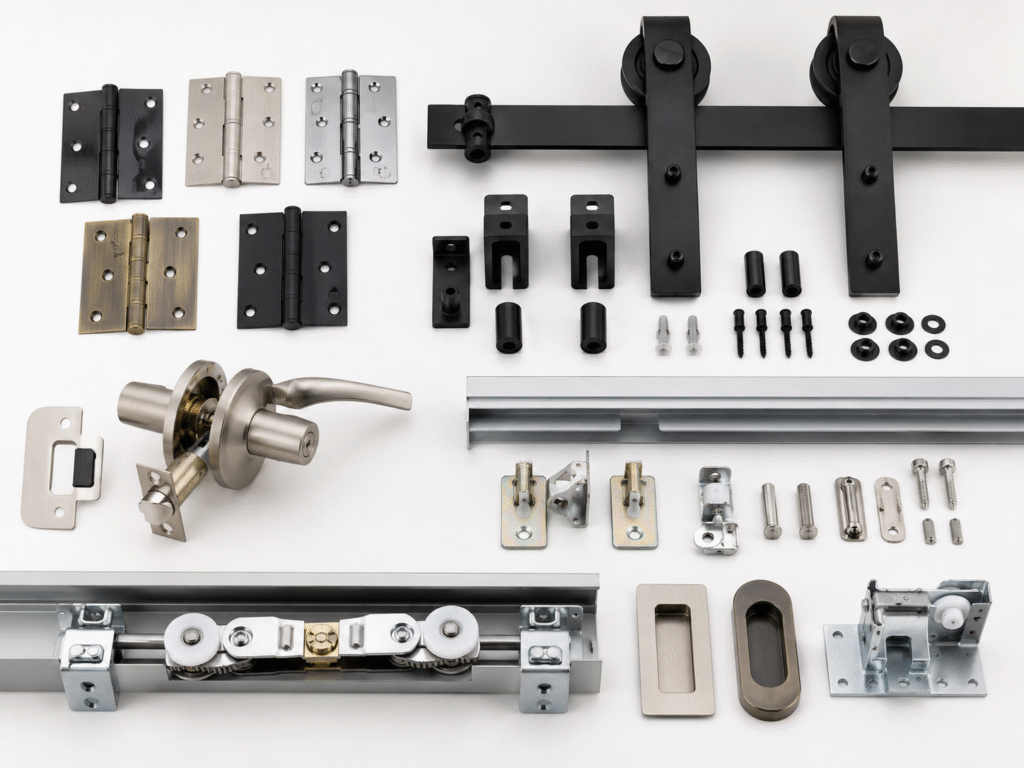
Interior Door Hardware Types at a Glance
| Hardware Type | Primary Function | Common Applications | Main Specification Questions |
|---|---|---|---|
| Hinges | Support and move a swing door | Bedrooms, bathrooms, offices and passage doors | Door weight, height, thickness, hinge type, size and quantity |
| Handles and knobs | Allow occupants to operate the latch | Most hinged interior doors | Lever or knob, function, handing, finish and accessibility |
| Locks and latches | Latch, lock or control access | Bedrooms, bathrooms, offices and storage rooms | Passage, privacy, keyed or specialty function |
| Catches and flush bolts | Hold or secure doors without a conventional latch | Closets, pantries and paired doors | Active leaf, inactive leaf, catch type and preparation |
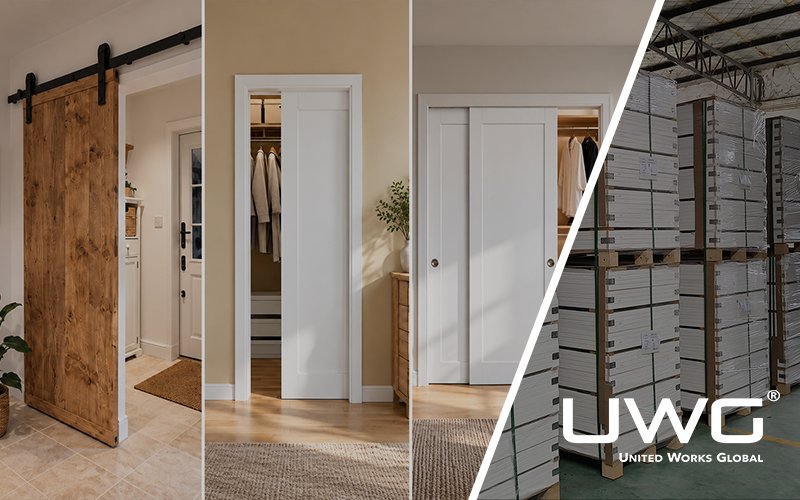
| Barn-door hardware | Move a slab along an exposed wall-mounted track | Pantries, offices, closets and feature openings | Track length, slab weight, wall support and floor guide |
| Bifold hardware | Allow connected panels to fold and travel along a track | Closets, laundries and pantries | Panel size, weight, pivot system and opening dimensions |
| Pocket-door hardware | Move a slab into a concealed wall cavity | Bathrooms, offices, bedrooms and compact rooms | Frame kit, track capacity, wall cavity and pull or lock |
| Door closers | Control automatic closing | Selected commercial or high-use openings | Door size, weight, opening force and project requirements |
| Stops and protection | Limit door movement and protect nearby surfaces | Residential and commercial interiors | Stop location, door swing, wall condition and floor condition |
This table provides a selection framework rather than a universal specification. The final hardware must be checked against the actual door, frame, opening and manufacturer’s product data.
Why Interior Door Hardware Selection Matters
IHardware affects daily operation, installation accuracy and long-term maintenance.
A coordinated hardware package can help builders:
- Support the slab correctly
- Maintain consistent door alignment
- Match lock function to room use
- Reduce field drilling and modification
- Improve installation consistency
- Maintain finish consistency across units
- Simplify replacement and spare-parts management
- Reduce callbacks caused by loose, noisy or incompatible components
Problems often appear when doors and hardware are purchased separately without a shared schedule. A lock body may not match the factory cutout, hinge locations may differ from the frame preparation, or a finish described as “satin nickel” may vary visibly between suppliers.
For repeated residential and multifamily projects, small specification errors can be reproduced across dozens or hundreds of openings. The hardware schedule should therefore be confirmed before door and frame machining begins.
Select Interior Door Hardware as a Complete System
A door does not operate through one component alone. The slab, frame, hinges, latch, strike, handle and stops must work together.
Before choosing individual products, confirm:
- Door type
- Door width, height and thickness
- Door material and core
- Approximate slab weight
- Swing and handing
- Single- or double-door configuration
- Frame and jamb material
- Room function
- Required privacy or access control
- Frequency of use
- Factory or field machining
- Finish schedule
- Applicable accessibility, safety or performance requirements
A heavy solid-core door may need a different hinge specification from a lightweight hollow-core door. A privacy lock for a bathroom has a different function from a passage set for a hallway. A pocket door requires hardware that fits inside the wall cavity and does not project excessively from the slab.
1. Interior Door Hinges
Hinges connect the door slab to the jamb and carry the slab while allowing it to swing.
The appropriate hinge specification depends on more than door height. Builders should evaluate:
- Door height
- Door width
- Door thickness
- Total slab weight
- Door construction
- Frequency of use
- Frame material
- Screw-holding capacity
- Required opening angle
- Self-closing requirements
- Fire or performance rating, where applicable
- Hinge manufacturer’s capacity data
Butt Hinges
Butt hinges are widely used on conventional swing doors. The leaves are commonly mortised into the door edge and hinge jamb.
They are available in different sizes, materials, bearing constructions, finishes and corner configurations.
Plain-Bearing Hinges
Plain-bearing hinges are commonly considered for lighter or moderate-use residential interior doors where the selected model supports the slab and application.
They should not be chosen only because they are less expensive. Door weight, usage and manufacturer ratings still need to be checked.
Ball-Bearing Hinges
Ball-bearing hinges use bearings between the knuckles to reduce friction. They are frequently considered for heavier, taller or more frequently operated doors.
A ball-bearing hinge is not automatically required for every solid-core door, but it can be appropriate where the load and use conditions justify it.
Spring Hinges
Spring hinges apply closing force to the door. They are used where a self-closing function is required by the project or selected for operational reasons.
Closing force and speed must be adjusted for the intended application. Do not substitute a spring hinge for a specified closer without confirming the project requirements.
Concealed Hinges
Concealed hinges are hidden or less visible when the door is closed. They can support a clean architectural appearance but normally require precise machining of the door and frame.
Before ordering, confirm:
- Load capacity
- Door thickness
- Opening angle
- Adjustment range
- Required mortise dimensions
- Frame compatibility
- Installation clearances
Pivot and Specialty Hinges
Pivot systems support a door from pivot points rather than conventional side-mounted butt hinges. They are used for selected architectural or specialty doors.
Pivot location, floor and head support, slab construction and hardware capacity must be coordinated as a complete system.
Hinge Size and Quantity
Common interior hinge sizes include 3-inch, 3-1/2-inch and 4-inch configurations, but size alone does not define capacity.
Do not use one universal rule such as “all 80-inch doors require three hinges” or “all 96-inch doors require four hinges.” These may be common project practices, but the final quantity depends on the complete slab and hardware specification.
Use the door and hinge manufacturer’s instructions, project documents and approved hardware schedule.
ANSI/BHMA standards evaluate hardware through product-specific performance criteria. Where a project requires graded or certified products, confirm the applicable standard and listing instead of relying only on marketing terms such as “heavy duty.” BHMA explains that Grade 1 is the highest of its common Grade 1, 2 and 3 performance levels within applicable standards. See the BHMA product grade information.
2. Interior Door Handles, Knobs and Pulls
Handles allow occupants to operate the latch or move the door.
The main forms include:
Lever Handles
Lever handles operate through downward movement rather than a twisting grip. They are widely used in residential, multifamily, hospitality and commercial interiors.
For applicable accessible openings in the United States, the complete hardware selection must meet the relevant operational and mounting requirements. The ADA Standards require covered door hardware to be operable with one hand without tight grasping, pinching or twisting of the wrist; they do not make every lever product automatically compliant. See the 2010 ADA Standards for door hardware.
Door Knobs
Door knobs provide a traditional residential appearance and are available in passage, privacy, keyed and dummy functions.
Where accessibility requirements apply, verify the actual operation rather than assuming that a conventional round knob is suitable.
Pull Handles
Pull handles do not normally operate a conventional tubular latch by themselves. They are used on sliding doors, paired doors, glass doors and other openings where pulling rather than turning is required.
Confirm:
- Center-to-center drilling
- Overall length
- Projection
- Through-bolt or surface-mount construction
- Door thickness
- Back-to-back or single-sided installation
Flush and Edge Pulls
Flush pulls sit within or close to the face of the slab so a sliding door can move past the frame or into a pocket.
Pocket doors may also use an edge pull to retrieve the slab from inside the wall cavity.
Projection and mortise depth must be compatible with the slab thickness and pocket frame.
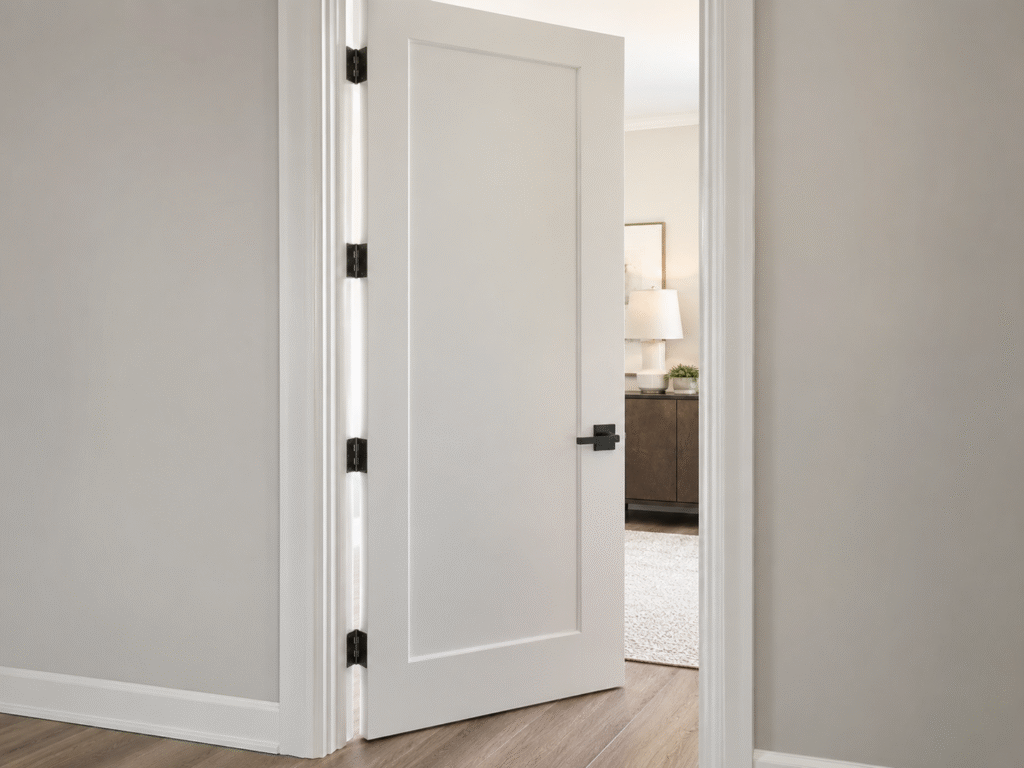
3. Interior Door Locks and Latches
The lock or latch should be selected according to room function and required control.
Passage Function
Passage hardware operates a latch but does not provide a privacy lock.
It is commonly used for hallways, general passage doors, pantries and selected closets.
Privacy Function
Privacy hardware allows the occupant to lock the door from the inside, normally with an emergency-release provision on the opposite side.
It is commonly considered for bedrooms, bathrooms and powder rooms. The exact function should match the project’s operational and safety requirements.
Keyed Function
Keyed hardware may be used for offices, storage rooms, utility rooms or other spaces requiring controlled access.
The keying system, cylinder type, master-key requirements and replacement strategy should be confirmed before ordering.
Dummy Trim
Dummy knobs or levers are non-operating trim. They do not latch or lock.
They are often used on:
- Closet pairs
- Pantry pairs
- Inactive leaves
- Doors held closed with ball or roller catches
- Decorative openings
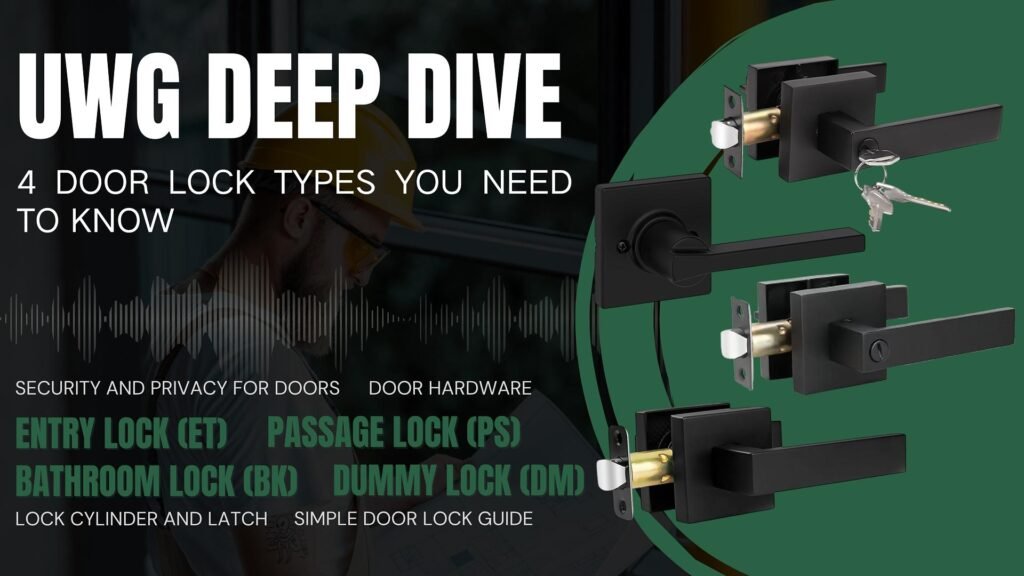
Tubular, Cylindrical and Mortise Construction
Lock function and lock construction are different specifications.
A passage or privacy function may be provided through different lock constructions depending on the selected product system.
- Tubular or cylindrical preparations are common in many residential applications.
- Mortise locks use a larger lock body installed into a pocket in the door edge.
- Specialty lockcases may require manufacturer-specific machining.
Before factory preparation, confirm the actual hardware template—not only a generic term such as “privacy lock.”
Magnetic Latches and Lockcases
Magnetic latches or magnetic lockcases can provide a clean appearance and quieter latching action in selected interior-door systems.
They should not be confused with electromagnetic access-control locks, often called maglocks. Electromagnetic locks use powered magnetic force and serve a different security and access-control function.
For magnetic latches or lockcases, confirm:
- Door thickness
- Lock-body dimensions
- Backset
- Handle preparation
- Strike dimensions
- Door and frame material
- Handing, where applicable
- Finish
- Manufacturer’s installation template
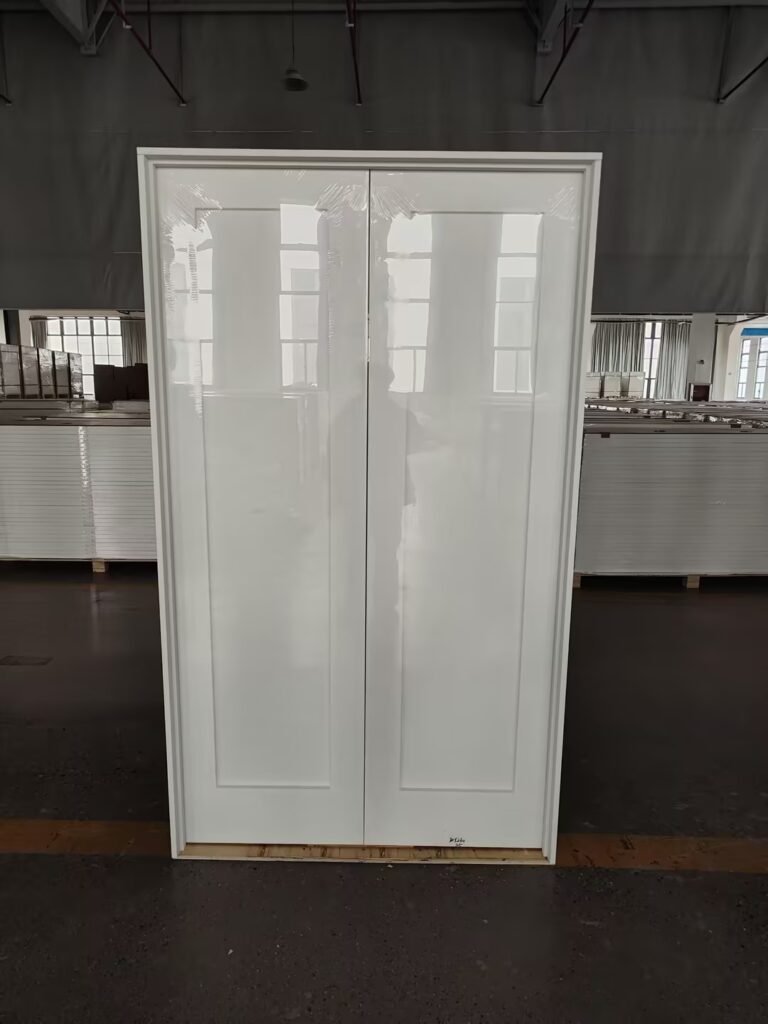
4. Hardware for Double Interior Doors
Double door” does not define the required hardware.
A paired opening may use:
- Ball catches
- Roller catches
- Dummy handles
- Passage or privacy hardware
- One active and one inactive leaf
- Flush bolts
- Surface bolts
- Astragals
- Coordinators or other project-specific components
Closet and pantry pairs often use catches with dummy trim, allowing the leaves to operate independently. Other pairs use one active leaf carrying the operating hardware while the inactive leaf remains secured.
The hardware schedule should identify:
- Active leaf
- Inactive leaf
- Handle or lock function
- Catch type
- Flush-bolt preparation
- Astragal, where specified
- Strike preparation
- Door handing and swing
- Sequence of operation
For handing and active-leaf coordination, see our interior door swing guide.
5. Barn Door Hardware
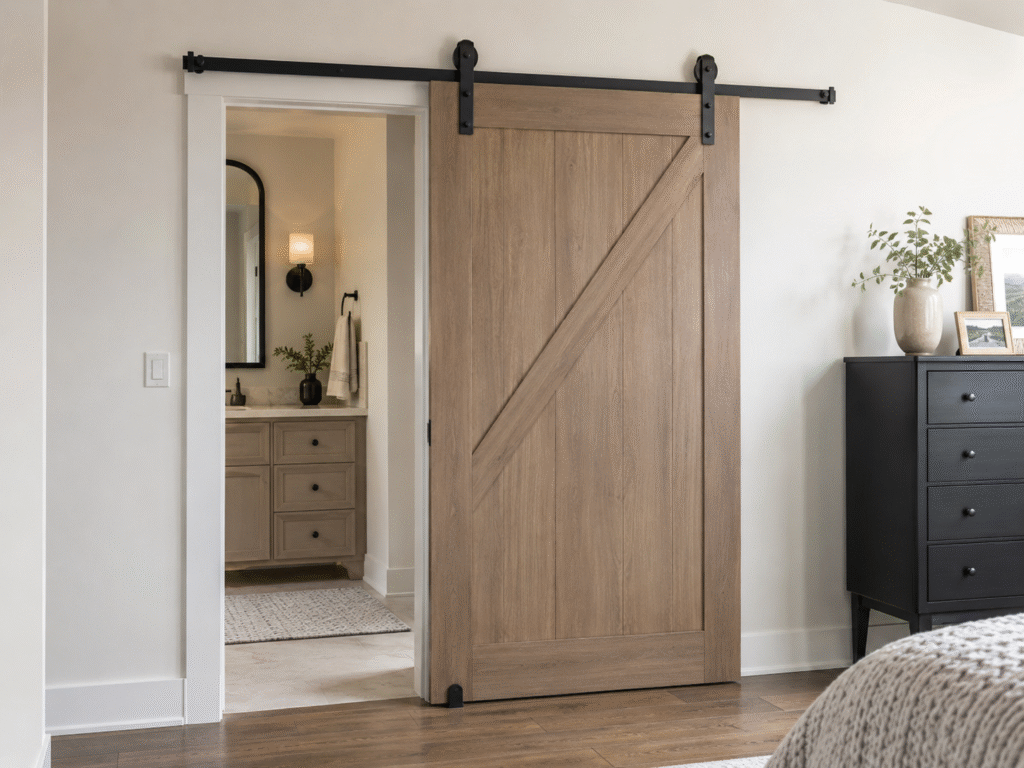
Barn-door hardware moves the slab along an exposed wall-mounted track.
A typical system may include:
- Track
- Hangers
- Rollers
- Spacers
- Stops
- Anti-jump devices
- Floor guide
- Mounting fasteners
- Pulls or flush handles
- Soft-close components, where available
The hardware should be selected according to the slab width, thickness, weight and required travel distance.
The supporting wall must also accommodate the track fasteners and loads. Framing or blocking should be coordinated before wall finishes conceal the structure.
Barn doors save floor-swing space, but they generally leave larger perimeter gaps than a conventional hinged door. Do not describe them as providing the same acoustic or visual sealing as a properly fitted swing-door assembly.
See the complete barn door hardware guide for track sizing and component selection.
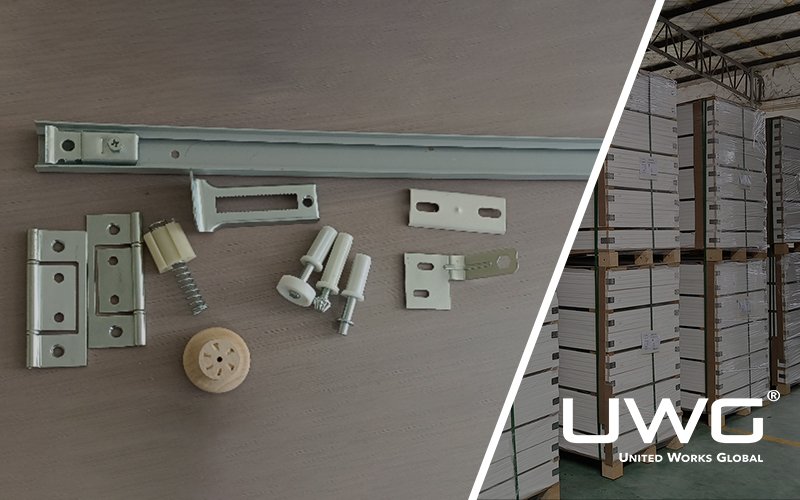
4. Bifold Door Hardware
Bifold hardware allows connected panels to fold and move along a track.
A typical residential bifold kit may include:
- Top track
- Top pivot
- Bottom pivot
- Guide roller
- Jamb bracket
- Alignment hardware
- Pull knob
- Fasteners
Bifold systems are commonly used for closets, laundries, pantries and utility areas.
Smooth operation depends on accurate opening dimensions, compatible panel weight, correct pivot positioning and proper alignment. Heavy or oversized panels require hardware specifically rated for those conditions.
Do not assume that every bifold kit supports every slab material, thickness or panel count.
5. Pocket Door Hardware
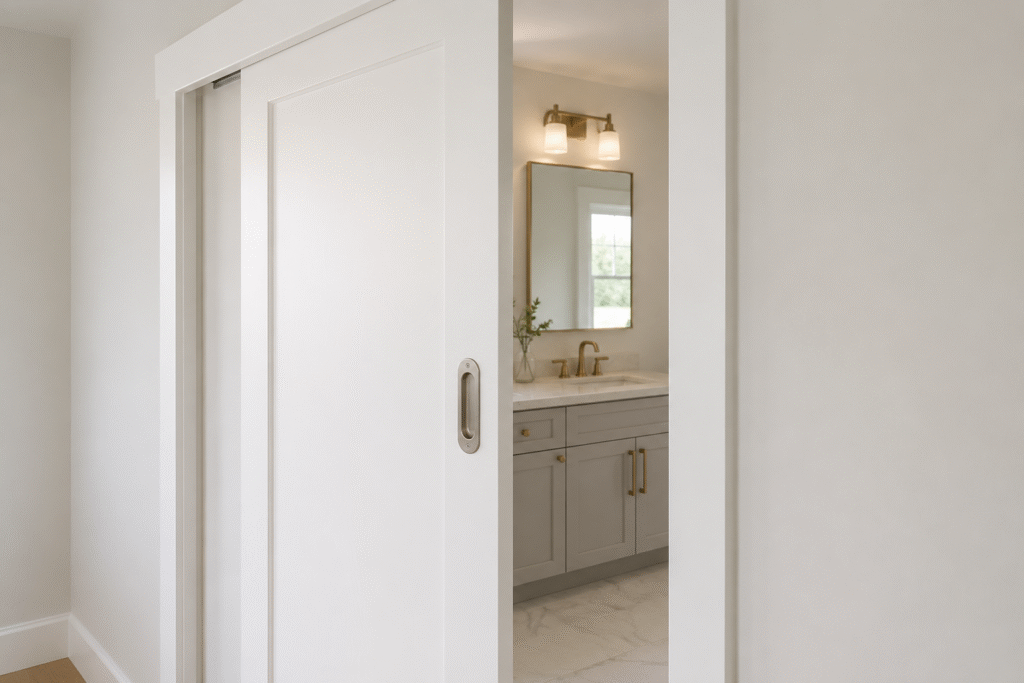
Pocket-door hardware allows a slab to slide into a concealed wall cavity.
A complete system may include:
- Pocket frame or framing kit
- Header track
- Hangers and rollers
- Floor or concealed guides
- Stops
- Soft-close components
- Flush pulls
- Edge pull
- Passage or privacy hardware
- Fasteners and adjustment components
Pocket doors should be planned before framing and services are finalized. Plumbing, wiring, blocking and fasteners must not interfere with the pocket or moving slab.
The pull and lock must also fit the available door thickness and retract sufficiently for the door to enter the pocket.
See our pocket door hardware selection guide for a detailed component checklist.
8. Door Stops, Closers and Other Accessories
Smaller components can have a significant effect on operation and maintenance.
Door Stops
Common options include:
- Wall-mounted stops
- Floor-mounted stops
- Hinge-pin stops
- Magnetic holders
- Overhead stops
Select the stop according to the swing angle, wall position, floor condition, nearby fixtures and risk of impact.
Door Closers
Closers control the movement and closing of selected doors. They may be required for particular commercial, high-use, fire-rated or operational applications.
Closer selection depends on the door size, weight, opening conditions, mounting position and project requirements. Installation and adjustment affect opening force, closing speed, latching and user experience.
Kick Plates and Protection Plates
Protection plates can help reduce surface damage on frequently used doors. Their material, dimensions, mounting and compatibility with the door construction should be specified.
Flush Bolts and Surface Bolts
These components secure inactive leaves in paired openings. Confirm bolt length, preparation, strike location, floor or head conditions and required operation.
How to Match Hardware to the Room
| Room or Opening | Common Hardware Direction | Items to Confirm |
|---|---|---|
| Bedroom | Hinges with privacy lever or knob | Privacy function, emergency release, finish and handing |
| Bathroom | Privacy hardware | Moisture exposure, emergency release, accessible operation where applicable |
| Hallway or general passage | Passage hardware | Latch function, finish and traffic level |
| Closet single door | Passage, dummy or catch configuration | Whether the door requires a conventional latch |
| Closet double doors | Dummy trim with catches, or active/inactive configuration | Ball catch, roller catch, flush bolts and active leaf |
| Home office | Passage, privacy or keyed function | Required access control and sound/privacy expectations |
| Pantry | Passage, dummy or catch hardware | Door type, daily use and swing clearance |
| Barn door | Track, hangers, guide and pulls | Slab weight, wall support, travel distance and perimeter gaps |
| Pocket door | Track, rollers, guides and flush hardware | Wall cavity, door thickness and lock projection |
| High-use opening | Higher-capacity hardware as specified | Traffic, cycle performance, maintenance and replacement parts |
These are common approaches, not automatic specifications. The hardware function must follow the actual use and project requirements.
Finish Options for Interior Door Hardware
Common finishes include:
- Matte black
- Satin nickel
- Brushed nickel
- Oil-rubbed bronze
- Satin brass
- Polished chrome
- Stainless steel
For entry-level and production housing, satin nickel, brushed nickel, and matte black are practical choices because they are widely available and easy to match.
For mid-range projects, matte black and satin brass can improve design value without excessive cost.
For luxury homes, premium brass, polished nickel, or high-grade stainless steel can support a higher-end interior package.
Common Hardware Selection Mistakes
1. Selecting Hardware Too Late
Hardware should be selected before door machining, drilling, and frame preparation. Late selection may cause bore mismatch, hinge mismatch, or installation delays.
2. Ignoring Door Weight
Heavy solid-core doors, tall doors, and large sliding doors require stronger hinges, rollers, or track systems.
3. Missing Hardware Components
Barn door, bifold, and pocket door systems need complete kits. Missing guides, stops, pivots, or fasteners can delay installation.
4. Not Coordinating Finishes
Hinges, locks, tracks, pulls, and stops should follow a consistent finish plan to maintain interior quality.
5. Underestimating Wall Preparation
Barn doors require wall blocking. Pocket doors require proper wall cavity planning. These details should be coordinated before drywall or framing is completed.
Builder Recommendations
For builders, the best approach is to specify hardware by door type, room function, and installation condition.
A practical strategy includes:
- Use standard butt hinges for most interior swing doors.
- Use ball bearing hinges for heavier or high-use doors.
- Use privacy locks for bedrooms and bathrooms.
- Use passage locks for hallways and general rooms.
- Use dummy handles with ball catches for closet double doors.
- Use complete barn door kits for exposed sliding systems.
- Use upgraded rollers for pocket doors.
- Standardize finishes across the project.
- Confirm hardware specifications before door drilling and frame preparation.
Based on our experience supplying residential door packages, standardizing hardware sizes and finishes across multiple units helps reduce procurement complexity, improve installation efficiency, and lower the risk of mismatched components.
FAQ
What Hardware Is Needed for a Standard Interior Door?
A conventional hinged interior door normally requires hinges, a latch or lockset, handles or knobs, a strike plate and an appropriate door stop. The exact components depend on the room function, slab, frame and project specification.
What Is the Most Common Hardware for Bedroom Doors?
Bedroom doors commonly use hinges with privacy-function levers or knobs. The selected product should match the door thickness, bore preparation, handing where applicable, finish and required emergency-release function.
What Is the Difference Between Passage and Privacy Hardware?
Passage hardware operates a latch but does not lock. Privacy hardware can be locked from the inside and is commonly used for bedrooms and bathrooms.
How Do I Choose Hinges for an Interior Door?
Select hinges according to the door’s height, width, thickness, weight, construction, frequency of use, frame material and hardware manufacturer’s capacity data. Do not choose hinge size or quantity from door height alone.
Are Ball-Bearing Hinges Required for Solid-Core Doors?
Not automatically. Ball-bearing hinges are commonly considered for heavier or frequently used doors, but the final requirement depends on the slab weight, dimensions, application and selected hinge capacity.
Are Lever Handles Better Than Door Knobs?
Lever handles are often easier to operate, while knobs offer a traditional appearance. Where accessibility requirements apply, evaluate the actual product and installation against those requirements rather than assuming every lever is compliant.
What Hardware Is Used on Double Interior Doors?
Double doors may use dummy trim with ball or roller catches, or an active/inactive configuration with operating hardware, flush bolts and an astragal. The intended operation must be defined before machining.
What Hardware Does a Pocket Door Need?
A pocket-door system normally requires a frame or framing kit, track, hangers, rollers, guides, stops, flush pulls and an optional passage or privacy lock. The components must match the slab dimensions, weight and wall construction.
When Should Interior Door Hardware Be Selected?
Hardware should be selected before the door and frame are machined. Final product models and templates should be confirmed before hinge routing, lock preparation, drilling and strike machining.
Do Hardware Finishes From Different Brands Match?
Not necessarily. Finish names such as matte black or satin nickel do not guarantee identical color, sheen or texture. Approve physical samples when several products need to match.
Summary
Interior door hardware includes hinges, handles, locks, latches, catches, stops and the track or guide systems used with barn, bifold and pocket doors.
The correct hardware package depends on the door type, slab dimensions, weight, room function, traffic, handing, frame, machining and finish requirements. Hardware should be selected as a coordinated system and confirmed before door production begins.
For repeated residential, multifamily and commercial projects, an approved hardware schedule, manufacturer templates and finish samples help reduce machining errors, installation delays, mismatched components and future maintenance problems.
Explore UWG’s interior door options or contact our team to coordinate door schedules, hardware templates, factory preparation and project-specific hardware packages