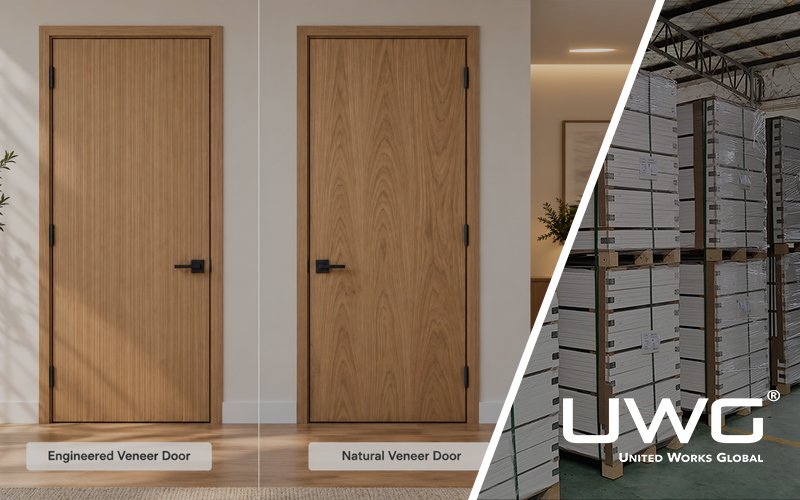
Two options buyers may encounter are engineered veneer doors and natural veneer doors. Both use wood-based surface materials, but they differ in how the veneer grain is formed, how consistently the pattern can be reproduced, and how much natural variation may appear between individual doors.
This guide explains the differences between engineered veneer and natural veneer doors, compares their main characteristics, and outlines how to choose the right option for your project.
What Is Engineered Veneer?
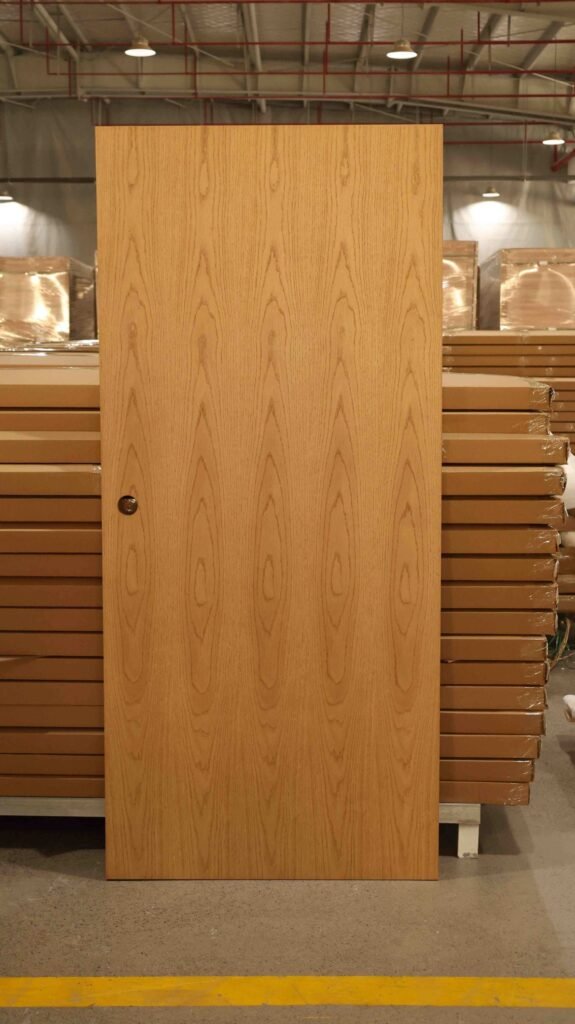
Engineered veneer, also called reconstituted or recomposed wood veneer in this article, is a wood-based decorative surface material made by processing and reassembling wood material to create a designed grain pattern.
Unlike natural veneer, which retains the grain characteristics of the original wood, engineered veneer is designed to produce a more controlled and repeatable visual appearance.
For interior doors, this can be useful when a project requires a coordinated finish across multiple openings. A selected grain pattern can be reproduced across a production run, although the actual consistency depends on the material, manufacturing process, and finishing specifications.
The term engineered veneer should be understood according to the supplier’s specific product definition. Buyers should verify the actual material composition and product description rather than relying on the name alone.
How Is Engineered Veneer Made?
The manufacturing process depends on the product, but reconstituted wood veneer generally involves processing wood material and arranging or bonding it to create a designed grain appearance.
Depending on the manufacturing method, the process may include:
- Preparing the wood material.
- Applying color or dye where required.
- Layering and bonding the material.
- Forming a controlled grain pattern.
- Slicing the reconstructed material into veneer sheets.
- Applying the specified finish and conducting quality checks.
Not every engineered veneer uses the same raw materials or manufacturing process. The actual production method should be confirmed through the manufacturer’s product documentation.
Engineered Veneer Grain Patterns and Appearance
One reason buyers consider engineered veneer is the ability to select a more controlled decorative pattern.
Available designs may include:
- Straight or linear grain.
- Crown-like grain patterns.
- Quarter-cut or rift-cut-inspired appearances.
- Oak-look or walnut-look finishes.
These descriptions refer to visual characteristics unless the supplier specifically identifies the underlying wood species.
For example, an engineered oak-look veneer does not automatically mean the veneer is made from oak. The name may describe its intended appearance rather than its actual raw material.
This distinction matters when material composition, species identification, or product documentation is part of the project specification.
What Is Natural Wood Veneer?
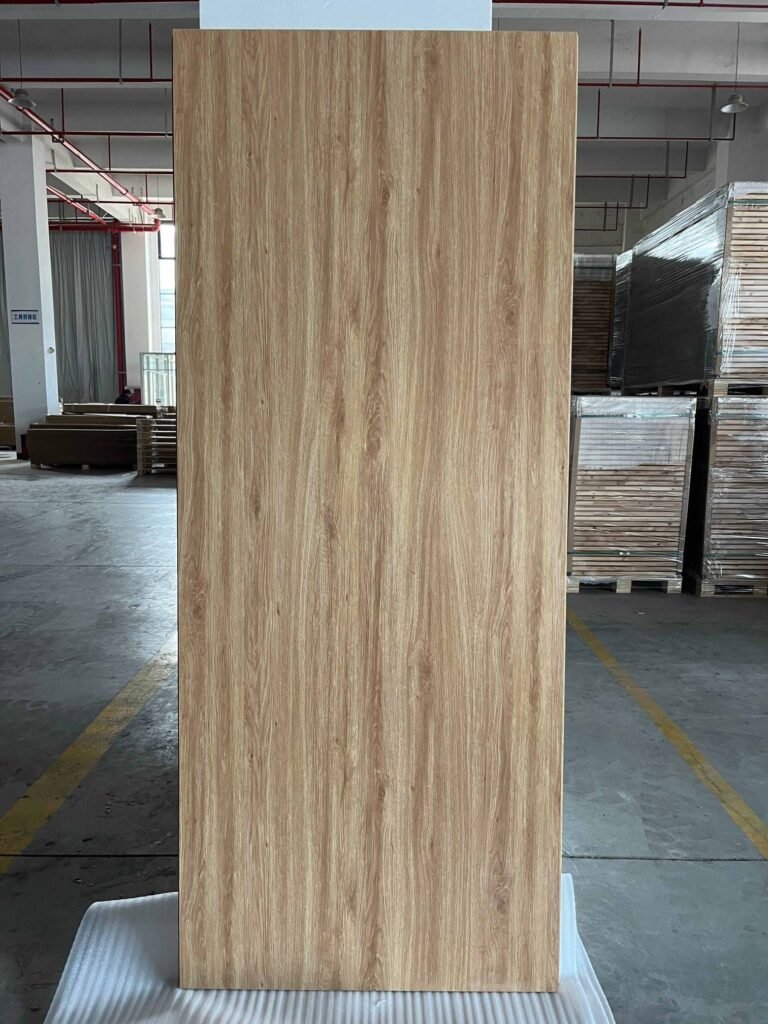
Natural wood veneer is a thin sheet of real wood produced by slicing or peeling a log or other suitable wood material. The resulting veneer is applied to a door substrate to create a natural wood appearance.
Because the grain comes from the original wood, each veneer leaf has its own characteristics. Differences in grain direction, color, figure, and other natural features can remain visible after finishing.
Natural veneer is often selected when the design calls for the distinctive appearance of a particular wood species rather than a deliberately repeated decorative pattern.
How Is Natural Wood Veneer Made?
Natural wood veneer is generally produced by slicing or peeling wood into thin sheets. The sheets are then selected, prepared, and applied to a suitable substrate as part of the door manufacturing process.
The appearance of the finished door depends on several factors, including:
- Wood species.
- Cutting method.
- Veneer grade.
- Leaf selection and matching.
- Surface preparation.
- Staining and finishing.
Even when the same species is specified, the finished appearance can vary between veneer leaves and production batches.
For projects requiring closely matched doors, veneer selection and the approved sample are therefore important parts of the specification.
Natural Wood Grain and Color Variation
Common natural veneer species include:
- Oak veneer: Often selected for its distinctive grain and versatile appearance.
- Walnut veneer: Commonly used where a deeper wood tone and characteristic grain are desired.
- Maple veneer: Often chosen for a lighter, more restrained wood appearance.
- Cherry veneer: Known for its characteristic color and grain, which may change with exposure and finishing.
These are examples rather than a complete list of available species.
Natural variation is not necessarily a defect. However, the acceptable range should be established before production, especially when doors are installed next to one another or as matching pairs.
Explore our guide to Veneer Door Surface Options to compare different veneer finishes, wood grain patterns, and surface characteristics for your project.
Engineered Veneer vs Natural Veneer: Key Differences
Both engineered veneer and natural veneer are wood-based decorative surfaces under the definitions used in this article. Their main differences concern grain formation, appearance, matching, and material selection.
Engineered Veneer vs Natural Veneer Comparison Chart
| Feature | Engineered Veneer | Natural Wood Veneer |
|---|---|---|
| Material | Reconstituted or recomposed wood veneer | Thin sheets of natural wood |
| Grain Formation | Created through processing and recomposition | Formed naturally in the original wood |
| Appearance | Can provide a more controlled, repeatable pattern | Retains natural grain characteristics and variation |
| Color Consistency | Can be easier to standardize across production | Depends on species, selection, and finishing |
| Door-to-Door Matching | Often suitable for repeatable patterns | Requires careful veneer selection and matching |
| Cost Factors | Processing, finish, material, and order quantity | Species, grade, selection, matching, and finish |
| Project Selection Considerations | Useful when a controlled, repeatable appearance is desired | Useful when natural wood variation is part of the design |
Actual results depend on the specific veneer product, manufacturing process, finish, and project requirements. Neither type should automatically be assumed to be cheaper, more durable, or better suited to every application.
Appearance and Grain Consistency
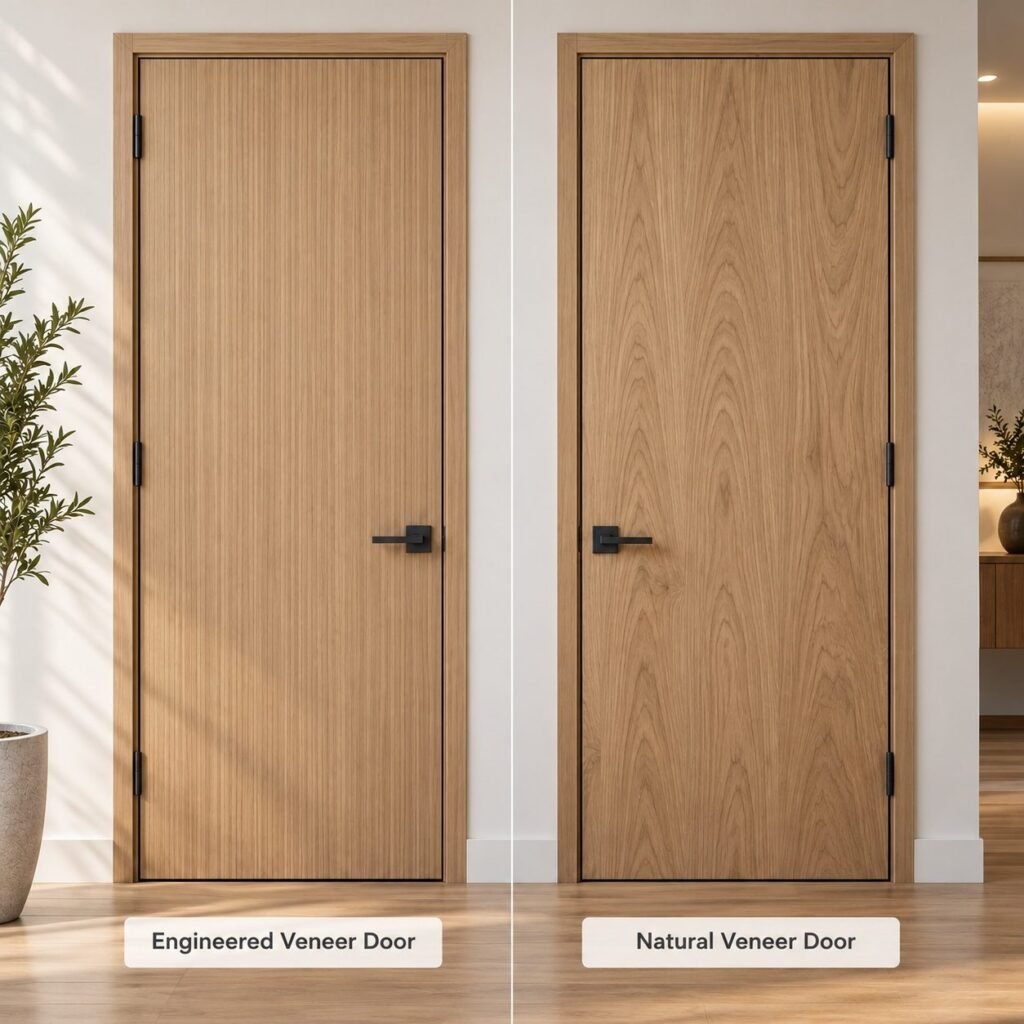
The most visible difference between engineered veneer and natural veneer is often the grain pattern.
Engineered veneer is designed to produce a particular visual result. This can make it easier to coordinate the appearance of multiple doors when the project requires a consistent pattern.
Natural veneer retains the characteristics of the original wood. Its grain and color may vary between leaves, even when the same species and finish are specified.
For building projects, the relevant question is how much variation the design can accommodate.
If adjacent doors need a highly consistent appearance, a controlled engineered pattern may be worth considering. If the design calls for the distinctive variation of natural wood, natural veneer may be the better fit.
Neither option guarantees a perfect match without appropriate material selection, finishing, and quality control.
Cost and Material Availability
There is no universal rule that engineered veneer is always cheaper than natural veneer.
The cost of either option may depend on:
- Raw material and processing.
- Wood species or engineered pattern.
- Veneer grade and thickness.
- Grain and color matching.
- Surface finishing.
- Order quantity.
- Material availability.
- Production requirements.
Natural veneer pricing can be influenced by the species, grade, and availability of suitable veneer leaves. Engineered veneer pricing can be influenced by the complexity of its production and the selected decorative finish.
When comparing quotations, buyers should compare products with equivalent door dimensions, core construction, surface finish, edge treatment, and quality requirements. Comparing veneer names alone may not provide a meaningful price comparison.
How to Choose Between Engineered and Natural Veneer Doors
The right choice depends on the intended appearance and the project’s requirements. Neither veneer type is universally better, and the building category alone should not determine the selection. When reviewing available interior door options, consider the required veneer appearance alongside the complete door specification.
When to Choose Engineered Veneer Doors
Engineered veneer may be suitable when a project prioritizes a controlled and repeatable appearance.
Consider it when:
- Multiple doors need a coordinated grain pattern.
- A standardized finish schedule is required.
- Color variation needs to remain within a defined range.
- The design calls for a particular repeatable grain appearance.
- Future replacement doors should match an established finish as closely as possible.
For projects with many openings, the ability to specify a consistent visual pattern can simplify finish coordination.
However, consistency should not be assumed from the material name alone. Review actual samples and confirm the manufacturer’s achievable matching tolerances.
When to Choose Natural Veneer Doors
Natural veneer may be suitable when the design prioritizes the distinctive characteristics of natural wood.
Consider it when:
- A particular natural wood species is specified.
- Natural grain variation is part of the intended design.
- The project requires the appearance of real wood grain.
- The designer wants to select specific veneer cuts or matching arrangements.
- The approved sample demonstrates the desired color and grain characteristics.
Natural veneer does not necessarily mean that every door will look different. Careful veneer selection and matching can coordinate doors, but the achievable consistency depends on the material and the agreed specification.
How to Evaluate Samples and Match Multiple Doors
Sample approval is important for both engineered and natural veneer doors.
Before production, review:
1. Grain pattern and direction
Confirm whether the design requires vertical grain, a particular grain figure, or a consistent pattern across adjacent doors.
2. Color and finish
Approve the intended color, sheen, and surface appearance. Lighting and surrounding finishes can affect how the door looks in the completed space.
3. Matching between doors
Specify whether adjacent doors, paired doors, or doors within the same room need to be visually matched.
4. Acceptable variation
Define the expected range of grain and color variation instead of relying on general descriptions such as “oak finish” or “walnut veneer.”
5. Production batches
For larger projects, confirm how samples will be used to assess consistency across production batches.
6. Future replacement
If replacement doors may be needed later, retain the approved sample, product identification, and finish specification.
Project Selection and Ordering Checklist
Use the following checklist before approving a veneer door specification.
| Item | What to Confirm |
|---|---|
| Veneer Type | Engineered/reconstituted veneer or natural veneer |
| Material Specification | Actual material composition and product description |
| Grain and Color | Approved pattern, color, and grain direction |
| Matching Requirements | Adjacent doors, pairs, and acceptable variation |
| Door Construction | Core and substrate specifications |
| Surface Finish | Coating, sheen, and approved sample |
| Edge Treatment | Edge material, finish, and appearance |
| Sample Approval | Approved physical sample or finish schedule |
| Future Replacement | Product identification and matching expectations |
Sourcing and Sustainability Documentation
If a project includes sustainability or responsible-sourcing requirements, verify the applicable documentation for the specific product.
Relevant documents may include material declarations, sourcing records, or certifications where applicable.
Neither engineered veneer nor natural veneer should automatically be described as more environmentally friendly without supporting evidence. Any sustainability claim should reflect the actual material, manufacturing process, and relevant documentation.
What Does the Veneer Type Not Tell You About the Door?
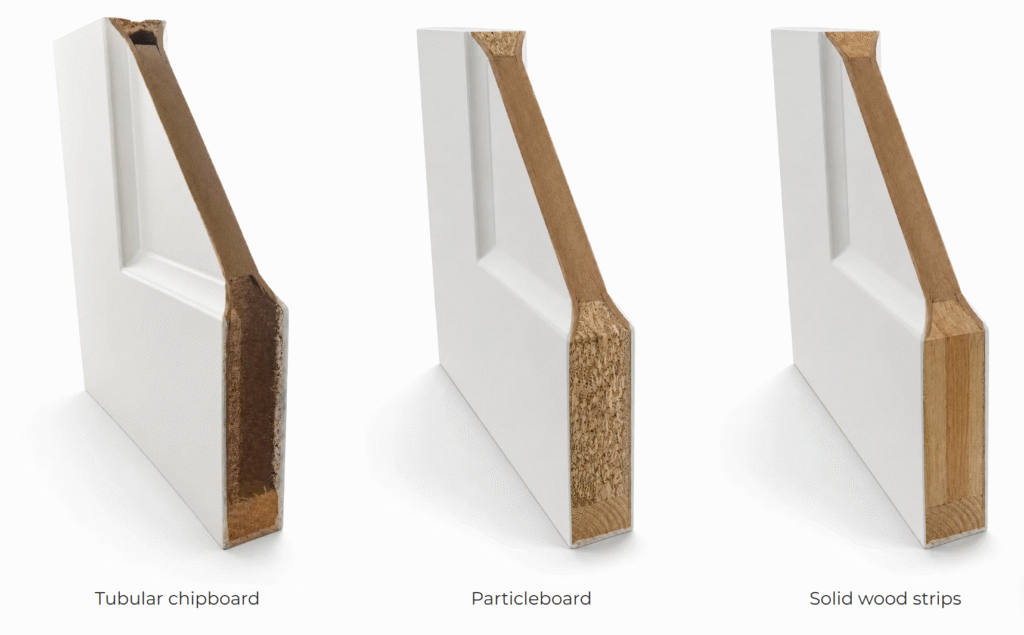
Veneer describes the decorative surface, not the complete door construction. Two doors with similar veneer finishes can have different cores, substrates, edge constructions, and performance characteristics.
Door Core and Substrate
The door core and substrate should be specified separately from the veneer type.
Depending on the product, the door may use different core constructions and substrate materials. Terms such as hollow core, solid core, and engineered wood substrate describe different aspects of construction and should not be treated as mutually exclusive categories.
The actual construction should be confirmed in the product specification rather than inferred from the veneer finish.
Edge Construction, Finish, and Performance
The appearance and performance of a veneer door can also depend on:
- Veneer thickness.
- Edge material and treatment.
- Adhesive and bonding specifications.
- Surface coating.
- Moisture-related requirements.
- Acoustic, fire-rating, or other performance requirements, where applicable.
The veneer face alone does not establish a door’s durability, moisture resistance, fire rating, or acoustic performance.
Where a project has specific technical requirements, confirm the relevant test data, product documentation, and construction details.
Hardware Preparation and Reinforcement
Hinge and lock installation depends on the door’s internal construction, including the stiles, rails, lock blocks, and any reinforcement provided for the specified hardware.
The veneer face and the substrate immediately beneath it do not, by themselves, establish the fixing strength of a hinge or lock.
For project-specific hardware requirements, verify the door construction, machining specifications, and reinforcement details with the manufacturer.
Engineered vs Natural Veneer Doors FAQs
Is Engineered Veneer Real Wood?
In this article, engineered veneer refers to reconstituted or recomposed wood veneer made from processed wood material. Its grain pattern is formed through processing rather than being retained solely from a natural wood leaf.
The actual composition depends on the specific product. Buyers should check the manufacturer’s material specification to confirm the raw materials and manufacturing method.
Are Engineered Veneer Doors More Expensive Than Natural Veneer Doors?
Not necessarily. Pricing depends on the material, production process, veneer grade, finish, matching requirements, order quantity, and availability.
For a meaningful comparison, evaluate doors with equivalent dimensions, core construction, surface finish, edge treatment, and quality requirements rather than comparing veneer type alone.
Conclusion: Choosing the Right Veneer Door for Your Project
Choosing between engineered veneer and natural veneer doors starts with the project’s appearance requirements.
Engineered veneer can be a practical option when repeatable grain patterns and a controlled appearance are important. Natural veneer is well suited to designs that value the distinctive grain and variation of natural wood.
However, neither veneer type automatically determines the door’s core construction, durability, or overall performance.
For building projects, the best approach is to confirm the actual veneer material, approve physical samples, establish acceptable color and grain variation, and verify the complete door construction before ordering.
The right veneer door is the one that meets the project’s documented appearance, matching, and performance requirements—not simply the one labeled engineered or natural.