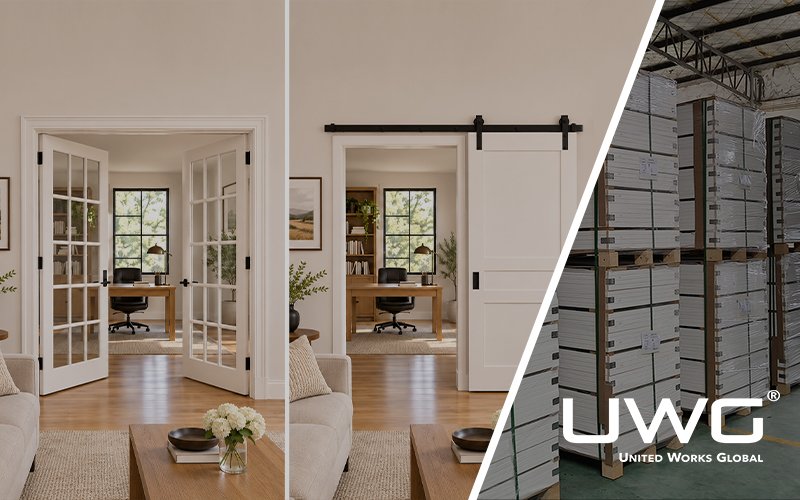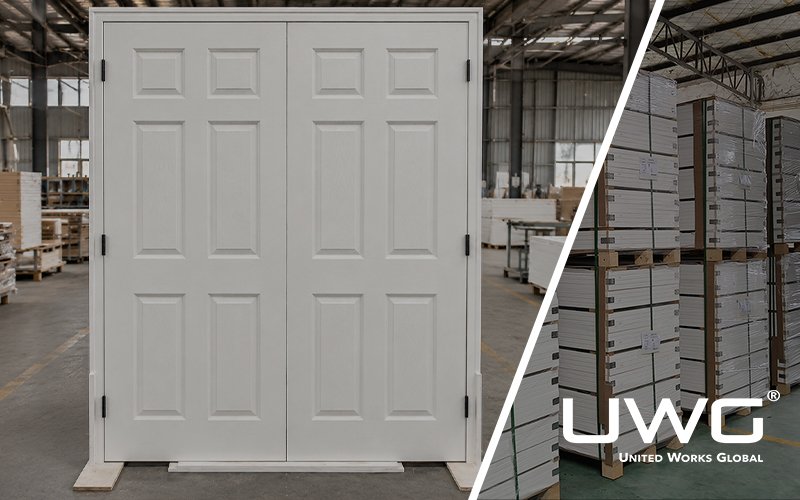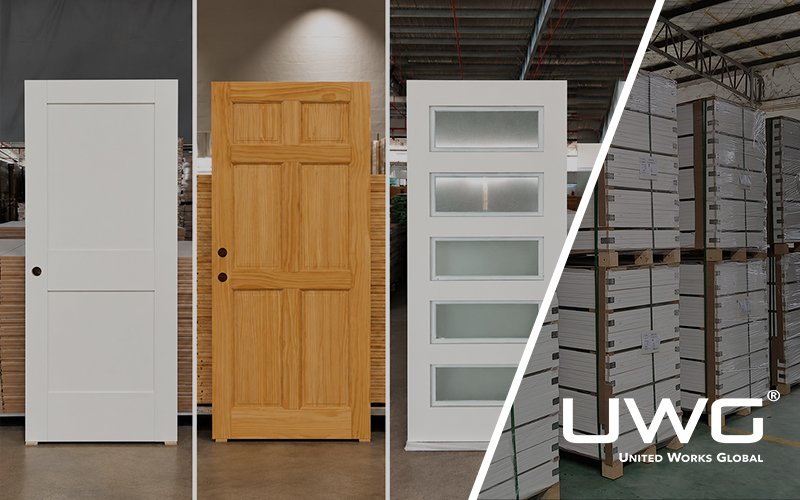
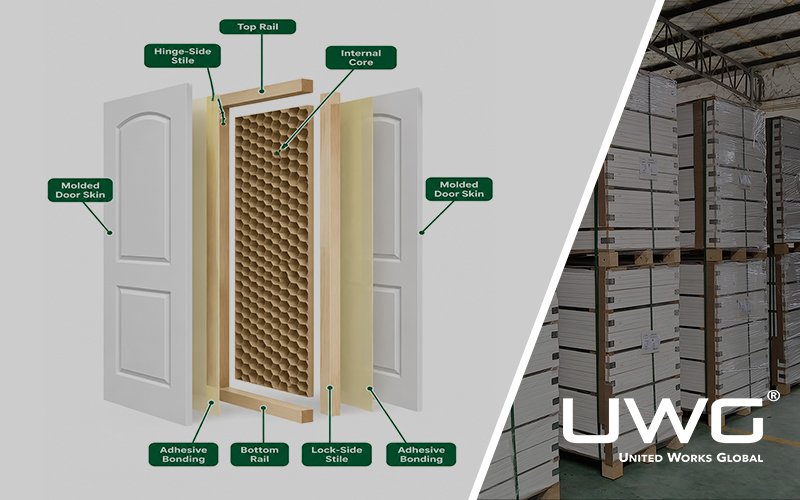
Two molded doors can look identical on the surface yet differ in their skins, perimeter frame, core, and hardware reinforcement. Understanding these internal components is essential when evaluating door specifications, selecting suitable core constructions, and confirming hardware compatibility.
This guide explains how molded door skins, stiles, rails, internal cores, and lock blocks work together. It also covers the differences between hollow-core and solid-core construction, bonding methods, and trimming limitations, helping builders, contractors, and door distributors verify the actual door construction before ordering or modifying a door.
Overview of Molded Door Components
A molded door uses sandwich construction: two outer skins enclose a core and perimeter frame. The skins provide the visible profile, the stiles and rails form the surrounding support, and the selected infill occupies the space between the faces. Adhesive bonding joins these parts into a door slab, with local hardware support added where the design requires it.
The table below shows one example of molded door construction:
| Component or Specification | Material or Option |
|---|---|
| Stiles and rails | Solid wood |
| Door skins | 3 mm MDF on each side |
| Hollow-core infill | Honeycomb; honeycomb plus foam as an option |
| Solid-core options | Tubular chipboard, solid particleboard, or solid wood |
| Surface finish | White primed |
| Surface texture | Smooth or woodgrain texture |
The 3 mm dimension is the thickness of each MDF skin. The core and reinforcement layout depend on the selected product.
The same skin pattern can be paired with different cores. For nonstandard dimensions, check the available skin size and the perimeter and reinforcement layout rather than assuming a standard door can simply be trimmed to fit.
Molded Door Skins: Materials and Panel Formation
Engineered Wood Materials
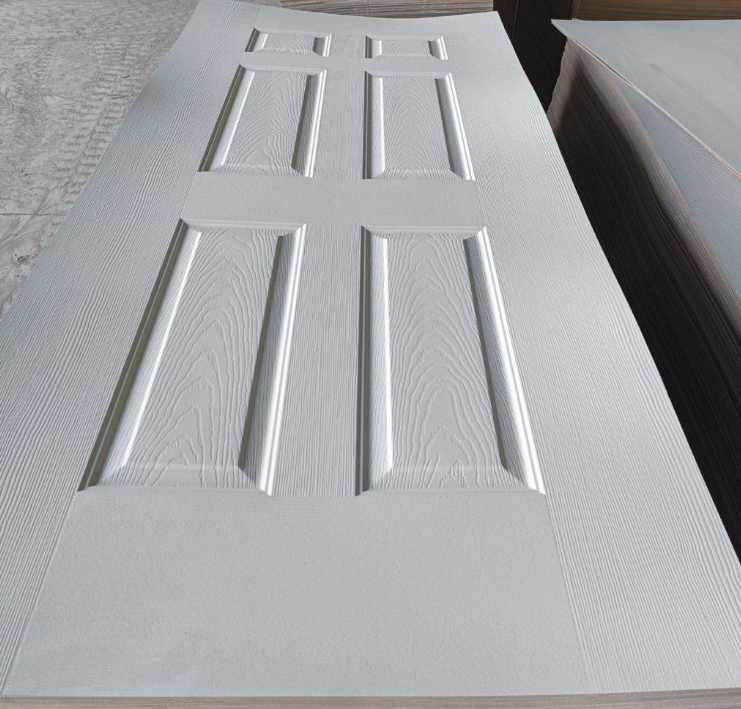
Molded door skins are made from formed wood-fiber composite materials, which may include MDF, HDF, or other engineered fiberboard materials depending on the specific product. These skins create the visible surfaces of the door and provide a suitable base for molded panel designs and paint finishes.
After forming, the skins are combined with the perimeter frame and internal core to create the complete door slab. The exact material composition and construction may vary by manufacturer.
How Molded Profiles and Sandwich Construction Work Together
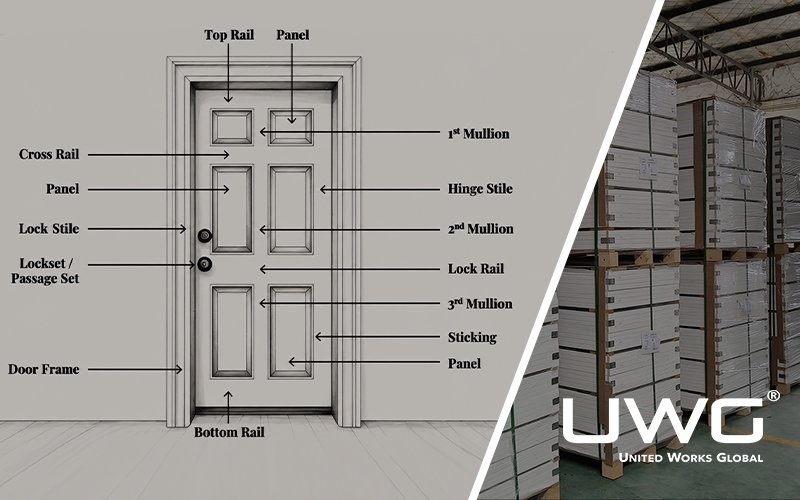
The panel profile is formed in each outer skin, creating the selected raised or recessed design, such as a two-, five-, or six-panel pattern. The visible lines belong to that formed face; they do not indicate a separate structural stile or rail behind every line, as in an assembled stile-and-rail layout.
The formed skins are then used in the sandwich assembly. One skin forms each face, while the core sits inside the perimeter frame between them. Bonding the skins to the supporting components creates the complete slab. Skin forming establishes the visible design; sandwich construction describes how the faces, frame, and core are combined.
Door Finishes and Surface Texture
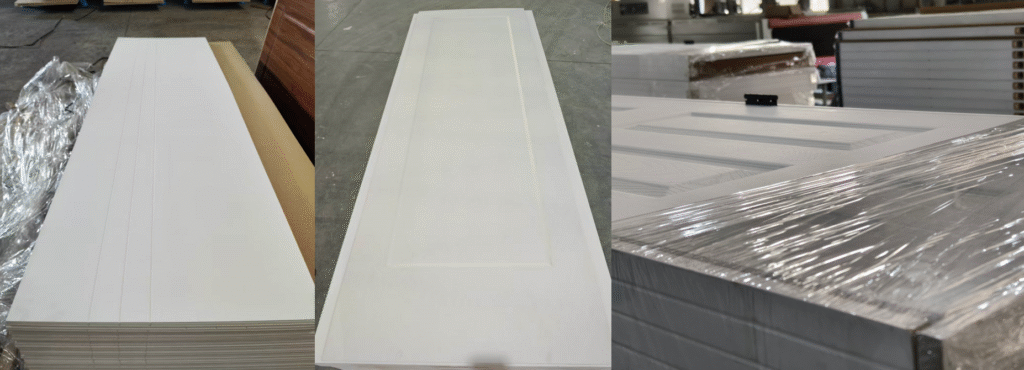
For molded doors, distinguish the paint condition from the texture of the skin. A smooth or woodgrain-textured face can be primed or supplied with a specified final paint finish. The molded door surface options guide provides further information about the available surface treatments and finish choices.
Primed Door: A factory-applied primer prepares the surface for the final paint coat. The molded-door configuration listed above is white primed; the project team arranges the final coating according to the agreed finishing scope and instructions. Primer alone should not be treated as the completed decorative paint system.
Paint Finish: For a factory-painted specification, the final color coating is completed before shipment. The product information lists water-based paint and PU paint among paint-finish options. Confirm the offered coating system, color, and sheen for the selected molded-door product rather than assuming every option is available on every model.
Surface Treatment / Texture: Smooth describes a face without embossed woodgrain; woodgrain texture provides a grain-like surface relief. This is a texture choice, not a veneer layer or a paint-delivery condition. Specify the panel design, texture, and primed or painted condition separately.
Stiles, Rails and the Perimeter Frame
How Stiles and Rails Support the Door Structure
In a molded door, stiles and rails form the perimeter support structure around the door slab. The two vertical stiles run along the left and right sides, while the top and bottom rails run horizontally across the ends of the slab.
These components help support and connect the molded skins and internal core, contributing to the overall door assembly.
Their functions also relate to hardware preparation:
- Hinge-Side Stile: Provides a supporting area for hinge installation and fastening.
- Lock-Side Stile: May include a lock block or additional local reinforcement to support lock preparation.
- Top and Bottom Rails: Form the horizontal perimeter sections and help maintain the door’s overall structure.
Door Slab Perimeter vs. the Installed Jamb Frame
The door slab perimeter is the internal support structure formed by the stiles and rails within the door itself. The installed jamb frame, on the other hand, is the separate frame fitted into the wall opening to hold and support the door.
This distinction is important when considering door trimming. Cutting the door edges may reduce or remove part of the original perimeter support, potentially affecting hinge or lock preparation. The available trimming allowance therefore depends on the internal construction.
Builders should not assume that all four edges have the same trimming allowance. Top, bottom, hinge-side, and lock-side trimming limits should be confirmed separately using the manufacturer’s specifications before modifying the door.
Hollow-Core vs. Solid-Core Molded Door Construction
The following comparison assumes doors with comparable dimensions, thickness, face materials, and installation and sealing conditions. Actual performance may vary depending on the specific core construction and complete door assembly.
| Feature | Hollow-Core Molded Doors | Solid-Core Molded Doors |
|---|---|---|
| Core Construction | Lightweight internal structure, which may include honeycomb support | Denser core material, such as solid particleboard |
| Internal Support | Perimeter components and internal supports, depending on the design | Core and perimeter components, depending on the design |
| Door Weight | Generally lighter | Generally heavier |
| Sound Control | Typically offers less sound reduction in comparable assemblies | May provide better sound reduction due to greater mass |
| Material Usage | Typically uses less core material | Uses denser core materials |
| Common Applications | Standard interior openings where lightweight construction and cost efficiency are priorities | Interior openings where greater door weight or improved sound control is desired, subject to project requirements |
For projects with specific sound-control requirements, solid-core construction can be a preferred option to evaluate. However, the actual acoustic performance should be confirmed through test data for the corresponding door assembly, rather than determined by core type alone.
When comparing available interior door options for a project, consider the core construction alongside the door’s intended application, hardware requirements, and overall specifications.
Hollow-Core Construction and Internal Support
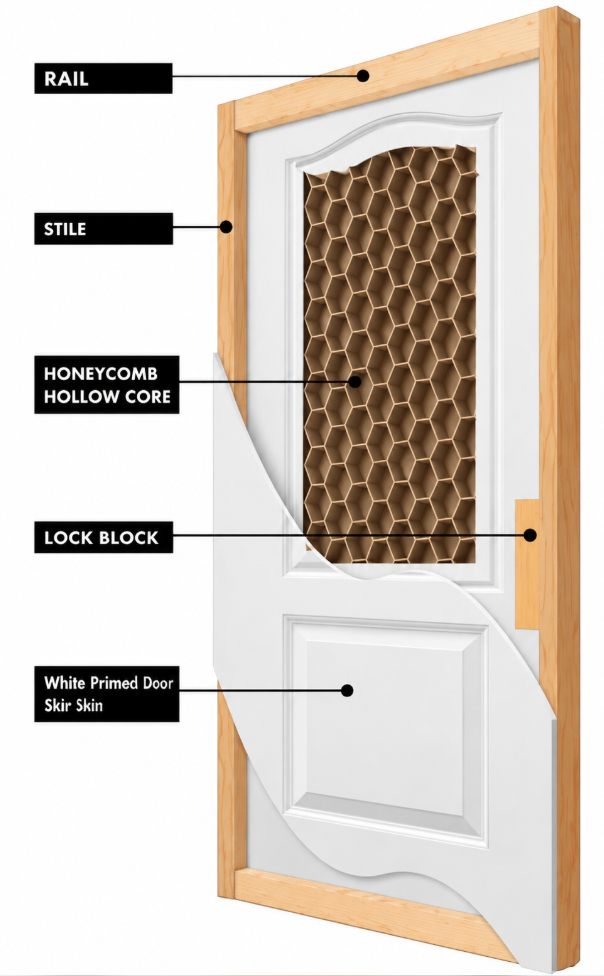
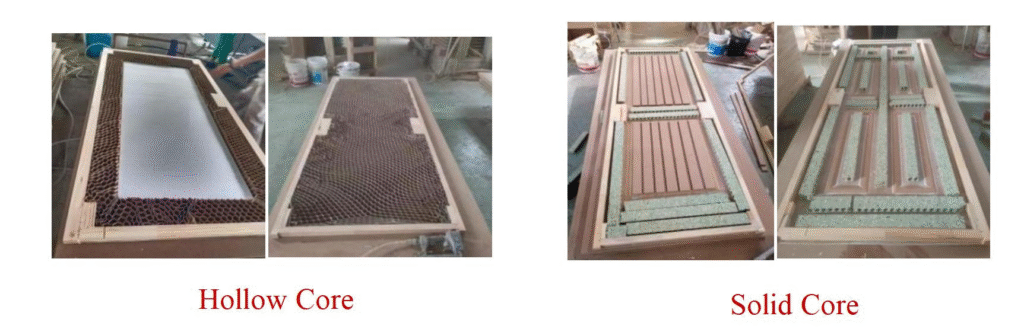
Hollow-core molded doors typically combine molded skins with a lightweight internal structure. This may include a honeycomb core, along with perimeter components and other supports required by the particular design.
Hollow core does not mean the entire space between the skins is necessarily empty. The internal arrangement depends on the product, and the presence of honeycomb material should not be assumed for every hollow-core door.
This construction generally reduces door weight and material use, making it suitable for many standard interior applications.
Solid-Core Construction and Core Materials
Molded doors can use different internal core materials depending on the required weight, strength, and performance.
Tubular particleboard core uses an engineered board with internal longitudinal channels. It differs from both paper honeycomb and continuous particleboard fill. Some product classifications include tubular constructions under solid-core options; the material specification should identify the channels rather than relying on the category name.
Solid particleboard core uses dense particleboard fill without the deliberate channels of tubular board. Compared with a similar honeycomb-core leaf, it generally adds mass; acoustic selection still requires the comparable-assembly conditions and evidence described above.
Wood core uses wood-based internal components arranged within the door structure. Its weight and performance depend on the materials and internal arrangement.
These core types should not be treated as interchangeable. In particular, a tubular particleboard core is different from both paper honeycomb and continuous solid particleboard. Also, solid core does not necessarily mean the entire door is made from natural solid wood.
Lock Blocks and Hardware Reinforcement
Lock Blocks and Integrated Hardware Support
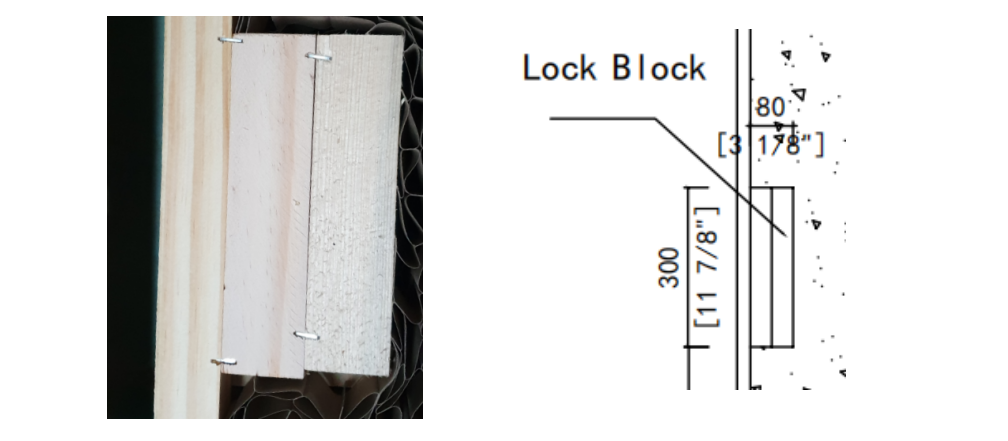
A lock block is an additional support component incorporated into a specific area of a door to provide sufficient material for lock machining and hardware fastening. It is particularly important in hollow-core molded doors, where much of the internal space may contain lightweight or hollow structures.
The lock block creates a designated support area around the lock location, helping accommodate the lock bore and related machining. Depending on the door construction, this support may be provided by a separate block or integrated into the internal frame structure.
It is important to distinguish between hollow areas and reinforced areas inside the door, as they do not provide the same support for hardware installation.
Hardware Preparation Within the Specified Support Areas
Hardware preparation should match the actual internal support layout. When reviewing door drawings, builders should confirm:
- Lock Bore Center Height: The vertical position of the lock bore, measured from the specified reference point.
- Backset: The distance from the door edge to the center of the lock bore.
- Lock Body Dimensions: The machining depth, width, and overall dimensions required by the selected lock.
- Door Thickness: Whether the lock and hardware are compatible with the specified door thickness.
For nonstandard hardware, such as mortise locks or concealed hinges, the full machining envelope must be checked against the available internal support area. The hardware preparation should not extend beyond the designated reinforcement or support zones.
Confirming these details against the door construction drawings before production helps avoid machining conflicts, insufficient fastening support, and hardware installation problems.
How Bonding Connects the Door Components
Molded door construction uses adhesive bonding to connect the molded skins, perimeter frame, and internal core into a complete door assembly. Bonding quality depends on material compatibility, component fit, and controlled pressing and curing. For more detail on the production process, see the molded door manufacturing guide. While surface inspection can reveal visible defects, internal bonding quality should also be evaluated through product specifications and applicable quality inspection records.
What Builders Should Confirm About the Construction
Before approving molded doors for a project, builders should verify the internal construction and ensure that the specified hardware and finishing requirements are compatible with the door design.
Key items to confirm include:
- Surface Quality and Bonding: Check for visible bubbles, uneven surfaces, or skin separation. Review applicable bonding and assembly quality records.
- Internal Component Layout: Confirm the skin material, core type, perimeter stiles and rails, and internal support arrangement.
- Hardware Support: Verify that hinge and lock preparation falls within the designated reinforcement areas, especially when using nonstandard hardware.
- Trimming and Machining Limits: Confirm the permitted trimming areas and dimensions, along with any restrictions on additional drilling or machining, before modifying the door.
FAQ
Can Molded Doors with the Same Panel Design Have Different Internal Constructions?
Yes. Doors with identical molded panel designs may use different core materials, perimeter structures, or reinforcement arrangements. Confirm the product specifications rather than relying on appearance alone.
Can Any Hinge or Lock Be Used on a Molded Door?
No. Hardware must be compatible with the door’s thickness, weight, preparation, and designated support areas. Special hardware may require manufacturer approval.
How Can Buyers Confirm a Molded Door’s Trimming Limits?
Check the manufacturer’s technical documentation for the specific door model. Do not apply a universal trimming allowance to all molded doors.
What Can a Door Corner Sample Reveal About the Construction?
A corner sample may reveal the skin material, perimeter components, core arrangement, and bonding layers at that location. However, it may not show the full internal layout or reinforcement elsewhere in the door. A construction drawing or manufacturer specification is needed for confirmation.
Summary
Molded door construction combines molded skins, perimeter support, an internal core, and bonded components into a complete door slab. The exact arrangement varies by product, affecting how the door is prepared for hardware and what modifications it can accommodate.
For builders and project buyers, the key is to verify the actual construction, core materials, reinforcement locations, and manufacturer-approved machining limits before ordering or modifying a door. These details provide a more reliable basis for product selection than panel appearance alone.