Introduction
A pair of doors can serve two different needs: everyday access through one leaf, or regular access through either leaf. That choice affects more than the handles. It determines how the leaves latch, how the second leaf is released, and which meeting-edge details the manufacturer must prepare.
This guide compares active/inactive and double-active configurations, explains handing and swing direction, and sets out the information builders, contractors, and door suppliers need to coordinate before ordering.
What Are the Main Double Door Configurations?
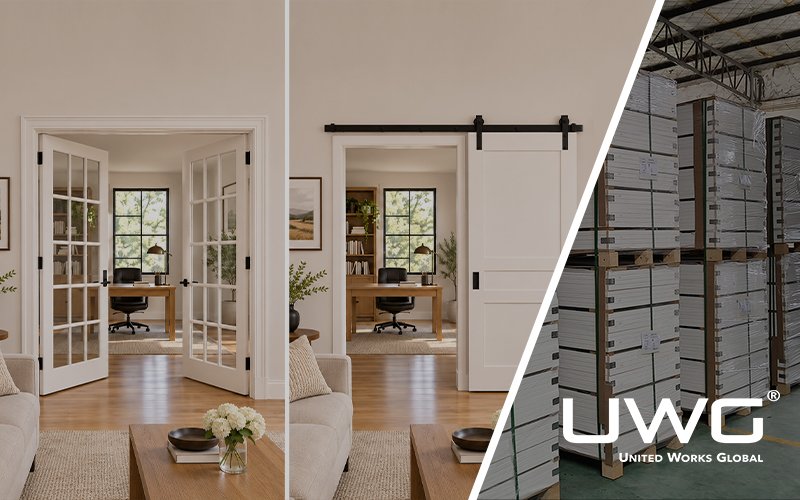
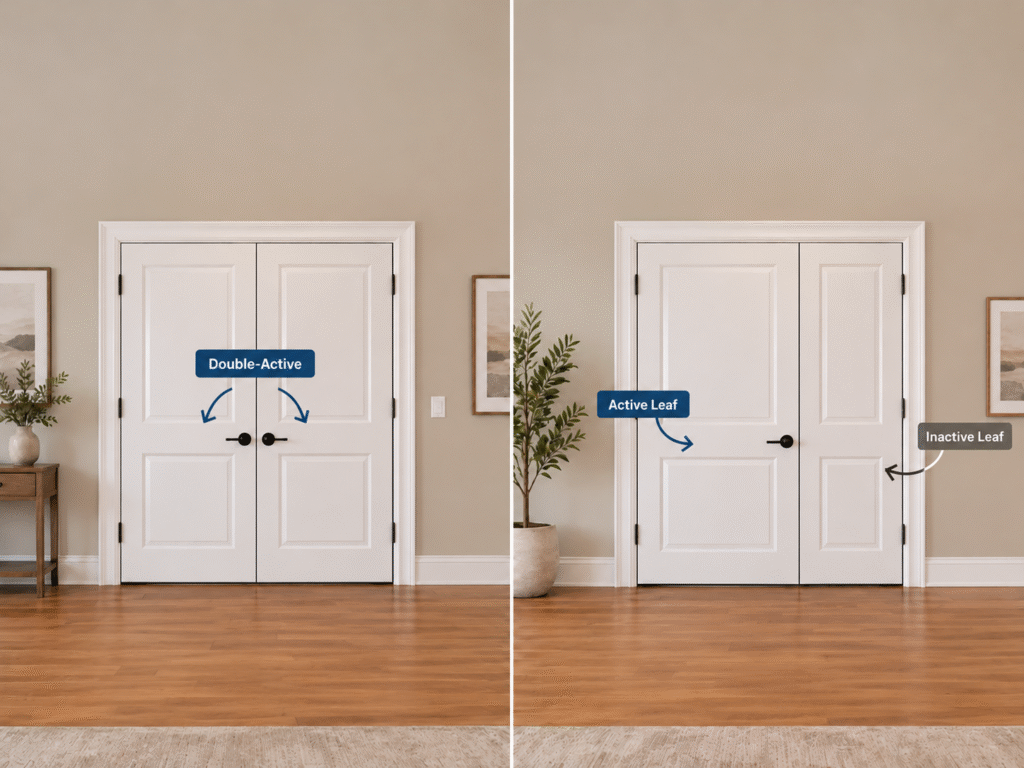
Double doors consist of two leaves installed within one frame. In an active/inactive pair, the active leaf handles everyday access while the inactive leaf normally remains secured. In a double-active pair, also called a both-active pair in this guide, both leaves are intended for regular operation.
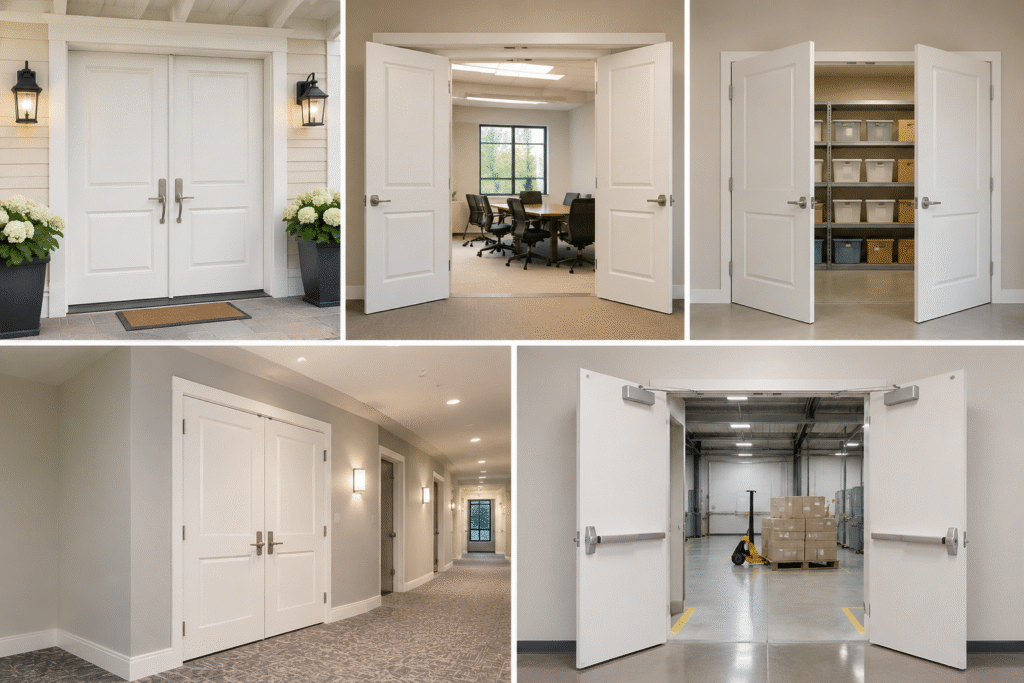
Use an active/inactive arrangement when one leaf provides sufficient everyday passage and the second is needed occasionally for furniture, equipment, or wider access. Consider a double-active arrangement when users need to operate either leaf regularly. Specify whether each leaf must open independently; the configuration name alone does not define the complete hardware arrangement.
| Selection point | Active/inactive pair | Double-active pair |
|---|---|---|
| Everyday access | Primarily through the designated active leaf | Through either leaf, as supported by the hardware |
| Second leaf | Normally secured; released for additional access | Intended for regular operation |
| Independent opening | The active leaf normally operates while the inactive leaf stays secured | Confirm that either leaf can open while the other stays closed |
| Securing arrangement | Commonly includes inactive-leaf flush bolts | Selected around each leaf’s latching and locking function |
| Wider passage | Requires releasing and opening the inactive leaf | Requires opening both leaves and checking any retained center components |
| Best starting point | Mainly single-leaf use with occasional wider access | Regular use of either leaf |
Both arrangements can use equal or unequal leaf widths. Width, swing direction, and operating function are separate decisions that should be shown on the drawings.
How Does an Active/Inactive Pair Work?
The Active Leaf Provides Everyday Access
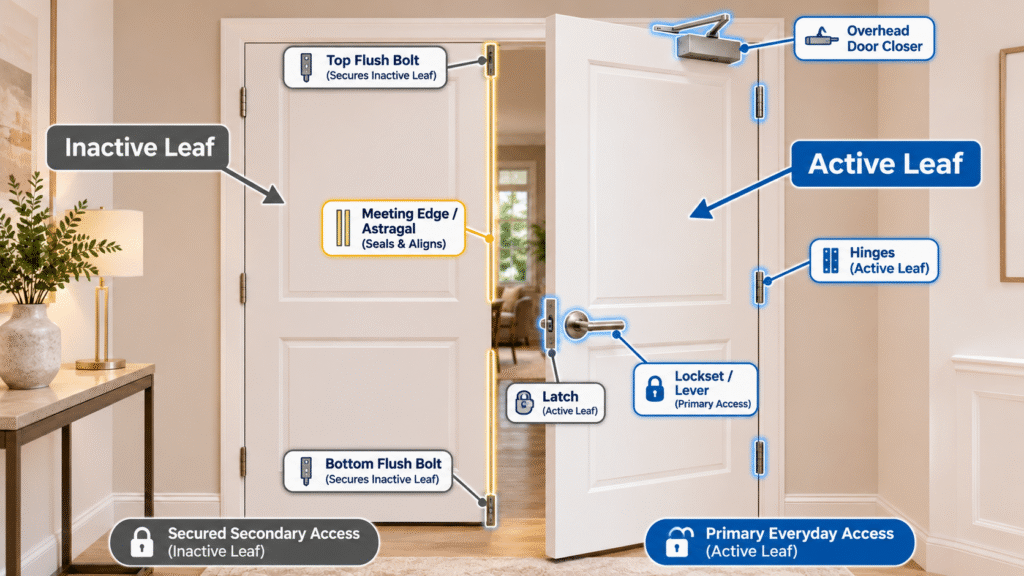
The active leaf typically carries the main operating lockset and latch. Select the function around the room’s use: passage hardware latches without locking, privacy hardware provides privacy, and keyed hardware provides controlled access. Hinges support the leaf, while a closer may be specified to control its closing movement.
The inactive leaf usually stays closed, providing a secured meeting point for the active leaf where the latching design requires it. It remains an operable leaf rather than a permanently fixed panel.
The Inactive Leaf Is Released for Wider Passage
Flush bolts commonly secure the inactive leaf into strikes at the head jamb and floor. Manual bolts are released by hand; automatic types coordinate their operation with the other leaf.
The inactive leaf’s release sequence depends on the flush-bolt type. Manual bolts require hand operation. Some automatic bolts retract when the active leaf opens, while certain configurations also require an additional manual release. Confirm the opening and closing sequence in the selected hardware’s installation instructions.
Record the approved operating sequence for the project: which leaf opens first, how the inactive leaf is released, and how both leaves are secured again. With overlapping meeting edges or hardware that requires sequential closing, the inactive leaf may need to close before the active leaf.
What Does Double-Active Mean in Practice?
A double-active pair provides two operable leaves, but the useful procurement question is whether either leaf can open while the other remains closed.
Independent operation allows that movement without releasing or moving the other leaf. A dependent arrangement requires an additional action involving the other leaf or shared hardware. Confirm this distinction using the hardware schedule and meeting-edge detail, rather than judging from two handles or two sets of hinges.
Ask the supplier to show:
- Each leaf’s operating hardware and locking function.
- Whether either leaf opens directly while the other remains closed.
- Any overlapping astragal or shared latching mechanism that affects movement.
- Any fixed or removable center mullion remaining between the leaves.
Opening both leaves can increase available passage, but a retained mullion or center post divides the opening. Do not describe the combined nominal leaf widths as one continuous clear opening without checking the actual assembly.
When coordinating the operating configuration with the door style and construction, the wider interior door collection provides additional context for reviewing available product configurations.
Double-Active, Double-Egress, and Double-Acting Are Different
Double-active describes the operating role of the two leaves. Double-egress describes a pair whose leaves swing in opposite directions. Double-acting describes a door that swings in both directions.
Record operating function and swing direction separately so that one term is not used as a substitute for the other.
Which Meeting-Edge Details and Hardware Matter?
The meeting edges are where the two leaves come together. Their profile determines how the joint closes and which hardware can be prepared there.
| Component or detail | Function | What to specify |
|---|---|---|
| Meeting stiles | Form the vertical joint between closed leaves | Flat, overlapping, or rabbeted profile; joint clearance and machining detail |
| Astragal | Covers the meeting gap or supports a specified meeting-edge or latching arrangement | Profile, material, mounting leaf, and compatibility with adjacent hardware |
| Flush bolts | Secure an inactive leaf | Exact type and model, top/bottom arrangement, strikes, and release sequence |
| Lockset and latch | Provide the required access, latching, and locking functions | Function on each leaf, strike location, and any shared mechanism |
| Door closer | Controls an individual leaf’s closing movement | Required leaf, mounting arrangement, and compatible preparation |
| Door coordinator | Controls the order in which the leaves close | Whether a sequence is required and which leaf must close first |
Flat meeting edges come together without an integral overlap. Overlapping edges cover the joint, while rabbeted edges use stepped profiles that fit together. Show the selected detail rather than asking the factory to infer it from the words “double door.”
An astragal may help cover light and air gaps, but it does not automatically lock the inactive leaf. Likewise, a ball catch is an option in some designs, not a standard requirement for every double-active pair.
Select these components as one operating arrangement. An overlap can affect opening order; a flush-bolt mechanism can affect closing order; and the machining must suit the door thickness and construction. Not every pair needs an astragal, automatic bolts, or a coordinator.
For fire-rated openings, check component compatibility against the applicable tested and listed assembly. General hardware descriptions do not establish that a particular pair is approved for that use.
How Should Handing and Swing Direction Be Shown?
Use a plan view with a defined reference side, leaf labels, hinge locations, and opening arcs. This communicates both the position of each leaf and its direction of movement.
For an active/inactive pair, label the active and inactive leaves. For a double-active pair, identify each leaf separately, such as left and right from the stated reference side. Match the supplier’s handing codes to the drawing before approving machining.
“In-swing,” “out-swing,” “left-hand,” and “right-hand” can be misunderstood without a shared reference. Interior openings in particular may not have an obvious exterior side. A verbal description should accompany, rather than replace, the marked plan.
Add an elevation for appearance and hardware positions, and a meeting-edge section where the joint affects operation. Keep all three consistent with the door schedule and hardware preparation details.
What Should Be Confirmed Before Ordering?
Leaf Widths and Usable Clearance
Equal-width leaves create a symmetrical pair. Unequal leaves can provide a wider everyday leaf with a narrower secondary leaf for occasional additional access. List the width, height, and thickness of each leaf separately from the overall opening dimensions.
Then check usable passage with the doors in their intended open positions. The frame, leaf thickness, hinges, hardware projections, center components, and opening angle can all affect clearance. Also check swing space against nearby walls, furniture, and adjacent doors.
Where accessibility requirements apply, verify the required operating leaf’s clear opening and maneuvering space under the applicable standards. Having two leaves does not itself demonstrate compliance.
One Coordinated Ordering Schedule
Use one approved schedule to connect the intended operation to the drawings and manufacturing preparation. For broader considerations covering materials, configuration, hardware, and installation, see our guide to choosing double doors.
| Order information | Required confirmation |
|---|---|
| Opening identification | Door mark and location |
| Operating configuration | Active/inactive or double-active; independent operation required or not |
| Dimensions | Overall opening dimensions and each leaf’s width, height, and thickness |
| Leaf arrangement | Equal or unequal widths; active/inactive labels where applicable |
| Reference and handing | Viewing side, hinges, swing arcs, and supplier handing codes |
| Meeting joint | Edge profile, astragal if specified, and any center mullion |
| Hardware | Each leaf’s operating function, exact hardware models, strikes, and machining requirements |
| Operation sequence | Opening, release, closing, and securing sequence; coordinator if required |
| Clearance | Required usable passage and swing space; applicable accessibility checks |
| Approval | Coordinated drawing revision, hardware schedule, and responsible party’s confirmation |
Before production, resolve any mismatch between the door schedule, plan, hardware list, and machining template. A correct door size does not compensate for an incorrect leaf function or handing detail.
Frequently Asked Questions
Can an Active/Inactive Pair Be Changed to Double-Active?
It may be possible, but the complete assembly needs review. Check the leaves, frame, meeting edges, existing machining, and locking arrangement before selecting replacement hardware. Changing a lockset or removing flush bolts alone does not establish that the revised pair will work as intended. Fire-rated and accessible openings also need review against their applicable requirements.
Does Every Active/Inactive Pair Need an Astragal?
No. The need depends on the meeting-edge design, gap coverage, sealing or latching requirements, and project specification. For a fire-rated pair, follow the relevant assembly requirements.
Does Every Automatic Flush-Bolt Arrangement Need a Coordinator?
No. A coordinator is used when the assembly requires a controlled closing order. Confirm the required sequence from the actual flush-bolt instructions, meeting-edge design, and approved hardware arrangement.
Conclusion
Choose active/inactive doors for mainly single-leaf access with occasional wider passage. Consider double-active doors when either leaf needs regular use, and specify whether independent opening is required.
Turn that operating choice into a coordinated door schedule, plan, meeting-edge detail, and hardware list. Confirm the usable opening and approve the handing and machining details before production.