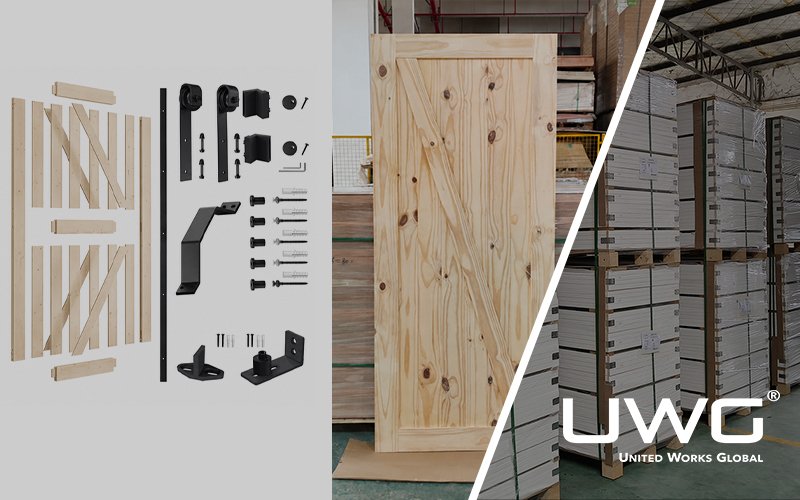
Wholesale barn door purchasing requires more than choosing a design or comparing unit prices. Builders and contractors must evaluate opening dimensions, sliding space, door materials, operating configurations, and hardware compatibility before placing bulk orders. Whether sourcing door slabs, hardware kits, or combined packages, buyers should coordinate product specifications, quantities, approved samples, packaging, and delivery schedules. Clear documentation and consistent supply requirements help prevent mismatched components, improve quotation accuracy, and support efficient project procurement.

Confirm the Application and Opening Requirements
Before selecting barn door materials or styles, determine whether the opening and surrounding wall can accommodate the proposed sliding system.
Interior Barn Doors and Project Applications
Interior barn doors are commonly used for closets, pantries, bedrooms, home offices, and room divisions. Their sliding operation eliminates the floor area needed for a conventional swinging door.
However, barn doors are not appropriate for every opening. Surface-mounted systems typically leave gaps around the door, which can affect privacy, sound separation, and light control.
Builders should identify the intended use and any access, privacy, or performance requirements before specifying the door system. Where fire, acoustic, accessibility, or other special requirements apply, the complete proposed system needs separate verification.
Opening Coverage, Sliding Space, and Clearances
The finished opening and barn door slab dimensions are not necessarily identical. The door must provide the required coverage while having sufficient space to slide along the wall.
Before ordering, evaluate:
- Opening coverage: Finished opening dimensions and any casing or trim that must be covered.
- Sliding space: Available wall area where the door will travel and park.
- Overhead clearance: Space for the track, hangers, and mounting components.
- Obstructions: Baseboards, switches, outlets, adjacent doorways, furniture, and projecting handles.
A wall may appear wide enough but still contain obstacles that prevent the door from opening completely.
Door overlap, mounting height, track length, and clearances should follow the selected hardware manufacturer’s drawings rather than a universal sizing formula.
Privacy, Access, and Mounting Conditions
A barn door may provide visual separation without offering the same perimeter sealing as a conventional hinged door.
Visual privacy, locking requirements, and acoustic expectations should therefore be considered separately.
Mounting conditions are equally important. Wall-mounted tracks require suitable structural support at the specified fastening points. Depending on the wall and selected hardware, additional blocking or a mounting header may be necessary. For site preparation and mounting considerations, refer to the barn door installation guide.
The project should also account for floor guides, stops, door travel, and any wall spacers needed to clear surrounding trim. These conditions must be reviewed against the actual hardware system.
Wholesale Barn Door Styles and Configurations
Wholesale barn doors are available in different panel styles and sliding configurations. Design appearance and operating arrangement should be specified independently.
Panel Styles and Glazed Designs
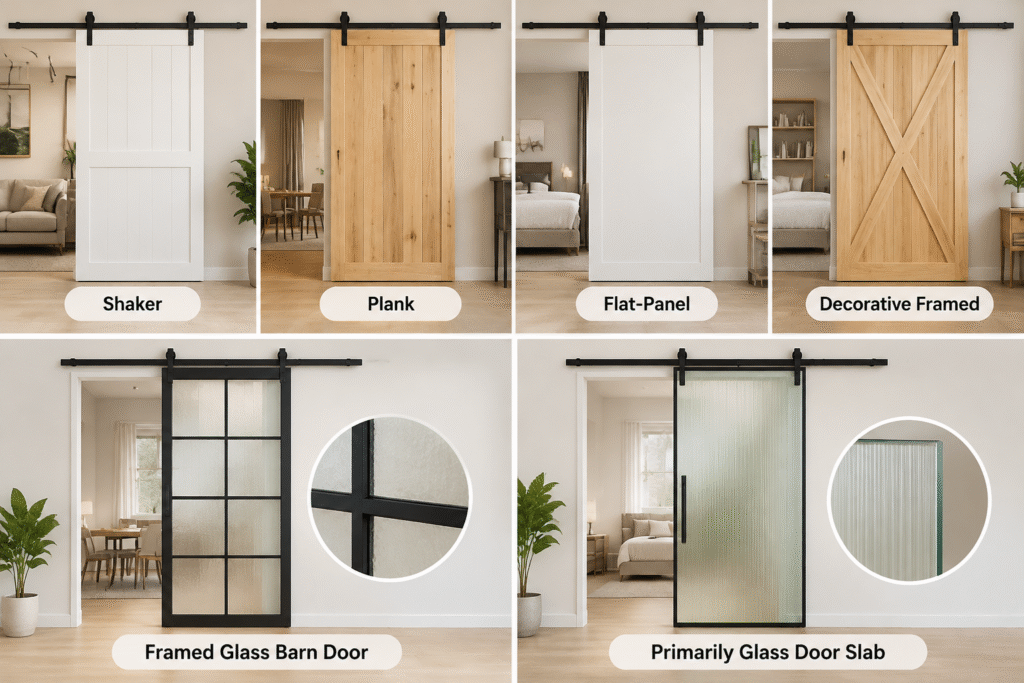
Common barn door designs include Shaker, plank, flat-panel, and decorative framed styles.
Shaker barn doors typically feature clean frame-and-panel detailing that can complement traditional, transitional, or contemporary interiors.
Flat-panel designs offer simpler surfaces, while plank-style doors emphasize visible wood boards or decorative texture. A flat-panel design should not automatically be treated as identical to every flush door construction.
Glass barn doors offer another design option where light transmission or visual connection is desired.
Two common glass-door constructions should be distinguished:
- Framed glass barn doors: Glass is supported within a wood, metal, or other specified frame.
- Primarily glass door slabs: The glass itself forms most of the door panel and requires hardware specifically designed for that construction.
Clear, frosted, or decorative glass may be available depending on the product. The visual appearance does not establish glass safety performance or hardware compatibility.
For projects coordinating barn doors with other interior openings, the wider range of interior door styles and configurations can also be considered when establishing a consistent design direction.
Single, Bi-Parting, and Bypass Configurations
The operating configuration determines how many panels are required and how they move.
- Single barn doors: One panel slides to one side of the opening.
- Bi-parting barn doors: Two panels slide in opposite directions and meet near the center when closed.
- Bypass barn doors: Two or more panels travel on parallel tracks and can overlap one another.
The term double barn doors may describe a two-panel arrangement, but it does not identify whether the system is bi-parting or bypass.
For bulk orders, specify the operating configuration, number of panels, parking space, and required clear opening.
Barn Door Materials, Finishes, and Supply Options
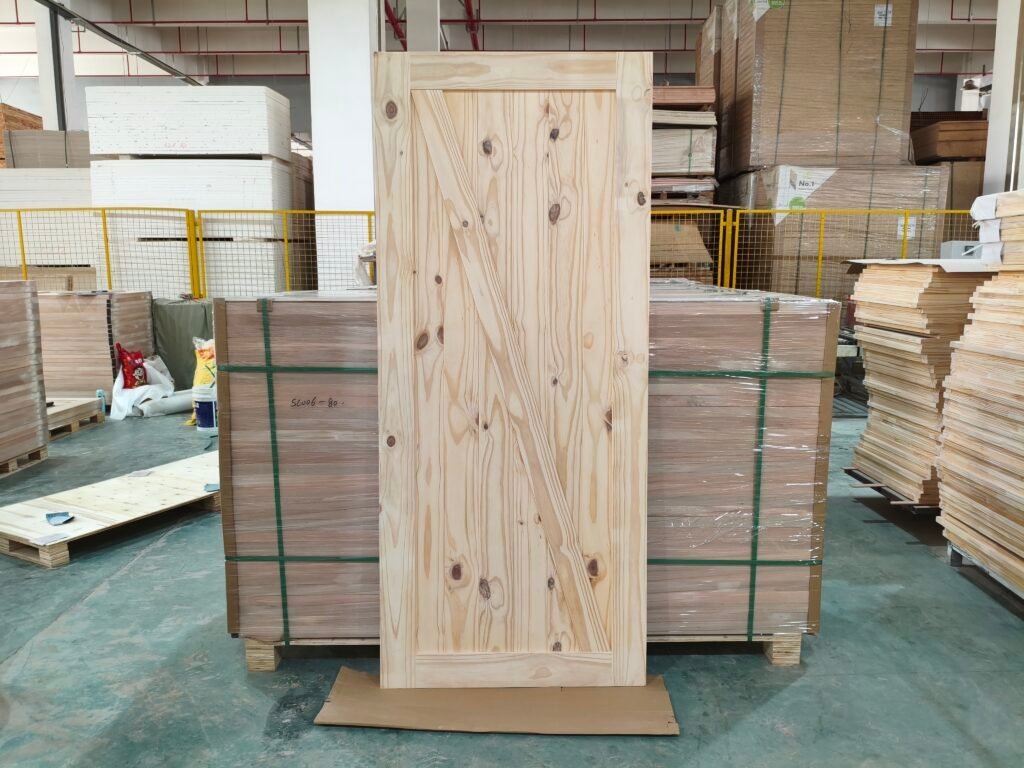
Door material affects appearance, weight, construction, and hardware requirements. Supply format determines which components are included in the quotation.
Common Barn Door Materials and Finish Options
Wood barn doors may use solid wood, engineered wood, or composite construction, depending on the manufacturer and product.
Available finishes may include natural stains, painted surfaces, primed doors, and other specified coatings.
Buyers should identify the actual substrate, panel construction, surface finish, and delivery condition rather than relying only on a product photograph.
For repeated project orders, approved samples help establish expectations for color, surface quality, and finish consistency.
Slab-Only, Hardware-Only, and Door-and-Hardware Packages
Wholesale orders can involve three different purchasing arrangements.
| Supply Format | What Is Purchased | What the Buyer Must Still Coordinate | Compatibility Responsibility |
|---|---|---|---|
| Slab-Only | Door slabs without sliding hardware | Track, hangers, guides, stops, handles, and other required components | Buyer and selected hardware supplier, using the slab manufacturer’s specifications |
| Hardware-Only | Specified track system and hardware components | Compatible door slabs, required preparation, mounting conditions, and excluded accessories | Hardware supplier and project team must verify suitability for the selected slabs |
| Door-and-Hardware Package | Door slabs with specified hardware components | Any excluded accessories, site materials, and installation work | Package supplier’s compatibility responsibilities should be clearly defined in the purchase agreement |
A combined package does not automatically include every installation component. Likewise, a hardware kit does not necessarily include the door slab, handles, locks, soft-close devices, or all mounting materials.
The quotation should include an itemized bill of materials (BOM) identifying supplied components and quantities.
Standard Products and Project-Specific Options
Standard models and finishes may simplify repeat purchasing, while project-specific requests can involve different sizes, materials, glazing, finishes, or hardware arrangements.
Custom configurations may affect minimum order quantities, sample requirements, production schedules, and prices.
Buyers should confirm which options are standard, which require separate approval, and whether different finishes or designs can be combined within one order.
Barn Door Hardware and Package Compatibility
Hardware compatibility depends on the door construction, weight, thickness, operating configuration, and mounting conditions.
Barn Door Hardware Kits and Track Systems
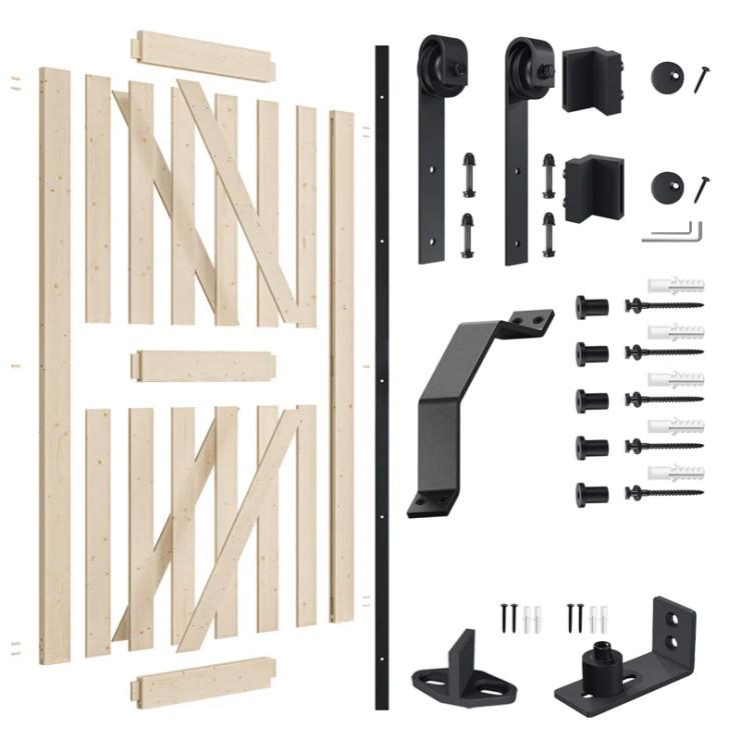
A barn door track system typically includes a horizontal track, hangers or rollers, stops, and a guiding arrangement.
Depending on the manufacturer, additional components may include mounting spacers, anti-jump devices, fasteners, or other accessories.
These components perform different functions. For example, stops limit door travel, while a floor guide helps control lateral movement. Anti-jump components, where required by the system, help prevent unintended disengagement.
Buyers should use the selected manufacturer’s component list rather than assuming all kits contain identical parts or quantities.
Soft-Close Barn Door Hardware and Other Accessories
Soft-close barn door hardware can help control movement near the end of travel, but compatibility involves more than the track’s maximum load rating.
Before including a soft-close or soft-open accessory, verify:
- Whether the mechanism operates in one direction or both directions.
- Supported door weight and minimum or maximum applicable door width.
- Available travel distance and activation position.
- Compatibility with the selected hangers and track.
- Required trigger components and their locations.
- Approved combinations for single, bi-parting, or bypass systems.
A track capable of supporting the door weight does not automatically mean every soft-close accessory is suitable for that door.
Soft-close mechanisms also do not replace required stops, guides, or other safety-related components specified by the hardware manufacturer.
Confirming Compatibility Between Door Slabs and Hardware
For wood or composite barn doors, confirm door weight, thickness, internal construction, hanger attachment positions, and permitted machining.
Glass barn doors require additional review.
A framed glass door may use hardware attached to its supporting frame, while a primarily glass door slab may require a dedicated clamping or attachment system.
Before production approval, confirm the relevant glass and hardware drawings, including:
- Glass dimensions, thickness, and specified safety-glazing documentation.
- Appropriate hanger attachment or approved clamping arrangements.
- Any required factory-prepared holes or slots.
- Floor guide and handle compatibility.
- Restrictions on subsequent glass processing.
Hardware preparation suitable for a wood slab must not automatically be applied to glass.
Glass drilling, cutting, and other processing requirements must be confirmed before manufacturing. Field modifications should not be assumed permissible.
Planning and Placing Bulk Barn Door Orders
Bulk barn door procurement requires coordinated specifications, quantities, component lists, approvals, and shipment arrangements.
Confirming Project Specifications, Drawings, and Samples
Start with an RFQ or order matrix organized by door mark or SKU. Each entry should identify the corresponding door, operating configuration, hardware, and delivery requirements.
| RFQ / Order Field | Information to Record | Approval or Control Reference |
|---|---|---|
| Door Mark / SKU | Project opening identifier and location | Door schedule |
| Door Style and Dimensions | Design, width, height, thickness | Approved door drawing |
| Material and Finish | Construction, surface material, finish | Material and finish sample |
| Operating Configuration | Single, bi-parting, or bypass | Opening and hardware drawing |
| Door Quantities | Number of openings and required door slabs | Quantity schedule |
| Hardware Kits | Kit model, configuration, and required kit quantity | Manufacturer BOM |
| Soft-Close Accessories | Model, operating direction, and quantity | Hardware compatibility documentation |
| Approved References | Drawing number, sample identification, revision | Approval record |
| Delivery and Labels | Delivery batch, destination, room or SKU label | Packing and delivery plan |
Opening count, door slab count, and hardware kit count are different quantities.
For example, a bi-parting opening involves two door panels, but its hardware configuration should be ordered according to the manufacturer’s BOM rather than assuming two identical single-door kits.
Bypass systems may also use different track arrangements and component quantities.
Before production, the approved drawings, samples, specifications, and BOM should be linked to the applicable door marks and order revisions. Any material change should be reviewed and approved before implementation.
Confirming Product Mix, Quantities, and Minimum Order Requirements
Bulk barn door orders may combine several styles, finishes, and configurations.
Organizing quantities by SKU allows buyers to determine the requirements for each product variation and coordinate hardware accordingly.
Minimum order quantities (MOQ) should be checked for standard products, custom finishes, and special hardware options.
Buyers should also confirm whether mixed-product orders are accepted and whether individual variations have separate minimum quantities.
Packaging, Labeling, and Shipment Preparation
Packaging should protect door surfaces, edges, glass, and hardware during storage and transportation.
Depending on the product, doors may require individual protective wrapping, foam edge guards, cartons, or palletized packaging.
For glass barn doors, packaging must account for the specific glass and frame construction.
Long tracks may need separate packaging from smaller hardware components. Packing dimensions and loading arrangements should be reviewed before shipment.
Labels should connect each package to the approved door mark or SKU, product configuration, quantity, and relevant order batch.
A coordinated packing list helps identify which door slabs and hardware components belong together.
For container shipments, buyers should confirm loading arrangements, unloading requirements, and whether different product types will be combined in the same shipment.
Production Lead Times and Delivery Planning
Production schedules should distinguish three milestones:
- Production-ready date: When approved specifications and necessary materials allow production to begin.
- Shipment date: When the goods are packed, inspected, and ready for dispatch.
- Required site delivery date: When the project needs the products at the specified location.
The factory production period is not the same as total delivery time.
Freight booking, transportation, customs clearance where applicable, and local delivery can affect the final arrival schedule.
For projects requiring phased deliveries, confirm which quantities belong to each shipment and how packaging labels will distinguish the batches.
Choosing a Reliable Barn Door Manufacturer or Supplier

A suitable barn door manufacturer or supplier should be evaluated through its actual product capabilities, documentation, and clearly assigned responsibilities.
Manufacturers and trading suppliers may use different production arrangements. Neither business model alone determines product quality.
Evaluating Manufacturing Capabilities and Product Consistency
Before placing a bulk order, identify which components the supplier manufactures directly and which are purchased from third parties.
This is particularly important when door slabs and hardware come from different sources.
The purchase agreement should identify who is responsible for providing the complete BOM and confirming compatibility between the supplied components.
For repeat projects, buyers should also ask how dimensions, finishes, and product references are controlled across production batches.
Reviewing Samples, Specifications, and Quality Documentation
The approval process should connect product drawings and samples to the actual production order.
Before shipment, the agreed inspection scope may include:
- Door dimensions, construction, and surface quality.
- Finish consistency and edge condition.
- Glass condition and specified processing.
- Hardware preparation and component completeness.
- Packaging protection and correct identification labels.
Where appropriate, a representative door slab and matching hardware set can be checked together to verify fit and compatibility.
Inspection methods, acceptance criteria, and responsibilities should be agreed upon before production rather than assumed.
Comparing Quotes for the Same Specification and Supply Scope
Wholesale quotations should be compared using the same required door specifications, approved hardware configuration, packaging requirements, and delivery scope.
The price comparison should identify whether door slabs, hardware kits, soft-close accessories, packaging, and transportation are included or separately charged.
Equally important are the commercial terms governing discrepancies and replacement orders.
Buyers should agree in advance on how missing components, incorrect hardware, or shipping damage will be documented and reported. This may include photographs, package references, batch identification, notification deadlines, and the agreed process for resolving discrepancies.
For future replenishment, confirm whether matching finishes, replacement components, and spare hardware can be supplied.
These arrangements should form part of the purchasing terms; they should not be assumed to be automatic supplier warranties or free replacement commitments.
FAQs
Can Wholesale Barn Door Orders Include Different Styles and Finishes?
Depending on the supplier’s product range and MOQ requirements, different styles and finishes may be combined in one order. Each variation should have its own SKU, quantity, and approved specification.
Can Barn Door Hardware Kits Be Ordered Separately?
Yes, hardware-only packages are available from some suppliers. Buyers should confirm the exact component list and compatibility with the intended door slabs.
Can Barn Door Slabs Be Supplied Without Hardware Preparation?
Some suppliers offer unmachined door slabs. The required hanger attachment positions, internal support, and permitted preparation must be confirmed before ordering.
What Should Buyers Check When Replacing an Existing Barn Door Slab?
Check the existing track system, hanger attachment positions, slab dimensions, thickness, weight, and floor guide arrangement.
A replacement slab should be evaluated against the original hardware specifications. Similar overall dimensions do not guarantee compatibility.
Conclusion
Wholesale barn door purchasing requires coordination between opening requirements, door construction, hardware compatibility, quantities, and delivery schedules.
For builders and contractors, a clear RFQ matrix, approved drawings, itemized component lists, and defined supply responsibilities provide a more reliable basis for comparing quotations and placing bulk orders.
Planning these details before production helps reduce mismatched components, improve shipment coordination, and support smoother project delivery.