

Builders often assume all doors fit standard frames—but that mistake can cost time and money. Confusion over measurements, units, and building codes can delay installations. Understanding standard sizes early in the project ensures smooth ordering, code compliance, and proper fit every time.
Yes, doors do have standard sizes. In most residential construction, interior doors are typically 80 inches (2032 mm) tall and range from 24 to 36 inches (610–914 mm) wide. Exterior doors commonly measure 36 inches wide and 96 inches high. Metric standards vary by region, and builders should also account for door frame dimensions and rough opening allowances when selecting a door.
Let’s explore how door sizing works, which dimensions matter most, and what you should check before placing that next big order.
Is a 32-Inch Door Really 32 Inches Wide?
Not quite. A 32-inch door is nominally 32 inches, but the actual size is typically 31.75 inches. This 1/4-inch difference allows the door to fit properly inside the frame and accounts for manufacturing and fitting tolerances. It’s important for constructors to always confirm if the listed size is nominal or actual before ordering.
What Are the Standard Door Sizes in Inches and Feet?
Standard door sizing in inches and feet is widely used in the US and many other countries. Here’s a quick reference:
🔹 Interior Doors:
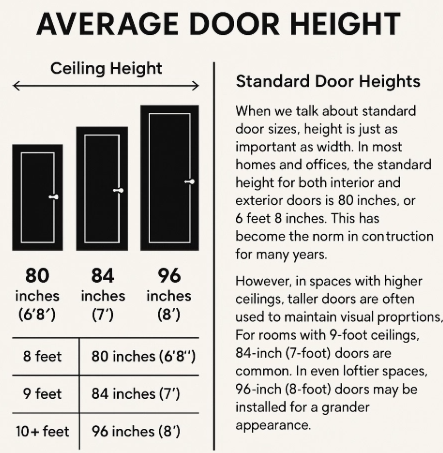
- Height: 80 inches (6 ft 8 in) is most common
- Widths: 24″, 28″, 30″, 32″, and 36″
- Thickness: Usually 1 3/8″
🔹 Exterior Doors:
- Height: Typically 80″, but 84″ and 96″ are also common in modern homes
- Width: Usually 36″, but also available in 32″, 34″, or 42″
- Thickness: Usually 1 3/4″
These standard door sizes in inches and feet are accepted by most US building codes and make for easier installation and replacement.

What Are Standard Door Sizes in Meters and Millimeters?
If you work internationally, you’ll often deal with metric dimensions. Here’s how the imperial standards convert:
🔸 Interior Doors:
- Height: 2.03 m (2032 mm)
- Widths: 610 mm, 710 mm, 760 mm, 810 mm, 914 mm
🔸 Exterior Doors:
- Height: 2.03 m, 2.13 m, or 2.44 m (2032–2438 mm)
- Widths: 813 mm to 914 mm
👉 Use metric sizes if you’re working in countries like Australia, the UK, or within the EU. Always verify with local codes and suppliers to ensure regional compliance.
What Is the Standard Door Frame Size for Residential Homes?
The door frame (also called a jamb or casing) adds size beyond the slab. You’ll also need to account for the rough opening when framing:
- For an 80-inch high door, the rough opening should be about 82.5 inches high
- For a 36-inch wide door, the rough opening should be 38 inches wide
These extra inches account for shims, hardware, and minor adjustments during installation.
Do Interior and Exterior Doors Have Different Standard Sizes?
Absolutely. Interior doors are generally lighter, thinner, and smaller than exterior doors. Here’s how they differ:
| Feature | Interior Doors | Exterior Doors |
|---|---|---|
| Widths | 24–36 inches | 32–42 inches |
| Height | 80 inches | 80–96 inches |
| Thickness | 1 3/8 inch | 1 3/4 inch |
| Material | MDF, hollow-core | Solid wood, steel, fiberglass |
| Weatherproofing | Not required | Required (sealed, insulated) |
Exterior doors must also meet energy codes and security standards, while interior doors focus more on aesthetics and space division.
How to Measure a Door for Replacement or New Installation
Correct measurement ensures your door fits the opening and the project stays on track. Here’s how:
- Width: Measure the door slab horizontally at the top, middle, and bottom. Use the largest measurement.
- Height: Measure vertically from the top edge to the bottom.
- Thickness: Measure the edge of the door.
- Rough Opening: Measure from stud to stud (not casing), and from subfloor to header.
- Door Frame: Measure the jamb width if replacing the frame too.

Can You Customize Doors Beyond Standard Sizes?
Yes, custom door sizes are widely available—but with longer lead times and higher costs. You might need a non-standard door size if:
- You’re renovating an older building
- Designing a custom entryway with sidelights
- Adding pocket or barn-style sliding doors
Manufacturers often allow custom orders in:
- Width: 20″ to 48″
- Height: Up to 108″
- Thickness: Special applications (e.g., soundproof or fire-rated doors)
If you’re ordering a custom door, always get specs in writing and verify the door slab, frame, and rough opening with the manufacturer.

Common Mistakes to Avoid When Choosing Standard Doors
Assuming all homes use the same sizes Not accounting for door swing (left-hand/right-hand) Using door slab size instead of rough opening measurements Not checking actual size vs. nominal size
🔨 Constructors should build these checks into their project timelines to avoid costly delays.
Frequently Asked Questions About Standard Door Sizes
Q: Are a 32-inch door’s actual measurements exactly 32 inches?
A: No, not exactly. A standard “32-inch door” is the nominal size. The actual width of the door slab is typically 31.75 inches (31 ¾ inches). This 1/4-inch difference provides the necessary clearance to ensure the door fits and swings properly within the door frame without rubbing or sticking.
Q: What is the standard size for residential interior doors?
A: In North America, the most common standard size for residential interior doors is 80 inches tall (6 feet 8 inches). The standard widths range from 24, 28, 30, 32, to 36 inches, with 32 inches being the most widely used width for bedrooms and bathrooms. The standard thickness for an interior door is typically 1 3/8 inches.
Q: How much bigger should a rough opening be than the door size?
A: As a general rule for builders, the rough opening should be 2 inches wider and 2.5 inches taller than the actual door slab. For example, if you are installing a standard 36-inch wide by 80-inch tall door, your rough framing opening should measure approximately 38 inches wide by 82.5 inches high to allow room for the door jamb, shims, and adjustments.
Q: What is the standard size for a front exterior door?
A: Exterior doors are typically larger and thicker than interior doors to provide better security and insulation. The standard size for a residential front door is 36 inches wide by 80 inches tall, with a thickness of 1 3/4 inches. However, in modern and luxury home constructions, 84-inch and 96-inch tall exterior doors are becoming increasingly common.
Final Thoughts: Get It Right the First Time
Standard door sizes save time—but only when you know them. Always check actual vs. nominal dimensions, local codes, and frame clearances. Need a custom solution? UWG offer plenty of flexibility. Got questions? Drop them below!