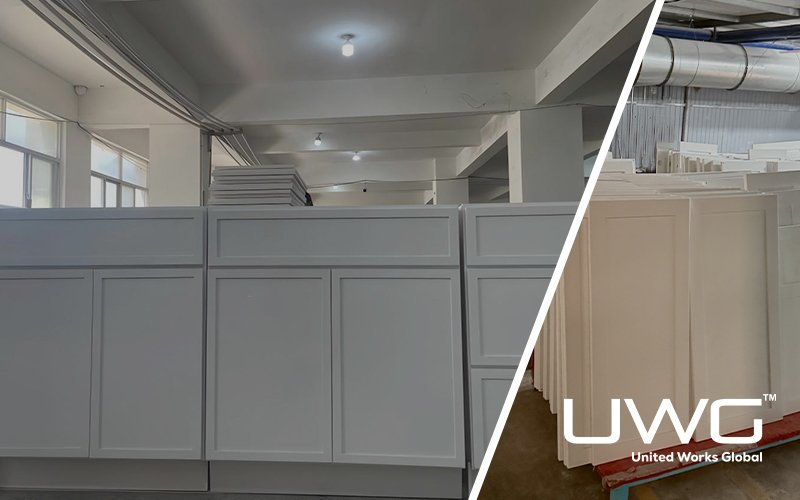
When choosing kitchen, bathroom, or laundry room cabinets, one of the most important decisions is the cabinet box material. Two of the most common options are plywood cabinets and particle board cabinets. While they may look similar once installed, their performance, durability, moisture resistance, and long-term value can differ significantly.
Many homeowners, builders, contractors, and cabinet distributors ask the same question: Should I choose plywood or particle board cabinets?
The answer depends on your budget, project requirements, and expectations for durability. In this guide, we’ll compare plywood and particle board cabinets in detail, helping you determine which material is the better fit for your project.
Plywood cabinets are generally the better choice for projects that prioritize durability, moisture resistance, strength, and long-term value. Made from multiple layers of wood veneer, plywood offers superior structural stability and performs well in kitchens, bathrooms, and high-humidity environments. Particle board cabinets are a more affordable option and can work well in budget-conscious projects where moisture exposure is limited. While particle board provides a smooth surface and lower cost, it is more susceptible to swelling and damage from water. For most homeowners, builders, and contractors seeking longevity and reliable performance, plywood cabinets are worth the additional investment. However, particle board cabinets remain a practical solution for cost-sensitive residential and multifamily projects where budget is the primary concern.
What Are Plywood Cabinets?
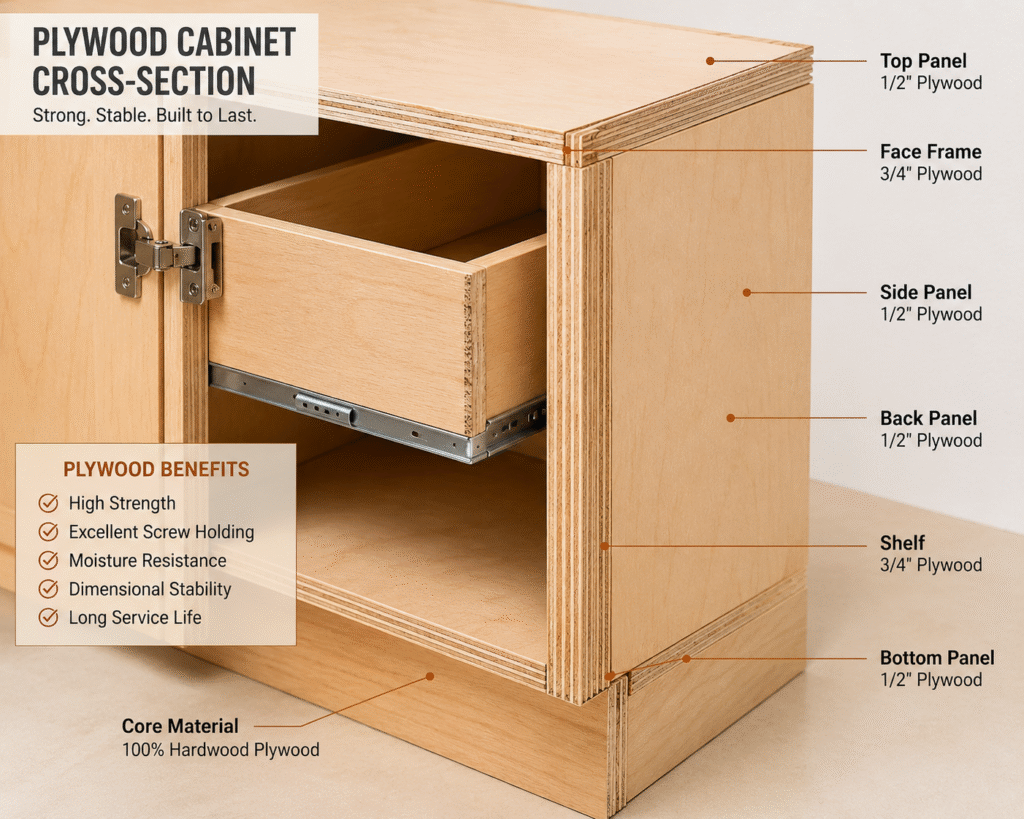
Plywood is an engineered wood product made by bonding multiple thin layers of wood veneer together. Each layer is arranged with alternating grain directions, creating a strong and stable panel.
Cabinet manufacturers commonly use plywood for cabinet boxes, sides, shelves, and backs because of its excellent strength-to-weight ratio.
Advantages of Plywood Cabinets
- High structural strength
- Excellent screw-holding capability
- Better moisture resistance
- Lightweight compared to solid wood
- Long service life
- Reduced risk of warping and sagging
Because of these characteristics, plywood is widely considered a premium cabinet construction material.
What Are Particle Board Cabinets?
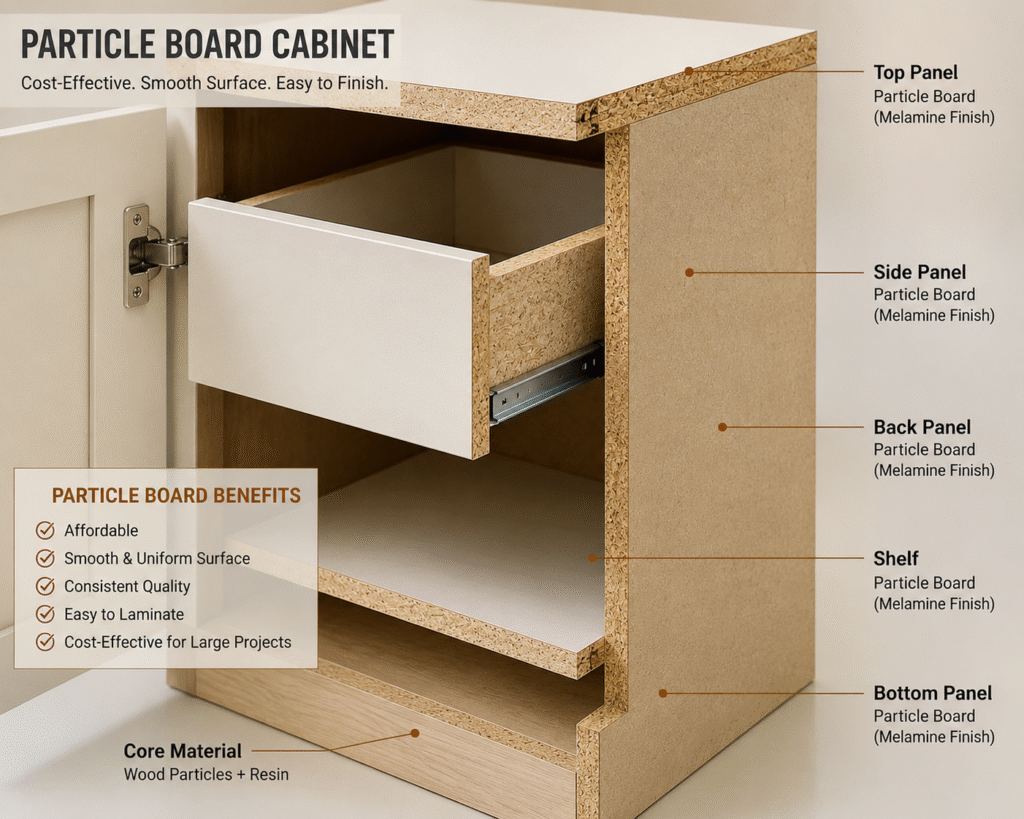
Particle board is manufactured from wood particles, sawdust, and wood chips bonded together with resin under heat and pressure.
It is one of the most economical materials used in cabinet manufacturing and is often found in budget-friendly kitchen and bathroom cabinetry.
Advantages of Particle Board Cabinets
- Lower material cost
- Smooth and uniform surface
- Easy to laminate and finish
- Cost-effective for large-scale projects
Particle board is commonly used in residential developments, apartment projects, and budget-conscious remodeling applications.
Plywood vs. Particle Board Cabinets
| Feature | Plywood Cabinets | Particle Board Cabinets |
|---|---|---|
| Cost | Higher | Lower |
| Durability | Excellent | Moderate |
| Moisture Resistance | High | Low |
| Weight Capacity | Strong | Moderate |
| Screw Holding Strength | Excellent | Fair |
| Lifespan | Long | Shorter |
| Structural Stability | Excellent | Good |
| Water Damage Risk | Lower | Higher |
| Repairability | Easier | More Difficult |
| Best For | Premium Projects | Budget Projects |
Durability and Strength
When it comes to durability, plywood is the clear winner.
Because plywood consists of multiple wood veneer layers, it can withstand daily use, heavy loads, and long-term stress better than particle board.
Kitchen cabinets often support:
- Stone countertops
- Dishes and cookware
- Appliances
- Pantry storage
Plywood shelves and cabinet boxes generally resist sagging and structural failure more effectively.
Particle board performs adequately under normal conditions but may weaken over time, especially under heavy loads.
Moisture Resistance
Moisture is one of the biggest threats to cabinet longevity.
Bathrooms, kitchens, and laundry rooms are all environments where cabinets may be exposed to humidity, leaks, or spills.
Plywood
Plywood offers superior moisture resistance because its layered construction helps maintain structural integrity when exposed to occasional moisture.
Particle Board
Particle board absorbs water more easily. Once saturated, it can swell, deform, and lose strength permanently.
This is why many builders prefer plywood cabinets for areas where moisture exposure is a concern.
Installation Performance
Cabinets must hold screws, hinges, drawer slides, and other hardware securely.
Plywood has excellent screw retention, making installation easier and reducing the likelihood of loose hinges over time.
Particle board can hold hardware adequately, but repeated adjustments or heavy usage may cause screws to loosen.
For contractors and installers, plywood generally provides a more reliable installation experience.
Cost Considerations
Budget is often the deciding factor.
Particle board cabinets can cost significantly less than plywood cabinets, making them attractive for:
- Multifamily housing projects
- Rental properties
- Budget remodels
- Large-volume developments
Plywood cabinets typically require a higher upfront investment, but many buyers view the additional cost as worthwhile due to improved durability and longer service life.
Appearance Differences
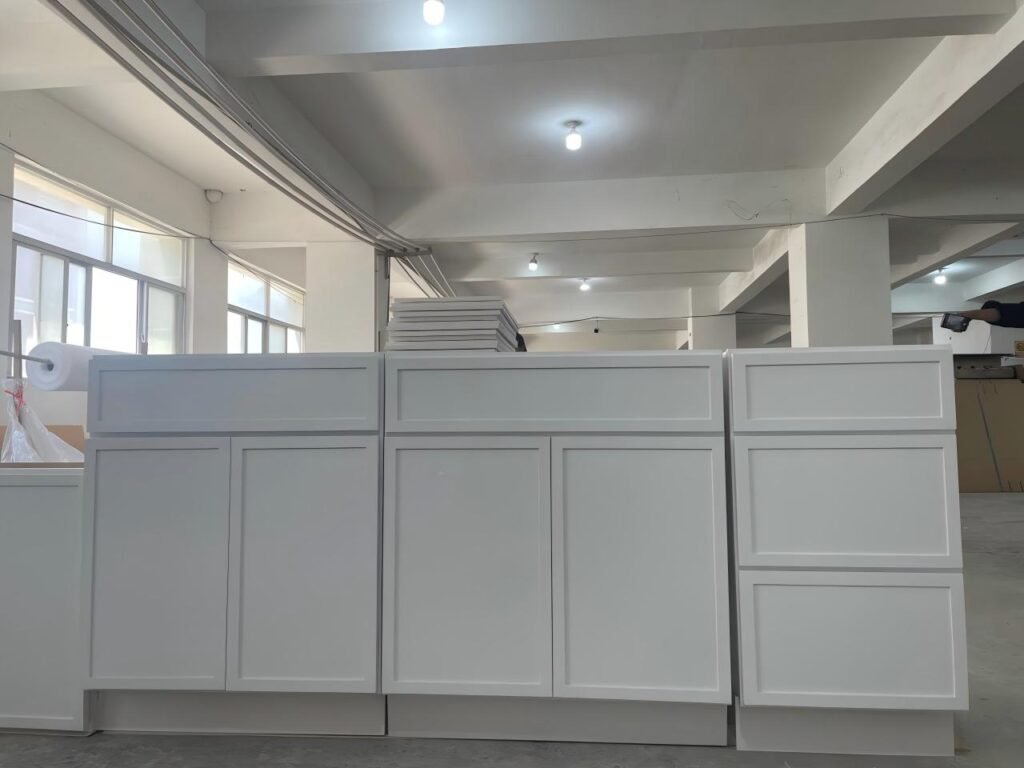
Surprisingly, the appearance difference between plywood and particle board cabinets is often minimal once finished.
Most modern cabinets use:
- Melamine
- Thermofoil
- Veneer
- Paint
As a result, the visible exterior can look nearly identical regardless of the cabinet box material.
The primary difference lies in what you cannot see: the cabinet’s internal structure and long-term performance.
Which Material Is Better for Kitchen Cabinets?
For kitchens, plywood is generally the preferred option because:
- It handles moisture better
- It supports heavier loads
- It provides longer-lasting performance
- It improves cabinet durability
Homeowners planning to stay in their homes for many years often find plywood cabinets to be a worthwhile investment.
When Should You Choose Particle Board Cabinets?
Particle board cabinets may still be a smart choice when:
- Budget is limited
- The project is a rental property
- Moisture exposure is minimal
- Cost savings are a priority
- The expected service life is shorter
For many entry-level and builder-grade cabinet projects, particle board remains a practical solution.
Frequently Asked Questions About Cabinet Materials
Q: What is the primary difference in structural strength between plywood and particle board?
A: Plywood is composed of cross-layered wood veneers, which provides superior structural integrity, excellent screw-holding power, and resistance to bowing under heavy loads. Particle board, made from compressed wood chips and resin, is denser but inherently weaker and more susceptible to sagging or crumbling, especially near fastening points.
Q: How do these materials differ in terms of moisture resistance?
A: Plywood is generally more resistant to water damage and humidity fluctuations because of its layered construction. Particle board is highly vulnerable to moisture; if it gets wet, it tends to swell, lose its structural rigidity, and disintegrate, which can lead to catastrophic cabinet failure in areas like kitchens or bathrooms.
Q: Why might a project budget favor the use of particle board?
A: Particle board is a mass-produced, cost-effective material that is significantly cheaper than plywood. For large-scale projects where minimizing unit costs is the priority and the cabinets will be installed in climate-controlled environments with low moisture exposure, particle board offers a budget-friendly solution that meets standard interior requirements.
Q: Is there a trade-off between weight and durability for cabinet construction?
A: Yes, particle board is significantly heavier than plywood, which can increase shipping and handling costs for bulk deliveries. Conversely, plywood is lighter and easier to work with, while offering better long-term durability, making it the preferred choice for high-end projects or environments where heavy-duty use is expected.
Conclusion
For most residential and commercial projects, plywood cabinets offer superior durability, moisture resistance, structural strength, and long-term value, making them the preferred choice for kitchens, bathrooms, and high-use spaces.
However, particle board cabinets remain a cost-effective option for budget-conscious projects where affordability is more important than maximum durability.
Ultimately, the right choice depends on your project goals. If long-term performance and reliability are your priorities, plywood is usually worth the investment. If minimizing upfront costs is the primary concern, particle board can provide acceptable performance at a lower price point.
Articles that you may be interested in:
Solid Wood vs. MDF for Painted Cabinets: Which Is Better for Your Project?
Shaker Cabinets vs Flat Panel Cabinets: Which Style Fits Your Project?