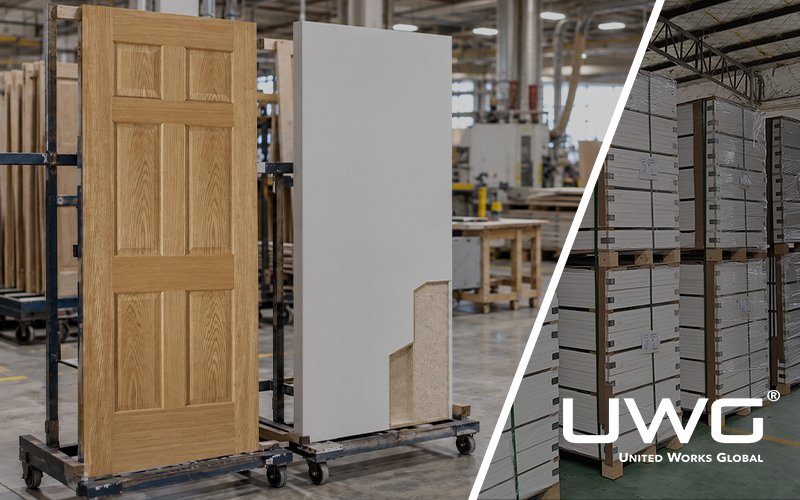
Choosing between stile and rail vs solid core doors can be confusing because the two terms do not describe exactly the same part of a door. Stile and rail refers primarily to how a door is constructed, while solid core refers to the material and structure inside the door.
Understanding this difference is important when comparing interior doors for appearance, durability, sound control, stability, cost, and project applications. This guide explains how each construction works, their key advantages and limitations, and where each option is commonly used.
The two categories are not necessarily mutually exclusive. Depending on the construction method, a stile and rail interior door can also incorporate solid materials or a solid engineered structure. Therefore, the better choice depends on whether the project prioritizes architectural appearance, performance, budget, or a combination of these factors.
Are Stile-and-Rail and Solid-Core Opposite Door Categories?
No. The terms classify doors in different ways.
Stile-and-raildescribes how a door is assembled. Separate vertical and horizontal components form a framework around one or more panels.
Solid-coredescribes the dense material used inside a door, usually beneath molded, veneered, laminated, or smooth faces.
This distinction matters because a buyer could otherwise compare two labels as if they represented the same product characteristic.
A stile-and-rail door may be made from solid wood, MDF, LVL, engineered wood, or several materials combined. It can feel solid and substantial, but suppliers may classify it as an assembled frame-and-panel door rather than a conventional solid-core door.
A solid-core molded or flush door normally uses a dense internal core bonded to separate faces or skins. Its visible appearance comes primarily from those faces rather than from separately assembled panels.
When reviewing a quotation, ask for the actual construction instead of assuming what either label means.
How Do Common Interior Door Terms Differ?
| Term | What it describes | What it does not automatically establish |
|---|---|---|
| Stile-and-rail | Assembly method using vertical stiles, horizontal rails, and panels | Material, core type, acoustic rating, or fire rating |
| Solid core | Dense internal core beneath the door faces | Solid natural wood construction |
| Hollow core | Lightweight internal structure, commonly honeycomb | An empty or unsupported door |
| Molded | A manufacturing method using formed door skins | Whether the internal core is solid or hollow |
| Flush | A door with flat faces | Core type or face material |
| Shaker | A visual style with clean, recessed panels | Material or manufacturing method |
| Solid wood | Material used in the structural components | A tested acoustic or fire rating |
These terms may be combined in one product description.
For example:
Molded MDF skin + solid engineered core + 6-panel design
or:
Engineered stile-and-rail construction + MDF center panels + Shaker style
The first describes a solid-core molded door. The second describes an assembled Shaker-style door.
What Is a Stile and Rail Door?
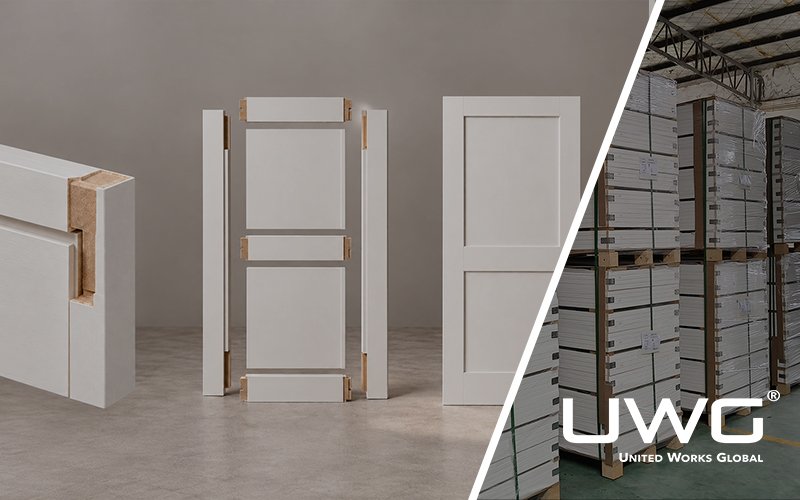
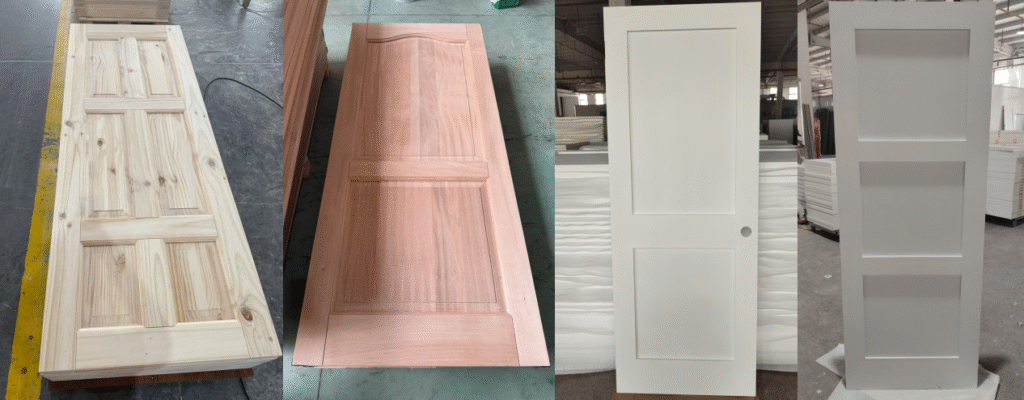
A stile and rail door is constructed from separate vertical and horizontal components that are joined together to form the door structure. The vertical members are called stiles, while the horizontal members are called rails. One or more panels are fitted between these components to create the finished door design.
The main components typically include:
- Stiles – Vertical members running along the sides of the door.
- Rails – Horizontal members connecting the stiles at the top, bottom, and sometimes through the middle.
- Panels – Sections fitted between the stiles and rails, which may be flat, raised, or otherwise profiled.
- Mullions – Additional vertical members used in certain multi-panel designs.
Unlike a door made from a single continuous core with applied faces, stile and rail interior doors are assembled from multiple structural components. This construction allows for a wide range of panel layouts, profiles, materials, and architectural styles, making it common in residential interiors where door design and detailing are important.
What Are the Main Advantages?
Potential advantages include:
- greater flexibility in panel layouts;
- more pronounced panel depth and shadow lines;
- compatibility with painted or wood-grain finishes;
- custom stile, rail, and panel proportions;
- the ability to combine different materials by component; and
- suitability for architectural and design-focused interiors.
What Should Buyers Confirm?
A complete stile-and-rail specification should identify:
- stile and rail materials;
- stile and rail widths;
- panel material and thickness;
- joint construction;
- edge construction;
- slab thickness;
- finish;
- hinge and lock preparation;
- available trimming limits; and
- permitted size range.
The term alone does not establish the exact materials or joinery.
What Is a Solid Core Door?
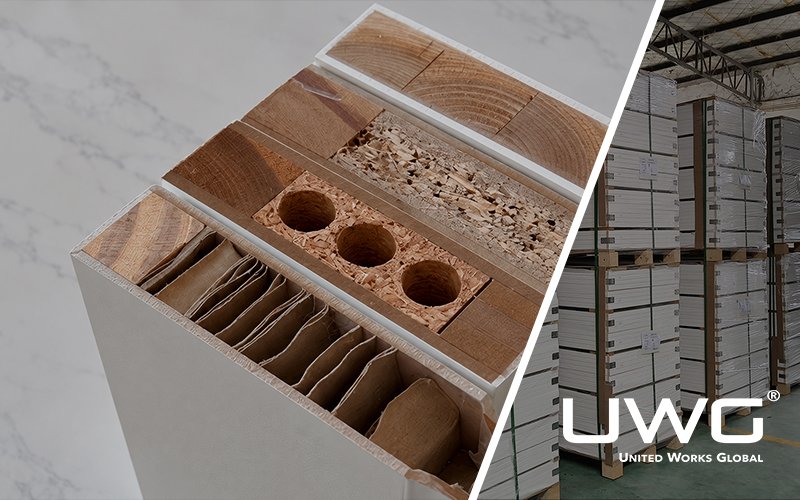
A solid-core door normally uses a dense internal core positioned beneath separate faces or skins.
The core may use:
- particleboard;
- tubular particleboard;
- composite fiberboard;
- engineered wood;
- mineral or specialty core materials; or
- another manufacturer-specific construction.
The perimeter normally includes edge components and hardware reinforcement. Faces are then bonded to the core and perimeter structure.
The exact construction varies, so the core material, density, face material, edge construction, lock block, and available machining should be confirmed.
For a complete explanation of core selection, see Solid-Core vs. Hollow-Core Doors.
Solid-Core Molded Doors
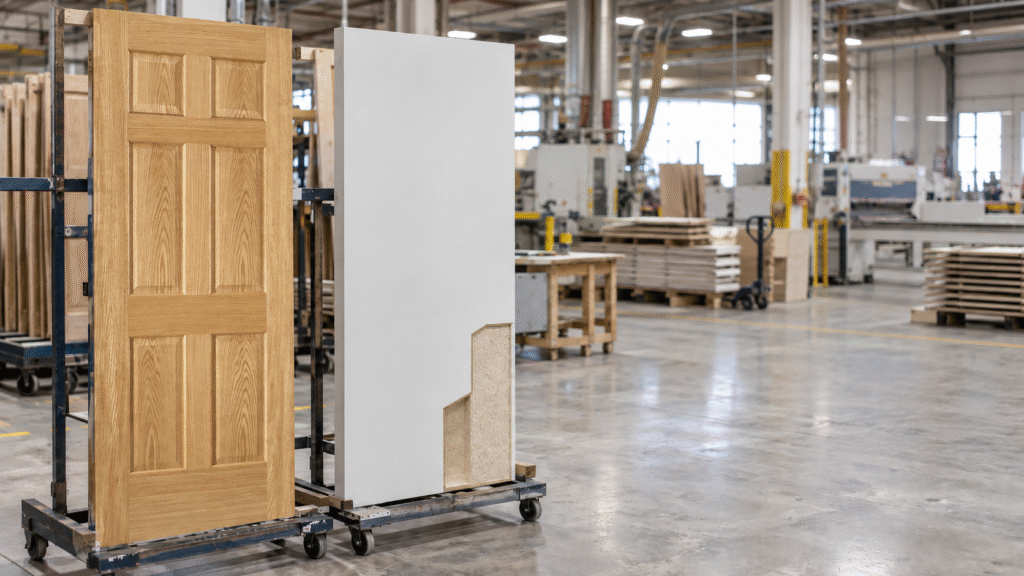
A solid-core molded door combines a dense internal core with molded MDF door skins.
The molded skins create the visible panel design, while the core adds mass and internal support.
A molded door may be manufactured with either a hollow or solid core, so the word molded does not define its internal construction.
For additional details, see What Is a Molded Door?.
Solid-Core Flush Doors
A solid-core flush door combines a dense internal core with flat faces.
The faces may use:
- wood veneer;
- engineered veneer;
- laminate;
- MDF;
- painted surfaces; or
- other decorative materials.
Flush doors are commonly used where the project requires a clean, flat appearance rather than molded or assembled panel detailing.
For more information, see What Is a Flush Door?.
Construction Differences: Stile and Rail vs Solid Core
Stile-and-Rail Construction
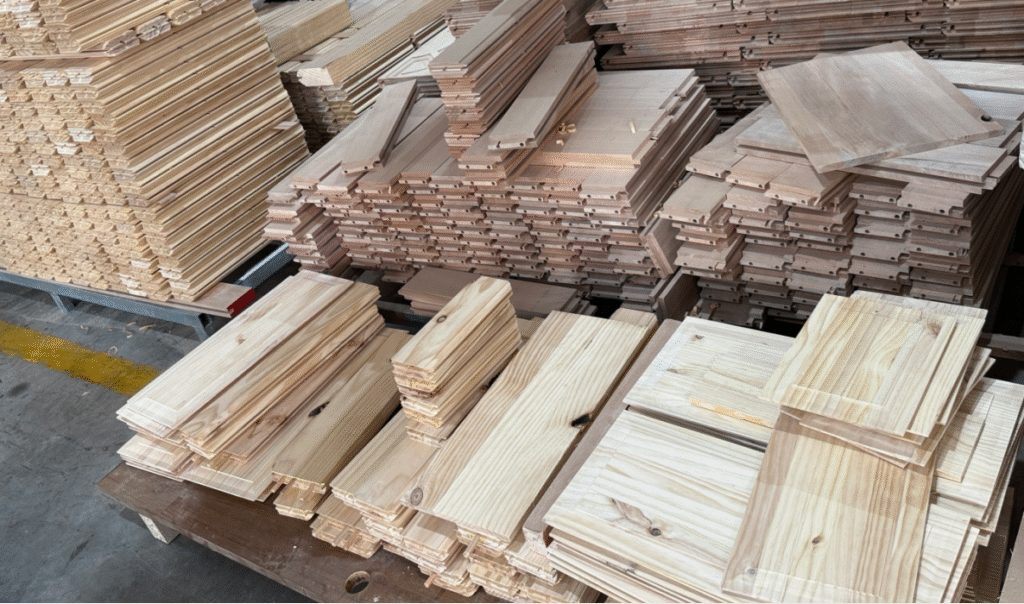
The manufacturing process generally involves:
- preparing the vertical stiles;
- preparing the horizontal rails;
- machining the required joints;
- producing or cutting the panels;
- assembling the components;
- pressing or clamping the assembly;
- sanding and calibrating the slab;
- completing hardware machining; and
- applying the required finish.
The exact sequence depends on the materials, joinery, panel design, and finish.
Solid-Core Construction
A typical core-and-face manufacturing process may involve:
- preparing the dense core;
- preparing the perimeter components and hardware reinforcement;
- preparing the molded or flat faces;
- applying the specified adhesive;
- assembling the layers;
- pressing the complete slab;
- trimming and calibrating the edges;
- machining the door for hardware; and
- applying the finish where required.
The distinction can be summarized as:
Stile-and-rail: components form the visible and structural panel assembly. Solid-core molded or flush: a dense core and perimeter structure are bonded beneath separate faces.
How Do Appearance and Finish Differ?
Stile-and-Rail Appearance
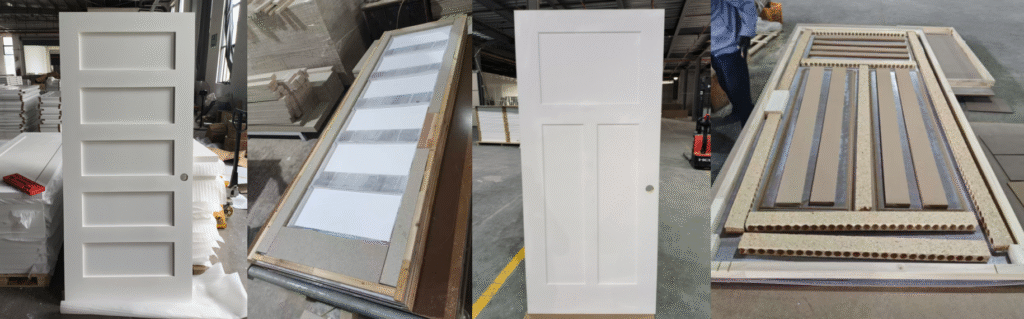
Stile-and-rail doors create their panel layout through assembled components.
This can produce:
- deeper panel recesses;
- stronger shadow lines;
- adjustable stile and rail proportions;
- flat or raised panels;
- different edge profiles;
- custom multi-panel arrangements; and
- painted, veneered, stained, or natural finishes.
A Shaker door can use stile-and-rail construction, but Shaker is a style rather than a construction category.
Solid-Core Door Appearance
The appearance of a solid-core door primarily comes from its face material.
A molded face can reproduce raised or recessed panel designs. A flush face can provide a smooth painted, veneered, laminated, or wrapped surface.
Solid-core construction therefore does not define one visual style. It describes the internal structure beneath the selected faces.
Stile-and-Rail vs. Solid-Core Door Comparison
| Factor | Stile-and-rail door | Solid-core molded or flush door |
|---|---|---|
| Primary classification | Assembly method | Internal core construction |
| Main structure | Separate stiles, rails, and panels | Dense core, perimeter components, and bonded faces |
| Visible design | Formed by assembled components | Formed by molded or flat faces |
| Common materials | Wood, MDF, LVL, engineered wood, veneer | Engineered core, MDF skins, veneer, laminate |
| Panel customization | Generally high | Depends on available molded skins or face designs |
| Natural wood finish | Available when suitable wood or veneer is specified | Available mainly through veneer or selected face materials |
| Sound-control potential | Depends on mass, materials, joints, gaps, and seals | Greater core mass can improve potential compared with hollow-core versions |
| Weight | Varies considerably | Usually heavier than comparable hollow-core doors |
| Hardware preparation | Depends on stile material and dimensions | Depends on edge construction and reinforcement |
| Production consistency | Depends on machining, materials, and assembly controls | Well suited to standardized core-and-face production |
| Typical cost direction | Often higher for custom materials and profiles | Often more predictable for standardized molded or flush products |
| Best fit | Design-focused and customized interiors | Repeated openings and performance-sensitive applications |
The table describes common tendencies, not universal performance ratings.
Pros and Cons of Each Door Type
Both door types can provide good durability and performance, but their advantages differ because of their construction.
Stile-and-Rail Doors
Pros
- More architectural depth and panel detailing
- High design and profile flexibility
- Suitable for painted or stained finishes
- Well suited to custom and higher-end interiors
Cons
- Typically more expensive
- More complex manufacturing process
- Natural wood components may respond to changes in humidity and temperature
Solid Core Doors
Pros
- Good durability and impact resistance
- Better sound control than typical hollow-core doors
- Consistent construction for larger project quantities
- Available in both molded and flush designs
Cons
- Heavier to handle and install
- Typically costs more than hollow-core doors
- Molded solid-core options generally offer less customization than stile-and-rail construction
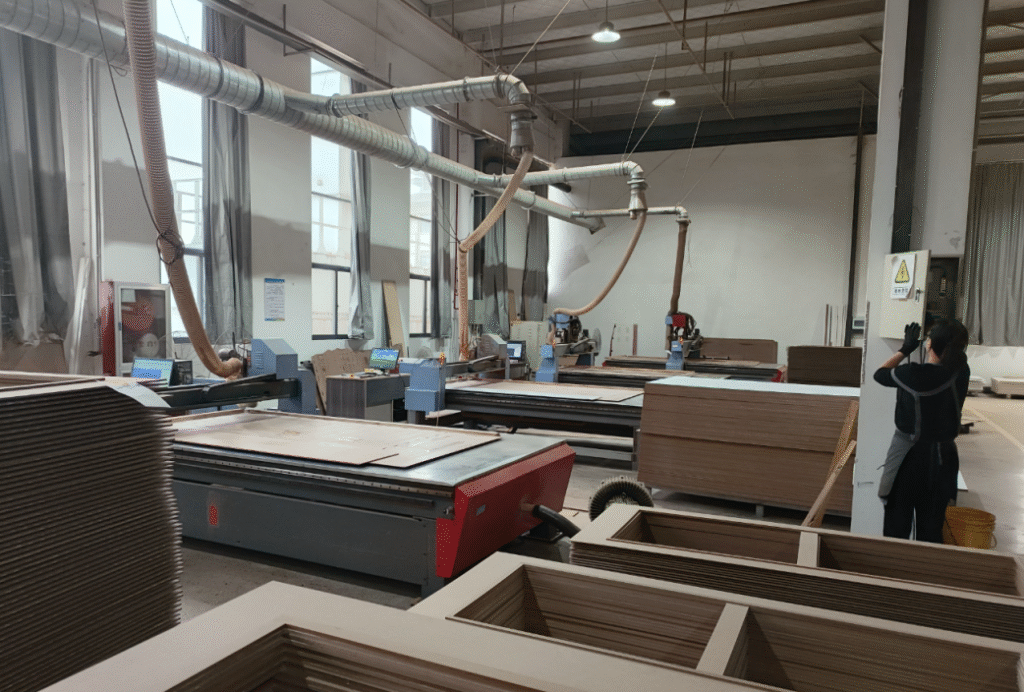
Performance Comparison: Stile and Rail vs Solid Core Doors
The performance of either door type depends on its specific materials and construction. The table below shows their typical characteristics rather than absolute performance ratings.
| Feature | Stile-and-Rail Doors | Solid Core Doors |
|---|---|---|
| Appearance | More architectural depth and authentic panel detailing | Consistent molded or flush appearance |
| Sound Control | Varies by materials and construction | Generally good due to the dense core |
| Durability | Good; depends heavily on component materials and joinery | Good impact resistance and solid feel |
| Stability | Depends on material, construction, and environment | Generally consistent with engineered core construction |
| Crack / Movement Resistance | Individual components may expand or contract with environmental changes | Less dependent on individual wood components |
| Weight | Varies by materials and construction | Typically heavier |
| Customization | High; panel layouts and profiles can be customized | More limited, especially for molded designs |
| Cost | Typically higher for detailed or custom construction | Typically more economical than comparable custom stile-and-rail doors |
| Production Consistency | More dependent on machining and assembly | Well suited to consistent, repeat production |
Which Construction Fits Different Projects?
Production and Multifamily Housing
For production builders and multifamily housing projects, solid-core molded or flush doors can be practical when the project requires:
– repeated sizes and designs;
– consistent factory construction;
– greater mass than hollow-core alternatives;
– predictable finishes;
– scalable production; and
– controlled specifications across many openings.
Not every opening requires solid core. The core should still be selected according to room function and the complete door schedule.
Hospitality and Office Projects
Solid-core doors are often considered where privacy, durability, and a more substantial operating feel are priorities.
If an acoustic, fire, or other performance rating is required, the project should specify and verify the complete tested assembly.
Custom and Design-Focused Homes
Stile-and-rail construction is useful where the project prioritizes:
- custom panel proportions;
- deeper architectural detailing;
- selected wood or veneer;
- specific profiles;
- stain-grade finishes; and
- close coordination with cabinets and millwork.
Mixed-Specification Projects
A project can use more than one construction.
For example:
- stile-and-rail doors in primary living areas;
- solid-core molded doors for bedrooms;
- solid-core flush doors for offices; and
- hollow-core molded doors for selected closets.
A room-by-room schedule can control cost while directing higher specifications to the openings where they provide the most value.
What Should Buyers Compare in Door Submittals?
Complete construction
Confirm:
- construction method;
- stile and rail materials;
- face or skin material;
- panel material;
- core material and density;
- edge construction;
- reinforcement;
- slab thickness; and
- finished weight.
Dimensions and limitations
Confirm:
- available widths and heights;
- slab thickness;
- maximum permitted trimming;
- hinge and lock locations;
- stile widths;
- panel dimensions; and
- oversized-door limitations.
Finish
Confirm:
- painted, primed, stained, veneered, laminated, or wrapped finish;
- approved color and sheen;
- edge finishing;
- acceptable natural variation;
- sample approval; and
- touch-up requirements.
Hardware
Confirm:
- hinge type, dimensions, quantity, and location;
- lock type and backset;
- latch and strike preparation;
- closer or access-control preparation;
- reinforcement;
- hardware templates; and
- total door weight.
Performance evidence
If the specification requires acoustic, fire, impact, or other performance, confirm:
- tested rating;
- applicable standard;
- laboratory or certification documentation;
- compatible frame;
- compatible hardware;
- seals and glazing;
- labeling; and
- installation requirements.
Project logistics
Compare:
- unit cost;
- finishing requirements;
- factory machining;
- shipping weight;
- packaging;
- site handling;
- frame and hardware requirements;
- installation labor; and
- potential field modifications.
The lowest slab price does not always produce the lowest installed cost.
How to Compare Stile-and-Rail and Solid-Core Door Submittals
Confirm What “Solid Core” Means
Check what core material and construction are actually specified. The term solid core can cover different engineered core materials and door constructions, so the detailed product specification matters.
Compare Like-for-Like Specifications
Compare doors with the same size, thickness, face material, finish, performance requirements, and frame conditions. This helps avoid comparing two products that may look similar on a schedule but are built for different requirements.
Check Hardware Preparation and Product Limitations
Confirm hinge preparation, lock machining, door thickness, available sizes, and other hardware requirements. Also check any limitations related to machining, trimming, finishes, or special applications before approving the product.
Compare Total Installed Cost, Not Door Price Alone
Door price alone does not reflect the full project cost. Builders should also consider hardware preparation, finishing, installation labor, handling, and potential field modifications. A lower-priced door may not always result in a lower installed cost if it requires additional work on site.
FAQ
Can a Stile-and-Rail Door Be Solid Core?
Yes. Stile-and-rail describes how the door is constructed, while solid core describes its internal material or structure. The two terms are not mutually exclusive.
Are All Solid-Core Doors Molded?
No. Solid-core doors can be molded or flush. Molded doors use profiled door skins, while flush doors typically use flat surfaces such as veneer, laminate, or smooth skins.
Is Solid Core the Same as Solid Wood?
No. Solid core usually refers to a door with a dense engineered or composite core, while solid wood means the structural components are made from natural wood.
Which Construction Provides Better Sound Control?
Solid-core doors generally provide good sound control because of their greater mass and dense core. However, actual acoustic performance also depends on the complete door assembly, gaps, seals, and installation.
Which Door Is Stronger or More Durable?
Both can be durable. Performance depends on the materials, construction quality, hardware preparation, and application.
When Should Builders Specify Solid-Core Bedroom Doors?
Solid-core bedroom doors are useful when a project requires better privacy, sound control, durability, or a more substantial door feel than a typical hollow-core door.
Which Construction Fits Multifamily or Custom Homes?
For multifamily projects, solid-core doors are often practical where repeatability, durability, and sound control are priorities. For custom homes, stile-and-rail doors are commonly selected when architectural detailing, wood appearance, and design flexibility are more important.
Summary
tile-and-rail and solid-core doors should not be treated as exact opposites.
Stile-and-rail describes an assembly method using vertical stiles, horizontal rails, and panels. Solid-core normally describes a dense internal core beneath molded or flat faces.
Stile-and-rail construction can provide greater flexibility in panel layouts, proportions, materials, and architectural detailing. Solid-core molded and flush doors can provide consistent production, additional mass, and a wide range of standardized surface options.
Neither category automatically establishes material quality, durability, acoustic performance, or fire resistance. Buyers should compare the complete door construction, materials, core, faces, edges, hardware reinforcement, finish, tested performance, shipping, and installed cost.
To compare available molded, Shaker, stile-and-rail, flush, hollow-core, and solid-core configurations, explore UWG’s interior door options.