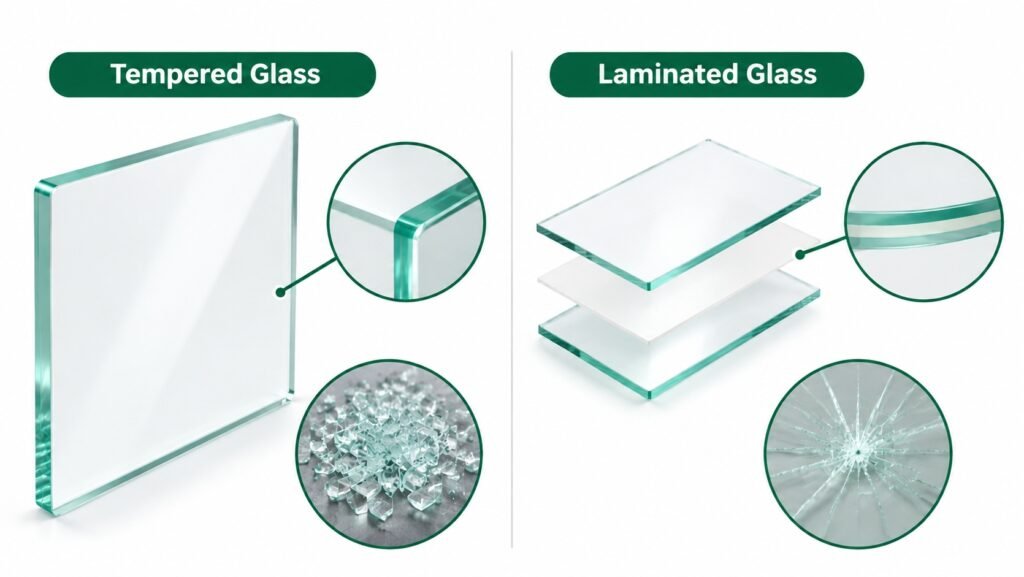
For interior doors, the key difference between tempered and laminated glass is how they behave when broken. Monolithic tempered glass breaks into small fragments, while laminated glass uses an interlayer to help retain broken pieces. Laminated units can also contain tempered glass plies.
This guide compares monolithic fully tempered glass with specified laminated constructions. It explains when to evaluate each option and what builders need to confirm about safety, weight, fabrication, and the complete door assembly.
What Are Tempered Glass and Laminated Glass?
What Is Tempered Glass?
Fully tempered glass is made by heating annealed glass and rapidly cooling its surfaces. This creates surface compression and internal tension, increasing its strength compared with ordinary annealed glass.
For comparable thickness and configuration, fully tempered glass is commonly described as approximately four times stronger than annealed glass. This is a general material comparison, rather than an impact rating for a particular door.
All conventional cutting, drilling, notching, and edge finishing must be completed before tempering. Once fully tempered, the glass cannot be conventionally modified without risking breakage.
What Is Laminated Glass?
Laminated glass consists of two or more glass plies bonded with one or more plastic interlayers. Polyvinyl butyral (PVB) is a common interlayer material. The plies and interlayer are bonded through a controlled manufacturing process involving heat and pressure.
When the glass cracks, the interlayer helps retain fragments. This is useful where keeping broken glass together is an explicit project objective.
Can Laminated Glass Also Be Tempered?
Yes. Tempering describes the heat treatment of an individual glass ply; lamination describes bonding multiple plies with an interlayer. A laminated unit may contain annealed, heat-strengthened, fully tempered, or differently treated plies.
For example, two fully tempered glass plies bonded with PVB form tempered laminated glass. Specify the treatment of each ply and the interlayer so the supplier can identify the actual construction.
What Happens When the Glass Breaks?
Monolithic fully tempered glass fractures into numerous small pieces, reducing the risk associated with large, sharp shards from ordinary annealed glass. The fragments can still cause cuts, and the panel may break apart and fall out of the opening.
In laminated glass, the interlayer helps hold cracked fragments together. The damaged panel may remain partly or substantially in the opening, depending on its construction, impact conditions, and support. Fragment retention does not guarantee that the panel remains securely supported or safe for continued use.
The practical distinction is simple: tempered glass manages the size of broken fragments; laminated glass helps retain them.
Tempered vs. Laminated Glass: Key Differences Compared
The table compares monolithic fully tempered glass with a specified laminated unit. The laminated option may itself use heat-treated plies.
| Comparison Factor | Monolithic Fully Tempered Glass | Specified Laminated Glass |
|---|---|---|
| Construction | One fully tempered pane | Two or more glass plies bonded with an interlayer |
| Breakage | Numerous small fragments | Plies crack; interlayer helps retain fragments |
| Fragment Retention | No interlayer to hold fragments together | Interlayer helps keep broken pieces attached |
| Remaining in the Opening | Panel may fall out | Depends on build-up, impact, and support |
| Ply Treatment | Fully tempered | Annealed, heat-strengthened, tempered, or combined |
| Fabrication | Conventional cutting and drilling before tempering | Sequence depends on ply treatment and interlayer |
| Weight | Glass area and thickness | Combined glass thickness, interlayer, and components |
| Cost Factors | Glass, heat treatment, and finishing | Glass treatments, interlayer, lamination, and finishing |
When Should Builders Prioritize Each Glass Type?
- Consider monolithic tempered glass first when human-impact safety is required, there is no separate fragment-retention objective, and the proposed product meets the applicable requirements. It can be a practical starting point when comparing tempered glass doors for ordinary interior use.
- Prioritize evaluating laminated glass doors when retaining broken fragments and reducing loose glass falling from the opening are explicit objectives. Evaluate the glass and supporting system together.
- Specify tested security glazing when the project requires resistance to forced entry or another defined threat. A human-impact safety rating does not establish forced-entry, ballistic, or other security performance.
When a specification calls for impact resistant glass, identify the impact type and required test. Safety glass for doors addresses a different objective from a system designed for a particular security threat.
Glass Thickness, Weight and Cost
Glass weight mainly follows glazed area and the combined thickness of the glass plies. The interlayer adds weight; frames, glazing components, and hardware contribute to the complete door weight.
For the same glass type, area, and combined glass thickness, the glass portions have broadly similar weights. For example, one 6 mm pane and two 3 mm plies contain the same nominal total glass thickness. The laminated unit also contains an interlayer. This is a weight comparison, not a recommended door glass thickness or a statement that the two constructions are interchangeable.
Cost depends on dimensions, individual ply thicknesses, heat treatment, interlayer, edge finishing, holes, cutouts, quantity, and supply conditions. Lamination adds materials and bonding processes. Compare supplier quotations against defined requirements rather than assuming a fixed price difference.
There is no universal thickness for every interior door. Use the approved design, glass build-up, support, hardware, and applicable safety requirements to establish the specification.
How Should Builders Specify Glass for Interior Doors?
A useful glass door specification identifies the safety objective, glass build-up, final dimensions, support, and hardware before production.

Safety-Glazing Requirements and Product Documentation
In the United States, 16 CFR Part 1201 applies to glazing in specified architectural products, including doors, subject to its scope and exceptions. Section 1201.4 currently references ANSI Z97.1-2015 test provisions.
ANSI Z97.1-2026 has been published. In its August 31, 2026 notice, SGCC said it was evaluating the new edition and instructed participants to retain existing certification labels pending formal adoption instructions. A new edition’s publication does not itself change the federal reference or certification labels. Confirm the applicable requirements and any later implementation notices for the project.
Request documentation matching the supplied construction:
- Treatment and thickness of each glass ply, plus the interlayer where applicable.
- Applicable standard, edition, and test classification or category.
- Manufacturer or fabricator identification.
- Required permanent markings and traceability.
- Supporting test reports, certificates, and compliance records as applicable.
Determine the required category from the application and applicable code; do not assign one category to every interior door. Human-impact compliance alone does not establish security performance.
Glass Build-Up, Frames, and Hardware Compatibility
1. Glass Build-Up and Dimensions
Specify the number of plies, individual thicknesses, heat treatment, interlayer material and thickness, and overall unit thickness.
Approved drawings should distinguish the rough opening, finished door opening, final glass cut size, and installation clearances. Confirm who determines and approves the glass dimensions before fabrication.
2. Edge Finishing, Holes and Cutouts
Identify polished edges, holes, notches, and cutouts from approved hardware drawings and the fabricator’s requirements. Fully tempered glass must be cut and drilled before tempering.
Annealed laminated glass may permit certain factory processing operations. For heat-treated plies, dimensional fabrication and openings generally need to be completed before heat treatment and subsequent lamination. Confirm the sequence with the fabricator rather than assuming every laminated unit can be modified after production.
3. Door Construction and Glass Support
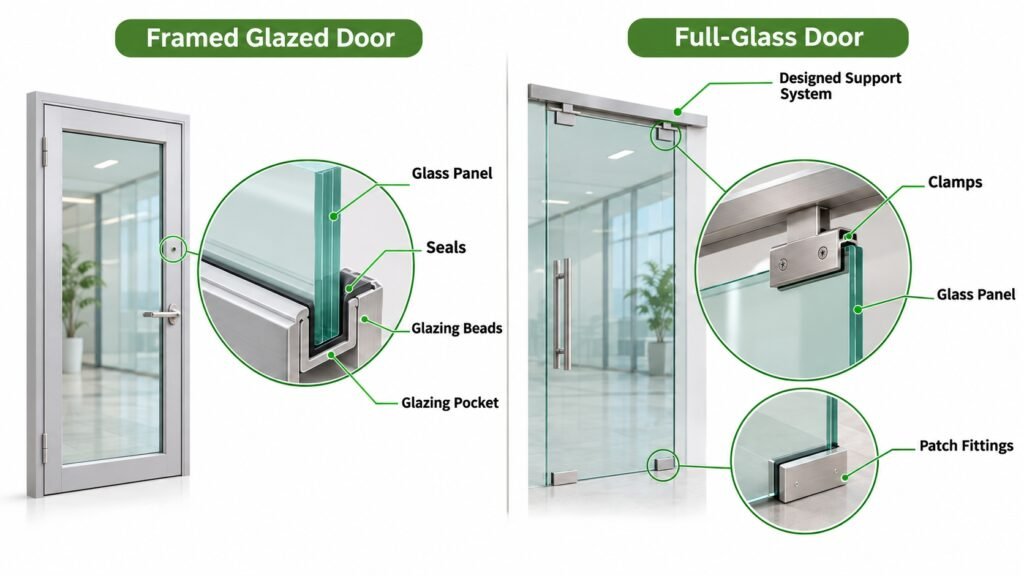
- Framed glazed door leaves: Glass sits in a glazing pocket within the leaf and is secured by suitable beads, seals, or retaining components.
- Full-glass doors: Glass uses compatible clamps, patch fittings, or another designed support system.
Glass thickness, edge preparation, support points, and fittings must match the approved door design. These support arrangements are not interchangeable.
4. Hardware Compatibility
For hinged doors, verify hinge capacity, quantity, fixing positions, and complete door weight. For sliding doors, check the track, rollers, and mounting system. Select hardware for the actual construction and assembly weight, not thickness alone.
Specification Checklist for Builders
| Specification | Items to Confirm |
|---|---|
| Glass Type | Monolithic tempered, laminated, or tempered laminated |
| Glass Build-Up | Ply count, treatment, and individual thicknesses |
| Interlayer | Material and thickness where applicable |
| Overall Thickness | Combined glass thickness plus interlayer thickness |
| Final Dimensions | Glass cut size and installation clearances |
| Approved Drawings | Opening dimensions, glass dimensions, and sizing responsibility |
| Edge Processing | Edges, holes, notches, and cutouts matched to hardware drawings |
| Door Construction | Glazing pocket or designed full-glass support |
| Hardware | Hinges, tracks, rollers, fixings, and complete weight compatibility |
| Safety Documentation | Standard, edition, classification, test evidence, and markings |
| Traceability | Manufacturer or fabricator identity and product records |
Use the same approved specification when coordinating the door manufacturer, glass supplier, and hardware supplier.
FAQ
When Should Builders Choose Tempered Laminated Glass Instead of Monolithic Tempered Glass?
Evaluate tempered laminated glass when the project requires both heat-treated glass plies and fragment retention. Confirm the ply thicknesses, interlayer, support, and test evidence for the proposed construction. The combination alone does not establish a security rating or safe continued use after damage.
Does Laminated Glass Always Contain Tempered Glass?
No. Laminated glass can use annealed, heat-strengthened, or fully tempered glass plies. Lamination describes how multiple glass plies are bonded with an interlayer, while tempering describes the heat treatment of an individual glass ply. The actual construction depends on the specified safety and performance requirements.
Does Laminated Glass Stay in Place After Breaking?
The interlayer helps hold broken glass fragments together, so a laminated panel may remain partly or substantially in the door opening after breakage. However, this depends on the glass construction, impact conditions, and support system. Fragment retention does not guarantee that the damaged panel remains securely supported or safe for continued use.
Can Tempered Glass Be Cut or Drilled After Manufacturing?
No. Conventional cutting, drilling, notching, and edge finishing must be completed before tempering. Once fully tempered, glass cannot be conventionally modified without risking breakage. For laminated glass, fabrication requirements depend on the treatment of each ply and the manufacturing sequence, so dimensions and hardware openings should be confirmed before production.
Does Safety Glass Automatically Provide Security Protection?
No. Safety glazing designed to reduce human-impact injury does not automatically provide resistance to forced entry, ballistic impact, or other security threats. If a project requires security protection, specify glazing that has been tested and rated for the particular threat rather than relying solely on a general safety-glass classification.
Conclusion
Monolithic tempered glass breaks into small pieces; laminated glass helps retain broken fragments and may itself use tempered plies. Select the construction around the required safety objective, then confirm dimensions, fabrication, support, hardware, and matching product documentation before production.