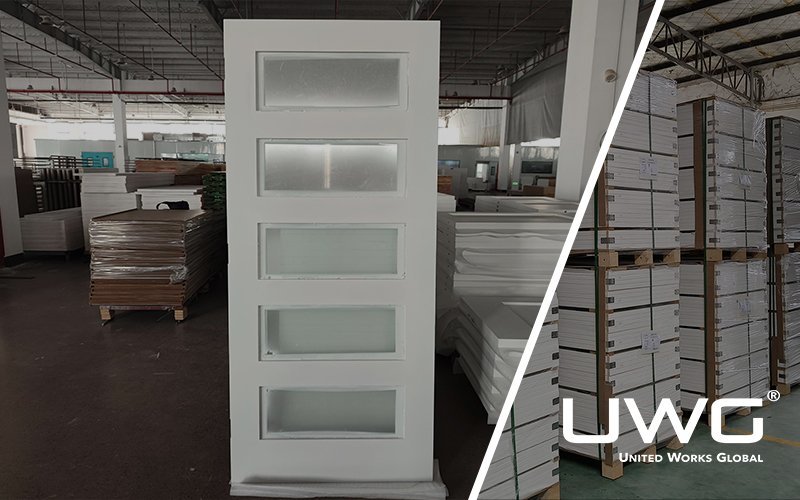
Glass can change how an interior door handles privacy, borrowed light, visual connection, and everyday maintenance. For builders and wholesalers, it also affects how the door should be specified, approved, and prepared for production.
The main types of glass for interior doors include clear, frosted, acid-etched, sandblasted, reeded, fluted, tinted, and patterned glass. Clear glass provides the greatest visibility, while frosted glass increases visual privacy by diffusing the view. Reeded and fluted glass use linear textures to distort visibility while allowing light through. The right option depends on room function, privacy, interior glass door design, maintenance, and applicable safety-glazing requirements.
Quick Comparison of Types of Glass for Interior Doors
The table below compares the practical differences builders and wholesalers should consider when selecting interior door glass.
| Glass Type | Privacy | Light | Main Advantage | Limitation | Common Applications |
|---|---|---|---|---|---|
| Clear | Low | High | Maximum visual connection | Limited privacy | Offices, living areas, French doors |
| Frosted | High | Good | Balances privacy and light | Reduced visual connection | Bathrooms, bedrooms, offices |
| Acid-Etched | High | Good | Consistent matte appearance | Surface requires appropriate care | Offices, bathrooms |
| Sandblasted | High | Good | Customizable matte effect | Textured surface may require more cleaning | Offices, feature doors |
| Reeded | Medium | Good | Texture with partial visual screening | Does not provide complete privacy | Pantries, offices, living areas |
| Fluted | Medium | Good | Distinct linear design effect | Pattern definitions vary by supplier | Modern residential interiors |
| Tinted | Varies | Moderate | Contemporary color and appearance | Reduces light compared with clear glass | Offices, modern interiors |
Privacy and light levels are general comparisons rather than fixed performance ratings. Actual results vary with the specific glass pattern, texture, thickness, viewing distance, angle, and lighting conditions.
What Are the Different Types of Glass for Interior Doors?
Clear Glass
Clear glass has little or no decorative surface treatment, giving it the highest visual clarity among common interior door glass options.
It works well when a door needs to separate two rooms without visually closing them off. Typical applications include home offices, living and dining spaces, and interior French doors. Its main trade-off is limited privacy.
Frosted, Acid-Etched and Sandblasted Glass
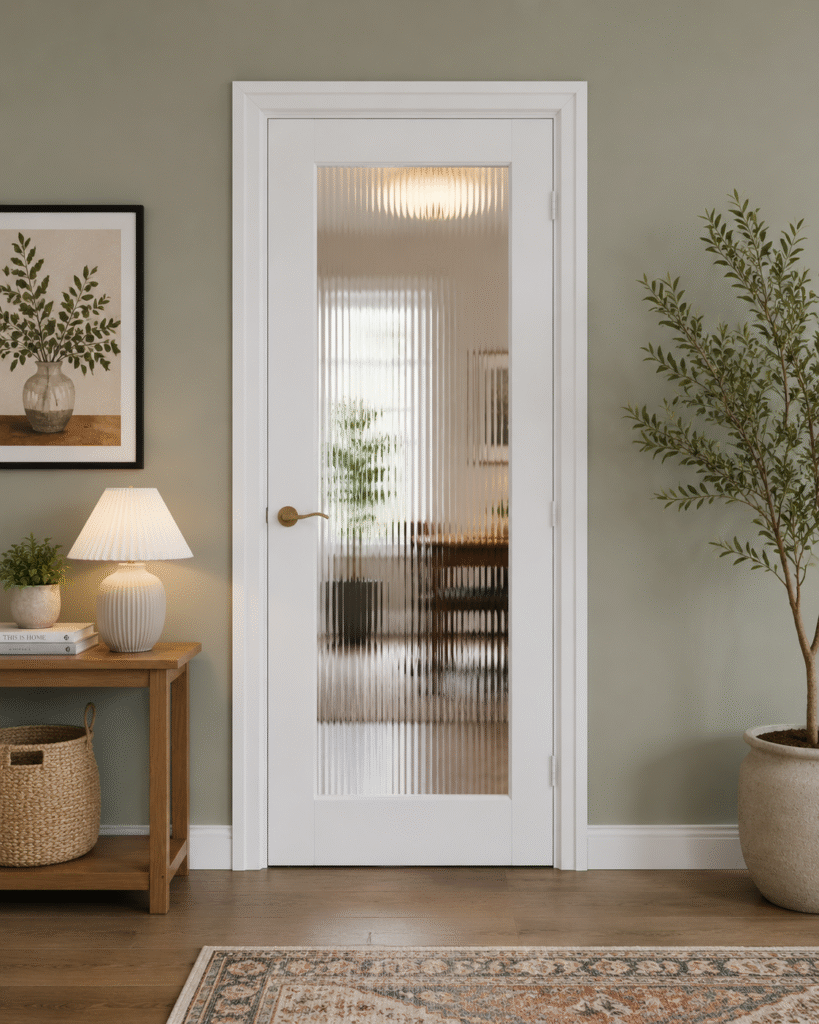
Frosted, acid-etched, and sandblasted glass are often grouped together because they create similar translucent appearances, but the terms do not necessarily describe the same manufacturing process.
Acid etching chemically alters the glass surface, while sandblasting mechanically abrades it. “Frosted” is often used more broadly to describe the resulting privacy-oriented matte appearance.
These surfaces scatter incoming light in different directions. This reduces the clarity of objects viewed through the glass while still allowing light to enter the adjoining space.
For project specifications, builders should confirm the actual finish rather than relying on the word “frosted” alone.
Reeded Glass
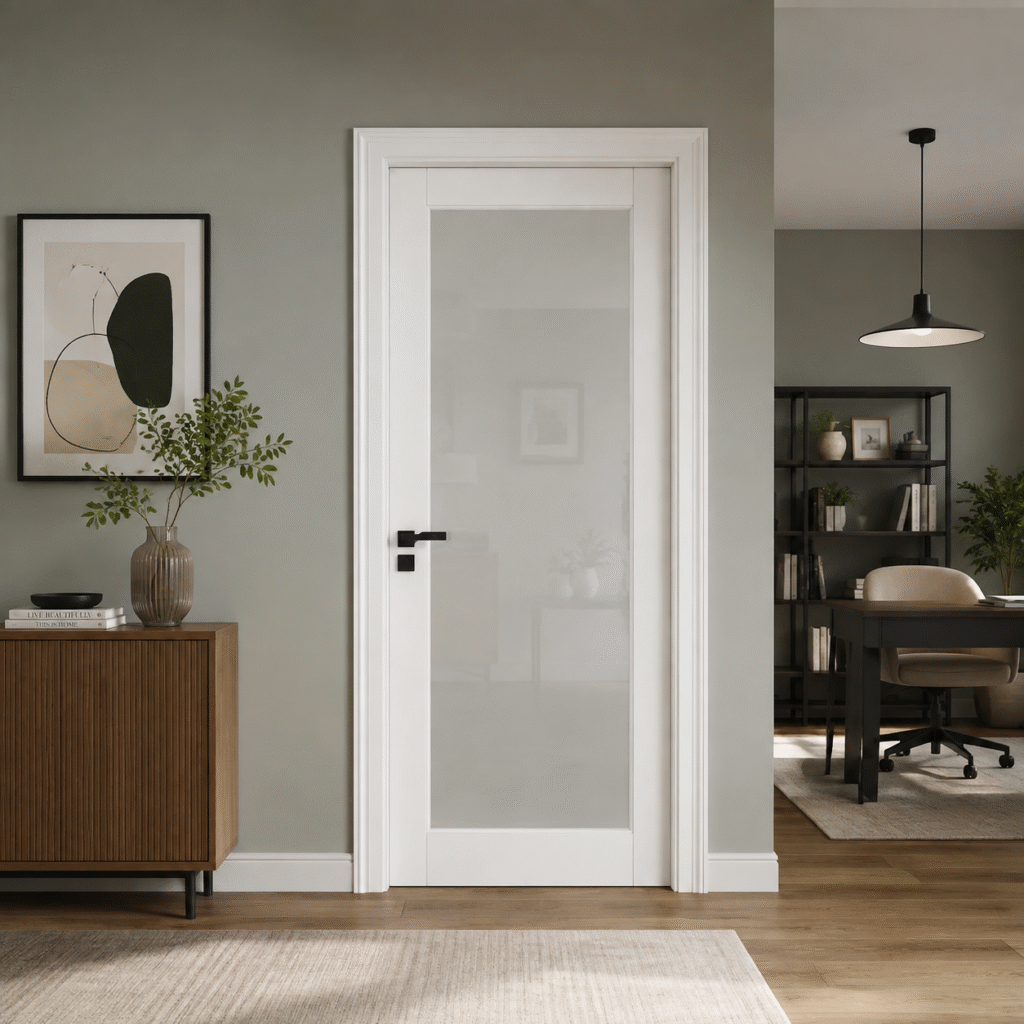
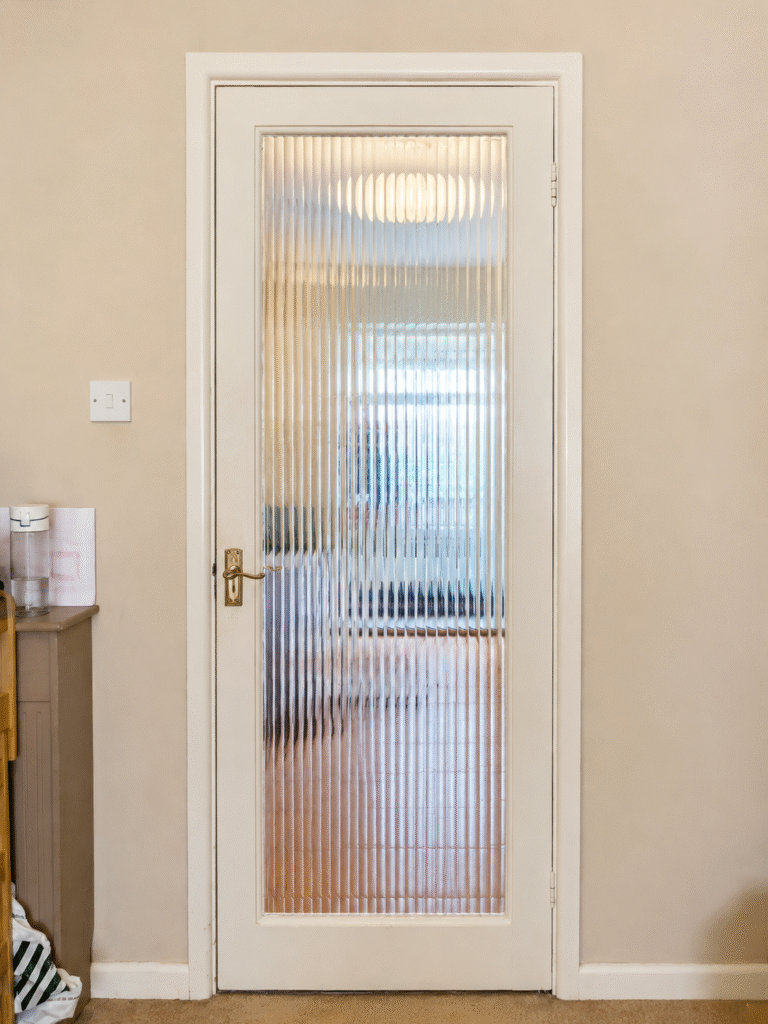
Reeded glass has repeated linear ribs across its surface. Unlike a matte finish, the physical texture changes how light and images pass through the panel, making objects behind it appear distorted.
This combination of light transmission, partial visual screening, and texture makes reeded glass popular for modern interior glass doors, including pantry doors, home offices, and decorative room dividers.
Fluted Glass
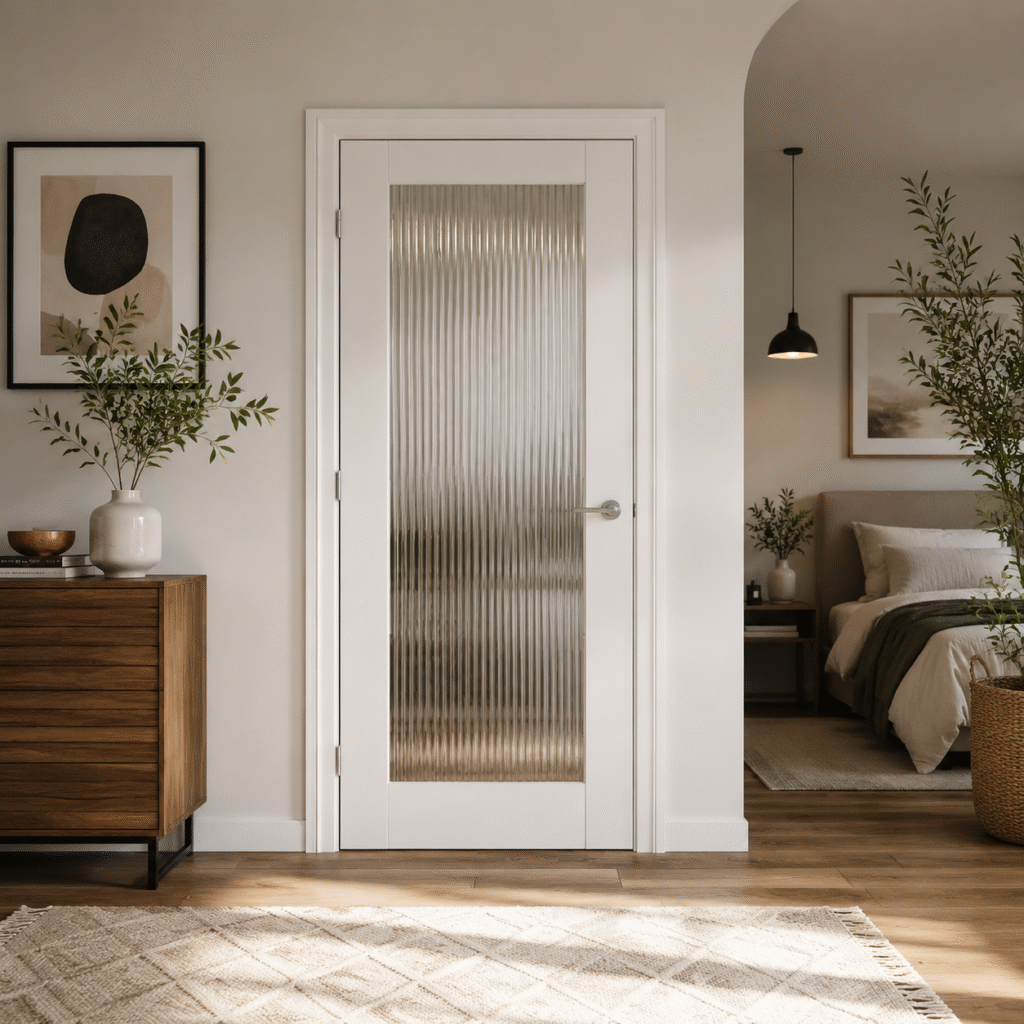
Fluted glass also uses a repeated linear texture to distort the view through the panel. Its visual effect can range from subtle to pronounced depending on the width, depth, and spacing of the pattern.
One important purchasing detail is that reeded and fluted are not always defined consistently between glass manufacturers. Two suppliers may use similar terminology for visibly different patterns.
For this reason, the actual pattern matters more than the product name when preparing a project specification.
Other Patterned, Tinted and Decorative Glass
Patterned glass uses geometric, irregular, or decorative textures to control visibility and create a specific visual effect. Tinted glass introduces color, such as gray or bronze, and can give the door a darker, more contemporary appearance.
These options are particularly useful when the glass is intended to become a visible part of the interior glass door design rather than simply an infill panel.
How Interior Door Glass Affects Privacy, Light, and Performance
Privacy and Visual Clarity
Glass privacy is not simply a choice between transparent and opaque.
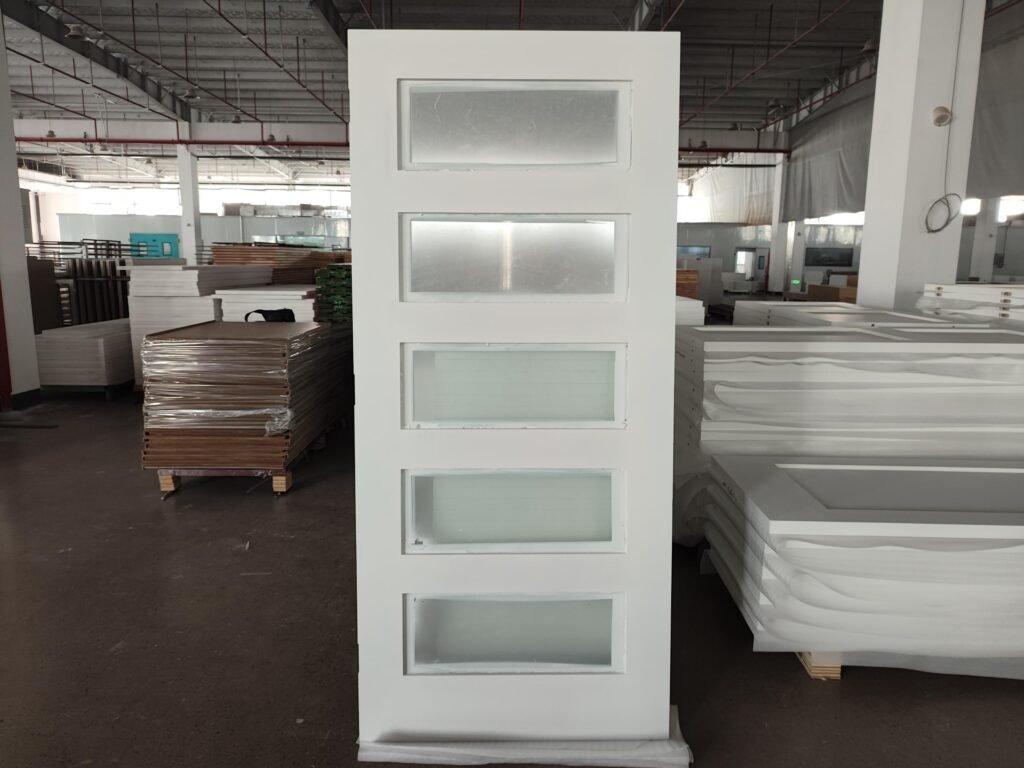
A textured or frosted panel may obscure facial details while still revealing movement or silhouettes. Viewing distance, angle, pattern density, and lighting on both sides of the door can all affect what is visible.
For privacy-sensitive applications, the actual glass should therefore be evaluated rather than assuming a category name guarantees a particular privacy level.
Light Transmission
One of the main reasons to use interior glass doors is to bring borrowed light into adjacent rooms.
Clear glass maintains the strongest visual connection. Frosted glass scatters light, while reeded and fluted surfaces refract and distort the view through their physical patterns. This allows builders to maintain some light connection while changing how clearly the adjoining space can be seen.
Glass Texture and Surface Treatment
The manufacturing method helps explain why different glass types behave differently.
Matte surfaces such as acid-etched or sandblasted glass scatter incoming light, reducing image clarity. Reeded and fluted glass work differently: their physical ribs change the path of light passing through the panel, visually stretching or distorting objects behind it.
Texture direction is also important. When several matching doors are installed together, inconsistent rib orientation can create an obvious difference in the finished project.
Safety and Durability
Decorative appearance and safety construction should be treated as separate specifications.
A panel can be clear and tempered, frosted and tempered, or use another decorative finish together with an appropriate safety-glazing construction. Choosing a decorative glass type does not by itself define its safety performance.
Which Types of Glass Work Best for Interior Doors by Room?
Room function is a practical starting point for glass selection.
Bathrooms and bedrooms generally place greater emphasis on visual privacy, making frosted or suitable patterned glass more practical. Home offices can use clear glass when openness is important or frosted and reeded options when more separation is preferred.
Reeded and fluted glass are frequently considered for pantry and feature doors because they partially screen what is behind the door while adding a decorative element. Clear glass works well between living and dining areas where maintaining light and visual connection is the priority.
These are common applications rather than fixed rules. The final specification should reflect the actual privacy and design requirements of the project.
How to Choose Glass for Modern Interior Glass Doors
Match Glass Type to Privacy Requirements
Start by determining what occupants should be able to see through each opening.
A bathroom, office, pantry, and living room may all use the same door dimensions but require very different levels of privacy. Selecting glass by room function prevents the door schedule from treating visually different requirements as identical openings.
Match Glass to Interior Glass Door Design
Glass should be selected together with the door design.
Clear glass works naturally with many French and minimalist doors, while reeded and fluted textures are frequently paired with contemporary and transitional designs. The size and proportion of the glass opening also affect how strongly a pattern appears.
A narrow lite and a large glass panel can therefore look quite different even when the same glass is specified.
Different glass options can be paired with different door styles and opening systems. To compare available configurations, explore our full range of interior doors.
Consider Cleaning and Maintenance
Smooth glass surfaces are generally straightforward to clean, although clear glass makes fingerprints more noticeable.
Textured glass can visually conceal fingerprints but may require additional attention around grooves or textured surfaces. This becomes more relevant on frequently handled doors in multifamily, hospitality, or other high-use projects.
How Builders Should Choose Glass for Interior Door Projects
Balance Borrowed Light and Visual Privacy
Based on the residential door schedules we review, we normally start with room function rather than assigning one glass type to every glazed opening.
An office may need borrowed light but not complete visual openness. A pantry may benefit from partial screening, while a living area may prioritize maximum visual connection.
Reviewing these requirements room by room helps builders avoid unnecessary upgrades while still placing privacy-oriented glass where it provides real value.
Match the Glass to the Room and Door System
The glass also needs to work with the complete door construction.
Door design, glass-opening dimensions, glass thickness, hardware, and fabrication requirements can affect which options are practical. This becomes particularly important on repeated-unit projects, where one unresolved specification can be duplicated across dozens of doors.
What Builders Should Confirm Before Ordering Interior Glass Doors
For project quotations, we do not recommend treating terms such as “reeded” or “fluted” as complete specifications because pattern names are not always standardized between suppliers.
For decorative glass, confirming the glass sample or pattern code, rib spacing, texture direction, thickness, safety treatment, dimensions, and door design gives the builder and manufacturer a common reference before production.
From our project experience, this is especially useful on repeated door packages. A small difference in pattern or orientation that seems minor during quotation can become very noticeable when multiple doors are installed next to each other.
When glass patterns, dimensions, safety requirements, and door specifications need to remain consistent across multiple openings, coordination becomes especially important. Our Turnkey Solutions help builders manage specifications, samples, drawings, production, and delivery through one streamlined project process.
Safety Glass and Specification Checks for U.S. Interior Door Projects
For U.S. projects, selecting clear, frosted, reeded, or fluted glass is only one part of the specification. Builders also need to determine whether the glazing is located where safety glazing is required.
The U.S. Consumer Product Safety Commission’s mandatory safety standard for architectural glazing materials covers glazing used in both exterior and interior doors. The International Residential Code (IRC) also addresses hazardous glazing locations. Under IRC Section R308.4.1, glazing in fixed and operable panels of swinging, sliding, and bifold doors is identified as a hazardous location, subject to specified exceptions.
Builders should verify the applicable code edition, local amendments, approved project documents, and specific door configuration rather than assuming the same requirement applies to every project.
Tempered and Laminated Are Safety Constructions, Not Decorative Styles
Clear, frosted, reeded, and fluted primarily describe the appearance or surface characteristics of glass. Tempered and laminated describe different safety treatments or constructions.
These specifications can therefore exist together. Depending on product availability and project requirements, an interior door might use clear tempered glass, frosted tempered glass, or another decorative glass manufactured to meet the required safety standard.
For additional reference, see the CPSC Mandatory Safety Standard for Architectural Glazing Materials and the ICC residential glazing requirements.
Confirm Thickness, Edges, Holes and Hardware Before Fabrication
Glass thickness, dimensions, edge treatment, holes, cutouts, and hardware preparation should be confirmed before fabrication.
This is particularly important with tempered glass because cutting, drilling, and similar fabrication generally need to be completed before tempering. If dimensions or hardware locations change later, replacement glass may be required instead of a simple jobsite modification.
For builders and wholesalers ordering repeated door types, confirming these details before production reduces the risk of one specification error being repeated across multiple openings.
FAQ
Which Type of Glass Is Best for Privacy?
Frosted, acid-etched, and some patterned glass generally provide greater visual privacy than clear glass. The best option depends on how much visibility is acceptable and how much borrowed light the room needs.
Does Frosted Glass Provide Complete Privacy?
Not necessarily. Silhouettes or movement may remain visible depending on the glass treatment, viewing distance, angle, and lighting conditions. Privacy-sensitive applications should be evaluated using the actual glass specification.
What Is the Difference Between Reeded and Fluted Glass?
Both use linear textures to distort visibility and create a decorative effect. However, pattern dimensions and terminology can vary between suppliers. For project orders, the pattern or sample is more reliable than the name alone.
Does Interior Door Glass Need to Be Tempered?
It depends on the glazing location, door configuration, applicable code, and project requirements. U.S. projects should be checked against the applicable safety-glazing requirements before production.
Can Clear, Frosted, Reeded, and Fluted Glass Be Tempered?
Potentially, yes. Decorative appearance and safety treatment are separate characteristics. Availability depends on the specific glass product and manufacturing process.
Which Interior Door Glass Is Easiest to Maintain?
Smooth glass is generally easier to wipe clean, although clear glass shows fingerprints more readily. Deeply textured glass may hide fingerprints visually but can require more attention when cleaning the textured surface.
Summary
The main types of glass for interior doors include clear, frosted, acid-etched, sandblasted, reeded, fluted, tinted, and patterned glass. Clear glass provides the strongest visual connection, frosted and matte finishes increase privacy by scattering light, while reeded and fluted glass use physical texture to distort the view while retaining useful borrowed light.
For builders and wholesalers, the best glass is determined by more than appearance. Room function, privacy, light, glass texture, maintenance, door design, safety treatment, and fabrication requirements all affect the final specification. On decorative glass projects, confirming the actual pattern, sample, texture direction, and safety requirements before production helps ensure that the quoted product, approved design, and installed doors match.