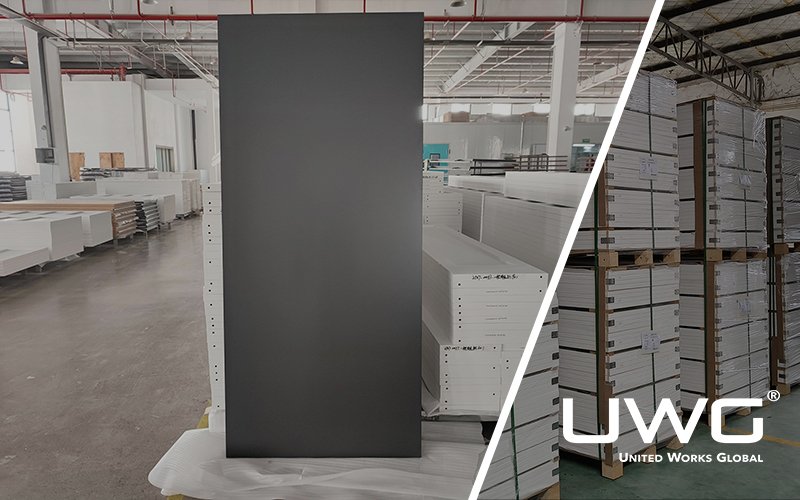
The main interior door material categories are solid wood, engineered wood, MDF/HDF, molded composite, glass, PVC/WPC, and metal. However, most modern doors combine several materials in their skins, cores, stiles, rails, glazing, and frame.
Buyers should therefore compare the complete construction—not just the material name—when evaluating finish, durability, moisture resistance, sound control, hardware preparation, and cost.
For example, two molded doors may have the same MDF skins, panel design, dimensions, and external finish while using different internal cores. A hollow-core version may use a lightweight honeycomb structure, while a solid-core version uses a denser filling material. The two doors can look nearly identical after installation, but their weight, acoustic performance, impact resistance, handling requirements, and cost can be significantly different. For project buyers, the core specification is therefore just as important as the visible door design.This guide compares the main interior door materials and explains what builders, developers, distributors, and project buyers should verify before ordering.
What Is an Interior Door Made Of?
Most modern interior doors are assemblies rather than products made from one material throughout.
A door slab may contain:
- a visible face or skin;
- an internal core;
- vertical stiles;
- horizontal rails;
- hinge and lock reinforcement;
- glazing;
- edge bands;
- a finish or decorative surface.
The frame is a separate assembly and does not have to use the same material as the slab.
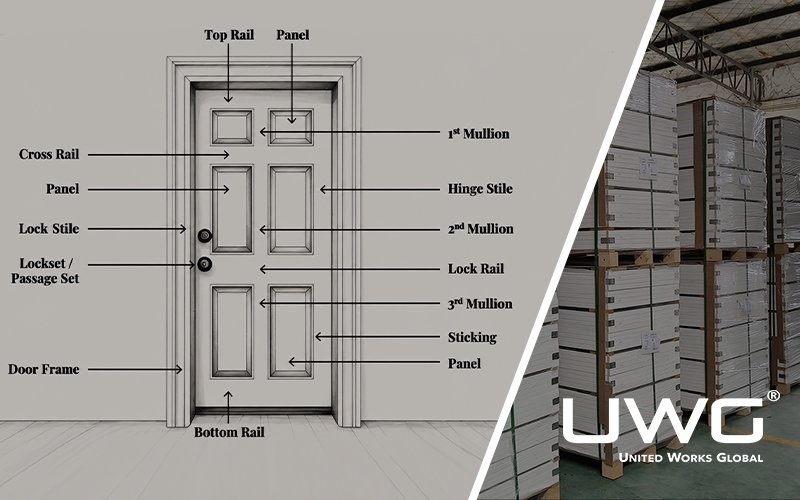
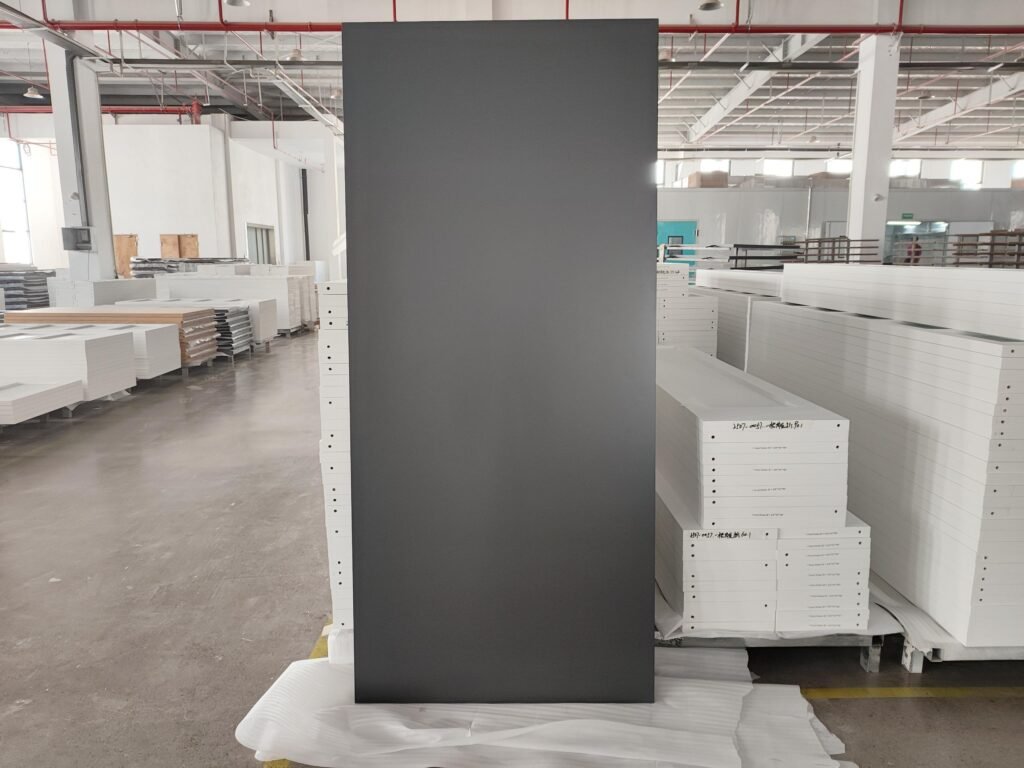
The components inside an interior door vary according to its construction. Not every door contains all of the parts listed below, and terms such as skin, stile, rail, core, and edge banding should be understood in the context of the specific door type. For example, a typical molded door consists of two molded MDF skins—one on each face—attached to an internal supporting frame, which is commonly made from finger-jointed pine in UWG door construction. The space inside the frame is filled with the specified core material, such as a lightweight honeycomb structure or a denser solid-core material. Edge banding or another edge-finishing system is then applied around the slab.
Door Face or Skin
The face is the visible surface of the door.
Common face materials include:
- solid wood;
- MDF;
- HDF;
- molded wood-composite skins;
- natural wood veneer;
- engineered veneer;
- PVC film;
- melamine;
- decorative laminate.
The face material strongly affects appearance and finishing, but it does not describe the complete door construction.
Door Core
The core is the internal structure between the two faces.
Common core constructions include:
- paper or composite honeycomb;
- particleboard;
- tubular particleboard;
- engineered wood;
- mineral or specialty core materials; and
- other project-specific composites.
Core construction affects weight, impact resistance, sound control, hardware support, and cost.
“Hollow core” and “solid core” describe internal construction—not the visible face material. A molded or HDF-faced door may be manufactured with either a hollow or solid core.
For a detailed comparison, see Solid-Core vs. Hollow-Core Doors.
Stiles and Rails
Stiles form the vertical edges of the slab, while rails run horizontally.
Depending on the door construction, these components may use:
- solid wood;
- finger-jointed wood;
- LVL;
- engineered wood;
- MDF; or
- composite materials.
The hinge and lock areas require particular attention because they receive hardware preparation and repeated operational loads.
Glazing
Interior doors may incorporate clear, frosted, laminated, tempered, patterned, or decorative glass.
The appropriate glazing depends on privacy, light transmission, appearance, maintenance, safety requirements, and the supporting door construction.
For detailed glazing options, see Types of Glass for Interior Doors.
What Are the Main Interior Door Material Categories?
Solid Wood Doors
Traditional wood doors are valued for their natural grain, strength, repairability, and substantial feel. Pine, oak, maple, poplar, and alder are among the species used for interior applications.
Their main limitations are higher cost and sensitivity to changes in humidity. For high-end residences and projects requiring stained finishes, however, solid wood remains an attractive option.
Engineered Wood Doors
Engineered wood can include LVL, finger-jointed lumber, veneer, and other manufactured wood components. Compared with full solid wood construction, engineered materials can improve dimensional consistency and make more efficient use of timber.
For larger residential projects, this consistency is valuable because hundreds of doors may need to maintain the same dimensions and finish quality.
MDF & HDF Doors
MDF (Medium Density Fiberboard) provides a smooth surface that machines and paints well, making it particularly suitable for Shaker and routed door designs.
HDF (High Density Fiberboard) is denser and harder and is frequently used as the face skin of molded doors.
Both offer good consistency, although moisture exposure must be considered when specifying standard MDF/HDF products.
Molded Composite Doors
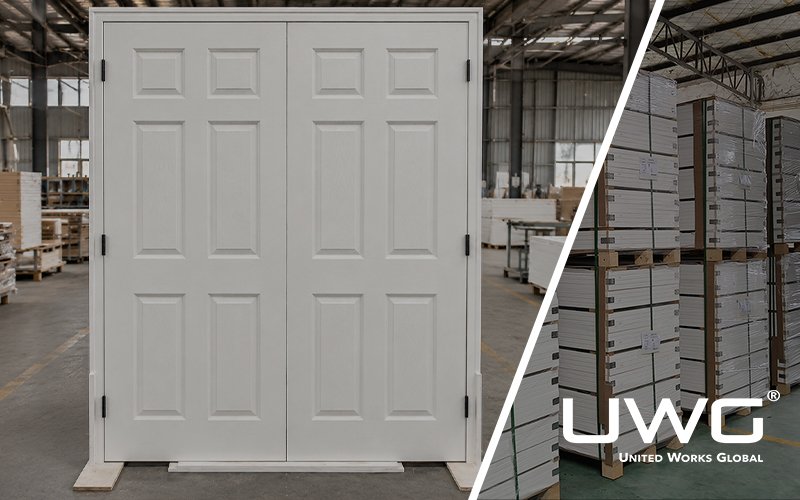
A molded composite door normally uses factory-formed skins attached over an internal frame and core.
The term molded describes how the visible skin or panel appearance is produced. It does not mean that the complete slab is made from one solid material.
Molded doors may be supplied with:
- hollow cores for lower weight and cost;
- solid cores for greater density and durability;
- smooth or wood-grain-textured skins;
- different panel patterns; and
- primed or factory-painted finishes.
They are widely used in residential, multifamily, hospitality, and other volume projects because standardized designs can be produced consistently.
For a dedicated explanation, see What Is a Molded Door?.

Wood-Veneer Doors
A veneered door uses a thin layer of real or engineered wood veneer over a substrate or core.
Veneer provides a wood-grain appearance without requiring the entire slab to be made from solid timber.
Potential advantages include:
- genuine or controlled wood appearance;
- efficient use of decorative timber;
- more consistent matching across a project;
- compatibility with engineered cores; and
- lower material usage than full solid wood construction.
Buyers should specify:
- natural or engineered veneer;
- wood species;
- cut and grain pattern;
- veneer grade;
- book matching or slip matching where applicable;
- substrate;
- finish; and
- acceptable color variation.
Glass Interior Doors
Glass works well for home offices, pantries, living areas, and commercial spaces where light and visual openness are priorities. Frosted or decorative glass can provide greater privacy, while safety glazing should be specified where required.
PVC & WPC Interior Doors
PVC and WPC Interior Doors
PVC and wood-plastic composite materials may be used for complete door constructions, surface layers, edges, frames, or selected components.
They are commonly considered for applications where moisture resistance and ease of maintenance are important.
Potential advantages may include:
- resistance to moisture absorption;
- easy-clean surfaces;
- repeatable decorative finishes; and
- suitability for selected humid indoor environments.
Points to confirm include:
- internal reinforcement;
- screw-holding performance;
- hinge and lock preparation;
- temperature limitations;
- impact resistance;
- surface-film durability;
- substrate construction; and
- applicable fire or smoke requirements.
A PVC film over MDF is not the same construction as a complete PVC or WPC door. Product descriptions should clearly identify the substrate, surface, edges, and internal structure.
For a detailed surface comparison, see Veneer Door Surface Options.
Metal / Steel Interior Doors
Metal doors provide high strength and durability. They are less common in bedrooms and other conventional residential spaces but are widely used in utility rooms, mechanical areas, commercial buildings, and certain fire-rated openings.
Interior Door Material Comparison
| Material category | Main appearance | Important advantages | Main points to confirm | Common applications |
|---|---|---|---|---|
| Solid wood | Natural grain | Stain-grade appearance, repairability, custom machining | Species, moisture, weight, finish, movement | Premium residential and custom projects |
| Engineered wood | Depends on finish | Consistency and efficient production | Exact material, location, fastening, finish | Residential and volume production |
| MDF | Smooth painted surface | Clean machining and consistent paint finish | Density, moisture, edges, reinforcement | Painted Shaker and routed doors |
| HDF/molded composite | Smooth or textured panels | Consistent molded designs and scalable production | Core, skin thickness, edge construction | Residential, multifamily and hospitality |
| Wood veneer | Natural or controlled wood grain | Wood appearance over engineered construction | Species, grade, matching, substrate | Residential, hotel and office projects |
| Glass | Transparent or decorative | Light transmission and visual connection | Safety, privacy, hardware, thickness | Offices, pantries and living spaces |
| PVC/WPC | Solid color or decorative film | Moisture resistance and easy maintenance | Substrate, reinforcement, hardware, heat | Bathrooms and selected humid interiors |
| Metal/steel | Painted or coated metal | Durability and hardware reinforcement | Gauge, core, frame, finish, ratings | Commercial, utility and high-traffic openings |
This table provides general selection guidance. The performance of an actual door depends on the complete construction and supporting documentation.
Material vs. Core vs. Style: What Is the Difference?
Door terminology often mixes three separate product characteristics.
Material
Material describes what one or more components are made from, such as solid wood, MDF, HDF, veneer, glass, PVC, or steel.
Core construction
Core describes the internal structure, such as hollow core, solid particleboard core, tubular core, or another engineered construction.
Style
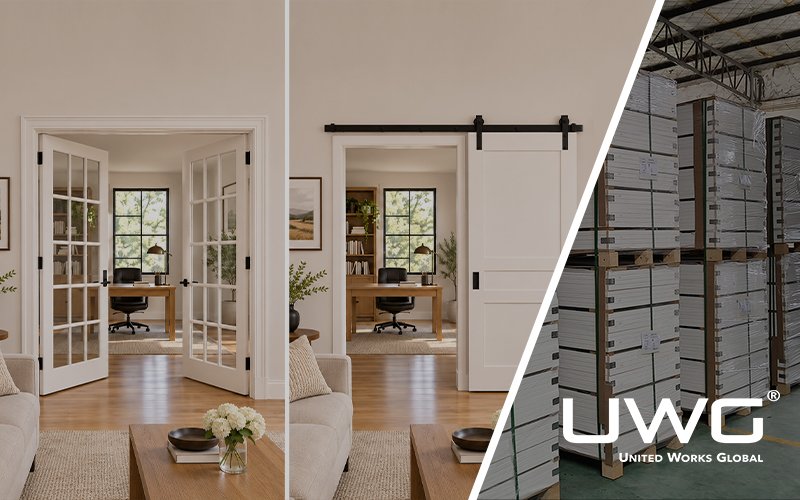
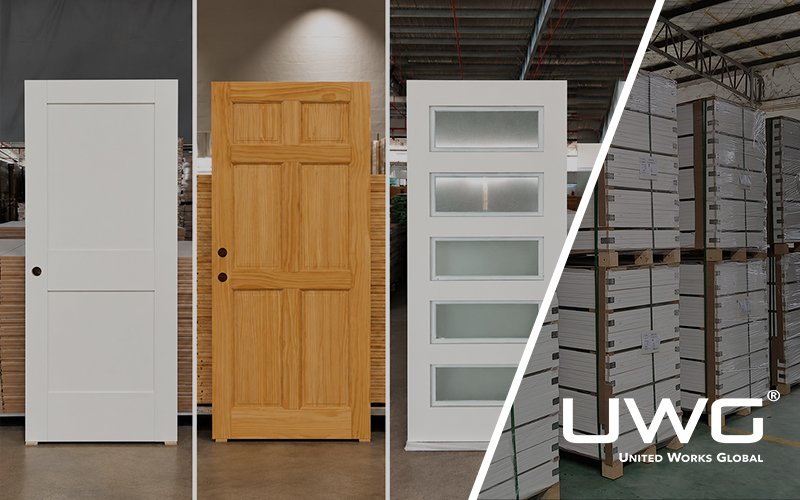
Style describes the visual design, such as Shaker, flush, molded panel, French, glass, or louvered.
A door can therefore be:
Molded HDF skin + solid particleboard core + six-panel style
or:
Painted MDF components + engineered stiles and rails + Shaker style
Using only one label—such as MDF door, molded door, or solid door—may not provide enough information for an accurate comparison.
How Do Materials Affect Finish and Appearance?
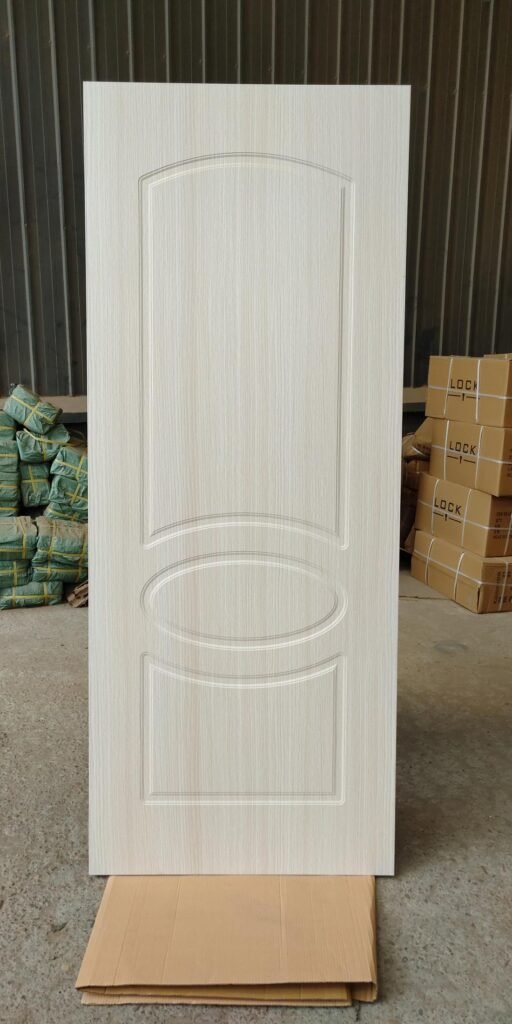
For painted doors, MDF and HDF are commonly used because their uniform surfaces can produce a consistent finish without natural knots or grain.
Paint-grade wood is another option, although some natural characteristics may remain visible depending on the species, preparation, and finish.
For stained or clear-finished doors, solid wood and wood veneer are more suitable because the grain is intended to remain visible.
PVC, melamine, laminates, and other decorative surfaces can provide:
- solid colors;
- printed wood patterns;
- different gloss levels;
- textured finishes; and
- repeatable batch appearance.
The chosen finish should be compatible with the substrate and door design. A surface material suitable for a flat door may not work equally well on deeply routed or molded profiles.
How Do Materials Affect Door Performance?
Durability and Impact Resistance
Durability depends on more than whether the door is described as wood, MDF, or composite.
Important factors include:
- face thickness;
- core density;
- stile and rail construction;
- edge reinforcement;
- door thickness;
- hardware preparation;
- surface finish; and
- expected traffic.
A dense material can improve impact resistance, but the complete assembly should be evaluated.
Acoustic Performance
Denser door constructions generally provide better potential for sound control than lightweight hollow constructions, but material name alone does not establish acoustic performance.
Sound transmission is affected by:
- slab mass;
- core construction;
- door thickness;
- perimeter gaps;
- seals;
- frame;
- undercut;
- glazing; and
- installation.
Where a project requires a specific acoustic rating, request tested data for the complete assembly.
Moisture Resistance
Standard wood-based materials require suitable protection from prolonged moisture exposure.
Solid wood can expand or contract as moisture conditions change. Standard MDF and HDF can swell if they absorb excessive moisture. Suitable PVC, WPC, composite, and moisture-resistant products may perform better in consistently humid environments.
Moisture resistance should be evaluated for the complete door, including edges, machining, joints, adhesives, finish, frame, and hardware—not only the face material.
Hardware Compatibility
Hinges, locks, closers, pulls, and other hardware place loads on the door edges and internal reinforcement.
Buyers should confirm:
- hinge and lock-block construction;
- reinforcement material;
- permitted machining locations;
- screw requirements;
- door weight;
- hardware templates; and
- any limitations on field modification.
Fire-Rated Applications
Material alone does not establish a fire rating.
Wood-composite and steel door assemblies may both be available with rated configurations, but buyers must confirm the applicable listing, label, frame, hardware, glazing, seals, wall construction, and installation requirements.
Door performance depends on more than the visible surface.
Which Interior Door Material Fits Different Applications?
| Application | Materials or constructions to consider | Main selection priority |
|---|---|---|
| Closets and low-use rooms | Hollow-core molded or lightweight engineered doors | Cost and ease of handling |
| Bedrooms | Molded, MDF/HDF, engineered or solid-core options | Privacy, finish and budget |
| Bathrooms and laundry areas | Properly sealed products, PVC/WPC or suitable moisture-resistant systems | Moisture exposure |
| Apartments and multifamily projects | Molded, MDF/HDF and engineered constructions | Consistency, volume production and cost |
| Hotels | Solid-core engineered, veneer or other documented assemblies | Acoustics, durability and finish |
| Offices | MDF/HDF, veneer, glass, wood or metal | Appearance, privacy and traffic |
| Premium residences | Solid wood, veneer or high-quality engineered doors | Natural appearance and customization |
| Utility or mechanical rooms | Metal, steel or specified composite systems | Durability and project requirements |
| Rated openings | Tested and labeled wood-composite or metal assemblies | Required listing and complete assembly |
Using one material for every opening is not always the most effective specification.
A project may use economical hollow-core doors for selected closets, denser solid-core doors where privacy matters, and moisture-resistant systems for bathrooms or service areas.
This room-by-room approach can improve performance without unnecessarily increasing the cost of the complete package.
What Should Buyers Confirm Before Ordering?
Complete construction
Request information about:
- face or skin material;
- skin thickness;
- core type and density;
- stile and rail materials;
- lock-block construction;
- edge material;
- slab thickness;
- glazing; and
- internal reinforcement.
Finish
Confirm:
- primed, painted, stained, veneered, laminated, or wrapped finish;
- color and sheen;
- approved sample;
- edge finishing;
- touch-up requirements; and
- acceptable batch variation.
Performance
Confirm any required:
- acoustic rating;
- fire rating;
- moisture resistance;
- impact resistance;
- hardware capacity;
- applicable label; and
- supporting test report.
Hardware preparation
Provide approved templates for:
- hinges;
- locks;
- latches;
- pulls;
- closers;
- access-control hardware; and
- other project-specific products.
Frame compatibility
Confirm that the door slab, frame, hinges, strike preparation, clearances, and wall conditions are compatible.
For frame systems and supply formats, see the Interior Door Frame Guide.
Production and logistics
For bulk orders, confirm:
- door schedule;
- opening labels;
- quantities;
- handing;
- machining;
- packaging;
- pallet or crate configuration;
- container-loading plan;
- approved sample; and
- inspection requirements.
Common Interior Door Material Selection Mistakes
Treating the Door as One Material
Most modern doors combine several materials. The face, core, edges, reinforcement, and frame should be evaluated separately.
Confusing Solid Wood With Solid Core
A solid-core door contains a dense internal core but is not necessarily made from solid natural wood.
Assuming All Molded Doors Are Hollow Core
Molded doors may use either hollow- or solid-core construction.
Calling Every Painted Door an MDF Door
A painted slab may combine HDF skins, MDF components, engineered wood edges, and a separate core.
Selecting Material Without Considering the Finish
Materials suitable for paint are not necessarily the best choice for a natural stained appearance.
Assuming Steel Automatically Means Fire-Rated
Only a tested and labeled complete assembly can support a stated fire rating.
Comparing Price Without Comparing Construction
Two doors with similar appearance may have different skin thicknesses, cores, reinforcement, edge construction, machining, and packaging.
Using One Specification for Every Room
Different rooms may require different levels of privacy, moisture resistance, durability, appearance, and cost.
Frequently Asked Questions
What Is the Most Common Material for Interior Doors?
There is no single material used throughout every modern interior door. MDF, HDF, molded composite skins, engineered wood, and wood-based cores are commonly combined in residential door production.
Is MDF Better Than Solid Wood for Interior Doors?
Neither is universally better. MDF provides a smooth, consistent painted surface, while solid wood provides natural grain and stain-grade appearance. The right option depends on design, moisture, door weight, finishing, budget, and project requirements.
What Is the Difference Between MDF and HDF Doors?
MDF is commonly used for routed panels and paint-grade components. HDF is denser and is frequently used for molded door skins. In both cases, buyers should confirm the complete core and edge construction.
Are Molded Doors Made From MDF?
Many molded doors use MDF or HDF composite skins over an internal frame and core. They are not necessarily made from solid MDF throughout.
Are Molded Doors Hollow or Solid?
They can be either. Molded describes the surface construction, while hollow core and solid core describe the internal structure.
What Material Is Best for a Painted Interior Door?
MDF and HDF are commonly used for painted doors because they provide smooth and consistent surfaces. Paint-grade wood and other engineered materials may also be suitable depending on the construction.
What Material Is Best for a Bathroom Door?
The answer depends on the actual moisture exposure and ventilation. Properly finished wood-based doors may be suitable for normal interior bathrooms, while PVC, WPC, or other moisture-resistant systems may be considered for consistently humid conditions.
Which Interior Door Material Provides the Best Sound Control?
Sound performance depends on the complete assembly. Dense solid-core constructions generally provide better potential for sound control than lightweight hollow-core doors, but the frame, seals, gaps, undercut, thickness, and installation also matter.
Are Steel Interior Doors Fire-Rated?
Not automatically. A fire rating must be supported by a tested and labeled door assembly that includes the compatible slab, frame, hardware, glazing, seals, and installation.
What Information Should Be Included in a Door Material Specification?
A useful specification should identify the face material, core, stiles and rails, edge construction, slab thickness, finish, glazing, hardware reinforcement, required performance, frame compatibility, and machining.
Summary
Interior doors are commonly made from combinations of solid wood, engineered wood, MDF, HDF, molded composites, veneer, glass, PVC/WPC, and metal.
The visible material is only one part of the product. Buyers should also compare the core, stiles and rails, edge reinforcement, slab thickness, finish, glazing, frame, and hardware preparation.
Solid wood and veneer suit projects where natural grain is important. MDF and HDF provide consistent painted surfaces. Molded composite doors support standardized volume production. Glass introduces light and visual connection. PVC and WPC may suit selected humid environments, while steel is commonly used for demanding commercial and utility openings.
For project purchasing, compare complete constructions rather than product names alone, and approve the material schedule, samples, drawings, hardware preparation, finish, performance documentation, and packaging before production.
To review available constructions for a project, explore UWG’s interior door options.