Common Molded Door Core Materials include honeycomb, tubular chipboard, particleboard, and solid wood filling, each with a different internal structure and performance profile. For contractors, builders, and purchasing teams, the key is not to choose the heaviest or most expensive option, but to understand how each core is built, what the project requires, and what should be confirmed before ordering.
What Are Molded Door Core Materials?
Molded door core materials are the internal filling or support structures used inside molded interior doors.
The core helps support the door, control finished weight, and provide the level of internal strength required for the intended application. Depending on the specification, the core may use a lightweight cellular filling, an engineered board with internal channels, a dense engineered wood filling, or solid wood blocks.
The four core types commonly discussed for molded interior doors are:
- Honeycomb
- Tubular chipboard
- Particleboard
- Solid wood block filling
The material name alone, however, does not fully describe the construction.
For purchasing purposes, it is also important to know how the material is arranged inside the door, whether the main area is fully or partially filled, and where separate reinforcement is provided.
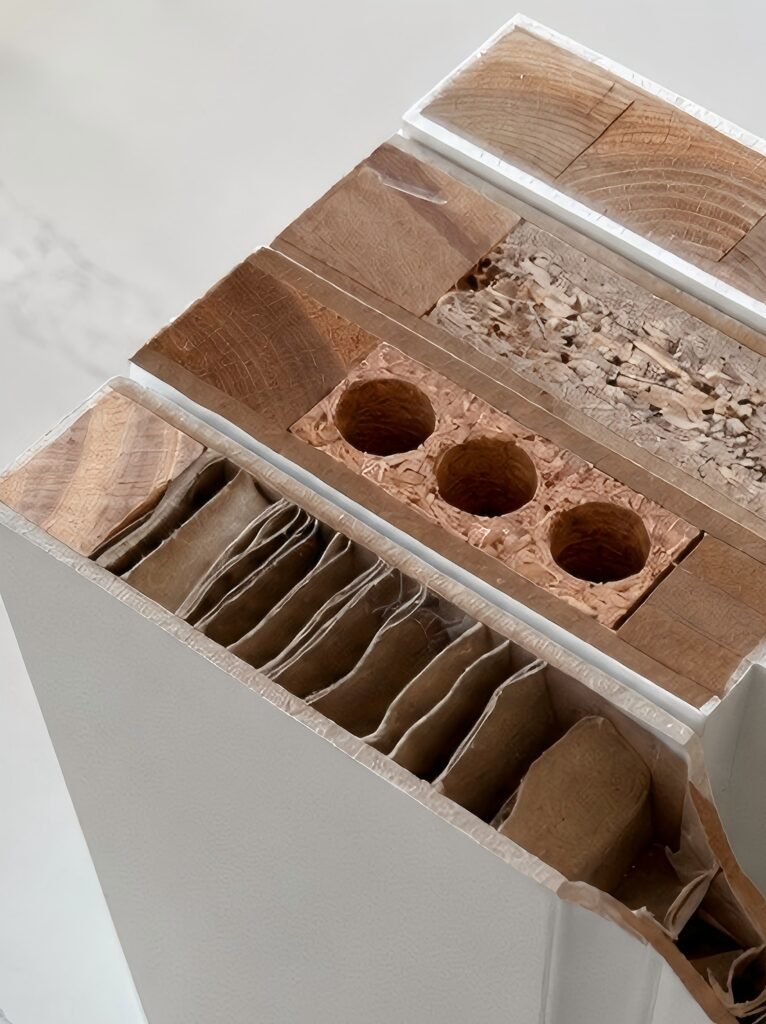
How the Core Fits Inside a Molded Door
The core works together with the perimeter structure and reinforced areas required for hinges, locks, and other hardware.
For example, a honeycomb door may use lightweight cellular filling across most of the internal area while using solid material at the hinge side and lock preparation area.
This means that writing only “honeycomb core” on a purchase order does not fully explain how the door is built.
The same principle applies to denser cores. When reviewing a molded door specification, three points should normally be confirmed together:
- Core material
- Internal filling arrangement
- Reinforcement at hardware fixing locations
For readers who need a broader overview of the complete construction, this guide explains what is a molded door and how the main components work together.
Door Skin vs. Door Core: Why the Difference Matters
The molded exterior surface and the internal core perform different functions.
The molded surface determines the visible panel design, texture, and finish. The core has a greater influence on finished weight, internal support, door feel, and some machining considerations.
This distinction is important when reviewing specifications.
An MDF or molded wood-fiber surface does not automatically mean the door also has an MDF core. The surface material and the internal core should therefore be listed separately in the specification.
Four Common Molded Door Core Materials
Honeycomb Core: Lightweight Cellular Filling
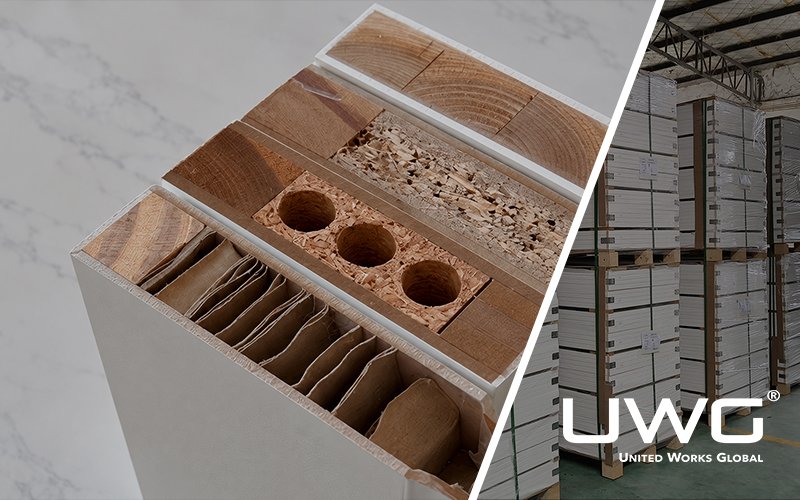
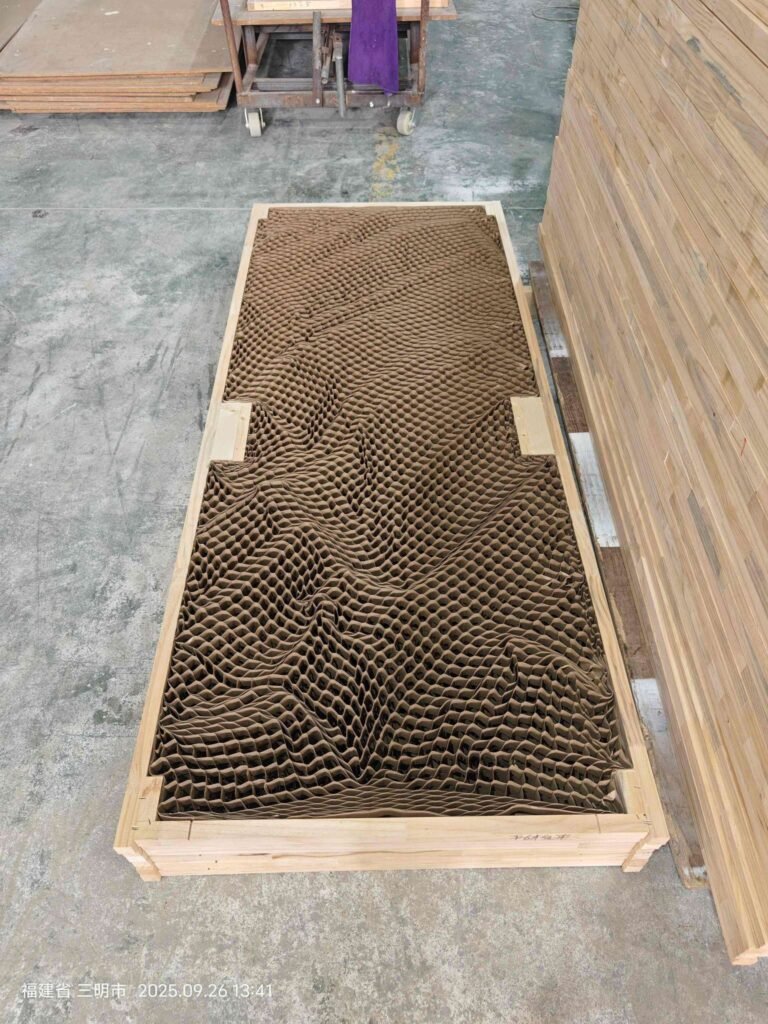
Honeycomb is a lightweight cellular filling rather than a solid board.
The expanded honeycomb structure supports the main internal area of the door while using relatively little material. This keeps finished weight low and makes honeycomb practical for many standard residential interior applications.
In our current molded door configurations, the honeycomb occupies the main internal area, while stronger material is used where specific hardware fixing support is required.
Honeycomb is often appropriate when:
- the opening uses a standard interior door size;
- lower finished weight is preferred;
- standard residential hinges and locks are used;
- installers need easier handling;
- freight and project cost need to be controlled.
In our current product range, an approximately 24–36 inch wide × 80 inch high honeycomb-core door typically weighs around 8–14 kg.
That lower weight is one of the main reasons honeycomb remains practical for large residential packages.
A lightweight core should not automatically be treated as an inferior specification. The better question is whether the project actually needs additional mass or a denser internal structure.
For many bedrooms, closets, and standard interior openings, a heavier core can add cost and handling requirements without solving a specific project need.
Tubular Chipboard Core: Engineered Board with Internal Channels
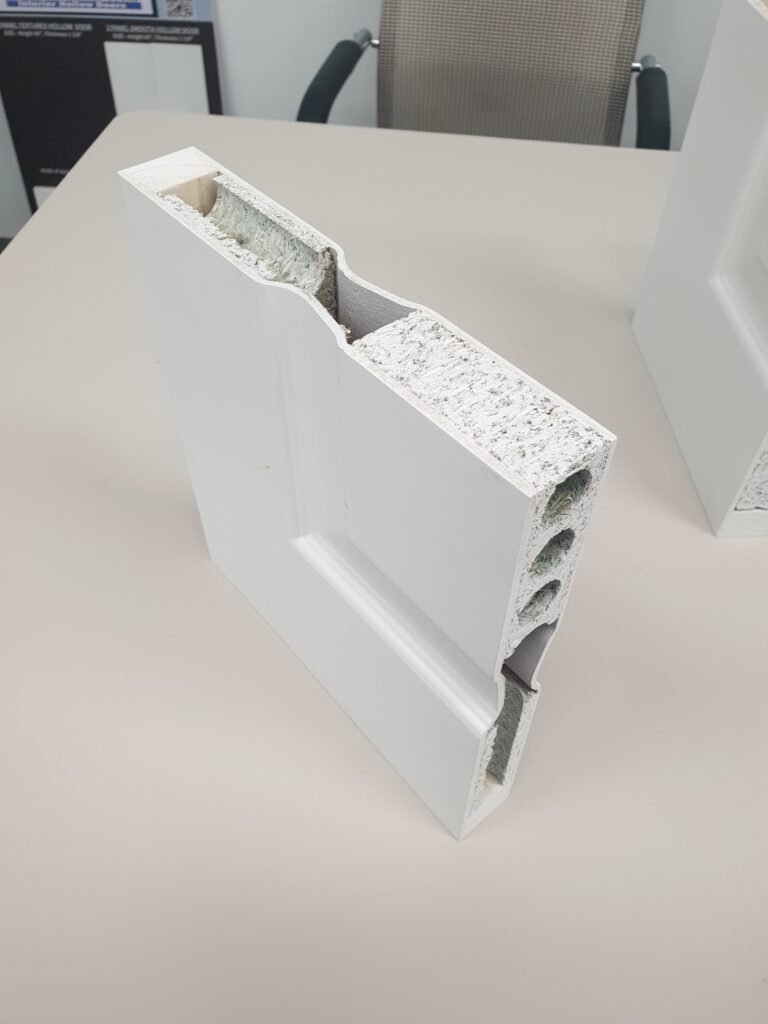
Tubular chipboard is an engineered chipboard core containing internal hollow channels.
It has more continuous wood-based material than honeycomb, but the internal channels reduce weight compared with a fully dense particleboard filling.
This makes it useful where a buyer wants a more substantial construction without moving directly to a fully dense core.
The cross-section photo should clearly show the engineered chipboard material and its internal hollow channels.
In our current range, tubular chipboard doors around 28–36 inches wide × 80 inches high typically weigh approximately 18–21 kg.
Tubular chipboard may be considered when:
- a more substantial door feel is requested;
- more continuous support behind the door faces is desired;
- usage conditions are more demanding than a typical lightweight residential opening;
- finished weight still needs to remain reasonably controlled.
The important distinction is that tubular chipboard provides more material behind the door faces, but this should not be confused with the fixing requirements for hinges, locks, or closers.
Those areas still need to be designed around the actual hardware.
Particleboard Core: Dense Engineered Wood Filling
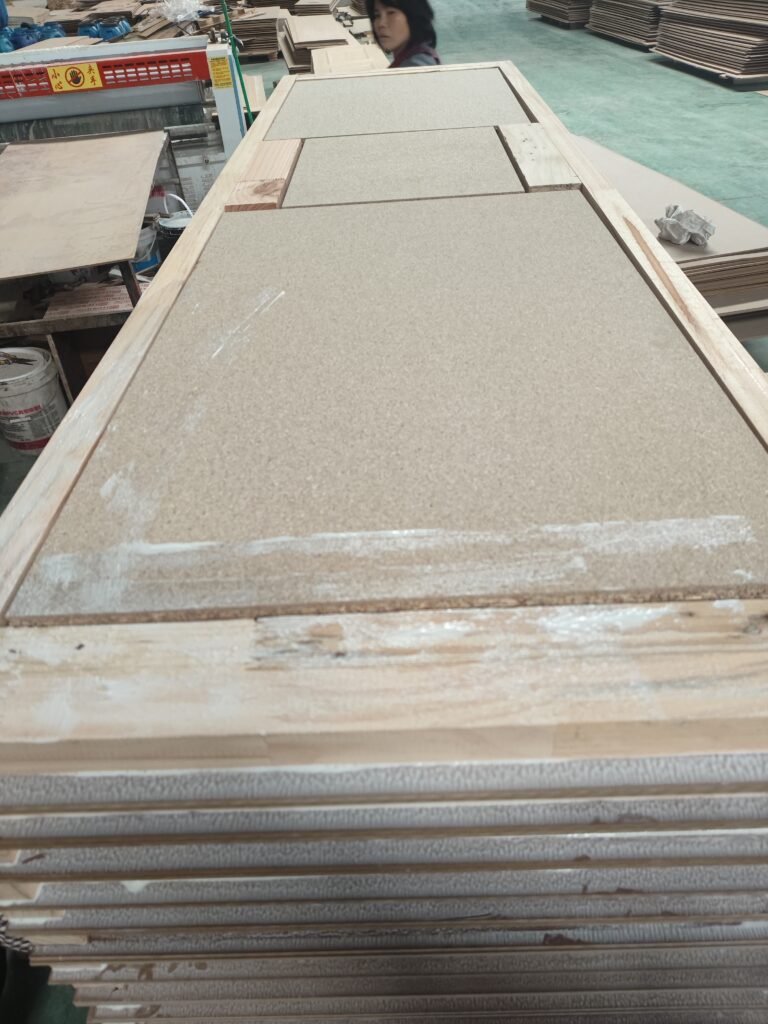
Particleboard is a dense engineered wood material made from compressed wood particles.
Compared with honeycomb and tubular chipboard, it provides a much more continuous internal filling.
This adds mass and creates a denser support structure behind the molded faces.
In our current configurations, particleboard doors around 18–36 inches wide × 80 inches high generally weigh approximately 15–30 kg, depending on width and construction.
This wider weight range is important.
Particleboard should not simply be described as “heavier than tubular chipboard” in every case because the final door weight also depends on dimensions and the complete construction.
Particleboard may be considered when the project calls for:
- higher door mass;
- a more substantial closing feel;
- a denser internal structure;
- more demanding machining or overall construction requirements.
The main trade-off is that additional mass affects more than the material itself.
As size and quantity increase, it can affect transportation, site handling, hinge selection, installation labor, and final project pricing.
Solid Wood Core: Wood Block Filling
In our current product discussion, solid wood filling refers to solid wood blocks used as the internal core structure, rather than one continuous solid timber slab.
That distinction should be made clear in a quotation or purchase order.
The phrase “solid wood core” by itself can be interpreted differently by different buyers and suppliers, so the actual arrangement should always be confirmed.
For the solid wood block configurations we currently discuss, finished door weight is generally similar to particleboard, depending on door size, the amount of wood used, and the internal arrangement.
Solid wood filling may be considered where the project places greater importance on:
- structural support;
- specific fixing requirements;
- machining requirements;
- a heavier or more substantial door specification.
It should not automatically be described as the heaviest option.
In our current configurations, its weight can be comparable to particleboard, so the actual construction should be reviewed instead of relying on a simple light-to-heavy ranking.
Honeycomb vs. Tubular Chipboard vs. Particleboard vs. Solid Wood: Key Differences
The four core types differ not only in material but also in internal layout, finished weight, handling, and how they support the door faces.
| Core Type | Typical Internal Structure | Typical Door Size Range | Approx. Door Weight | Support Behind Door Faces | Typical Selection Reason |
|---|---|---|---|---|---|
| Honeycomb | Lightweight cellular filling | 24–36 in. wide × 80 in. high | About 8–14 kg | Lightweight distributed support | Lower weight, easier handling, cost control |
| Tubular Chipboard | Engineered chipboard with internal hollow channels | 28–36 in. wide × 80 in. high | About 18–21 kg | More continuous support than honeycomb while retaining internal voids | Balance between weight and a more substantial construction |
| Particleboard | Dense engineered wood filling | 18–36 in. wide × 80 in. high | About 15–30 kg | Dense, continuous support behind the door faces | Higher mass and denser internal construction |
| Solid Wood | Solid wood block filling | Varies by specification | Generally similar to particleboard in current configurations | Solid wood support where blocks are positioned | Structural or specific fixing requirements |
These are typical ranges from our current product configurations rather than fixed values for every door.
Final weight can change with:
- width and height;
- finished door thickness;
- perimeter construction;
- reinforcement;
- molded face material;
- hardware preparation.
Door Weight and Handling
Door weight is one of the clearest practical differences between core constructions.
A honeycomb-core molded interior door in our current range typically weighs around 8–14 kg at approximately 24–36 inches wide and 80 inches high.
A tubular chipboard door at approximately 28–36 inches wide and 80 inches high is typically around 18–21 kg.
Particleboard doors cover a wider range, approximately 15–30 kg for doors around 18–36 inches wide and 80 inches high.
Solid wood block configurations are generally comparable to particleboard in weight, depending on the amount and arrangement of wood.
This difference becomes much more important on a large project.
Moving from an 8–14 kg honeycomb door to an 18–21 kg tubular chipboard door affects every opening in the schedule.
Installers have more weight to:
- unload;
- move between floors;
- lift into position;
- align;
- hang.
For a few doors, that may not be significant. For hundreds of openings, the cumulative handling impact is much more noticeable.
Sound-Control Requirements
A denser and heavier core can contribute to sound-control performance because additional mass can help reduce sound transmission.
However, core weight alone does not determine acoustic performance.
Other factors include:
- door thickness;
- perimeter sealing;
- frame construction;
- gaps and undercuts;
- installation quality;
- the complete door assembly.
For that reason, we would not recommend choosing particleboard or solid wood solely because a project requests “better sound insulation.”
If a specified acoustic rating is required, the tested or approved complete door system should be reviewed.
Hardware Support and Machining Requirements
A denser core provides more continuous support behind the door faces, but this should not be confused with hardware-specific fixing strength.
Hinges, locks, handles, closers, and other surface-mounted hardware still require suitable material at their actual fixing positions.
For example, a honeycomb door may use lightweight cellular filling across most of the door area while incorporating solid hinge-side material and a reinforced lock block.
Likewise, changing to tubular chipboard or particleboard does not remove the need to confirm:
- hinge-side construction;
- lock block position and size;
- hardware fixing depth;
- machining location;
- reinforcement for closers or other surface-mounted hardware.
A denser core can improve general support behind the door faces, but it does not replace hardware-specific reinforcement.
Material Cost and Shipping Considerations
A core upgrade affects more than raw material cost.
Moving from honeycomb to a denser core can increase:
- finished door weight;
- freight weight;
- manual handling;
- installation effort;
- hardware requirements;
- final quotation.
These differences may be relatively small on a limited order.
On a large residential, hotel, or multi-unit project, however, the cumulative effect can become commercially important.
How Core Construction Affects Molded Door Performance
Full-Core Filling vs. Partial Reinforcement
“Full-core filling” and “local reinforcement” describe two different parts of the door construction.
Full-core filling refers to how the main internal area of the door is supported.
Local reinforcement refers to stronger material added at specific fixing points.
For example, a honeycomb door may use cellular filling across most of the door leaf while solid material is provided around hinges and lock preparation.
A particleboard door provides much denser support across the main area, but the hinge side, lock block, and other hardware fixing locations still need to match the specified hardware.
This is why a purchase specification should describe both the core arrangement and the reinforcement details rather than relying on the material name alone.
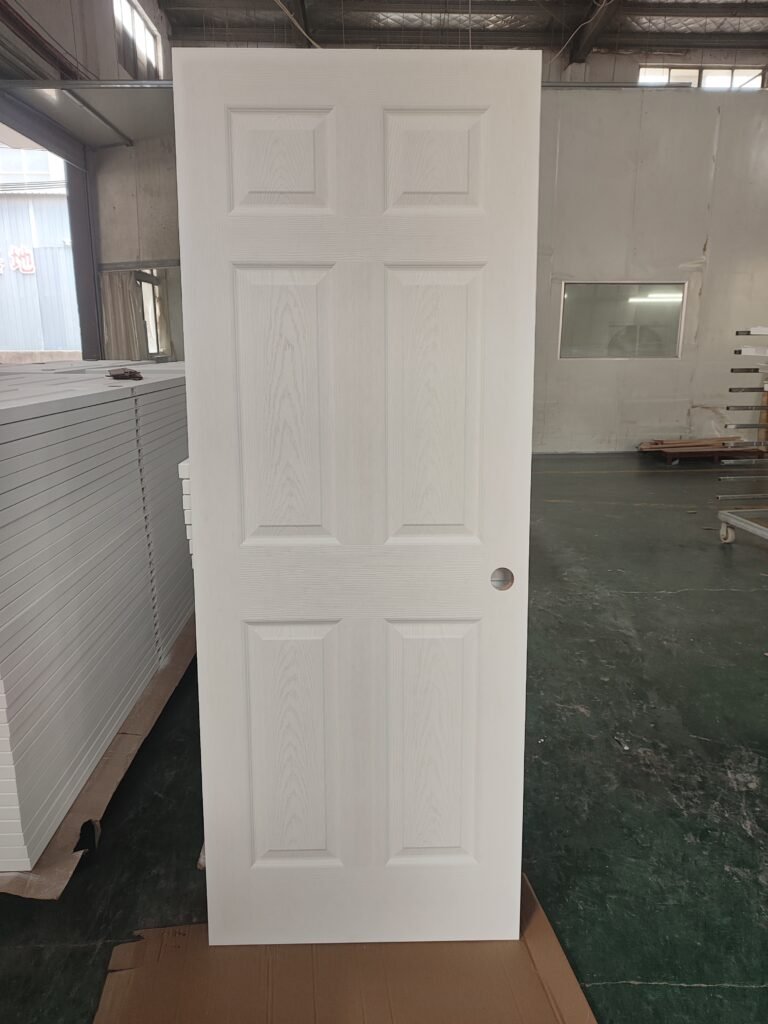
Lock Blocks, Stiles and Hinge Fixing Areas
Hardware fixing areas should be confirmed before production whenever the hardware schedule is known.
The lock block should align with the intended lock preparation.
The hinge-side structure should suit both the hinge specification and the finished door weight.
This becomes especially important when doors will be machined locally after delivery.
If the buyer and supplier do not agree on these locations in advance, the selected core material may be correct while the finished door can still be difficult to machine or install.
Door Thickness, Panel Size and Hardware Compatibility
Core selection should always be reviewed together with the overall door dimensions.
As a door becomes taller, wider, or heavier, its handling and hardware requirements may change.
For non-standard sizes, it is good practice to confirm the expected finished weight before upgrading from a lightweight core to a denser one.
The actual door dimensions also help explain why particleboard, for example, has a wider finished-weight range than tubular chipboard in our current product range.
How to Choose a Molded Door Core for the Project
Start with Room Use and Required Door Specifications
The most practical way to select a core is to start with the application rather than the material.
Before recommending a configuration, we normally need to understand:
- building and room type;
- door dimensions;
- finished thickness;
- expected usage level;
- hinge and lock specification;
- sound or durability requirements;
- installation conditions;
- target budget.
Once those points are clear, unnecessary upgrades are easier to avoid.
When to Evaluate a Honeycomb Configuration
Consider a standard residential package for bedrooms, closets, and other internal rooms.
If the doors are standard sizes, use conventional hinges and locks, and do not have a specific acoustic rating, honeycomb can remain a practical option.
The main reasons are straightforward:
- finished weight remains relatively low;
- installers can handle the doors more easily;
- freight weight is lower;
- standard hardware can be accommodated with appropriate local reinforcement;
- project cost remains controlled.
In our current range, that can mean working with an approximately 8–14 kg door instead of moving immediately to a tubular chipboard door in the 18–21 kg range.
If the project does not require the additional mass, changing the core simply because a denser material appears “better” may add cost and handling requirements without solving a real project problem.
When to Evaluate Tubular Chipboard or Particleboard
A denser core becomes more relevant when the buyer’s requirements change.
For example, the project may request:
- a more substantial door feel;
- greater mass;
- a denser support structure behind the faces;
- higher-use openings;
- more demanding machining conditions.
At that point, tubular chipboard or particleboard may be evaluated against honeycomb.
Tubular chipboard can be useful when the buyer wants a more substantial construction while retaining internal hollow channels to control weight.
Particleboard becomes more relevant where a denser and more continuous internal filling is specifically required.
The decision should follow the actual requirement rather than a fixed assumption that one material is always an “upgrade” over another.
What to Verify When Solid Wood Filling Is Proposed
When solid wood block filling is proposed, the specification should answer several practical questions:
- How are the wood blocks arranged inside the door?
- Which areas of the door are filled?
- What is the expected finished door weight?
- What hardware or machining requirement is driving the use of solid wood?
- Does the increased material and weight justify the additional project cost?
This is particularly important because “solid wood core” can mean different things in the market.
A clear internal construction description is more useful than the material name alone.
What Builders Should Confirm Before Ordering Molded Doors
Core Material and Internal Filling Structure
A purchase order should not stop at:
“Core: Honeycomb”
or:
“Core: Particleboard”
Those descriptions still leave room for different interpretations.
At minimum, two or three additional structural details should be included.
1. Filling arrangement
State whether the internal construction is:
- cellular filling;
- tubular board;
- dense board filling;
- solid wood block filling;
- another agreed arrangement.
2. Reinforcement
Identify where dedicated reinforcement is required, such as:
- hinge-side reinforcement;
- lock block;
- closer backing;
- other hardware fixing zones.
3. Relevant dimensions
Where applicable, state:
- finished door thickness;
- door width and height;
- any construction dimension that affects the final assembly.
A clearer specification might read:
Honeycomb core, cellular filling to main door area, reinforced hinge and lock fixing zones, 35 mm finished door thickness.
That gives the supplier much more useful information than simply writing “Honeycomb core.”
Door Skin, Frame and Reinforcement Details
The core should also be reviewed together with the rest of the door construction.
The specification may need to confirm:
- molded face material;
- perimeter construction;
- edge requirements;
- hinge preparation;
- lock preparation;
- reinforcement positions;
- surface finish.
The objective is to define a complete door construction rather than purchase an isolated core material.
Door Size, Weight and Hardware Preparation
When the core is changed, the first secondary item to review should be finished door weight.
In our current product range, moving from honeycomb at approximately 8–14 kg to tubular chipboard at approximately 18–21 kg can create a noticeable difference even before considering particleboard or solid wood.
That additional weight may affect:
- manual handling;
- unloading;
- movement through the building;
- hinge selection;
- installation labor;
- freight calculation;
- final pricing.
These effects become more obvious when:
- project quantities are high;
- doors are wider;
- access between floors is difficult;
- heavier hardware is specified;
- installers must handle doors manually.
For this reason, we normally recommend reviewing the complete door schedule when changing core construction rather than treating the change as a simple material upgrade.
FAQ
Is an MDF Door Skin the Same as an MDF Door Core?
No.
They describe different parts of the door.
An MDF or molded wood-fiber surface refers to the exterior component, while the core refers to the internal filling or support structure.
They should be specified separately.
Is Tubular Chipboard the Same as Solid Particleboard?
No.
Tubular chipboard contains internal hollow channels.
Particleboard provides a denser and more continuous engineered wood filling without the same tubular internal structure.
Is a Solid Wood Core Door an All-Wood Door?
Not necessarily.
In the configurations discussed here, solid wood core refers to solid wood blocks used internally. It does not mean the entire door leaf is one solid timber slab.
The actual internal arrangement should always be confirmed.
Which Molded Door Core Is Lighter?
Honeycomb is clearly the lightest option in our current molded door range.
For approximately 24–36 inch wide × 80 inch high doors, honeycomb configurations are typically around 8–14 kg.
Tubular chipboard doors in the 28–36 inch wide × 80 inch high range are typically around 18–21 kg.
Particleboard has a broader range of approximately 15–30 kg for doors around 18–36 inches wide × 80 inches high.
Solid wood block configurations are generally similar to particleboard in weight, depending on the internal construction.
Does a Heavier Door Core Always Provide Better Sound Insulation?
No.
Higher mass can contribute to sound control, but the final result depends on the complete door system.
Seals, gaps, frame design, thickness, and installation quality all matter.
For rated applications, complete tested door-set performance is more reliable than judging acoustic performance by core weight alone.
Can Different Core Materials Use the Same Hinges and Locks?
Sometimes, but it should not be assumed.
Changing the core changes the finished door weight and may also change the overall construction.
Hinge quantity, hinge rating, fixing depth, lock block arrangement, and reinforcement should therefore be checked against the actual door specification.
A denser core does not automatically eliminate the need for hardware-specific reinforcement.
Summary
Choosing the right Molded Door Core Materials is less about ranking materials from “light” to “heavy” and more about matching the internal construction to the project.
In our current molded interior door configurations, honeycomb doors at approximately 24–36 inches wide × 80 inches high typically weigh around 8–14 kg. Tubular chipboard doors around 28–36 inches wide × 80 inches high are typically around 18–21 kg. Particleboard doors around 18–36 inches wide × 80 inches high cover a wider range of approximately 15–30 kg, while solid wood block configurations are generally comparable to particleboard depending on construction.
For builders and purchasing teams, the safest specification identifies the core material, filling arrangement, reinforcement locations, and relevant door dimensions.
When a core is changed, finished weight, hardware, handling, freight, installation, and pricing should be reviewed at the same time.
That makes the specification clearer and helps ensure the molded interior doors delivered to site match what the project actually requires.