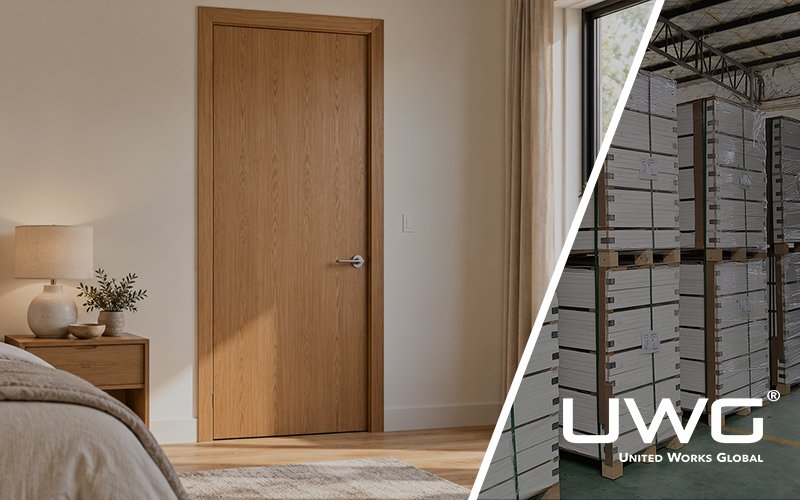
Veneer flush doors combine a smooth, flat door profile with the natural appearance of wood veneer, making them a versatile choice for residential and commercial interiors. Available in natural and reconstituted veneer, these doors offer different grain patterns, wood species, and finish options to suit a range of interior designs.
Core construction, edge details, hardware preparation, and factory finishing can vary significantly between products. This guide covers the main veneer types, core options, surface finishes, and common applications, helping builders, contractors, and project buyers specify the right door configuration and compare suppliers on a consistent basis.
What Are Veneer Flush Doors?
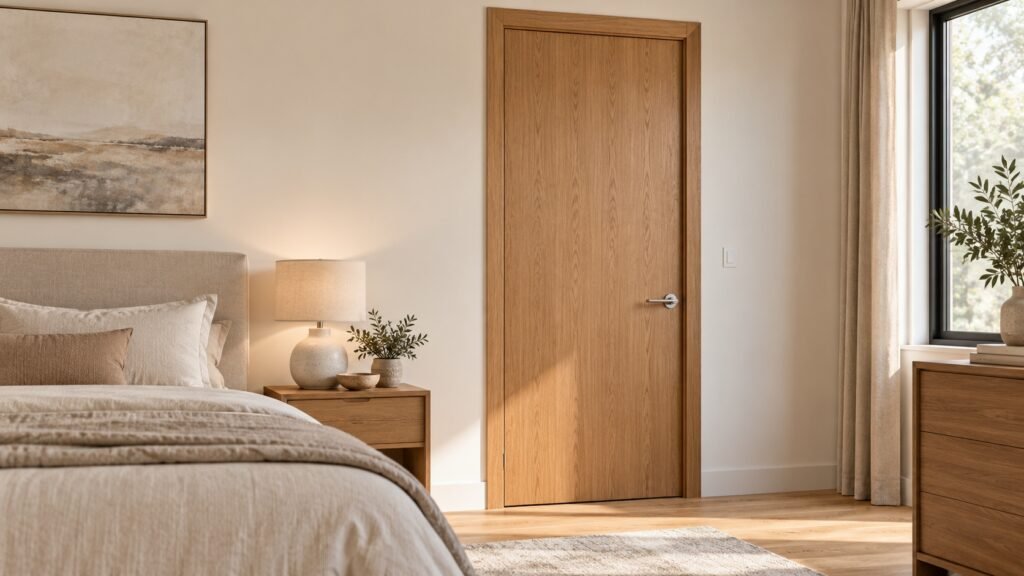
Veneer flush doors have flat faces covered with thin sheets of natural or reconstituted wood veneer. The veneer supplies the visible grain and color, while supporting panels, a core, and perimeter components form the door body. This combination provides a wood appearance with a choice of internal configurations.
The continuous face suits interiors where a simple door profile needs to coordinate with flooring, cabinetry, or wall panels. This guide focuses on interior applications and on selecting the veneer, core, and finish as one door package.
Veneer identifies the face material, flush describes the flat profile, and core identifies the internal construction. An oak veneered flush door can therefore have a particleboard core; it does not need to be solid oak throughout.
Veneer Types for Flush Wood Doors
Veneer species, manufacturing methods, and grain matching influence the finished appearance.
Two main categories are used in wood veneer applications:
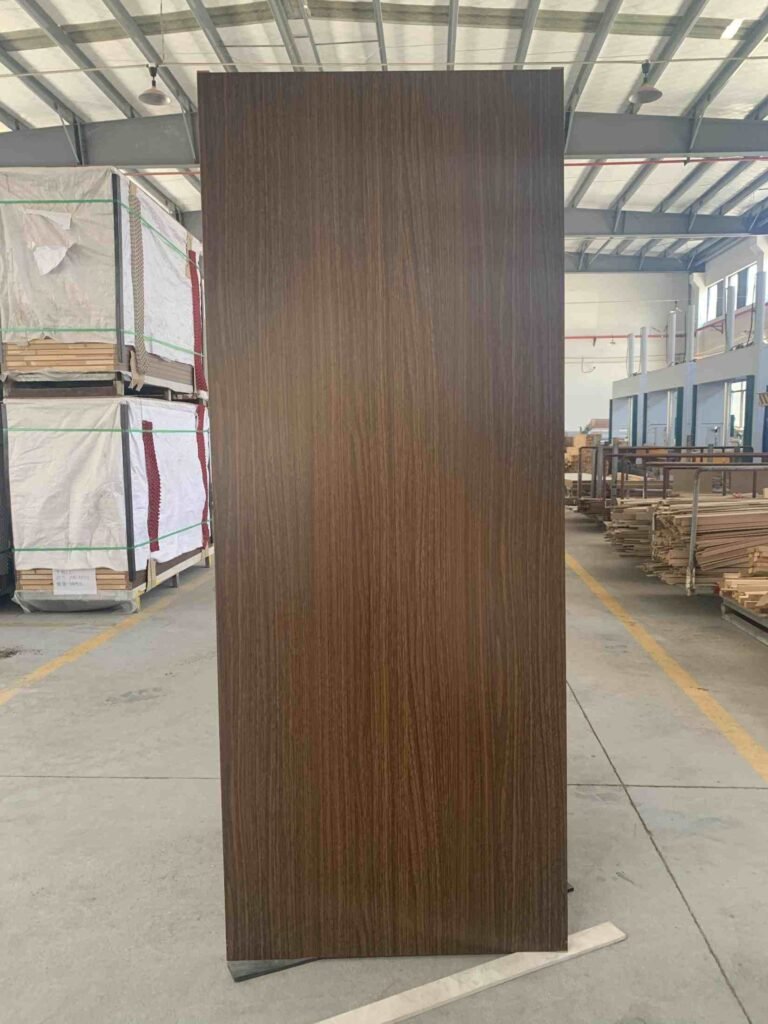
- Natural wood veneer: Sliced or peeled from timber, preserving naturally occurring grain and color variation.
- Reconstituted wood veneer: Made by processing, coloring where required, assembling, and re-slicing wood veneers to create more repeatable grain patterns.
Natural veneer suits projects emphasizing the grain of a selected natural species. Reconstituted veneer can be useful when consistent color and grain are priorities across multiple doors. Both are wood-based materials, unlike PVC decorative films. For a closer comparison of their appearance and production characteristics, see the engineered vs. natural veneer doors comparison.
Choosing Veneer Species and Grain Patterns
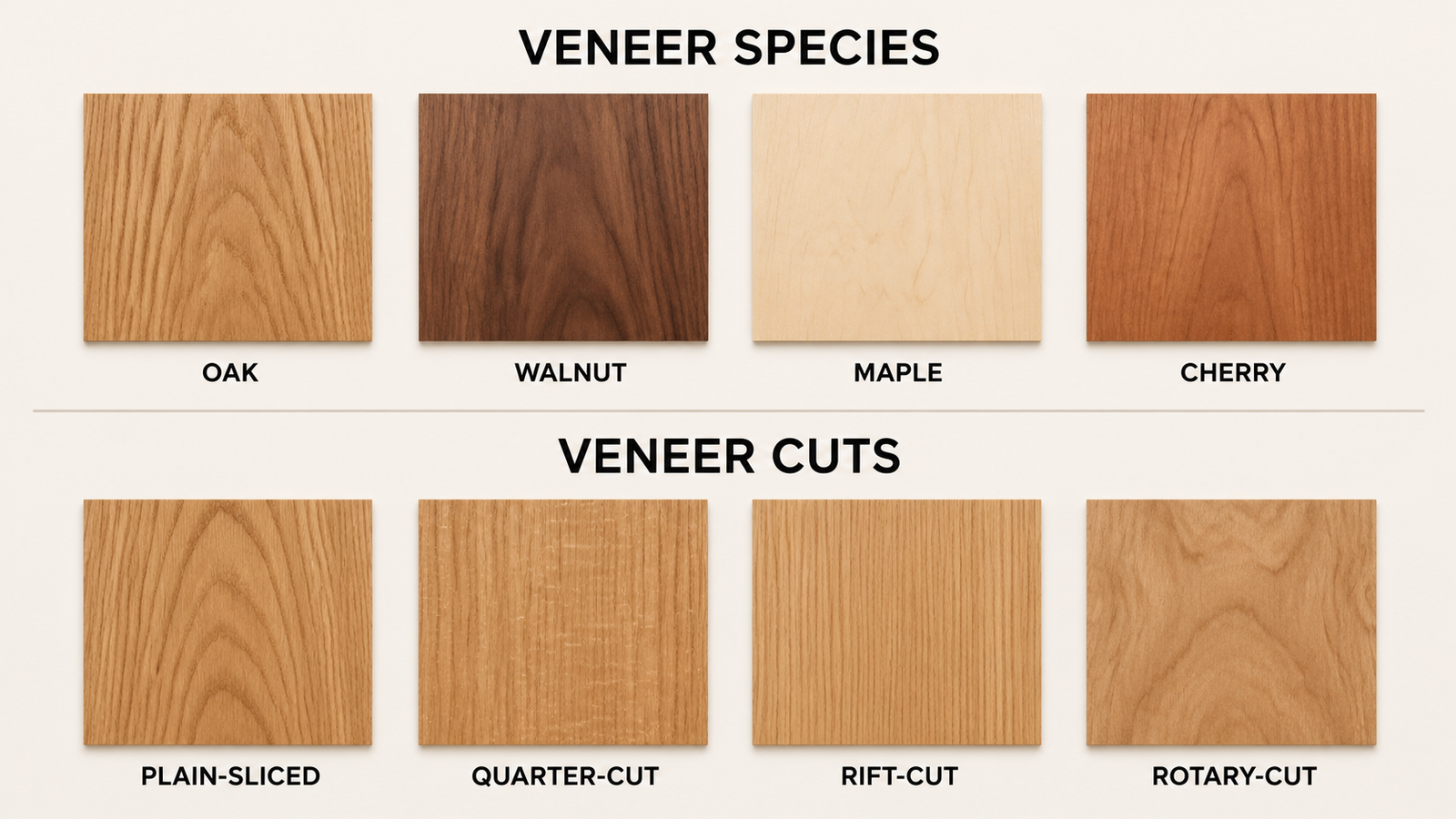
Common architectural veneer species include oak, walnut, maple, and cherry.
Oak features distinctive grain, walnut provides rich brown tones, maple offers a lighter appearance, and cherry often displays warm reddish coloring.
The cut determines how the natural grain appears across the flat face:
Plain-sliced veneer is cut in a direction that commonly produces arching or cathedral figures. Choose it when prominent, flowing grain is part of the design, and approve how those figures are positioned on the door.
Quarter-cut veneer generally produces straighter stripes. In oak, it can also reveal noticeable ray fleck, so a quarter-cut specification does not necessarily mean a uniform linear face. Review a sample if that figure would affect the intended look.
Rift-cut veneer is commonly specified in oak to reduce prominent ray fleck and create a more linear appearance. It is a useful direction when doors need to coordinate with a restrained, straight-grained interior.
Rotary-cut veneer is peeled as the log rotates, producing broad sheets with more varied grain. It suits designs that accept a less regular figure rather than requiring a closely repeated straight-grain effect.
The cut shapes the grain within a veneer leaf; matching determines how leaves form the door face. Specify both, together with the species and finished sample.
Natural Wood Grain, Color Variation, and Veneer Matching
Veneer matching involves two separate decisions: how individual veneer leaves join and how those leaves are arranged across the door face.
Book matching alternates veneer leaves by turning over every other piece, creating mirrored grain patterns. Slip matching places consecutive leaves in the same orientation, producing repeated rather than mirrored patterns.
Face assembly methods then determine the overall layout:
- Running match: Uses successive veneer leaves without requiring equal widths or symmetry.
- Balanced match: Uses leaves of approximately equal width across the face; a centered, symmetrical layout needs to be specified separately.
These methods describe the arrangement on an individual face, not automatic grain continuity between different doors.
For coordinated openings, buyers should separately specify any required matching between door pairs or adjacent doors.
Core Options for Veneer Flush Doors
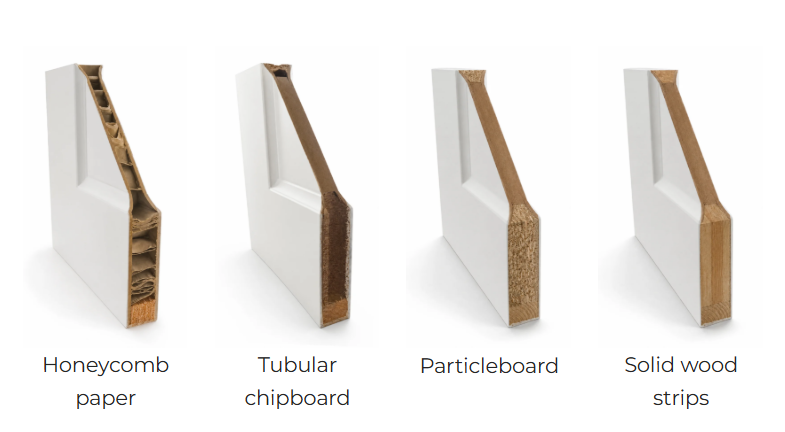
Choose the core separately from the decorative face. For comparison, keep door size, face panels, and hardware preparation the same. The following headings identify core materials; hollow-core and solid-core are broader construction descriptions. The veneer door construction guide explains how the face substrate, internal core, and perimeter components work together.
Honeycomb Core
Honeycomb infill provides lightweight internal support between the face panels. It is a practical starting point when lower door weight and budget are priorities. Hardware positions still need suitable perimeter support or lock blocking.
Tubular Particleboard Core
Tubular particleboard has longitudinal channels within a formed wood-based board. It reduces material compared with a fully dense particleboard core while retaining a board structure. Consider it when evaluating a configuration between cellular infill and continuous particleboard fill; compare actual leaf weight and the specified hardware support.
Solid Particleboard Core
A particleboard core door uses compressed wood particles bonded into a dense board. Choose this option when the specification calls for continuous particleboard fill rather than honeycomb cells or tubular channels. Allow for its weight when selecting hinges and planning handling.
Other Wood-Based Cores: Stave Lumber and SCL
Stave lumber uses assembled wood strips, while structural composite lumber (SCL) is another industry core option. Availability and construction depend on the supplier. These are wood-based alternatives, not a category separate from all engineered wood: particleboard is itself an engineered wood product.
Core names do not establish fire or acoustic ratings. Where those properties are required, select a documented complete-door configuration and compatible assembly components.
Edges and Hardware Preparation
Approve edge appearance alongside the face: the edge material, color, and finish affect how the door looks when open. Then confirm hinge and lock positions, machining, reinforcement, and trimming limits against the actual construction. Decorative edge banding alone does not establish hardware support.
Veneer Finishes and Surface Appearance
Wood veneer determines the underlying grain, while the finishing system influences color, sheen, and surface protection.
Finish Options and Delivery Condition
Veneer flush doors may receive clear finishes, stains, or other compatible coatings.
Clear finishes emphasize natural grain, while stained finishes modify the visible color without necessarily concealing the wood texture.
Before production, the project team should approve the veneer species or pattern, stain color, finish sheen, and a representative completed finish sample together.
Delivery condition also matters:
- Factory-finished: The specified finish is applied before shipment.
- Unfinished: Finishing is completed after delivery by the responsible project party.
For site finishing, responsibilities should cover the approved coating process, inspection criteria, and treatment of freshly machined edges, hinge mortises, or lock openings where required by the manufacturer.
Cleaning, repairs, and refinishing should follow the particular veneer and coating instructions rather than a universal treatment method.
Where Are Veneer Flush Doors Used?
Veneer flush doors can serve different building applications, but selection should begin with the requirements of each opening. When evaluating other interior door options for the same project, apply the same opening-by-opening specification approach.
| Project Scenario | Primary Requirement | Selection Approach |
|---|---|---|
| Repeated apartment layouts | Consistent appearance and budget | Standardize veneer, finish, and door schedule |
| Custom residential interiors | Coordination with architectural woodwork | Approve species, grain, and finish samples |
| Office meeting rooms | Privacy, hardware, and acoustic requirements | Review opening specifications and assembly performance |
| Hotel guestrooms and corridors | Repeated finishes and project performance requirements | Verify door schedules, hardware, and applicable ratings |
Residential and Multifamily Projects
In residential interiors, veneer flush doors coordinate with wood flooring, cabinetry, and interior trim.
Custom homes may prioritize natural grain and finish matching, while multifamily projects often emphasize repeatable specifications and controlled procurement costs.
Different openings can share the same veneer appearance while requiring different internal configurations.
Commercial Interiors and Project-Specific Requirements
Commercial applications may involve additional hardware, acoustic, fire, or operational requirements.
For meeting rooms, privacy and sound control should be evaluated through the specified opening assembly rather than veneer appearance.
Hotel guestrooms and corridor openings may require particular fire-rated or acoustic assemblies. Any selected veneer door must satisfy the applicable project requirements and approved component specifications.
Combining Appearance, Core, and Finish
Build the specification in three decisions. For a room coordinated with straight-grained oak joinery, begin with an approved rift-cut oak face and a clear or lightly stained finish sample. For repeated openings seeking the same decorative figure, begin with a selected reconstituted pattern and a common finish reference. In either case, choose the core for the opening’s weight, hardware, and performance requirements rather than for the face color.
These are specification starting points, not preset products. They show why the same veneer look can be combined with different cores, and why changing the veneer cut or stain requires appearance approval even if the core stays the same.
How to Specify and Compare Veneer Flush Doors for a Project
Clear specifications help purchasing teams compare products accurately and reduce changes before manufacturing.
Confirm Door Dimensions, Veneer, Core, and Finish
Before requesting a quotation, prepare a clear door schedule covering the following specifications:
- Door Dimensions: Width, height, and thickness.
- Veneer: Natural or reconstituted veneer, wood species or pattern, cutting method, and grain matching.
- Core Construction: Core type, material, and internal structure.
- Surface Finish: Color, sheen, and factory-finished or unfinished delivery condition.
- Edge and Hardware: Edge construction, reinforcement, hinge and lock preparation, and machining requirements.
- Supply Scope: Door slabs, frames, casings, hardware, and other accessories included in the quotation.
- Performance Requirements: Fire rating, acoustic performance, or other project-specific requirements, where applicable.
These details provide a consistent basis for technical review and quotation, helping suppliers identify suitable configurations and avoid misunderstandings before production.
How to Compare Quotes on a Like-for-Like Basis
Two quotations for oak veneered flush doors may look comparable but include different cores, finishes, or hardware preparation.
For example, a factory-finished particleboard core door should not be compared directly with an unfinished tubular-core alternative without accounting for those differences.
A meaningful comparison keeps door dimensions, veneer specifications, construction, finishing, machining, accessories, quantities, and delivery terms consistent.
Where a lower-cost alternative is proposed, identify precisely which specifications change and confirm that the revised product still meets the project’s essential requirements.
Approving Samples and Managing Veneer Variation
Sample approval helps establish appearance expectations before bulk production.
Review the veneer species or pattern, grain direction, matching arrangement, color range, finish sheen, and edge appearance.
Small swatches assist initial selection, while larger finished samples provide a better representation of the complete door face.
For adjacent doors or coordinated wall panels, specify whether additional matching is required.
Acceptance should follow approved samples and agreed appearance criteria while recognizing reasonable variation in natural wood.
FAQ
Can Veneer Flush Doors Be Refinished?
Some can be refinished, depending on veneer thickness and the existing coating. Excessive sanding may damage the thin wood layer. Always follow the manufacturer’s approved refinishing instructions.
Can Veneer Flush Doors Be Used in Bathrooms or Other Humid Areas?
Some products may suit controlled indoor humidity, but direct water exposure or prolonged high humidity requires additional consideration. Confirm the core, surface finish, edge protection, and manufacturer’s environmental limitations.
Are Veneer Flush Doors Suitable for Fire-Rated Openings?
Certain products are available with fire-rated construction. However, compliance depends on the approved door assembly, including compatible frames, hardware, and applicable labeling. Veneer appearance or core material alone does not establish a fire rating.
How Should Veneer Flush Doors Be Stored Before Installation?
Store doors in a clean, dry, well-ventilated interior environment, properly supported and protected from water, direct sunlight, and construction moisture. Follow the manufacturer’s handling and acclimatization requirements.
Conclusion
Veneer flush doors offer natural wood aesthetics with multiple construction and finishing options. The right configuration depends on veneer type, grain matching, core structure, edge details, and project requirements.
For builders, contractors, and bulk buyers, clear specifications, comparable quotations, and approved samples are essential for effective procurement.
Before ordering, share the door schedule, finish samples, and required performance documentation with the supplier to confirm the proposed configuration and quotation scope.