

Are supply delays, rising costs, and vendor coordination slowing down your construction projects?
Procurement in construction is becoming increasingly complex. Delayed materials, inconsistent quality, and poor coordination can quickly impact timelines and budgets. Choosing the wrong sourcing strategy doesn’t just create inefficiencies—it directly affects project outcomes. So, should builders rely on a single supplier or manage multiple vendors?
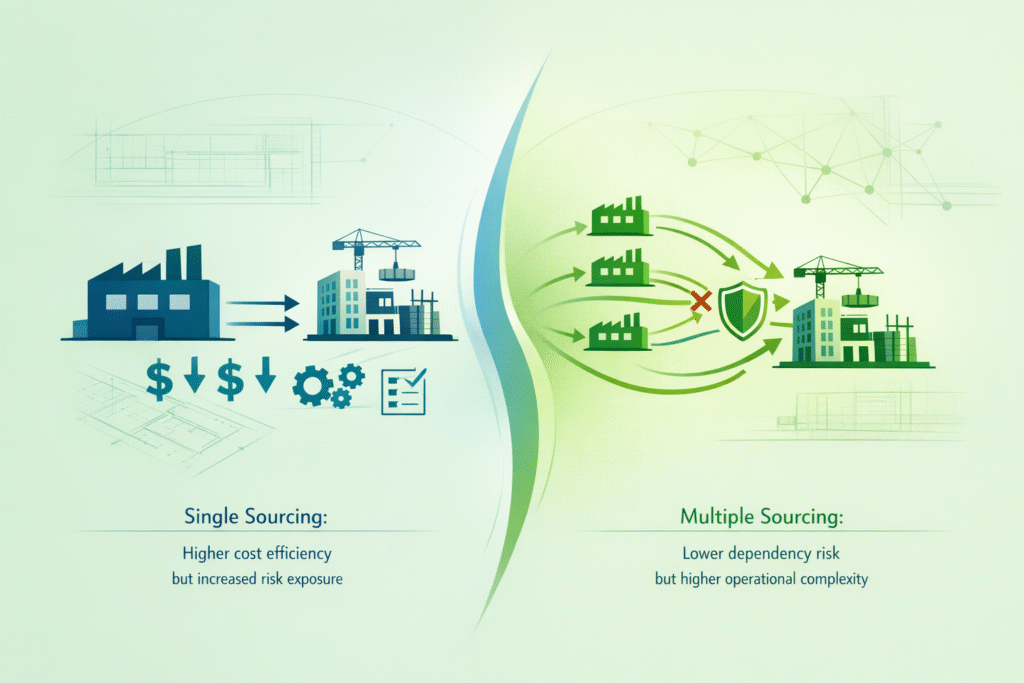
For builders, the choice between a single supplier and multiple vendors depends on balancing cost efficiency, risk exposure, and operational complexity. Single sourcing offers streamlined communication, consistent quality, and better pricing through consolidation, while multiple vendors provide flexibility and reduce supply chain risks. In general, smaller projects benefit from single sourcing, whereas large or complex projects require diversified supplier strategies.
Making the right sourcing decision requires understanding not just the differences—but how each approach impacts cost, risk, and execution.
What is the difference between single supplier and multiple vendors?
In construction procurement, the difference between a single supplier and multiple vendors goes far beyond the number of suppliers—it directly impacts cost control, risk exposure, and project efficiency.
Single sourcing refers to relying on one supplier to provide most or all construction materials. This approach centralizes procurement, allowing builders to streamline communication, standardize quality, and often secure better pricing through volume agreements.
In contrast, multiple supplier sourcing involves distributing procurement across several vendors. Builders may source different materials from specialized suppliers or maintain backup vendors to reduce dependency and mitigate supply chain disruptions.
From a strategic perspective, the choice reflects a trade-off:
- Single supplier = efficiency, consistency, and cost leverage
- Multiple vendors = flexibility, resilience, and risk diversification
For builders, this is not just an operational decision—it is a procurement strategy that directly influences project timelines, budget stability, and execution risk.

Single vs Multiple Suppliers: Key Differences for Builders
To make a practical decision, builders need to evaluate how each sourcing model performs across key operational dimensions:
| Factor | Single Supplier | Multiple Vendors |
| Cost Structure | Lower total cost through bulk purchasing and negotiated contracts | Higher unit costs due to fragmented orders and reduced bargaining power |
| Supply Risk | High dependency on one source; vulnerable to disruptions | Diversified risk across suppliers; stronger supply continuity |
| Operational Efficiency | Centralized procurement, faster coordination, fewer administrative tasks | Increased complexity in communication, logistics, and contract management |
| Quality Control | Easier to maintain consistent material standards | Potential variability in quality across suppliers |
| Flexibility | Limited ability to switch materials or suppliers quickly | Greater flexibility to adapt to changes or shortages |
| Scalability | May struggle in highly complex or large-scale projects | Better suited for large, multi-phase, or technically diverse projects |
Cost vs Risk: Why Builders Choose Single or Multiple Sourcing
When evaluating sourcing strategies, builders are essentially balancing two core factors: cost efficiency and supply risk.
Single sourcing is typically more cost-effective. By consolidating orders, builders can negotiate better pricing, reduce logistics costs, and simplify procurement workflows. This makes it especially attractive in competitive or budget-sensitive projects.
However, this efficiency comes with increased risk exposure. Relying on one supplier creates a single point of failure, which can lead to delays if disruptions occur.
On the other hand, multiple supplier sourcing reduces dependency risk. By diversifying suppliers, builders can maintain supply continuity even if one vendor fails.
The trade-off is cost. Managing multiple vendors often leads to higher procurement expenses and operational complexity.
👉 In practice, this reflects the classic single sourcing advantages and disadvantages versus advantages and disadvantages of multiple sourcing.
Operational Complexity: Management Efficiency vs Coordination Burden
Beyond cost and risk, operational efficiency is a critical factor in construction procurement.
With a single supplier, procurement becomes centralized. Communication is faster, order tracking is simpler, and accountability is clearer. This can significantly reduce administrative workload for project teams.
In contrast, multiple vendors introduce coordination challenges. Builders must manage multiple contracts, delivery schedules, and quality standards simultaneously.
This often increases the likelihood of miscommunication, delays, and inconsistencies—especially in fast-paced construction environments.
Quality Control and Consistency in Material Supply
Material consistency is another key consideration for builders.
Single sourcing allows for standardized quality across all materials. Long-term partnerships also enable suppliers to better understand project requirements, improving reliability over time.
With multiple vendors, quality can vary between suppliers. While this approach allows access to specialized materials, it also requires stricter quality control processes.
Builders must invest more time in inspection, validation, and supplier management to maintain consistent standards.

When to Use Single vs Multiple Suppliers
Ultimately, the best sourcing strategy depends on project conditions.
Single sourcing is often the better option when:
- Projects are small to medium in scale
- Timelines are tight
- Cost control and efficiency are priorities
Multiple supplier sourcing is more suitable when:
- Projects are large or complex
- Supply chain uncertainty is high
- Risk diversification is critical
In many real-world cases, builders adopt a hybrid approach—combining a primary supplier with backup vendors. Working with integrated suppliers like uwgco.com can help bridge this gap by offering both efficiency and supply reliability within a single sourcing framework.
Risk Mitigation in Large Projects: Why Builders Rely on Multiple Vendors
In large-scale construction projects, supply chain risk becomes a critical concern rather than a secondary factor.
Complex builds typically involve multiple material categories, tight schedules, and high dependency on timely delivery. In this context, relying on a single supplier creates a significant vulnerability.
This is why many builders adopt multiple supplier sourcing as a risk mitigation strategy.
By working with multiple vendors:
- Supply disruptions can be absorbed without halting the entire project
- Specialized suppliers can provide higher-quality or niche materials
- Procurement becomes more adaptable to changing project demands
Although this approach increases coordination complexity, it significantly improves supply continuity and project resilience—two key priorities in large construction environments.
When Single Sourcing Becomes the Smarter Choice
While multiple sourcing reduces risk, it is not always the most efficient model.
For small to mid-sized construction projects, operational efficiency often outweighs the need for risk diversification.
Single sourcing allows builders to:
- Streamline procurement workflows
- Reduce communication layers
- Maintain tighter control over cost and delivery timelines
This approach is particularly effective when projects require speed, budget discipline, and consistent material standards. In practice, many builders partner with integrated suppliers like uwgco.com, who combine centralized supply with stable delivery capabilities—helping reduce both operational friction and supply uncertainty.
A Practical Framework for Builders
Selecting between single and multiple sourcing should not be based on preference, but on project conditions.
A practical decision framework includes:
- Project Size → Larger projects favor multiple vendors
- Timeline Sensitivity → Tight deadlines favor single sourcing
- Supply Chain Stability → Uncertainty favors diversification
- Management Capacity → Limited teams benefit from simplification
Rather than treating sourcing as a fixed model, experienced builders align their strategy with these variables. In many cases, a hybrid approach—combining a primary supplier with backup vendors—offers the best balance between efficiency and resilience.
Frequently Asked Questions About Wholesale Shaker Doors
Q: How much do wholesale primed white shaker doors usually cost?
A: In the U.S. wholesale market, bulk pricing for primed white shaker doors typically ranges from $70 to $250 per door. The exact price depends heavily on the panel design (1-panel doors are the most cost-effective and popular for large developments, while 3- to 5-panel doors are more expensive), core material quality, total order volume, and the agreed-upon shipping terms.
Q: Why should builders buy factory-primed doors instead of unfinished wood?
A: Buying factory-primed doors saves builders and painting contractors a massive amount of time and labor on the job site. The white primer provides a perfectly smooth, professionally sealed base over the MDF or engineered wood surface. This means the doors arrive completely ready for a final coat of paint, eliminating the need for extensive on-site sanding, filling, and prep work.
Q: What is the difference between FOB and DDP pricing when buying wholesale doors?
A: FOB (Free on Board) means the supplier pays to deliver the doors to the port of origin; the buyer is then responsible for booking ocean freight, handling customs clearance, and arranging inland delivery. DDP (Delivered Duty Paid) means the supplier handles all logistics end-to-end, including ocean freight, import duties, and final truck delivery to your warehouse or job site. DDP is highly recommended for builders because it provides a predictable total landed cost.
Q: How do I ensure quality consistency across a large bulk order of shaker doors?
A: To guarantee batch consistency, always request physical samples before placing a full container order. You must ensure your supplier uses uniform MDF panel materials and high-grade primer across the entire lot. Working directly with a dedicated manufacturing partner like M4B allows you to lock in strict production standards, secure reliable lead times, and streamline your entire procurement process without middleman markups.
Summary
There is no universally “better” sourcing strategy—only the one that best fits your project.
Single sourcing excels in efficiency, cost control, and simplicity. Multiple vendors provide flexibility, risk mitigation, and scalability.
The key is to evaluate trade-offs strategically, not operationally. As construction projects become more complex, builders who optimize their sourcing strategy gain a clear advantage in both execution and profitability.
So, the real question is not which model is better—but which one is better for your next project.
Articles that you may be interested in:
China Supplier Sourcing Guide: Tips for Finding Trusted Partners
Shaker Cabinets vs Flat Panel Cabinets: Which Style Fits Your Project?