
For builders, door procurement is not just about choosing a product with the lowest unit price. In large residential projects, the real cost of a door is often determined after the product arrives on site. Installation labor, on-site preparation, rework, schedule delays, and consistency across multiple units can all affect the final project cost.
This is why prehung doors are increasingly used in residential developments, townhouses, apartments, multi-family buildings, and large-scale renovation projects. Although a prehung door usually has a higher initial product cost than a slab door, it can help builders reduce the total installed cost by improving installation speed, reducing errors, and minimizing jobsite preparation.
For large projects where hundreds of doors need to be installed within a fixed schedule, the savings from prehung doors can be significant.
What Is a Prehung Door?
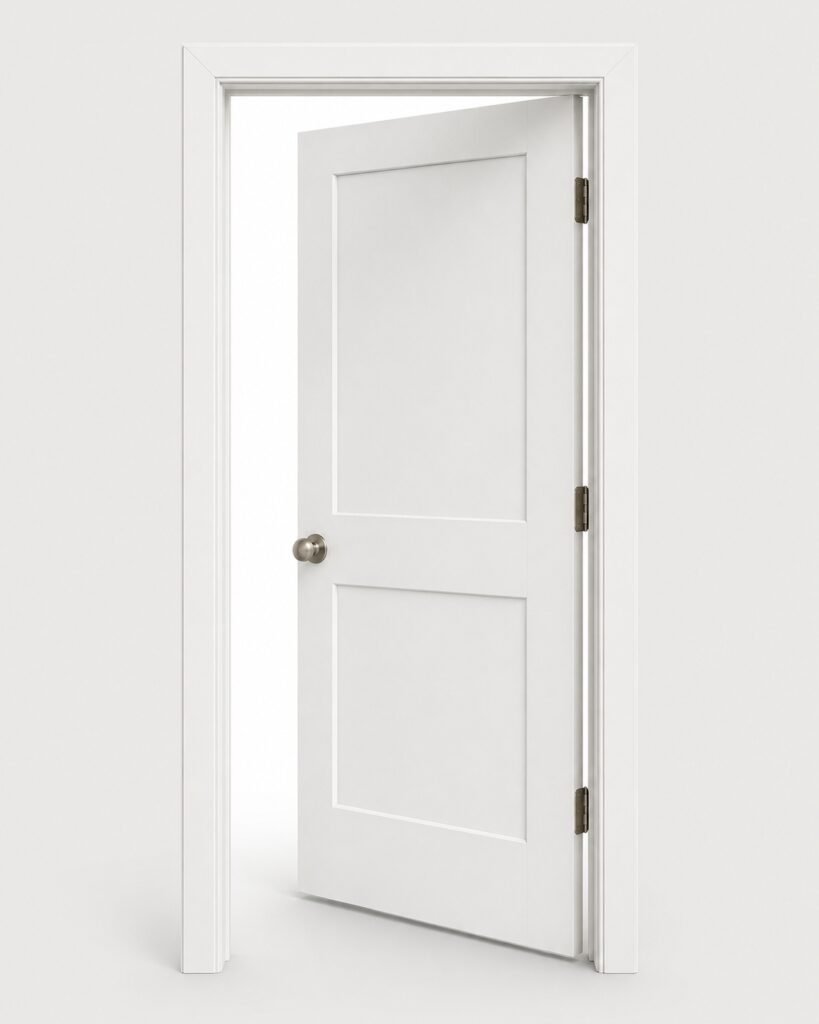
A prehung door is a complete door unit that comes already assembled with the door slab, frame or jamb, and hinges. In many cases, it also includes factory-prepared hardware locations such as hinge mortises, bore holes, and latch preparation.
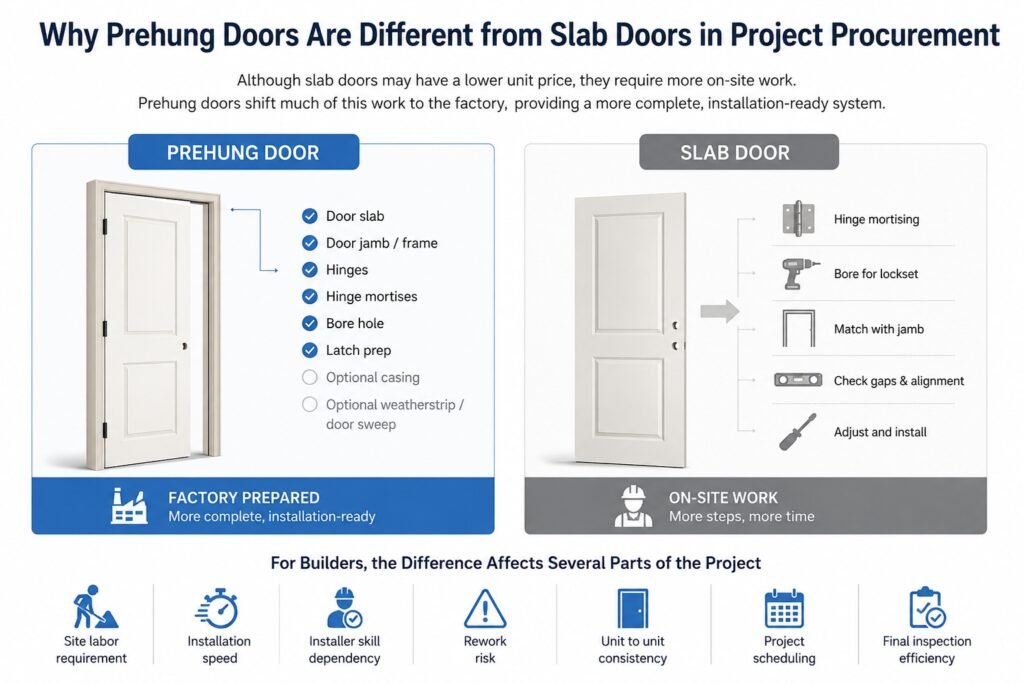
A typical prehung door unit may include:
- Door slab
- Door jamb or frame
- Hinges
- Hinge mortises
- Bore hole
- Latch prep
- Optional casing
- Optional weatherstrip or door sweep, depending on the door type
This is different from a slab door, which is only the door panel. A slab door must be matched with a frame, machined for hinges and locks, adjusted, and installed on site.
In simple terms, a slab door is a component. A prehung door is a more complete door system that is closer to ready-to-install.
Why Prehung Doors Are Different from Slab Doors in Project Procurement
At first glance, slab doors may appear more cost-effective because their unit price is usually lower. However, slab doors transfer more work to the jobsite. Installers must spend time matching the door with a jamb, cutting hinge mortises, drilling lock holes, checking gaps, and adjusting the door until it opens and closes properly.
Prehung doors shift much of this work to the factory. The door slab and jamb are already matched, hinges are installed or prepared, and key machining work is completed before delivery. This changes the procurement decision from simply buying a door panel to buying a more complete installation-ready system.
For builders, the difference affects several parts of the project:
- Site labor requirement
- Installation speed
- Installer skill dependency
- Rework risk
- Unit-to-unit consistency
- Project scheduling
- Final inspection efficiency
In large residential projects, these differences become more important because small time savings on each door can turn into major savings across the entire project.
Slab Doors vs Prehung Doors
| Factor | Slab Doors | Prehung Doors |
|---|---|---|
| Initial Product Cost | Lower | Higher |
| Included Components | Door slab only | Door slab, jamb/frame, hinges, prep |
| Site Labor | Higher | Lower |
| Installation Speed | Slower | Faster |
| Alignment Risk | Higher | Lower |
| Hardware Prep | Usually done on site | Usually pre-machined |
| Installer Skill Requirement | Higher | Lower to moderate |
| Rework Risk | Higher | Lower |
| Best For | Custom jobs, small projects | Large residential projects |
| Total Installed Cost | Can increase later | More predictable |
The table shows why builders should not evaluate doors only by unit price. A slab door may cost less at the purchasing stage, but the total installed cost can increase once labor, machining, adjustment, and rework are included.
For large residential projects, prehung doors often provide a more predictable and cost-efficient solution.
Key Cost-Saving Benefits of Prehung Doors
Lower Labor Cost
Labor is one of the biggest cost factors in door installation. With slab doors, installers must complete multiple steps on site, including hinge mortising, lock boring, jamb fitting, and alignment adjustment. These tasks require time, tools, and experienced workers.
Prehung doors reduce much of this labor because the door slab and frame are already matched. The installer mainly needs to position the unit, level it, shim it, secure it, and make final adjustments.
For a single door, the time difference may seem small. But in a project with hundreds of doors, saving even 15 to 30 minutes per opening can significantly reduce total labor hours.
Faster Installation Schedule
Large residential projects usually operate under tight schedules. Door installation must coordinate with drywall, flooring, painting, trim, hardware, and final inspection. If door installation is slow, it can delay multiple trades.
Prehung doors help speed up the installation phase because each unit arrives as a more complete system. Installers do not need to spend as much time matching parts or preparing each door individually.
Faster installation can help builders:
- Reduce crew waiting time
- Improve jobsite workflow
- Keep installation phases on schedule
- Move faster toward finishing and inspection
- Reduce delays between trades
For builders managing multi-unit projects, schedule control is often just as important as material cost.
Reduced Rework and Alignment Problems
Door alignment issues are common when slab doors are installed on site. Problems may include uneven gaps, rubbing, poor closing, hinge misalignment, or latch problems. These issues can require repeated adjustment and may create punch-list items before handover.
Prehung doors reduce these risks because the door and jamb are assembled or prepared together. The hinge positions, door clearances, and frame relationship are more controlled before the product reaches the jobsite.
This does not mean prehung doors require no adjustment. Installers still need to level and shim the unit correctly. However, the starting point is more consistent, which helps reduce installation errors and rework.
Better Consistency Across Multiple Units
Large residential projects often include many repeated door sizes and layouts. For example, a townhouse or apartment project may have the same bedroom, bathroom, closet, and utility room doors repeated across dozens or hundreds of units.
Consistency is critical. If each slab door is cut and adjusted separately on site, the final result may vary depending on the installer, tools, or jobsite conditions.
Prehung doors improve consistency because more of the work is standardized before delivery. Door size, jamb matching, hinge placement, and hardware preparation can be controlled at the factory level.
This helps builders achieve a more uniform finished result across the entire project.
Less Site Preparation and Waste
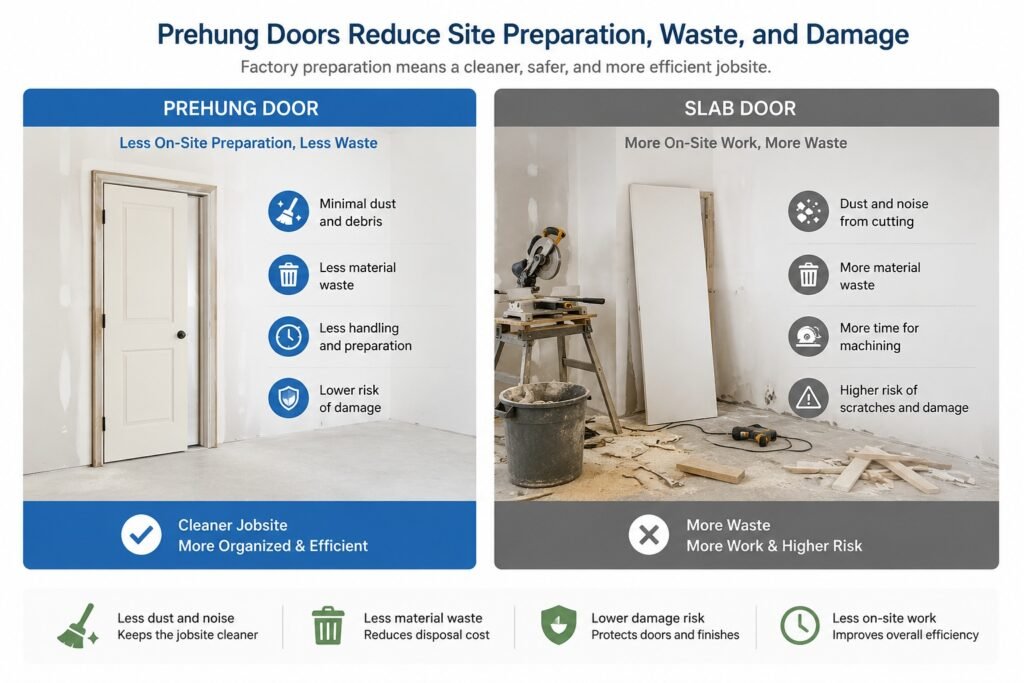
On-site machining creates dust, noise, waste, and additional handling. Cutting hinge mortises, drilling bore holes, trimming doors, and fitting jambs all create extra work and material waste.
Prehung doors reduce the need for this kind of on-site preparation. This can help keep the jobsite cleaner and more organized, especially in large projects where many doors are being installed at the same time.
Less site preparation also reduces the chance of damage. Every time a door is moved, cut, drilled, or adjusted on site, there is a risk of scratches, chips, incorrect machining, or handling damage.
Easier Quality Inspection
Prehung doors make quality inspection more straightforward. Since the slab, jamb, hinges, and prep work are already matched, builders can inspect the door system as a complete unit.
This makes it easier to check:
- Door operation
- Reveal gaps
- Hinge alignment
- Frame condition
- Hardware prep
- Surface finish
- Packaging and labeling
For large projects, easier inspection can reduce the time needed for site checks and help identify issues earlier.

Pros and Cons of Prehung Doors for Builders
Pros
Prehung doors offer several advantages for builders working on large residential projects.
They can:
- Speed up installation
- Reduce on-site labor
- Improve alignment consistency
- Lower rework risk
- Reduce the need for on-site machining
- Improve project scheduling
- Support repeatable installation across multiple units
- Make total installed cost more predictable
For projects with many repeated openings, these advantages can directly improve installation efficiency and reduce jobsite complexity.
Cons
Prehung doors also have some limitations that builders should consider.
Potential drawbacks include:
- Higher initial unit price
- Larger packing volume than slab doors
- More careful handling during transportation
- Less flexibility for last-minute site changes
- Need for accurate rough opening information
- Need for a clear loading and delivery plan for bulk orders
Because prehung doors are larger and more complete units, packing and logistics must be planned carefully. For container shipments, builders should confirm whether the doors will be shipped fully assembled or in knock-down packaging, depending on loading efficiency and project needs.
How Prehung Doors Reduce Cost in a Multi-Unit Project
Consider a builder working on a 120-unit townhouse project. At the beginning of the project, the team considered using slab doors because the unit price was lower. On paper, this seemed like a good way to reduce material cost.
However, each slab door required on-site jamb matching, hinge mortising, lock boring, and alignment adjustment. Different installers worked at different speeds, and the quality of the final installation varied from unit to unit. Some doors needed extra trimming. Others had uneven gaps or did not latch properly. These issues created more punch-list work near the end of the project.
After reviewing labor hours and installation delays, the builder switched to prehung doors for the next phase. Each door unit arrived with the door slab, jamb, hinges, and key preparation already completed. Installers were able to position, level, shim, and secure each unit much faster.
The result was a more predictable installation process. Door gaps were more consistent, fewer doors required repeated adjustment, and the installation schedule became easier to control.
Even though the prehung door unit price was higher, the builder reduced labor hours, avoided repeated corrections, and improved overall project efficiency. In a large residential project, this type of cost saving can have a major impact on the final budget.
What Builders Should Confirm Before Ordering Prehung Doors
Prehung doors can save time and cost, but only when the specifications are correct. If the wrong jamb width, swing direction, hinge size, or bore location is ordered, mistakes can be repeated across many units.
Before placing a bulk order, builders should confirm:
- Door size
- Door style
- Hollow core or solid core
- Jamb width
- Jamb material
- Swing direction: LH, RH, LHR, or RHR
- Hinge size and finish
- Bore hole size
- Backset
- Latch prep
- Casing requirement
- Rough opening size
- Packing method: assembled or KD
- Labeling by unit, floor, or room
- Loading plan for bulk shipments
For large residential projects, clear labeling is especially important. Doors can be labeled by floor, unit, room, opening number, or installation phase. This reduces sorting time on site and helps installers find the correct unit faster.
Conclusion
Prehung doors can help large residential projects save money by reducing labor, speeding up installation, lowering rework risk, improving consistency, and making the schedule easier to manage.
Slab doors may still be useful for small custom jobs or projects with special site conditions. But for large residential developments with repeated door openings, prehung doors often provide a stronger cost advantage.
When selected and specified correctly, prehung doors are not just a door product. They are a project efficiency tool that helps builders control labor, reduce mistakes, and deliver a more consistent final result.
Articles that you may be interested in:
Builder Guide: When to Use Prehung Doors in Renovation or New Construction